
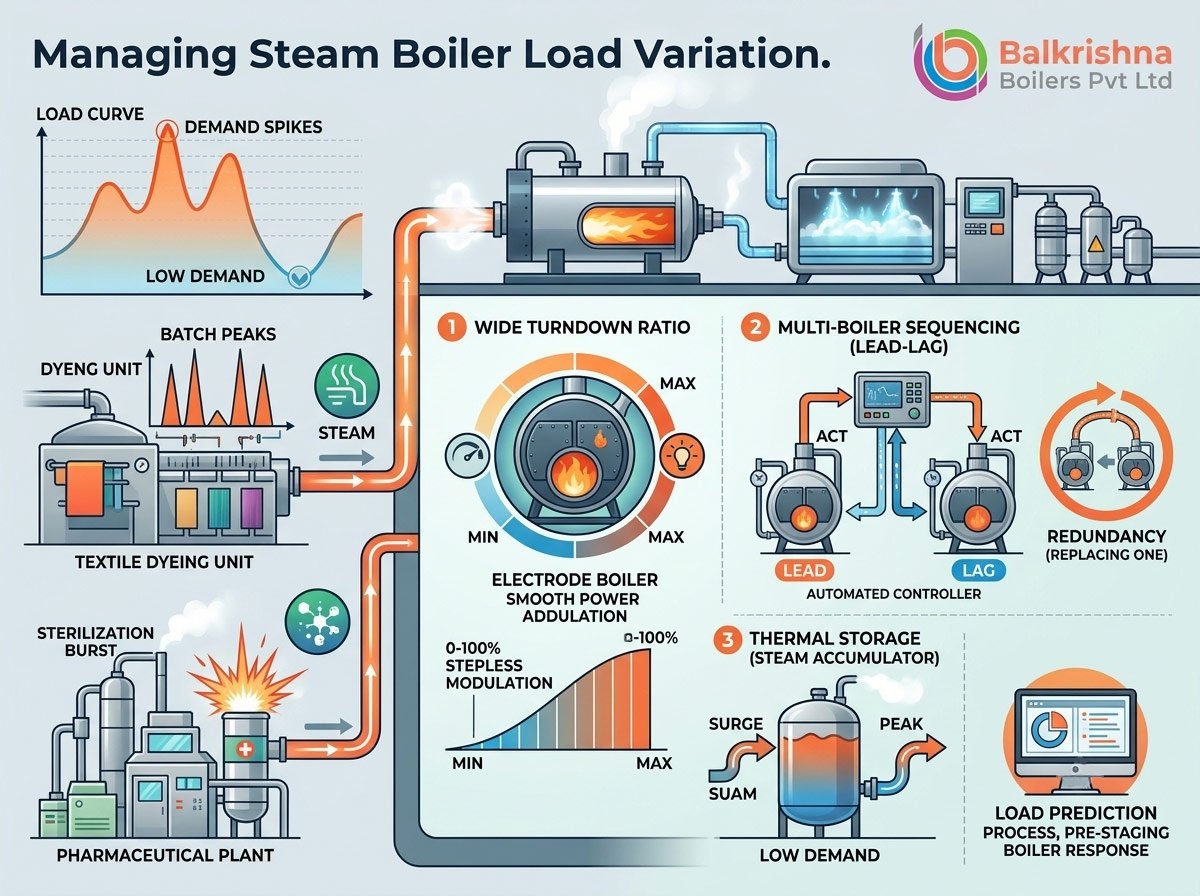
Very few industrial plants run a flat, constant steam load. A dyeing unit might idle between batches and then demand a sudden surge when a new vat fills. A food processing line might see steam demand triple during a morning pasteurization run and fall to a trickle by afternoon. A pharmaceutical facility might need a burst of high-pressure steam for sterilization cycles, interspersed with long stretches of low, steady demand. This is load variation — and how a plant’s steam boiler system handles it has a bigger impact on fuel cost, equipment life, and process reliability than almost any other single operating factor.
This guide covers why load variation happens, why it’s genuinely harder on a boiler than steady operation, and the practical strategies — from turndown ratio selection to multi-boiler sequencing — that keep steam supply stable without burning excess fuel to get there.
What Is Steam Boiler Load Variation?
Load variation refers to fluctuations in steam demand over time — daily, hourly, or even minute-to-minute — driven by production schedules, batch cycles, shift patterns, or seasonal changes in process requirements. It’s distinct from a plant’s average or design steam demand; a boiler sized correctly for average load can still struggle badly if it can’t respond fast enough to short, sharp peaks.
Common sources of load variation in Indian industrial settings include:
- Batch processing: dyeing, cooking, sterilization, and curing cycles that demand steam in short, intense bursts rather than continuously
- Shift changes: steam demand spiking at shift start as multiple process lines fire up simultaneously
- Multi-line facilities: several process lines drawing from a shared header, with demand shifting unpredictably as individual lines start and stop
- Seasonal swings: space heating or process heating demand shifting with ambient temperature in some industries
- Startup and shutdown cycles: cold-start demand spikes as equipment and piping come up to temperature
Why Load Variation Is Genuinely Hard on a Boiler
Part-load efficiency loss Boilers are generally most efficient at or near their rated firing rate. Running significantly below rated load — which happens constantly in a variable-demand plant — typically means the burner cycles on and off more frequently, combustion efficiency dips at low fire, and the ratio of standby losses to useful output rises. This is one of the less obvious factors behind the fuel-cost gaps explored in our comparison of boiler efficiency vs. fuel cost.
Thermal stress and wear Rapid swings between low and high fire, or frequent burner cycling, subject the boiler shell, tubes, and refractory to repeated thermal expansion and contraction. Over years of operation, this accelerates fatigue at welds and joints far more than steady, continuous operation would.
Pressure and steam quality instability A boiler that can’t respond quickly enough to a sudden demand spike will see a pressure drop at the header, which can translate into wet, lower-quality steam reaching the process — a problem particularly costly in applications like pharmaceutical sterilization or textile finishing, where steam quality directly affects product outcome.
Oversizing as a (bad) workaround Facing unpredictable peaks, some plants simply oversize their boiler to cover the worst-case demand. This solves the peak problem but creates a new one: the boiler now spends most of its operating life running well below its efficient firing range, quietly wasting fuel during every low-demand period — which, in most plants, is most of the time.
Understanding Turndown Ratio
Turndown ratio is the range between a boiler’s maximum and minimum firing rate — a boiler with a 5:1 turndown ratio can modulate its firing rate down to 20% of full capacity while still burning cleanly and maintaining stable combustion. A boiler with a wide turndown ratio can absorb a much broader range of load swings without cycling the burner on and off, which is both more fuel-efficient and gentler on equipment life.
This is precisely why turndown capability is a key differentiator between boiler technologies. Electrode-based electric steam boilers offer stepless power modulation across a full 0–100% turndown range through PLC-based thyristor control, making them exceptionally well suited to sharply fluctuating demand. Water-tube boilers also respond well to load swings because of their low water inventory — heat transfer area is large relative to stored water volume, so the boiler reacts quickly as demand changes, a characteristic explained further in our article on water-tube boiler design and circulation.
Strategies for Managing Peak Demand
1. Match Boiler Type to Your Load Profile
Not every boiler technology handles variable load equally well.
- Water-tube boilers reach full working pressure in minutes from a cold start and respond almost instantly to fluctuations, thanks to their low water inventory — ideal for pharmaceutical, food & beverage, and chemical processing environments with frequent, sharp demand swings.
- Fire-tube boilers, particularly larger horizontal 3-pass designs, carry a much larger water reservoir, which acts as a natural buffer during short demand spikes — a useful characteristic for plants with occasional peaks rather than constant rapid cycling, as discussed in our overview of horizontal steam boilers.
- Electrode electric boilers offer the fastest response of all, reaching full pressure from cold in minutes with true stepless modulation — a strong fit for facilities where demand is highly unpredictable and grid power is reliable, as detailed in our electrode boiler technology guide.
- Liquid fuel-fired units, such as diesel or LDO-fired boilers, offer precise, fast-responding combustion control that adapts well to fluctuating loads — a benefit highlighted in our overview of the 6 Ton Diesel Fired Steam Boiler, which is engineered specifically for instant response to load fluctuations in sophisticated manufacturing environments.
The choice ultimately comes back to the fundamentals covered in our water-tube vs. fire-tube comparison — turndown capability and response speed are two of the most important criteria for any plant with genuinely variable demand.
2. Right-Size Using Multiple Smaller Boilers Instead of One Large Unit
Rather than installing a single large boiler sized for peak demand, many well-designed boiler houses use two or three smaller units operating together. This approach — often called modular or multi-boiler sequencing — lets the plant run just enough boiler capacity to match current demand, bringing additional units online only as load actually rises.
The benefit is significant: each active boiler runs closer to its efficient firing range, rather than one oversized unit idling at low fire most of the day. It also builds in redundancy — if one unit needs maintenance or trips out, the others continue supplying steam rather than the whole plant losing supply.
3. Use a Boiler Sequencing Controller (Lead-Lag Control)
For multi-boiler installations, an automated sequencing controller — sometimes called a lead-lag controller — monitors header pressure and automatically brings additional boilers online or takes them offline based on real demand, rather than relying on manual operator intervention. This keeps the “lead” boiler running at its most efficient firing point while “lag” boilers cover only the incremental demand above that point, and rotates which boiler carries the lead role over time to balance wear across the fleet.
4. Use Thermal Storage to Buffer Short, Sharp Peaks
Where demand spikes are short but intense — a batch process that needs a sudden burst of steam for a few minutes — a steam accumulator or thermal storage vessel can absorb excess steam production during low-demand periods and release it during the spike, smoothing the load the boiler itself actually sees. This lets a smaller, more efficient boiler handle a peak that would otherwise require significant oversizing.
5. Manage Feedwater and Blowdown Through Load Swings
Rapid load changes affect water level control and TDS concentration more than steady operation does. Automated feedwater regulation and TDS-controlled continuous blowdown — rather than manual, fixed-interval blowdown — help maintain consistent water chemistry even as demand rises and falls, reducing the risk of the scaling issues covered in our guide to steam boiler scaling causes and prevention.
6. Keep Condensate Recovery and Steam Traps Working Under Variable Load
Variable demand puts extra strain on condensate systems — a sudden load drop can cause condensate to back up in heat exchangers before traps catch up, while a sudden spike can push more condensate through the system than usual. Well-maintained steam traps, discussed in detail in our article on how steam traps improve boiler system efficiency, keep condensate recovery working reliably even as load conditions change minute to minute — protecting both efficiency and equipment life.
7. Build in Monitoring and Predictive Load Planning
Where possible, correlating steam demand data with production scheduling — knowing in advance that a particular shift or batch will trigger a demand spike — lets operators pre-stage additional boiler capacity rather than reacting after header pressure has already started to drop. PLC-based monitoring systems increasingly support this kind of predictive sequencing as standard.
Industry Examples of Load Variation in Practice
Textile mills are a classic example: dyeing kettles filling and emptying in batches create sharp, repeated demand swings throughout a shift, which is why steam boilers for textile mills are typically specified with strong turndown and rapid load response as a baseline requirement, not an optional upgrade. Pharmaceutical facilities present a different pattern — long low-demand periods punctuated by short, high-pressure sterilization cycles — which is why water-tube and electrode technologies are frequently the preferred choice in that sector.
How Indian Boilers and Balkrishna Boilers Help Plants Manage Load Variation
Both companies design boiler solutions around actual demand profiles rather than a one-size-fits-all approach. Indianboilers.com’s steam boiler and electric boiler ranges include fast-response water-tube and electrode designs purpose-built for fluctuating demand, alongside larger, buffer-capacity fire-tube units for plants with occasional rather than constant peaks — all backed by engineering support to help specify the right turndown ratio and sequencing approach for your actual load profile.
Balkrishna Boilers offers the same range of response characteristics across its steam boiler line, including the rapid-response INDUCTRON induction boiler, the STEAMJET combustion-fired series, and the buffer-capacity VEPOMAX — giving plant engineers a genuine choice of technology rather than forcing every application into the same boiler design.
Frequently Asked Questions
Is it better to install one large boiler or multiple smaller ones? For plants with genuinely variable demand, multiple smaller boilers with sequencing control generally outperform a single oversized unit — each boiler runs closer to its efficient firing range, and the plant retains redundancy if one unit needs maintenance.
What turndown ratio should I look for? It depends on how sharply your demand fluctuates. A plant with gradual, predictable swings may do fine with a 3:1 or 4:1 turndown boiler, while facilities with sudden, sharp spikes benefit from wider-range or electrode-based systems offering closer to full stepless modulation.
Does load variation shorten boiler life? Frequent, extreme swings — particularly rapid burner cycling and repeated cold starts — do accelerate thermal fatigue compared to steady operation. Matching boiler technology and turndown capability to your actual load pattern is the most effective way to reduce this wear.
Can a steam accumulator really reduce the boiler size I need? Yes, for applications with short, intense peaks against an otherwise moderate average load, a properly sized accumulator can meaningfully reduce the peak capacity the boiler itself needs to supply, since stored steam covers the spike.
How do I know if my current boiler is undersized for peak demand rather than just poorly sequenced? Track header pressure during your worst demand spikes. A gradual pressure droop that recovers within a reasonable time usually points to a sequencing or turndown issue; a pressure collapse that doesn’t recover even at full fire usually indicates genuine undersizing for your peak load.
Struggling with unpredictable steam demand? Talk to the Indian Boilers engineering team or contact Balkrishna Boilers for a load profile assessment and boiler sizing recommendation suited to your actual production pattern.