
Every plant engineer eventually faces the same question about an ageing steam boiler: is this next repair worth it, or are we just delaying the inevitable? It’s rarely an easy call. The boiler still technically works. The repair quote is smaller than a new unit. And there’s always production pressure to keep the existing system running rather than plan a shutdown for replacement.
The problem is that “still working” and “still worth repairing” are two very different things. This guide walks through the concrete technical and financial signs that tell you when a boiler has crossed the line from “repairable” to “replace it” — so the decision is based on data rather than deferred indefinitely.
Why This Decision Matters More Than It Seems
Delaying a replacement decision on an ageing boiler rarely just costs you the price of one more repair. It usually costs you in several compounding ways at once: declining thermal efficiency that quietly inflates every fuel bill, rising unplanned downtime that disrupts production schedules, escalating repair frequency that eventually exceeds what a new boiler would have cost outright, and — in the worst cases — a genuine safety risk from a pressure vessel that’s been patched past the point good engineering practice would recommend.
Sign 1: The Boiler Is Approaching or Past Its Design Lifespan
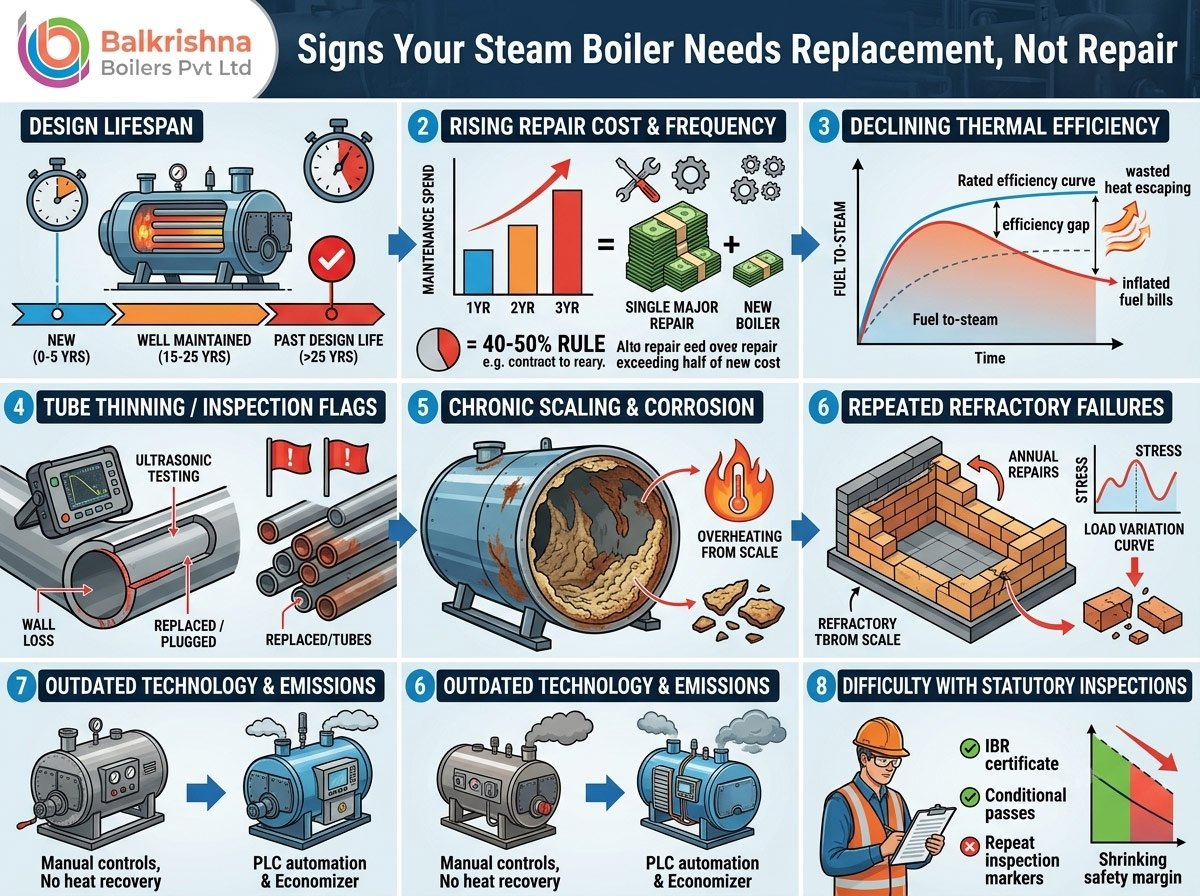
Most industrial fire-tube and water-tube boilers are engineered for a service life of roughly 15–25 years, depending on construction quality, water treatment discipline, and duty cycle. A boiler that’s been well maintained with consistent water treatment can run toward the higher end of that range; one that’s had inconsistent maintenance or chronic scaling issues often shows serious deterioration well before 15 years.
Age alone isn’t a reason to replace a boiler that’s still passing inspection and performing well. But once a unit is past 15–18 years and starting to show other warning signs on this list, age becomes the tipping factor that makes replacement the more rational financial decision.
Sign 2: Repair Frequency and Cost Are Climbing
Track your maintenance spend over the last 2–3 years, not just the most recent repair. A pattern worth watching for: repair frequency increasing year over year, and the nature of repairs shifting from routine wear items (gaskets, burner nozzles) to structural or major component issues (tube replacements, refractory rebuilds, shell repairs).
A commonly used industry rule of thumb: if the cost of a single major repair exceeds 40–50% of the cost of a new boiler of equivalent capacity, replacement is almost always the better financial decision — because you’re paying a large fraction of new-boiler cost for equipment that will likely need another major repair again within a few years, on top of continuing to run at reduced efficiency in the meantime.
Sign 3: Efficiency Keeps Declining Despite Proper Maintenance
This is one of the clearest replacement signals, because it’s measurable. If your boiler’s fuel-to-steam efficiency has dropped noticeably compared to its rated performance — and this decline persists even after routine maintenance, cleaning, and proper water treatment — the losses are likely structural rather than something maintenance can fix. Tube wall thinning, degraded refractory, and worn combustion components all reduce heat transfer in ways that cleaning alone can’t reverse.
As covered in our comparison of boiler efficiency vs. fuel cost, even a 1–2% efficiency gap compounds into a significant sum over a full operating year — and an ageing boiler that’s lost 10–15% of its original efficiency is often costing more in wasted fuel annually than the finance payment on a replacement unit would be.
Sign 4: Tube Thinning or Repeated Inspection Flags
During routine ultrasonic thickness testing — a standard part of the steam boiler maintenance checklist — tubes showing wall loss above roughly 10% of original thickness are typically flagged for replacement. If this is happening across multiple tubes, or recurring in the same zones repeatedly after previous tube replacements, it’s a sign the underlying corrosion or erosion mechanism (often chronic scaling, poor water chemistry, or abrasive ash from certain solid fuels) hasn’t actually been resolved — a pattern we cover in detail in our guide to husk-fired boiler efficiency, where silica ash abrasion is a known driver of accelerated tube wear in biomass units without proper protective ferrules.
Patching individual tubes indefinitely is not a long-term strategy — at some point, the number of plugged or replaced tubes compromises the boiler’s original design steaming capacity.
Sign 5: Chronic Scaling or Corrosion Damage
If internal inspections consistently reveal significant scale buildup or corrosion despite properly functioning water treatment, the boiler may have accumulated damage from years of past neglect — before current water treatment practices were in place — that ongoing good practice can no longer reverse. Our detailed guide on steam boiler scaling causes, signs, and prevention explains how scale-driven overheating causes lasting metal fatigue; once that fatigue has accumulated over many years, no amount of current-day water treatment discipline restores the tube metal’s original integrity.
Sign 6: Repeated Refractory Failures
For combustion-fired boilers, refractory that needs rebuilding annually — rather than the expected multi-year service interval — often points to a deeper issue: chronic thermal cycling from load variation, burner misalignment, or structural movement in the boiler shell itself. As discussed in our guide to managing steam boiler load variation, boilers subjected to constant thermal stress from poorly managed demand swings degrade structurally faster than those running steady, well-sequenced loads — and an older boiler may simply no longer have the structural margin to absorb that stress the way it once did.
Sign 7: The Boiler Can No Longer Meet Current Production Demand
Plants grow. A boiler that was correctly sized a decade ago may now be running flat-out just to meet baseline demand, leaving no margin for peak loads or future expansion. Constantly running at or above rated capacity accelerates every other item on this list — faster wear, lower efficiency, and higher failure risk — and no repair can fix a fundamental capacity mismatch. If this sounds familiar, it’s worth reading alongside our guide on managing peak demand, since undersized capacity and load-variation stress often compound each other.
Sign 8: Repeated Difficulty Passing Statutory Inspection
For IBR-registered boilers, an inspector who is increasingly flagging issues at annual renewal — thinning walls, mounting deficiencies, documentation gaps — is effectively telling you the vessel is approaching the end of what it can safely certify for. Our comparison of IBR vs. Non-IBR steam boilers explains just how rigorous this statutory process is; a boiler that keeps needing conditional passes or repeat re-inspections after remedial work is signalling that its safety margin is shrinking, not just its efficiency.
Sign 9: The Technology Itself Is Outdated
Beyond the physical condition of the vessel, some older boilers are simply built on outdated combustion or control technology — manual firing controls instead of PLC automation, no economizer or waste-heat recovery, and combustion systems that can’t meet current emission norms without expensive retrofits. Our guide to reducing boiler carbon emissions outlines how much of a difference modern combustion and automation technology makes — and in many cases, retrofitting an old boiler to modern emission standards costs nearly as much as replacing it with a boiler that meets those standards natively.
Sign 10: Spare Parts Are Getting Harder or More Expensive to Source
As boiler models age out of production, OEM spare parts become scarcer, lead times stretch out, and plants are increasingly forced to rely on generic or fabricated replacement components that may not match original specifications. This is a quieter but very real signal — a boiler that’s becoming difficult to keep in spares is a boiler whose next serious failure could mean extended, unplanned downtime rather than a quick repair.
When Repair Is Still the Right Call
Not every issue is a replacement signal. Repair generally remains the smarter choice when:
- The boiler is under roughly 10–12 years old and otherwise well maintained
- The failure is a discrete component issue (a burner, a control, a single valve) rather than a structural or vessel-level problem
- Efficiency and capacity still meet current production needs
- The repair cost is a modest fraction of replacement cost, with no pattern of recurring major repairs
A Simple Decision Framework
When weighing a major repair against replacement, run the numbers side by side:
- Repair cost vs. new boiler cost (as a percentage)
- Annual fuel cost at current declining efficiency vs. projected fuel cost at rated new-boiler efficiency
- Frequency of recent major repairs — is this a one-off, or the third major fix in two years?
- Remaining useful life estimate after this repair, realistically
- Compliance and capacity fit — does the current boiler still meet today’s emission norms and production demand, or is it already behind?
If two or more of these point toward replacement, it’s usually the financially sounder long-term decision, even though the upfront number looks larger.
The Upside of Replacing Rather Than Repairing Again
A modern replacement isn’t just a like-for-like swap — it’s an opportunity to close efficiency and capacity gaps that the old boiler could never have addressed even when new. Advanced designs like membrane panel FBC boilers virtually eliminate the recurring refractory repair costs that plague older solid-fuel boilers, often reaching full ROI within 14–20 months purely from avoided maintenance and efficiency gains. Modern electric boiler technology — particularly induction-based systems — largely eliminates the scaling-driven element failures that plagued older resistance-heater designs. And every current-generation boiler benefits from the core components — economizers, air preheaters, automated blowdown — that older units were rarely built with, typically adding 5–10% efficiency on their own.
How Indian Boilers and Balkrishna Boilers Support Replacement Decisions
Both companies offer technical assessments to help plants make this call with real data rather than guesswork — reviewing tube thickness records, inspection history, and fuel consumption trends before recommending repair or replacement. Where replacement is the right call, Indianboilers.com’s steam boiler, electric boiler, and industrial boiler ranges offer a direct upgrade path with modern automation and efficiency built in from day one.
Balkrishna Boilers provides the same assessment and upgrade support across its steam boiler range, including the scale-resistant INDUCTRON and heavy-duty COMBIPOWER series — giving plants replacing an ageing unit a like-for-better upgrade rather than a like-for-like swap.
Frequently Asked Questions
What’s the average lifespan of an industrial steam boiler in India? Typically 15–25 years, depending on construction quality, water treatment discipline, fuel type, and duty cycle. Boilers with consistent maintenance and good water chemistry commonly run toward the higher end.
Is it ever worth replacing a boiler before it fails completely? Yes — proactive replacement based on declining efficiency, rising repair costs, and inspection trends is usually far cheaper than reactive replacement after a catastrophic failure, which also risks unplanned production downtime.
Can retrofitting an old boiler achieve the same results as replacement? Sometimes, for specific upgrades like adding an economizer or automated blowdown. But retrofits can’t reverse structural issues like tube thinning or accumulated metal fatigue — at that point, replacement is the only real fix.
How do I calculate the true cost of keeping an inefficient old boiler running? Compare your current fuel consumption per tonne of steam against the rated consumption of a modern equivalent boiler, then multiply the difference by your annual operating hours and fuel price — this “efficiency gap” cost, added to rising repair spend, usually makes the replacement case clear.
Does replacing a boiler require re-registration under IBR? Yes — a new boiler is a new vessel and requires fresh IBR registration, hydrostatic testing, and commissioning, following the same process outlined in our commissioning checklist for new installations.
Not sure whether your current boiler is worth repairing again? Get a technical assessment from the Indian Boilers team or contact Balkrishna Boilers for a repair-vs-replace evaluation based on your actual maintenance and efficiency history.