
Fuel cost is the single biggest recurring expense in any steam-based manufacturing plant, and for most Indian industries it is also the easiest place to lose money without noticing. A boiler that “runs fine” on paper can still be quietly wasting 10–15% of its fuel value through poor combustion, tube fouling, and heat that escapes straight up the stack. Over a year, that gap is the difference between a husk fired boiler that pays for itself and one that just becomes another fixed cost line item.
Rice husk itself is not the variable that decides this outcome. It is genuinely one of the cheapest and most abundant biomass fuels available in India, especially for plants located near paddy-processing belts in Punjab, Haryana, West Bengal, and parts of Gujarat. What decides the outcome is boiler engineering — how the husk is fed, how completely it is burned, how efficiently that heat is transferred into water, and how much of the waste heat is recovered before it leaves the system. This guide breaks down exactly what separates an efficient husk fired boiler from an average one, and what to check for before you invest in — or retrofit — one for your plant.
1. Why Husk Behaves Differently From Other Fuels
Before looking at technology, it helps to understand why husk needs a purpose-built combustion system rather than a generic solid-fuel furnace.
Rice husk has three properties that make it tricky to burn well:
- Low bulk density — husk is bulky and light, so it needs consistent, high-volume feeding rather than the batch-loading approach used for coal or wood logs.
- High volatile matter — a large share of husk’s energy content is released as combustible gases rather than as a solid char, which means combustion air has to be introduced in stages rather than all at once.
- High ash content, dominated by silica — husk ash can run as high as 20–25% by weight, and that ash is largely abrasive silica rather than inert residue.
Every one of these properties has a direct engineering consequence somewhere in the boiler, and each one is addressed differently depending on whether you’re running a compact husk-fired unit or a larger biomass system such as a chain grate boiler or a reciprocating grate boiler. If you want a deeper comparison of how husk stacks up against other biomass fuels before committing to a system, our guide on why rice husk is India’s most practical biomass fuel covers handling and storage in detail, and our rice husk vs mustard straw comparison is useful if your plant has access to multiple agricultural residues.
2. Optimised Combustion: Where Efficiency Is Won or Lost
Combustion efficiency is the foundation everything else is built on. If husk isn’t burning completely inside the furnace, no amount of downstream heat recovery can fully compensate for it — you’re simply recovering heat from a process that already wasted fuel.
A. Furnace Design by Capacity
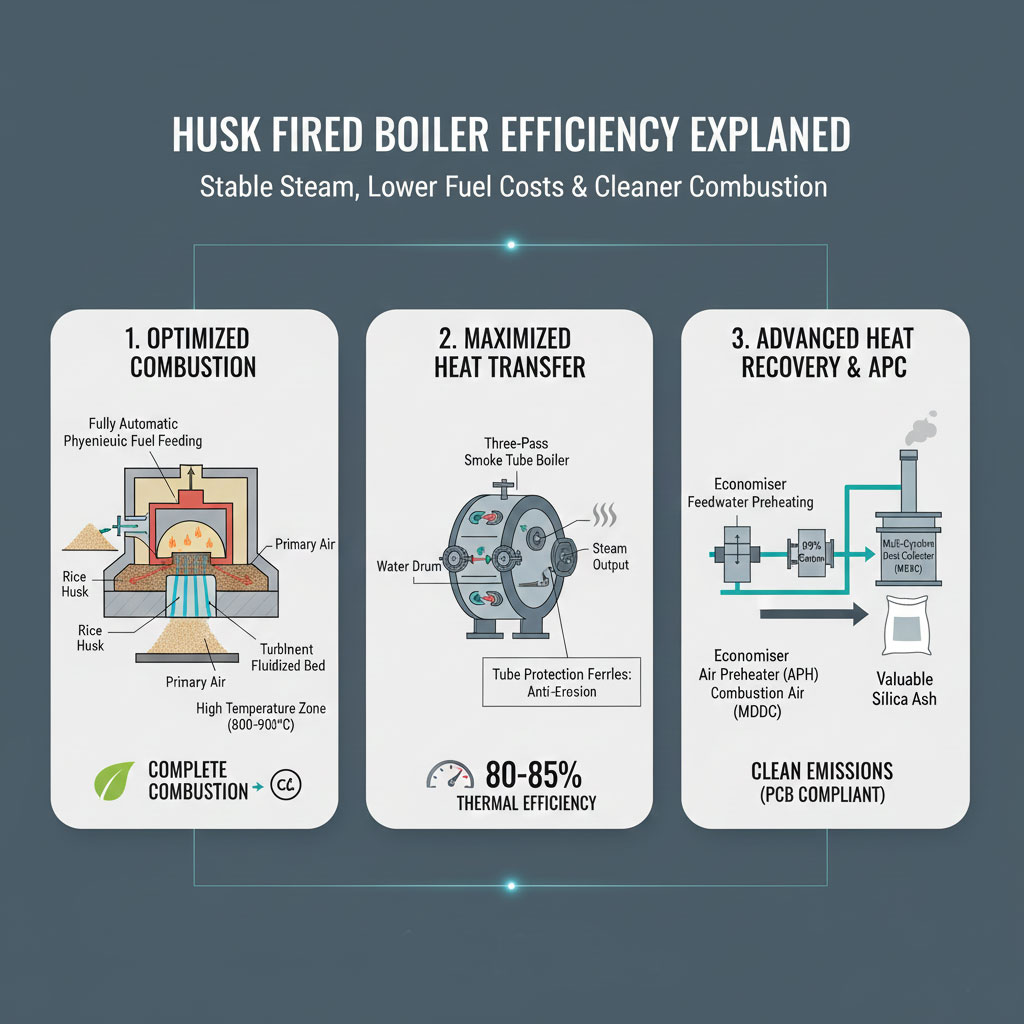
Internal Furnace with Top Feed (up to ~6 TPH): For small and mid-capacity boilers, husk is fed pneumatically from the top of the furnace, building a controlled fuel bed. Primary air enters from below the grate to sustain the base combustion, while secondary air is injected above the fuel bed in carefully metered quantities to burn off the volatile gases released during combustion. This two-stage air supply is what prevents the smoky, incomplete combustion typical of poorly designed husk furnaces.
Fluidised Bed Combustion, FBC (4 TPH and above): At larger capacities, husk is introduced into a bed of hot inert sand that is fluidised by high-velocity air from below. The constant turbulent mixing this creates gives three measurable advantages:
- Uniform temperature distribution across the entire combustion zone, avoiding hot and cold spots
- Longer residence time for husk particles in the high-temperature zone, allowing near-complete burnout
- Combustion efficiency up to 95%, leaving minimal unburnt carbon in the bottom ash
FBC systems are particularly well suited to plants that also want fuel flexibility — many FBC husk boilers can co-fire with other biomass residues when husk supply tightens seasonally. If you’re evaluating grate-based alternatives for high-moisture biomass blends, it’s worth reading how reciprocating grate boilers handle high-moisture biomass compared with conventional designs.
B. Automated Fuel Feeding and Air-Fuel Control
Manual or semi-automatic husk feeding is one of the most common causes of unstable steam pressure. When fuel supply fluctuates even slightly, the furnace temperature swings with it, and steam output follows the same unstable curve — which is a real problem for continuous processes like dyeing, drying, or sterilisation where pressure consistency matters as much as total steam volume.
A properly engineered husk boiler uses:
- Fully automatic pneumatic feeding systems that maintain a continuous, uniform husk supply to the furnace regardless of load changes
- Combustion air control systems that automatically adjust primary and secondary air flow in real time based on steam demand, keeping the air-to-fuel ratio close to optimal at all load points, not just at full load
This automation is the difference between a boiler that holds steam pressure within a tight band and one that needs constant manual adjustment from the operator — and it’s a feature worth specifically asking about when comparing quotations, since it’s often left out of base specifications to lower the headline price.
3. Maximising Heat Transfer: Turning Combustion Heat Into Usable Steam
Generating heat is only half the job. The other half — arguably the more commercially important half — is how efficiently that heat actually ends up in the steam rather than being lost to the stack, the boiler shell, or wasted on tube erosion downtime.
A. Three-Pass Design With Wet Back Configuration
A well-designed husk fired boiler routes hot flue gases through the boiler shell a minimum of three times before they exit to the stack. Each additional pass increases the contact time between the hot gases and the water-filled tubes, extracting more heat per kilogram of fuel burned.
The wet back arrangement — where the rear of the furnace is fully surrounded by water rather than refractory brick — adds further heat transfer surface and reduces radiation losses at the same time. This single design choice typically accounts for a meaningful share of the efficiency gap between a well-engineered husk boiler and a basic three-pass unit built to a lower cost specification.
B. Protecting Tubes Against Silica Ash Erosion
This is the detail that separates boilers that perform well for 15+ years from boilers that need premature tube replacement within 3–5 years.
Because husk ash contains up to 25% abrasive silica, the high-velocity flue gas stream erodes unprotected tube entrances over time — thinning the tube wall, reducing heat transfer efficiency, and eventually causing tube failures that force unplanned shutdowns.
The solution is protective ferrules — replaceable inserts placed at the entrance of each smoke tube that absorb the abrasive impact instead of the tube itself. It’s a low-cost component relative to the tube it protects, but it’s frequently missing or under-specified in cheaper husk boiler builds, which is why asking specifically about ferrule material and placement is worth doing during technical evaluation — not just assuming it’s included.
C. Minimising Radiation and Shell Losses
Robust insulation across the boiler shell, combined with the wet-back configuration in internal furnace designs, keeps radiant heat loss to the surrounding plant area to a minimum. Every degree of heat retained inside the boiler system is heat that doesn’t need to be replaced by burning additional husk.
4. Advanced Heat Recovery: Where the Real Fuel Savings Happen
This is the section that determines whether your husk fired boiler operates in the 65–70% efficiency range typical of a basic unit, or the 78–85% range achievable with proper heat recovery integration.
A. Economiser — Feedwater Preheating
An economiser sits in the flue gas path after the main boiler bank and uses residual heat — heat that would otherwise be discharged straight to the atmosphere — to preheat incoming feedwater before it enters the boiler drum.
The rule of thumb here is worth remembering: for every 6°C rise in feedwater temperature, boiler efficiency improves by approximately 1%. On a boiler running continuously, that translates directly into lower husk consumption per tonne of steam generated, month after month.
B. Air Preheater (APH)
An APH works on the same principle as an economiser but targets combustion air instead of feedwater — recovering flue gas heat to preheat the air entering the furnace. Preheated air produces a hotter, more complete flame, which improves combustion efficiency on top of the direct thermal gain.
A well-integrated APH can lift overall boiler efficiency by 2–5%, depending on the flue gas temperature drop achieved. Combined with an economiser, this is typically what pushes a husk fired boiler from the “acceptable” efficiency band into the genuinely competitive one.
C. High-Efficiency Multi-Cyclone Dust Collector (MCDC)
Ash management isn’t just an emissions requirement — it’s part of the efficiency and reliability picture too. A properly sized MCDC, positioned after the boiler, separates fine silica-rich particulate from the flue gas stream before it reaches the stack, ensuring:
- Compliance with State Pollution Control Board (PCB) emission norms
- Reduced particulate load on any downstream pollution control equipment
- Recovery of Rice Husk Ash (RHA) as a saleable byproduct — RHA is widely used as a raw material input in the cement and construction materials industry, turning a waste stream into a secondary revenue line
For plants that need a broader view of emission control system design across biomass fuels, our detailed breakdown of biomass boiler emission control systems covers MCDC sizing, ESP options, and wet scrubbers in more depth.
5. What the Numbers Actually Look Like
Put together — optimised combustion, three-pass wet-back heat transfer, ferrule-protected tubes, economiser, and APH — a properly engineered husk fired boiler should deliver:
| Efficiency Driver | Typical Impact |
|---|---|
| FBC or optimised internal furnace combustion | Up to 95% combustion efficiency |
| Economiser (feedwater preheating) | ~1% efficiency gain per 6°C rise |
| Air preheater | 2–5% additional efficiency |
| Combined thermal efficiency (with APH + economiser) | 78–85% |
That 78–85% band is the number worth anchoring your fuel-cost projections to when comparing husk against alternative fuels. If you’re weighing husk against coal or diesel for a new installation or a fuel-switch decision, our detailed operating cost breakdown — rice husk fired boiler vs coal/diesel: operating cost, maintenance and payback — walks through the payback math in more detail.
6. Sizing and Selecting the Right Husk Fired Boiler
Not every plant needs the same configuration, and matching capacity and technology to your actual steam demand is as important as the combustion technology itself.
- Under ~6 TPH: Internal furnace with top feed is usually the more capital-efficient choice, provided steam demand is relatively steady.
- 4 TPH and above, especially with variable load or fuel blending needs: FBC technology generally justifies its higher upfront cost through combustion efficiency and fuel flexibility.
- Plants with fluctuating husk supply: Consider a design that can also handle secondary biomass fuels — our guide on best biomass fuels for reciprocating grate boilers is a useful reference if fuel security is a concern in your region.
Balkrishna Boilers manufactures husk and biomass-fired steam boilers across this full capacity range under our Steam Boiler range, including the HUSKPOWER series purpose-built for rice husk and agro-residue firing, viewable on our full Steam Boiler category on Balkrishn.com.
7. Common Operating Issues — and How Good Engineering Prevents Them
Even a well-specified husk boiler can underperform if operating practices don’t match the design. The most frequent issues we see across installations are:
- Inconsistent fuel moisture causing unstable combustion — addressed through proper husk storage and handling, not boiler redesign
- Under-sized or poorly placed ferrules leading to early tube erosion
- Manual air damper adjustment instead of automated air-fuel control, causing efficiency to drift over a shift
- Delayed ash removal from the MCDC, which increases back-pressure and reduces draft efficiency over time
Our broader troubleshooting reference, common biomass boiler problems and their solutions, covers these and other issues with root-cause explanations if you’re currently running an older husk-fired unit and trying to diagnose falling efficiency.
8. The Balkrishna Boilers / IndianBoilers.com Efficiency Promise
Bringing together optimised combustion, maximised heat transfer, and integrated heat recovery and pollution control, a properly engineered husk fired boiler from our range is built to deliver:
- Stable, consistent steam output — critical for uninterrupted industrial processes across textiles, food processing, pharma, and chemical manufacturing
- Significantly lower fuel cost per tonne of steam, through 78–85% thermal efficiency with APH and economiser fitted
- Cleaner emissions, compliant with PCB norms, with RHA recovered as a usable byproduct rather than pure waste
Choosing an efficient husk fired boiler isn’t really a decision about cheap fuel — husk is already the cheap option. It’s a decision about which system actually converts that cheap fuel into steam without leaking value through poor combustion, tube erosion, or heat that escapes up the stack unused. Across different industries the fuel-handling and steam-demand profile can vary significantly, so if you want sector-specific guidance, our Industries page and application-specific installation references are a good next stop.
9. A Simple Way to Estimate Your Fuel Savings
Plant managers evaluating a husk fired boiler often ask the same question first: “What does the efficiency difference actually mean in rupees?” Here’s a simplified way to think about it.
Assume two boilers of identical capacity, both rated to generate the same tonnes of steam per hour, but one operating at 68% thermal efficiency (a basic unit without APH or economiser) and the other at 82% (a properly engineered husk fired boiler with both fitted).
- Both boilers need roughly the same amount of energy input to produce a tonne of steam, but the less efficient boiler needs to burn proportionally more husk to deliver that same energy, because more of the fuel’s heat value is being lost to the stack and shell rather than converted to steam.
- The efficiency gap of roughly 14 percentage points translates to needing close to 17–20% more husk on the lower-efficiency unit to match the same steam output over a month.
- On a mid-sized plant burning several tonnes of husk per day, that gap compounds into a significant recurring cost difference — often enough to justify the incremental capital cost of APH and economiser within 12–24 months, depending on local husk pricing and boiler running hours.
This is a simplified illustration rather than a site-specific calculation — actual savings depend on your steam load profile, husk moisture and calorific value, and running hours per day. Our engineering team can run a plant-specific fuel-cost projection during a technical consultation, factoring in your current boiler’s actual efficiency versus what a modern husk fired unit would deliver.
10. Maintenance Practices That Protect Long-Term Efficiency
Efficiency isn’t a one-time design outcome — it’s something that has to be maintained through the boiler’s operating life. A few practices make a measurable difference over time:
- Scheduled ferrule inspection: Since ferrules are the sacrificial component protecting smoke tubes from silica erosion, periodic inspection and timely replacement is far cheaper than an unplanned tube failure and the associated production downtime.
- Regular economiser and APH cleaning: Both components rely on clean heat-exchange surfaces to function at rated efficiency. Soot and ash buildup on either can quietly erode the efficiency gains they’re meant to provide, often without any obvious symptom until fuel consumption creeps up over a few months.
- Consistent husk moisture control: Fuel with inconsistent moisture content forces the combustion system to compensate constantly, which shows up as steam pressure instability even when the boiler itself is mechanically sound.
- MCDC ash discharge monitoring: Delayed ash removal increases system back-pressure, which can reduce draft efficiency and, over time, push the induced draft fan to work harder than necessary.
- Periodic combustion air system calibration: Automated air-fuel ratio controls drift slightly over months of operation. Recalibrating primary and secondary air distribution against actual load conditions keeps combustion efficiency close to its designed peak rather than letting it degrade gradually.
None of these are complex interventions, but they require a maintenance schedule that treats efficiency as an ongoing operating target rather than a one-time commissioning result.
11. Frequently Asked Questions
What thermal efficiency should I expect from a husk fired boiler? A well-engineered unit with economiser and air preheater fitted should deliver 78–85% thermal efficiency. Units without these heat recovery systems typically run in the 65–70% range.
Is FBC always better than an internal furnace top-feed design? Not necessarily — it depends on capacity and load profile. FBC generally justifies its higher cost at 4 TPH and above, especially where fuel blending or variable load is expected. For smaller, steady-load requirements, internal furnace designs are often the more cost-effective choice.
How often do ferrules need replacement? This depends on husk silica content and boiler running hours, but periodic inspection during scheduled maintenance shutdowns is the standard practice, rather than waiting for a tube failure to signal the need.
Can a husk fired boiler run on other biomass fuels as well? Many husk-fired designs, particularly FBC systems, can accommodate blended or alternative biomass fuels. If fuel security is a concern, it’s worth discussing multi-fuel capability at the specification stage rather than after installation.
Ready to see how a properly engineered husk fired boiler changes your fuel economics?
Explore our full Husk Fired Boiler range and Steam Boiler category on IndianBoilers.com, or view the HUSKPOWER series and complete Steam Boiler range on Balkrishn.com. Contact our engineering team through IndianBoilers.com for a site-specific consultation and fuel-cost projection.