
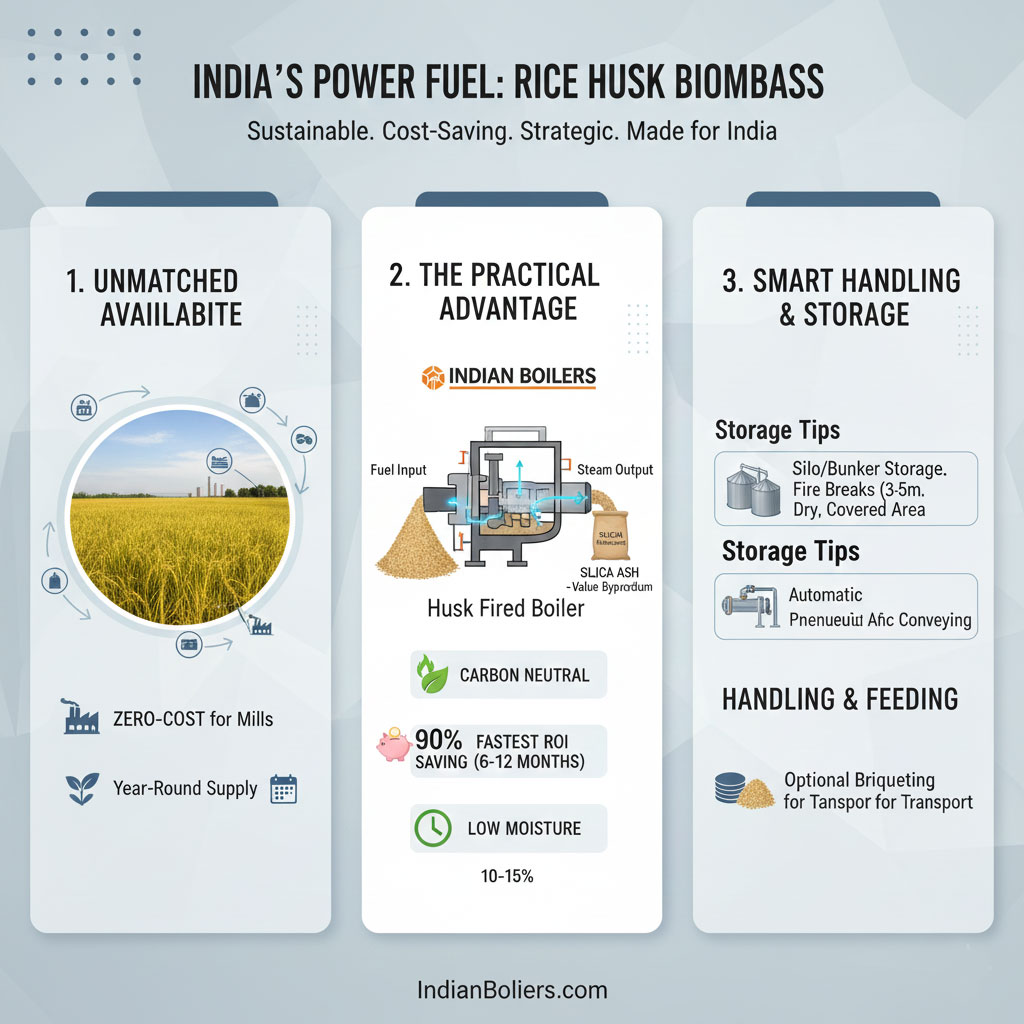
Why Rice Husk is India’s Most Practical Biomass Fuel
India mills over 120 million tonnes of paddy every year, and roughly one-fifth of that weight ends up as rice husk — the hard, silica-rich outer covering of the grain. For decades this by-product was treated as farm waste. Today, it is one of the most sought-after fuels for steam boilers and thermic fluid heaters across rice mills, textile units, food processing plants, and chemical industries.
This guide looks at why rice husk has become India’s go-to biomass fuel, how it compares with other agro-residues, and — just as importantly — how to store and handle it safely so a plant doesn’t lose fuel value or invite a fire hazard.
Why Rice Husk Works So Well as a Boiler Fuel
Three factors decide whether a biomass fuel is “practical” for industrial use: how easily it can be sourced, what it costs, and how consistently it performs in combustion. Rice husk scores well on all three.
1. Supply That Never Really Runs Out
Rice cultivation happens across almost every state — Punjab, Haryana, West Bengal, Andhra Pradesh, Chhattisgarh, and Tamil Nadu among the largest producers. Because milling happens throughout the year and across so many locations, husk supply doesn’t collapse the way single-season crop residues do. A factory built near any rice-growing belt can usually count on a nearby mill for fuel, cutting down transport distance and price volatility.
2. A Fuel That Often Costs Next to Nothing
For the rice mill itself, husk is a disposal problem, not a product — which is why it’s frequently sold at rock-bottom prices, or in some cases given away. For a factory switching from furnace oil, diesel, or coal to a husk-fired boiler, the fuel bill can drop dramatically, often cutting payback time on the equipment down to a couple of years.
3. Carbon-Neutral by Nature
Rice husk releases only the CO₂ that the paddy plant absorbed while growing, making it a carbon-neutral fuel on a lifecycle basis. For companies chasing ESG targets, export compliance, or green financing eligibility, that’s a meaningful point in the fuel’s favour, alongside the cost savings.
Rice Husk vs. Other Common Biomass Fuels
| Parameter | Rice Husk | Sugarcane Bagasse | Wood Chips / Mustard Straw |
|---|---|---|---|
| Source pattern | Decentralised, rice mills nationwide | Centralised, sugar-mill dependent, seasonal | Regional, often seasonal |
| Moisture content | Low (10–15%) | High, up to 50% wet | Variable, 15–35% |
| Calorific value | ~3,200–3,800 kcal/kg | Lower when wet; needs drying | Depends on species/source |
| Pre-processing needed | Minimal | Drying almost always required | Often needs chopping/drying |
| Ash & silica content | High silica ash (~18–22%) | Lower ash | Lower ash, but variable quality |
Rice husk’s low moisture is a genuine operational advantage — it can go almost straight from the mill into the boiler’s fuel feed without a drying step, which keeps combustion steady and avoids the efficiency losses that wet bagasse or straw can cause. Its main trade-off is a slightly lower calorific value than coal (roughly 3,200–3,800 kcal/kg versus coal’s ~6,000 kcal/kg) and a high ash content that boiler design has to account for — which is exactly why husk-specific grate designs matter. For a deeper look at how boiler technology adapts to this, see our comparison of Vibrating Grate vs Reciprocating Grate boilers and our guide on selecting the right fuel for a travelling grate boiler.
If you’re weighing rice husk against another regional crop residue for a specific plant, our detailed breakdown of Rice Husk vs. Mustard Straw ROI walks through the numbers side by side.
Storage: Getting the Basics Right
Rice husk is light, loose, and highly combustible — which means storage mistakes show up quickly, either as fuel degradation or, worse, a fire incident. A few practices consistently separate well-run fuel yards from problem ones.
Plan for the Volume, Not Just the Weight
Loose rice husk takes up roughly 2.5–3 cubic metres per tonne — far more space than coal or oil for the same energy content. Sites often underestimate this and end up with husk piled outdoors, exposed to rain and pests. A dedicated silo or covered bunker sized for at least a few days of consumption, positioned close to the boiler house, solves both the space and handling-distance problem in one step.
Treat It as a Fire Risk, Because It Is One
Fine husk dust combined with organic material is an easy ignition source. Standard precautions include:
- Splitting storage into separate stockpiles with 3–5 metre fire breaks between them, rather than one continuous mountain of fuel.
- Keeping the yard away from welding sparks, open flames, and electrical equipment.
- Installing fire extinguishers and, for larger installations, a fixed fire-detection system at the storage point.
Keep Moisture Out
Even though husk arrives relatively dry, ground moisture and monsoon exposure will still degrade it over time. Raised platforms or pallets, combined with a shed roof, keep the pile off wet ground and out of direct rain — protecting the calorific value that makes the fuel attractive in the first place.
Rotate Stock (FIFO)
Rice husk is chemically stable in storage, but running a first-in-first-out system still helps maintain consistent fuel quality batch to batch, which in turn keeps combustion and steam output predictable.
Handling and Feeding: From Yard to Furnace
Getting husk into the boiler efficiently matters as much as storing it correctly.
Pneumatic conveying is the standard for most sites: a fan-driven system moves husk through enclosed pipelines from the storage bunker directly to the furnace, cutting down on manual labour, spillage, and dust exposure. It pairs well with automatic feed systems on modern biomass boilers, which regulate fuel input based on steam demand.
Densification becomes worth considering when a plant sits far from any rice mill. Loose husk has a bulk density of only around 150 kg/m³, which makes long-distance transport expensive relative to the fuel’s low cost. Compressing it into briquettes or pellets pushes density up to 600–800 kg/m³, making freight economical again — a trade-off explored further in our comparison of Biomass Pellet vs. Biomass Briquette performance.
Dust control deserves its own line item in any project budget. Husk handling generates fine particulate matter at every transfer point — unloading, conveying, and feeding. An enclosed feed system paired with a dust collector or bag filter keeps the work area safe and compliant, and also protects the boiler’s emission control equipment downstream. For plants also managing flue-gas emissions from husk combustion, our Biomass Boiler Emission Control Systems guide covers the full picture, and Balkrishna Boilers’ own dust collector and bag filter systems are built specifically for high-ash biomass fuels like husk.
Matching the Boiler to the Fuel
Not every steam boiler handles rice husk equally well — the high silica ash content and loose bulk density call for grate designs and ash-handling systems built with husk specifically in mind. Balkrishna Boilers’ HUSKPOWER series is engineered around exactly this fuel profile, and is also listed on IndianBoilers.com as the Rice Husk Fired Steam Boiler — a common choice for rice mills, textile units, and food processing plants that want to convert a locally available waste stream into steam at low running cost.
If you’re comparing feed and grate configurations before finalising a boiler, two resources worth reading are our Rice Husk Fired Steam Boiler Buyer’s Guide and our follow-up piece on Husk Fired Boiler Efficiency, which explains how grate type, air distribution, and fuel moisture together affect steam output and running cost.
Frequently Asked Questions
Is rice husk available all year round? Yes. Because rice milling happens continuously across multiple growing regions and harvest cycles in India, husk supply doesn’t disappear the way single-harvest residues can.
Does rice husk need drying before use? Generally no — its natural moisture content of 10–15% is already low enough for direct combustion in a properly designed husk-fired boiler.
How much space does husk storage need? Budget roughly 2.5–3 m³ of covered storage per tonne of husk, sized to your expected consumption between fuel deliveries.
Can an existing coal-fired boiler be converted to run on husk? In many cases, yes, though grate design, fuel feed, and ash handling usually need modification. It’s worth a technical review before committing — our team can help assess feasibility for your specific setup.
Final Word
Rice husk earns its place as India’s most practical biomass fuel through a straightforward combination: it’s everywhere, it’s cheap, and with the right storage and feed system, it burns cleanly and predictably. The technology to use it well already exists and is proven across thousands of installations — the deciding factor is usually getting the boiler design, storage layout, and fuel handling system right from day one.
To discuss a husk-fired boiler sized for your plant’s steam demand, get in touch with our engineering team or explore the full product range built for biomass fuels like rice husk.