
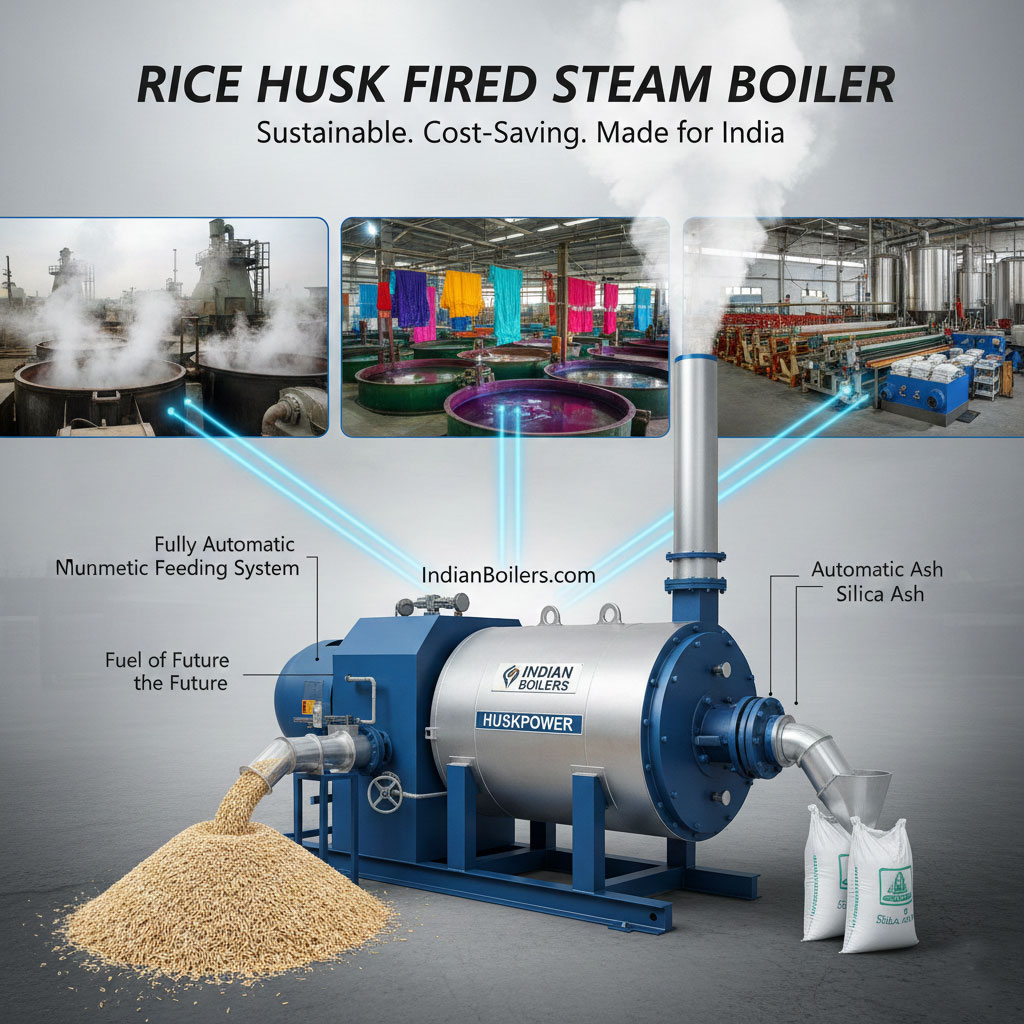
Rice Husk Fired Steam Boiler for Indian Industry: The Complete Buyer Guide
India runs on agricultural biomass, and nowhere is that more visible than in the boiler rooms of the country’s rice mills, textile units, dairies, and food processing plants. Every year, millions of tonnes of rice husk — once treated as low-value farm waste — are converted into steam that powers parboiling, dyeing, sterilization, and drying operations across the country. A well-engineered rice husk fired steam boiler turns this locally available residue into one of the cheapest sources of industrial steam in India, often cutting fuel costs by more than half compared to coal or furnace oil.
This buyer guide is written for plant owners, project engineers, and procurement teams who are evaluating a husk fired boiler for the first time, or replacing an aging unit. It walks through capacity planning, boiler design options, the real economics of husk firing, and a procurement checklist so you can make a confident, well-informed purchase decision.
If you manufacture or specify boilers on a larger scale — for example a steam boiler range for a textile cluster — the same fundamentals apply, just at a different scale of engineering and automation.
1. Why Rice Husk Has Become India’s Default Biomass Fuel
Rice husk is abundant near every rice-growing belt in India — Punjab, Haryana, West Bengal, Andhra Pradesh, Chhattisgarh, and beyond. For a rice mill, husk is essentially a by-product of its own operation, which means the fuel cost can be close to zero. For textile units, food processing plants, and dairies located near mandis, husk is available on contract at prices well below coal or furnace oil on a per-tonne-of-steam basis.
What makes husk different from other biomass is its ash content. Rice husk contains a relatively high proportion of silica, and its ash is abrasive. This single characteristic drives almost every engineering decision that separates a genuine husk fired boiler from a boiler that has simply been “adapted” to burn husk. We cover this in more depth in our related post on why rice husk is India’s most practical biomass fuel for steam boilers, including handling and storage tips that matter as much as the boiler design itself.
2. Step One: Correctly Sizing Your Boiler
Before comparing vendors or prices, the first and most important decision is capacity. Buyers frequently oversize or undersize their boiler because sizing is done on rated production capacity rather than actual peak steam demand of the process equipment.
Capacities for husk fired boilers in the Indian market typically range from 500 kg/hr to 10 TPH (Tonnes Per Hour) for standard packaged units, with specialized fluidized bed designs available up to 50 TPH and beyond for large industrial clusters.
Typical Capacity Benchmarks by Industry
| Industry Sector | Typical Steam Application | Boiler Capacity Range (TPH) | Working Pressure (kg/cm²) |
|---|---|---|---|
| Rice Mills | Parboiling, drying, conditioning | 0.5 – 4 TPH | 10.54 (standard) |
| Textile Units | Dyeing, sizing, finishing, curing | 2 – 8 TPH | 10.54 – 17.5 (higher for larger units) |
| Food Processing | Sterilization, cooking (dairy, breweries) | 1 – 6 TPH | 10.54 – 21.0 (higher for faster cycle times) |
| Paper & Pulp | Digestion, drying | 5 – 15 TPH | 17.5 – 32.0 |
Buyer tip: Work with your boiler vendor to calculate peak and average steam consumption based on your actual process equipment and duty cycle — not nameplate production capacity — to avoid an oversized (and inefficient) or undersized (and unreliable) installation. If your plant also runs process heating alongside steam, it’s worth reviewing whether a thermic fluid heater or a hybrid setup fits certain sections of your process better.
3. Boiler Design Options for Husk Firing
Because husk is low-density and high in abrasive ash, not every “biomass boiler” on the market is genuinely engineered for it. Two designs dominate the Indian market, each suited to a different scale and application.
A. Internal Furnace Top Feed (Packaged Fire Tube) Boiler
This is the workhorse design for small and mid-sized plants.
- Capacity range: 500 kg/hr to 6 TPH
- Design: A three-pass, fully wet-back, smoke tube boiler with an internal furnace
- Combustion: Husk is pneumatically fed from the top of the internal furnace by a high-velocity forced draft fan
- Advantages:
- Compact and skid-mounted, requiring minimal civil foundation
- High thermal efficiency — up to 80%+ with an economiser and air preheater
- Enclosed furnace design keeps radiation losses low
- Best suited for: Rice mills, small and medium food & beverage units, and any operation needing low-to-medium pressure saturated steam
B. Fluidized Bed Combustion (FBC) Boiler
For larger, high-pressure, or multi-fuel requirements, FBC technology takes over.
- Capacity range: 4 TPH to 50 TPH and above
- Design: Water tube or hybrid smoke-cum-water tube construction
- Combustion: A bubbling bed of fluidized sand ensures turbulent, near-complete combustion and excellent fuel flexibility
- Advantages:
- Higher efficiency — often 85%+ due to superior combustion
- Can burn husk alongside coal, briquettes, or pellets with minimal changeover
- Scales to the high-pressure, high-capacity needs of textile clusters and co-generation plants
- Best suited for: Large textile clusters, chemical plants, and units requiring stable high-pressure steam
If you’re weighing husk against other agricultural residues for an FBC or grate-based design, our comparison of rice husk vs. mustard straw for better ROI is a useful next read, and our guide on choosing the right fuel for a travelling grate boiler covers grate-based alternatives in more detail.
C. Non-Negotiable Features for Husk Firing
Regardless of which design you choose, insist on these three features:
- High-efficiency dust collection — A Multi-Cyclone Dust Collector (MCDC), or a bag filter/ESP for larger FBC units, is mandatory to capture abrasive silica ash before it damages boiler tubes and to stay within Pollution Control Board norms. Our biomass boiler emission control systems guide explains how these systems are selected and sized.
- Tube protection — Look for special ferrules or protective rings at smoke tube entrances to resist erosion from high-velocity silica ash.
- Automatic fuel and ash handling — A pneumatic husk feeding system and automated de-ashing reduce labour dependency, cut manual cleaning cycles, and directly improve uptime.
4. The Economic Case: Why Husk Firing Pays for Itself Fast
The single biggest reason Indian industries switch to husk firing is fuel cost. The comparison below is based on approximate fuel consumption per tonne of steam generated.
| Fuel Type | Consumption (per tonne of steam) | Fuel Cost Comparison | Payback Period vs. Coal/Oil |
|---|---|---|---|
| Rice Husk | ~270 kg | Low to near-free (especially for rice mills) | 6 months to 1 year |
| Coal | ~140 kg | High and volatile | 3 to 5 years |
| Furnace Oil (FO) | ~80 kg | Highest, market-linked | 5 years or more |
Fact check: Industry comparisons of boiler fuel costs in India consistently show that a well-designed husk fired boiler can pay back its incremental capital cost in 6 months to 1 year, compared to 3–5 years for a comparable coal-fired unit.
Beyond Fuel Savings: Long-Term Benefits
- Lower operating cost, higher upfront value: The capital cost of a husk fired boiler may be marginally higher than a simple oil/gas unit, but operational savings dwarf that difference within the first year of operation.
- Rice Husk Ash (RHA) has resale value: RHA is a valuable source of amorphous silica for the cement and construction industry, and selling it can help offset disposal costs entirely.
- Environmental compliance: Switching to a carbon-neutral fuel future-proofs your plant against tightening emission norms and national mandates to reduce fossil fuel dependence. For a broader look at emission compliance across biomass systems, see our biomass boiler emission control guide.
5. Procurement Checklist: What to Verify Before You Buy
- IBR certification is mandatory. Every industrial steam boiler above a specific capacity/pressure threshold must be certified under the Indian Boiler Regulations (IBR). Don’t compromise on this — it’s a legal requirement, not an optional add-on. Our resource on The Boilers Act, 2025 and The Indian Boilers Act, 1923 is a useful reference for compliance details.
- Vendor experience with husk specifically. Designing for high-ash, low-density biomass is a specialized skill, not a generic biomass boiler exercise. Ask any prospective vendor for installation references specifically in rice mills or textile units.
- Automation level. Prioritize fully automatic fuel feeding, pressure control, and ash removal to minimise labour cost and stabilise steam output.
- After-sales service network. Because husk ash is abrasive, routine maintenance matters more than with cleaner fuels. Confirm the vendor has a genuine service and spares network across your region, not just a head-office promise.
- Heat recovery systems. Confirm the quoted design includes an economiser (to pre-heat feedwater) and/or an air preheater (APH) to actually achieve the quoted thermal efficiency of 78–85%.
If your plant is in the food processing or dairy segment specifically, our dedicated guide on boiler selection for food processing units and the broader best boiler for textile, pharma, and food industry guide go deeper into sector-specific requirements like hygiene standards and steam purity.
6. Choosing the Right Manufacturer
A husk fired boiler is a long-term capital asset, typically running for 15–20+ years with proper maintenance. The manufacturer you choose matters as much as the boiler specification itself. At Balkrishna Boilers Pvt Ltd, our HUSKPOWER series is engineered specifically for India’s biomass profile — high-ash, low-density husk — with reinforced tube protection, efficient dust collection, and IBR-compliant construction as standard, not an upgrade.
Whether you need a compact packaged unit for a single rice mill or a larger FBC system for a textile cluster, our team can help you size the right capacity and pressure for your process, and walk you through a customised ROI analysis before you commit. You can also browse our complete steam boiler range or explore our broader biomass boiler category for related technologies such as grate-fired and multi-fuel systems.
Final Word
A rice husk fired steam boiler is more than a fuel-cost decision — it’s an investment in operational stability and long-term financial resilience for your plant. Focus on getting three things right: accurate capacity sizing based on real steam demand, a design (Top Feed or FBC) genuinely engineered for husk’s abrasive ash, and a vendor with proven experience and IBR-compliant manufacturing. Get these right, and your rice mill, textile unit, or food processing plant can turn what was once agricultural waste into some of the cheapest industrial steam available in India today.
Ready to start generating steam at near-zero fuel cost?
Contact IndianBoilers.com today for a free, customised ROI analysis based on your specific industrial steam requirement, or explore our complete product range to find the right fit for your plant.
Frequently Asked Questions
1. How much rice husk is required to generate one tonne of steam? On average, a well-designed husk fired boiler consumes approximately 270 kg of rice husk per tonne of steam, though this varies with husk moisture content, boiler efficiency, and feedwater temperature.
2. Can an existing coal-fired boiler be converted to run on rice husk? In some cases a retrofit is possible, but husk’s abrasive ash and lower bulk density usually demand changes to the furnace, fuel feeding system, and dust collection — it is rarely a simple fuel swap. A proper engineering assessment is essential before committing to a retrofit route.
3. Is IBR certification required for small capacity husk fired boilers too? IBR requirements are based on capacity and pressure thresholds, so even smaller units used in rice mills can fall under IBR depending on their design pressure. Always confirm applicability with your vendor before finalising a specification.
4. What is the typical thermal efficiency of a husk fired boiler? With a properly sized economiser and air preheater, packaged husk fired boilers typically achieve 78–80% efficiency, while fluidized bed combustion designs can reach 85% or higher due to more complete combustion.
5. How long does a rice husk fired boiler typically last? With proper maintenance, abrasion protection, and timely tube replacement where needed, a well-built husk fired boiler can operate reliably for 15–20 years or more.
Related Reading
- Husk Fired Boiler: Working, Benefits, Fuel Specs & Cost Saving Guide for Indian Industries
- Why Rice Husk is India’s Most Practical Biomass Fuel for Steam Boilers
- Rice Husk vs. Mustard Straw: Which Biomass Fuel Offers Better ROI
- Best Biomass Fuels for Reciprocating Grate Boilers
- Boiler Selection for Food Processing Units