
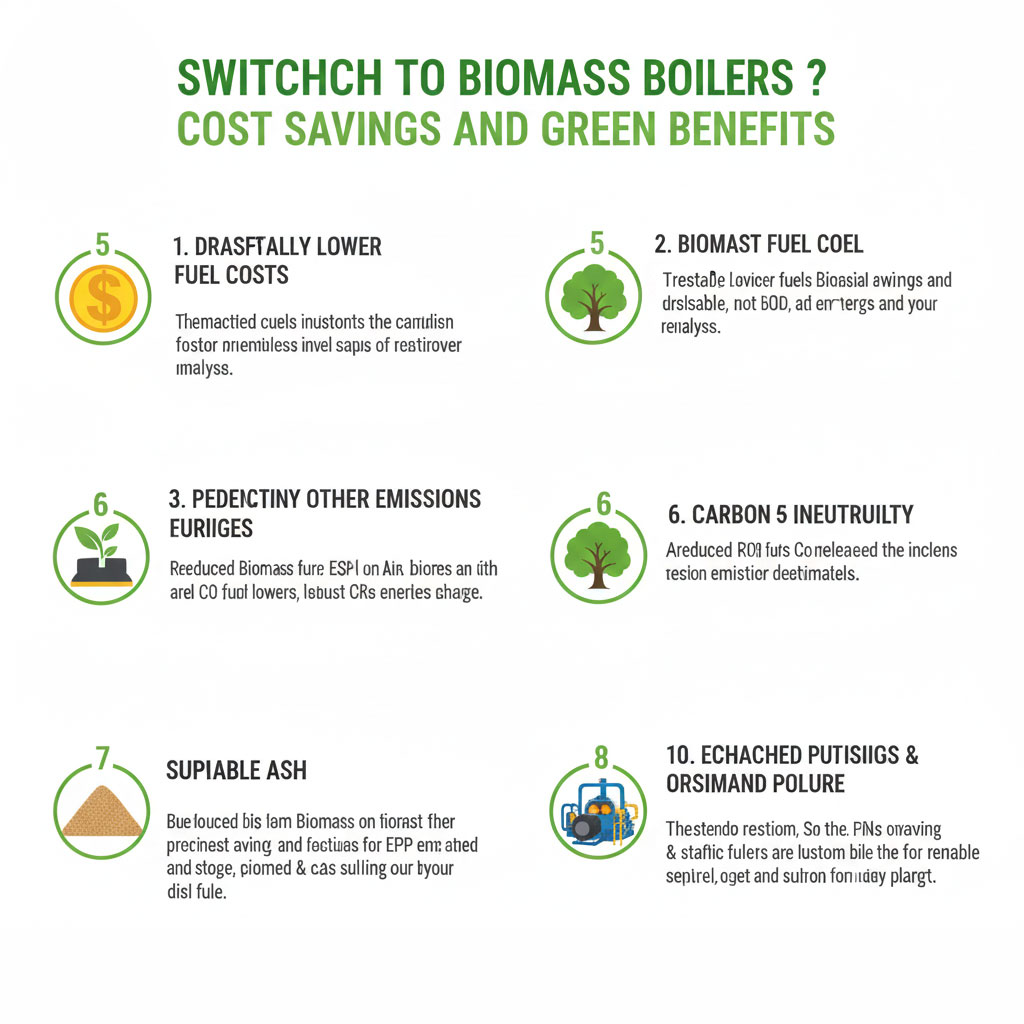
Why Switch to Biomass Boilers? Cost Savings, Green Benefits, and the Business Case for Indian Industries
Every industrial plant in India runs on one non-negotiable input: heat. Whether it’s steam for a textile dyeing line, hot water for a dairy, or thermic fluid for a chemical reactor, the boiler room quietly decides how profitable — and how sustainable — a factory really is. For decades, that boiler room ran on coal, furnace oil, or diesel. Today, a growing number of plant owners across Gujarat, Maharashtra, Punjab, and beyond are asking a different question: why are we still paying fossil-fuel prices when agricultural waste is sitting in our own backyard?
That question is exactly what’s driving the rapid adoption of biomass boilers across Indian industry. This isn’t a niche green experiment anymore — it’s a mainstream capital decision backed by hard numbers on fuel cost, payback period, and regulatory compliance. Below, we break down exactly why switching makes sense, what the real savings look like, and what to consider before you invest.
1. The Fuel Cost Gap Is Too Large to Ignore
Fuel is typically the single largest recurring cost in steam or thermal fluid generation — often 60–70% of total operating expense over a boiler’s lifetime. This is where biomass changes the entire economics of the plant.
Direct savings of 50–90% on fuel
Depending on region and fuel type — rice husk, bagasse, groundnut shell, mustard straw, wood chips, or biomass briquettes and pellets — factories typically cut fuel spend by 50% to 90% compared to coal, and by an even wider margin against furnace oil or diesel. Units that generate their own agro-waste, such as rice mills or sugar mills, can push effective fuel cost close to zero, since the “fuel” is a byproduct they were already paying to dispose of.
If you’re weighing which raw material makes the most financial sense for your plant, it’s worth reading our comparison of rice husk vs. mustard straw as boiler fuel and our breakdown of biomass pellets vs. biomass briquettes, since fuel choice directly affects both running cost and boiler performance.
Payback periods as short as 6 months
Because the fuel savings are so steep, most factories recover their capital investment in a biomass steam boiler within 6 months to 2 years — a payback window few other capital upgrades on the shop floor can match. That’s a big reason biomass has moved from “sustainability initiative” to “finance-team-approved project.”
Insulation from fuel price volatility
Coal and furnace oil prices move with international markets, currency swings, and geopolitics — none of which a plant manager controls. Biomass fuel is sourced locally, which means prices are far more stable and predictable, making annual energy budgeting significantly easier and reducing financial risk across the board.
Waste disposal becomes a revenue stream, not a cost
For rice mills sitting on husk, sugar mills with bagasse, or any facility generating organic waste, a biomass boiler eliminates a costly disposal problem and converts it into usable fuel. In many cases, this alone changes the ROI calculation before you even factor in the energy savings.
2. The Environmental Case: Compliance Today, Advantage Tomorrow
The financial argument gets most factories to the table. The environmental one is what makes the switch future-proof.
A genuinely closed carbon cycle
Biomass is considered carbon-neutral because the CO₂ released during combustion roughly equals the CO₂ the plant absorbed while growing — unlike coal or furnace oil, which release carbon that’s been locked away for millions of years. Switching directly reduces your facility’s net greenhouse gas footprint and supports both India’s national climate commitments and your own company’s net-zero targets.
Lower SOx, NOx, and particulate emissions
Biomass fuels carry very low sulfur content, which all but eliminates SOx emissions — a leading cause of acid rain and respiratory illness. NOx output is also generally lower than coal-fired combustion. When paired with proper emission-control equipment such as multi-cyclone dust collectors or bag filters, particulate matter stays comfortably within Pollution Control Board norms. For a deeper look at what “compliant” actually requires on the ground, see our complete guide to biomass boiler emission control systems.
A real solution to crop-residue burning
Open burning of crop residue is a major contributor to seasonal air quality crises across northern India. Biomass boilers give farmers and mills a productive outlet for that same residue — turning an air-quality liability into a functioning fuel supply chain.
Regulatory future-proofing
Environmental norms in India are only getting stricter. Investing in biomass-ready thermal equipment now means you avoid retrofit costs, penalties, and compliance scrambles later — while also strengthening your standing with environmentally conscious clients, auditors, and investors who increasingly screen suppliers on sustainability practice.
3. Strategic Advantages That Go Beyond the Balance Sheet
A few benefits of switching to biomass don’t show up directly on a cost sheet, but they matter over the long run:
- Supporting the local economy. Biomass procurement channels money back to farmers, aggregators, and local transport operators instead of overseas fuel suppliers.
- Employment along the supply chain. Collection, processing, and logistics for biomass fuel create jobs that a fossil-fuel supply chain simply doesn’t generate locally.
- Fuel flexibility. A well-engineered biomass system, like a reciprocating grate or traveling grate design, can burn multiple biomass fuel types, giving you a hedge if one particular fuel source becomes scarce or expensive in a given season.
- A valuable byproduct. Rice husk ash (RHA), the residue from husk-fired boilers, is rich in silica and much sought after by the cement, construction, and refractory industries — turning your ash disposal into an additional, if modest, revenue line. Our guide to the rice husk-fired steam boiler covers this in more depth.
4. Biomass vs. Coal vs. Furnace Oil: A Realistic Cost Comparison
Numbers convince plant owners faster than adjectives do, so it helps to see the fuel-cost logic laid out side by side.
Furnace oil and diesel sit at the top of the cost ladder. They’re convenient to store and burn cleanly with minimal ash handling, but their price is tied directly to crude oil markets, which means a plant’s single biggest operating cost can swing sharply from one quarter to the next with zero warning. For most industrial users, furnace oil has become the most expensive way to raise steam in India today.
Coal is cheaper than furnace oil but still an imported or long-haul commodity in many states, with pricing that tracks international coal indices and rail or road freight costs. Coal also carries a heavier compliance burden — higher sulfur and ash content generally require more robust emission-control investment to stay within Pollution Control Board limits.
Biomass — husk, bagasse, groundnut shell, mustard straw, briquettes, or pellets — is priced locally, close to the point of agricultural production, which insulates it from the currency and freight swings that hit coal and oil. Even accounting for seasonal price movement in raw biomass, the delivered cost per unit of steam generated is typically a fraction of coal or furnace oil. For a plant that also generates its own agro-waste, the comparison isn’t close at all: the fuel is essentially free, and the only real cost is handling and storage infrastructure.
The trade-off worth planning for is combustion consistency. Biomass fuels vary more in moisture content and calorific value than a standardized fossil fuel, which is why grate design and fuel handling — discussed above — matter more with biomass than with oil or coal. A boiler engineered specifically for biomass combustion, rather than a coal-fired unit retrofitted to “also” burn biomass, will consistently deliver better efficiency and lower maintenance over its operating life.
5. Choosing the Right Biomass System for Your Plant
Not every plant needs the same configuration, and getting this decision right up front saves years of operating headaches.
For steam-intensive operations — textiles, food processing, chemicals, pharma — a biomass-fired steam boiler sized to your peak steam demand is usually the starting point. If your process instead needs indirect heating through oil rather than steam, a thermic fluid heater running on biomass fuel may be the better fit, particularly for applications where precise, uniform temperature control matters.
For process water or space heating, a biomass-fired hot water boiler is typically more efficient and lower-maintenance than repurposing a steam system for hot water duty.
Grate technology matters more than most buyers expect. The type of grate — vibrating, reciprocating, or traveling — determines how well your boiler handles fuel moisture, ash content, and load variation. If you’re evaluating options, our guides on vibrating grate vs. reciprocating grate performance and fuel moisture vs. boiler efficiency walk through the trade-offs in practical terms.
If you’re on the Balkrishna Boilers side of the business, the equivalent product range is available directly through balkrishn.com — including the HUSKPOWER and PELLETAX biomass-fired steam boiler ranges, both purpose-built for agro-residue fuels like husk, briquettes, and pellets. You can browse the full steam boiler range and hot water boiler range to compare capacities and configurations side by side.
6. What to Plan for Before You Switch
Switching fuel type isn’t just a procurement decision — it changes how the boiler is operated day to day. A few things worth budgeting for early:
- Fuel storage and handling infrastructure. Biomass has lower energy density than coal by volume, so you’ll need adequate covered storage and a reliable fuel-handling system to keep combustion consistent.
- Combustion control. Biomass moisture content varies by season and source, which affects flame stability and efficiency. Our piece on fuel moisture vs. boiler efficiency is a useful reference when setting operating parameters.
- Preventive maintenance. Ash handling and grate wear patterns differ from fossil-fuel operation. Reviewing common issues in advance — covered in our guide to common biomass boiler problems and solutions — helps avoid unplanned downtime in the first year.
- Digital monitoring. Newer installations increasingly use sensor-based monitoring to track combustion efficiency in real time; see how this is playing out in practice in how AI and IoT are transforming biomass boiler operations.
None of these are reasons to delay a switch — they’re simply part of a proper commissioning plan, and an experienced boiler manufacturer will walk you through each one before installation.
Frequently Asked Questions
How much can a biomass boiler actually save on fuel costs? Most Indian factories report savings of 50% to 90% on fuel expenditure compared to coal or furnace oil, depending on the biomass fuel used and local availability. Plants that generate their own agro-waste, such as rice mills or sugar mills, often see the steepest savings since their fuel cost approaches zero.
What is a typical payback period for switching to biomass? Given the scale of fuel savings, payback periods of 6 months to 2 years are common, making biomass one of the fastest-returning capital investments available to an industrial plant.
Which industries benefit most from biomass boilers? Textiles, food and beverage processing, chemicals, pharmaceuticals, rice and sugar mills, and paper manufacturing are among the heaviest adopters, largely because these sectors both consume large volumes of steam and often generate their own biomass waste as a byproduct.
Is biomass combustion actually compliant with Indian pollution norms? Yes, when paired with proper emission-control equipment such as multi-cyclone dust collectors, bag filters, or scrubbers. Biomass inherently produces far lower SOx emissions than coal, and PM levels stay within Pollution Control Board limits when the boiler and emission-control system are correctly sized. See our emission control systems guide for specifics.
Can an existing coal-fired boiler be converted to biomass, or is a new unit required? In some cases a retrofit is possible, but a boiler engineered from the ground up for biomass combustion — with the right grate design, fuel-feed system, and ash-handling setup — will almost always outperform a converted coal unit in efficiency and reliability over time.
Which biomass fuel gives the best return — rice husk, briquettes, or pellets? It depends on regional availability and pricing. Husk is often the most cost-effective where rice milling is common, while briquettes and pellets offer more consistent calorific value and easier storage. Our comparisons of rice husk vs. mustard straw and pellets vs. briquettes go into the specifics for each.
Conclusion: A Decision That Pays for Itself — Then Keeps Paying
Switching to a biomass boiler is one of the rare industrial upgrades where the financial case and the environmental case point in exactly the same direction. Fuel costs drop by as much as 90%, payback often arrives within two years, emissions fall well within regulatory limits, and your plant gains a hedge against the volatility of imported fossil fuels — all while supporting local farmers and rural supply chains instead of global commodity markets.
If you generate agricultural or industrial waste on-site, the case is even stronger: what used to be a disposal cost becomes your primary fuel source.
Ready to see the numbers for your own plant? Get in touch with our engineering team at IndianBoilers.com or explore the complete biomass-ready product range at Balkrishna Boilers Pvt Ltd for a personalized fuel-cost and payback projection.
Related reading: Top 10 Benefits of Biomass Fired Boilers for Indian Factories · How Biomass Boilers Turn Agro-Waste into Reliable Steam Power · Best Biomass Fuels for Reciprocating Grate Boilers