
In a food processing plant, steam isn’t just a utility — it’s frequently in direct or near-direct contact with the product itself. It cooks, sterilizes, pasteurizes, cleans, and humidifies. That single fact changes everything about how a boiler should be chosen, operated, and maintained compared to almost any other industrial setting. A boiler that would be perfectly acceptable in a textile mill or a chemical plant can be entirely wrong for a food unit if it can’t guarantee contaminant-free steam, precise pressure control, and zero risk of product spoilage from a breakdown.
This guide covers what food, dairy, and beverage manufacturers need to evaluate before buying a boiler — from steam purity and water treatment to fuel choice, compliance, and the reliability questions that matter most when your raw material is perishable.
Why Food Processing Demands a Different Standard of Boiler
Most industrial boiler buyers optimize primarily for capacity and running cost. Food processors have to optimize for those plus three things that carry zero tolerance for compromise:
- Steam purity — zero tolerance for contaminants or “carryover” that could reach the product, whether directly (culinary steam, direct injection cooking) or indirectly (jacketed vessels, retorts, pasteurizers)
- Precise, stable pressure control — many food processes need pressure held within a very tight margin, since even small fluctuations can under- or over-process a batch
- Reliability — a boiler breakdown in a plant handling perishable goods isn’t just downtime, it’s potential product loss, and in some cases a full batch write-off
Add to that the compliance layer — FSSAI guidelines, HACCP principles, and for pharma-adjacent food operations, GMP expectations — and boiler selection becomes a food-safety decision as much as an engineering one. This is covered in more depth in Best Boiler for Textile, Pharma, and Food Industry: An Industry-wise Guide, which breaks down how the “best” boiler changes entirely by sector.
Where Steam Actually Touches Your Product
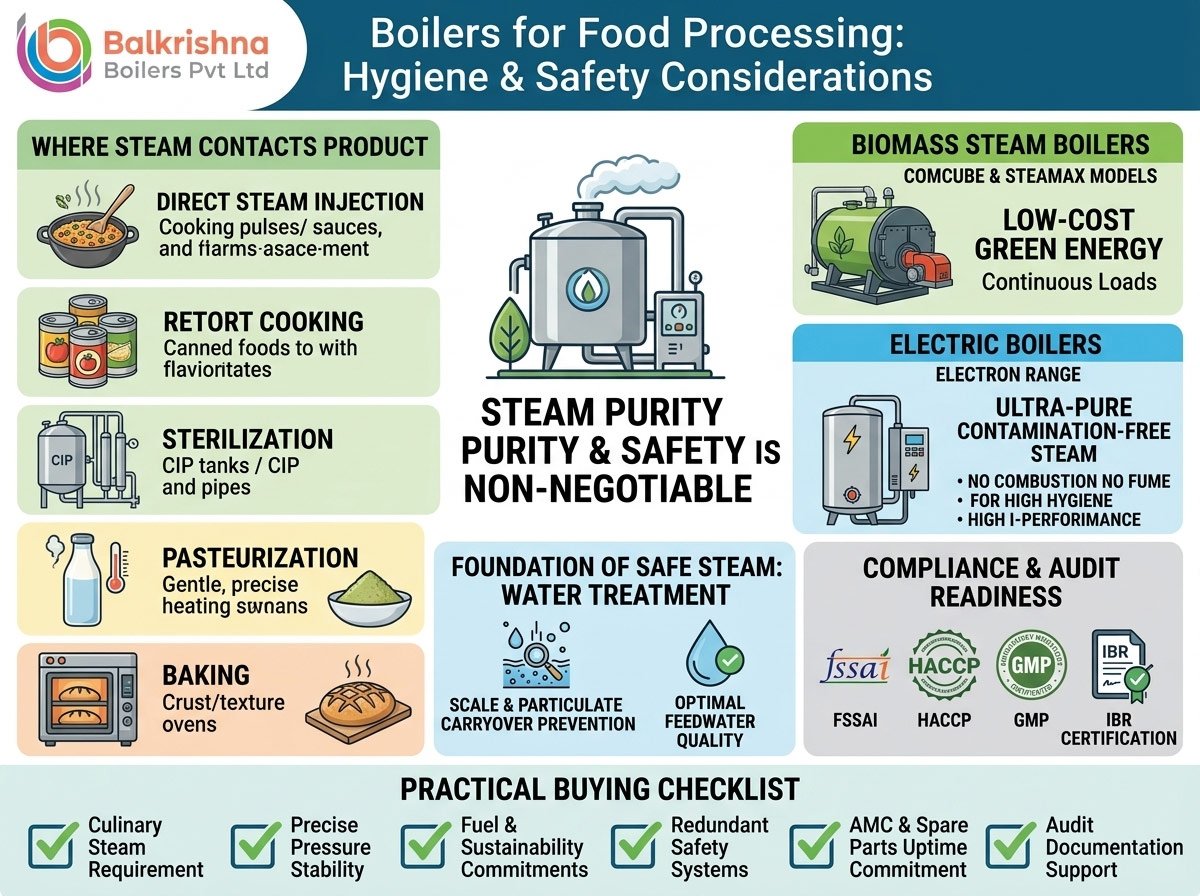
Understanding where steam contacts food (directly or indirectly) helps clarify why purity requirements are non-negotiable:
- Direct steam injection — used for cooking vegetables, pulses, and certain sauces, where the steam itself becomes part of the product
- Sterilization and sanitation — cleaning tanks, pipes, and bottling lines between production runs
- Pasteurization — gentle, precisely controlled heating for milk, juices, and other beverages
- Retort cooking — for canned and packaged foods requiring exact temperature holds for food safety
- Baking — steam injection ovens rely on consistent culinary-grade steam for crust and texture
Because several of these are direct-contact applications, any combustion byproduct, treatment chemical residue, or carryover in the steam has a real chance of reaching the food itself — not just the equipment.
Boiler Types Suited to Food Processing
Biomass Steam Boilers for Cost-Efficient, High-Volume Plants
For large-volume food processors — bakeries, confectionery units, spice processing, dairy plants running continuous pasteurization — biomass steam boilers offer a strong balance of low running cost and steady steam output. The COMCUBE Biomass Fired Steam Boiler is engineered with a compact “cube” footprint for factories where floor space is tight but steam demand is high, making it a common fit for small-to-medium bakeries and spice units. For larger loads, the STEAMAX Briquette Fired Steam Boiler is built to hold a steady steam profile even during peak loads — a critical requirement where pressure swings directly affect food safety and product consistency. More on how these fit food operations specifically is covered here: Biomass Boilers for Food Processing: Unlocking Green Energy.
Browse the full steam boiler range, including options like the Oil / Gas Fired Steam Boiler 500 Kg/hr to 10 TPH/hr for plants that prioritize clean-burning fuel with pipeline access.
Electric Boilers for Maximum Purity and Compliance
Where hygiene requirements are strictest — pharma-adjacent food manufacturing, infant nutrition, injectable-grade pharmaceutical water systems, or any plant chasing tighter FSSAI or GMP audits — electric boilers have become the preferred option. Because they’re zero-emission at the point of use, they eliminate the entire category of combustion-related contamination risk: no fume, no soot, no particulate matter near the processing area, and no flue gas venting concerns. This is covered in detail here: Electric Boilers for Food, Pharma & Dairy: Safe, Clean Steam Solutions, and the broader case for electric steam beyond the obvious use cases is explored in What Applications Utilize Electric Steam Boilers, Besides Laundries and Hospitals?
Explore the electric boiler category, including the IBR Electric Steam Boiler for larger certified installations. On the Balkrishna Boilers side, the ELECTRON series is purpose-built for exactly this kind of ultra-pure, contamination-free steam demand, alongside the ELECTROMAX and INDUCTRON ranges.
Hot Water Systems for Non-Steam Applications
Not every food process needs steam. Large-scale frying, oil heating, and hot water washing are typically better served by a dedicated hot water boiler rather than a full steam system. Explore the hot water boiler category, or the AQUAMAX and VTFH SERIES models — the latter also available in a biomass-fired configuration for plants prioritizing fuel cost savings alongside hygiene.
Water Treatment: The Foundation of Safe, Pure Steam
Water treatment matters in every industry, but in food processing it’s inseparable from product safety. Untreated or poorly treated water causes scaling and corrosion inside the boiler, and scale buildup doesn’t just cut efficiency — it increases the risk of particulate carryover into steam that may be in direct contact with food. Even a thin layer of internal scale can raise fuel consumption by 7–10% while steadily degrading the reliability of pressure control.
A properly designed water treatment plant, combined with disciplined blowdown practice, is what keeps steam consistently clean batch after batch. For plants specifying an electric boiler specifically, feedwater quality tolerances are even tighter than for fuel-fired systems — worth reviewing before finalising your order: Electric Boiler Water Quality Requirements Explained. The mechanics of how water is converted into usable steam, and why treatment quality determines steam purity downstream, are explained here: Steam Boiler Working Principle Explained Simply.
Fuel Choice: Balancing Cost, Hygiene, and Sustainability
Fuel selection in food processing carries an extra dimension beyond running cost — many global food brands now mandate “Green Steam” from their suppliers as part of sustainability commitments, and export-focused plants increasingly face carbon-intensity scrutiny from international buyers.
- Biomass (briquettes, pellets, agricultural waste) is treated as carbon-neutral, since the CO₂ released during combustion roughly equals what the source plant absorbed during growth — making it an increasingly important lever for exporters facing carbon border considerations, and a genuinely low-cost, decentralized fuel source for Indian manufacturers. More detail on how agro-waste is converted into reliable process steam is covered in How Biomass Boilers Turn Agro-Waste into Reliable Steam Power.
- Natural gas / PNG delivers very clean combustion, well suited to plants that need to meet strict hygiene standards without moving fully to electric.
- Electricity removes combustion entirely from the equation, the cleanest option where audit scrutiny is highest.
If you’re weighing biomass against a switch to electric for cost and compliance reasons, it’s worth reviewing the running-cost comparison in detail: Electric Boiler ROI: When Does It Pay Off? and Electric Boiler Power Consumption: Formulas and Examples.
Compliance, Safety, and Audit Readiness
Food processing boilers sit at the intersection of two regulatory worlds: standard boiler safety compliance (IBR certification for units above the threshold capacity or pressure) and food-safety compliance (FSSAI guidelines, HACCP principles, and GMP expectations where applicable). A few practical points worth confirming before you order:
- IBR classification, confirmed with your supplier in writing, since it affects inspection requirements and commissioning timelines
- Auditing ease — in a highly audited environment, a boiler system with a simpler fuel train and fewer combustion-related components (as with electric units) is generally easier to defend during a hygiene or safety audit
- Redundant safety systems — high-pressure cut-offs, low-water level alarms, flame sensors (for fuel-fired units), and spring-loaded safety valves should be standard, not optional
- Documentation trail — water treatment logs, blowdown records, and maintenance history are frequently requested during food-safety audits, so make sure your supplier’s after-sales support includes structured reporting
Reliability: Why Downtime Costs More in Food Processing
A boiler failure in a textile mill delays production. A boiler failure in a food plant can mean an entire batch of perishable product is lost, along with the raw materials that went into it. This makes uptime — not just efficiency — a central buying criterion.
Look for suppliers offering genuine Annual Maintenance Contracts (AMC), 24/7 technical support, and a ready stock of spare parts, since food plants typically can’t absorb multi-day downtime waiting for a part to arrive. It’s also worth confirming turndown ratio and load-response speed at the time of purchase — food processing demand often fluctuates sharply between shifts (a bakery’s overnight bake cycle versus daytime packaging, for instance), and a boiler that can’t respond quickly ends up either wasting fuel or under-delivering pressure exactly when it’s needed most.
A Practical Buying Checklist for Food Processing Boilers
- Steam purity requirement — confirm whether your process needs culinary-grade (direct-contact) steam or standard process steam
- Pressure stability tolerance — some processes need control within a very tight margin; confirm this with your supplier against the boiler’s rated performance
- Fuel choice, balanced against hygiene priorities, sustainability commitments, and running cost
- Water treatment plan, sized specifically for food-grade steam purity, not just scale prevention
- IBR classification and safety systems, confirmed and documented before commissioning
- AMC and spare parts availability, given the higher cost of unplanned downtime with perishable goods
- Audit documentation support from your supplier, covering water treatment and maintenance logs
Why Food Processors Choose Balkrishna Boilers
Balkrishna Boilers Pvt Ltd has spent over 25 years engineering steam boilers, electric boilers, thermic fluid heaters, and hot water systems for hygiene-critical industries, with food, dairy, and beverage processing among our most consistently served sectors. Our steam boiler, electric boiler, and hot water boiler ranges are engineered for the purity, pressure stability, and reliability that food-grade steam demands, and every IBR-rated unit is inspected and tested before it leaves the factory.
If you’re evaluating a new boiler for a food processing line, our engineering team can help match your product, process, and compliance requirements to the right capacity and fuel combination — reach out through the contact page or browse the full product range to compare specifications directly.
Frequently Asked Questions
Do food processing boilers need special certification beyond IBR? IBR certification covers boiler safety, but food plants also need to demonstrate compliance with FSSAI guidelines and, where applicable, HACCP or GMP principles — these govern water treatment, documentation, and steam purity rather than the boiler itself.
Are electric boilers worth the switch for food processing plants? For hygiene-critical operations — dairy, infant nutrition, pharma-adjacent food manufacturing — many processors find the elimination of combustion-related contamination risk worth the running-cost difference, particularly as audit standards tighten.
How often should water treatment systems be checked in a food plant boiler? Beyond routine blowdown (typically once per shift), a full water treatment plant review is generally recommended monthly, given how directly feedwater quality affects steam purity in direct-contact applications.
What’s the biggest risk of an undersized boiler in food processing? Beyond slower cycle times, an undersized boiler struggles to hold the pressure stability many food processes require, which can directly affect food safety outcomes like pasteurization or sterilization efficacy.
Can biomass boilers meet food-grade steam purity requirements? Yes, when paired with proper water treatment and a well-maintained boiler — biomass and steam purity are not mutually exclusive, though electric systems remove combustion-related risk entirely for the most hygiene-sensitive applications.
Evaluating a boiler for a food, dairy, or beverage processing line? Get in touch with our engineering team for a purity, pressure, and capacity assessment.