
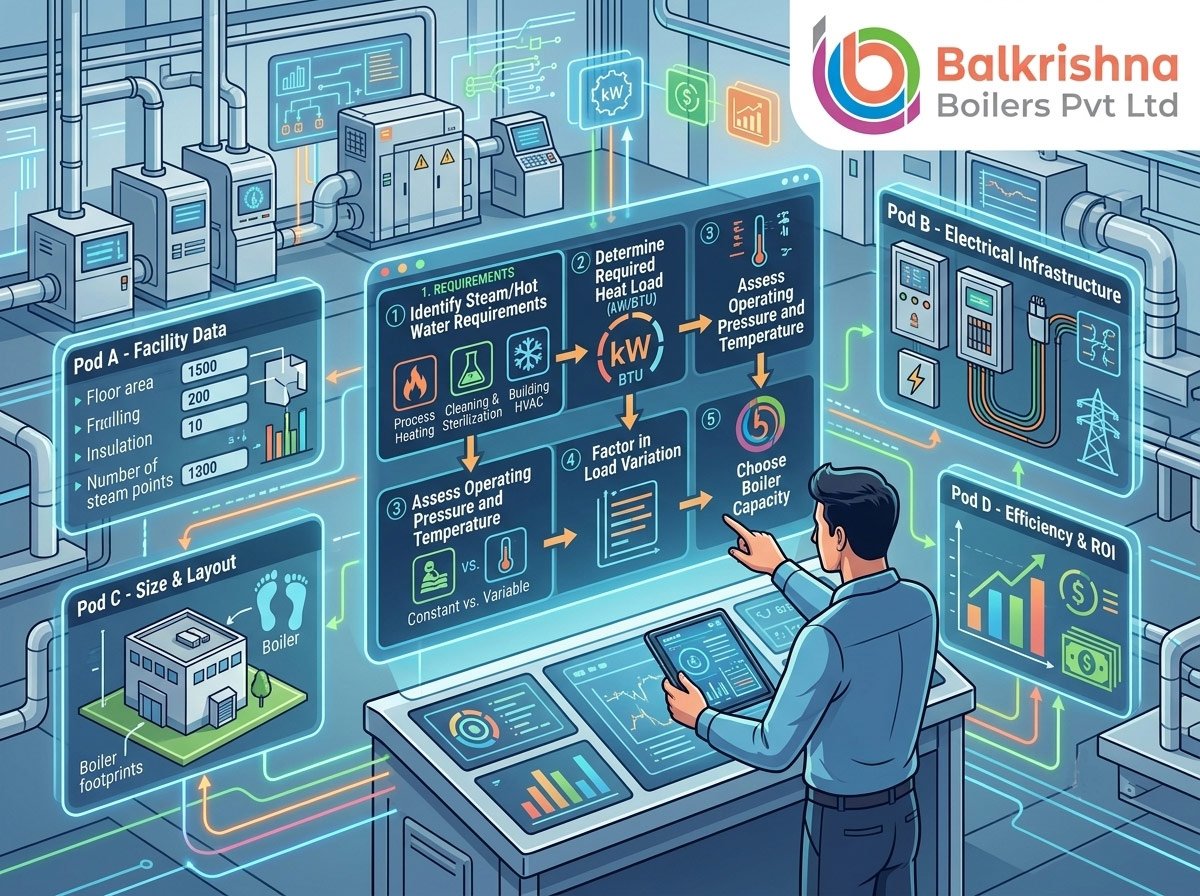
Sizing is the single most consequential decision in any boiler purchase, and it’s the one buyers get wrong most often. An undersized electric boiler can’t keep up with peak demand, creating production bottlenecks that show up the moment you scale beyond commissioning conditions. An oversized one wastes capital, runs inefficiently at partial load, and locks you into an electrical infrastructure upgrade you didn’t need. Getting sizing right isn’t guesswork — it’s a calculation based on actual process data, and it’s worth doing properly before you request a quote.
At Indian Boilers.com, part of Balkrishna Boilers Pvt Ltd, our engineers size electric boilers for plants every week, and the same handful of inputs come up every time. This guide walks through exactly what those inputs are and how to work through them yourself, so you can have an informed conversation with any supplier — including us.
Why Sizing Matters More With Electric Boilers Than You Might Expect
With fuel-fired boilers, there’s some tolerance for oversizing — a larger unit can often modulate down reasonably well, and the fuel cost of running below capacity is a relatively minor inefficiency. Electric boilers are more sensitive to correct sizing for a different reason: capacity is tied directly to your electrical infrastructure. A larger unit than you need doesn’t just cost more upfront — it can demand a higher sanctioned load, a transformer upgrade, or additional electrical infrastructure that adds real, avoidable capital cost.
Getting sizing right the first time avoids both the operational risk of undersizing and the unnecessary infrastructure cost of oversizing.
Step 1: Determine Your Actual Steam or Hot Water Demand
This is the foundation of every sizing calculation, and it’s where most sizing mistakes originate — usually because buyers size against a rough estimate or a legacy boiler’s rated capacity rather than genuine process data.
For steam applications, demand is expressed in kg/hr. This should be based on:
- The steam consumption of each piece of equipment connected to the boiler (autoclaves, jacketed vessels, dryers, sterilizers)
- Whether equipment runs simultaneously or in sequence — simultaneous demand requires sizing for the combined peak, not the sum of all equipment’s rated maximum
- Any process losses in distribution piping, particularly if the boiler will be located some distance from point of use
For hot water applications, demand is expressed as flow rate (litres/hour) combined with the required temperature rise — the difference between incoming water temperature and target output temperature. A larger temperature rise requires proportionally more heating capacity for the same flow rate.
The most reliable method is to review actual consumption data from an existing boiler if you’re replacing one, or to calculate demand directly from equipment manufacturer specifications if this is a new installation. Avoid sizing purely off a previous fuel-fired boiler’s rated capacity — many existing systems are oversized relative to actual demand, and carrying that oversizing forward into an electric replacement compounds the infrastructure cost unnecessarily.
Step 2: Distinguish Between Peak Demand and Average Demand
A boiler needs to be sized for peak demand — the highest simultaneous load your process will realistically place on it — not average demand across a shift or day. But it’s equally important not to over-correct by sizing for a theoretical worst case that never actually occurs in practice.
The practical approach: identify your genuine peak operating scenario (for example, the specific combination of equipment running simultaneously during your busiest production window), add a reasonable safety margin — typically 10 to 20 percent — and size to that figure. This avoids both the risk of undersizing against real peak conditions and the waste of sizing against an unrealistic maximum that combines every piece of equipment running flat out simultaneously, which rarely reflects actual operations.
Step 3: Account for Future Growth — Carefully
If you expect production to scale meaningfully within the next two to three years, it’s often more economical to size slightly ahead of current demand than to replace or supplement the boiler later. However, this should be a deliberate, quantified decision based on a real growth plan — not a generic buffer added “just in case,” which is one of the more common ways facilities end up with an oversized, underutilized unit.
A useful approach is to size the boiler itself close to genuine current-plus-near-term demand, while confirming your electrical infrastructure (transformer capacity, sanctioned load) has headroom to support a future capacity addition if growth materializes. This avoids paying for unused capacity today while keeping the door open for a straightforward upgrade later.
Step 4: Confirm Operating Pressure Requirements
Pressure requirements vary significantly by process, and this affects both which product category fits your need and whether IBR certification applies.
- Low-pressure applications (many laundry, washing, and small process-heating uses) often fit within Non-IBR configurations, which are simpler and faster to commission — our Electric Steam Boiler 100 Kg/hr to 400 Kg/hr covers this range.
- Higher-pressure industrial applications — sterilization, certain chemical processes, larger continuous production lines — typically require IBR certification. Our IBR Electric Steam Boiler range is engineered and tested specifically for this regulatory standard.
Confirm your actual process pressure requirement rather than defaulting to a higher rating “to be safe” — this directly affects both cost and compliance complexity without necessarily benefiting your process.
Step 5: Check Your Available Electrical Supply
This is the step most frequently overlooked until late in the buying process, and it can derail an otherwise correct sizing calculation if addressed too late.
Industrial electric boilers typically require a 3-phase, 415V, 50Hz supply, with total power draw (kW) scaling directly with steam or hot water output capacity. Before finalizing a model, confirm:
- Your facility’s sanctioned electrical load has sufficient headroom for the boiler’s full power draw, alongside your existing equipment.
- Transformer capacity can support the additional load without upgrade — or budget for that upgrade if it’s needed.
- Cabling and switchgear sized for the boiler’s specific current draw are included in your installation planning, not treated as an afterthought.
Skipping this check is one of the most common causes of installation delays — a correctly sized boiler that can’t actually be connected to available power on schedule.
Step 6: Match Capacity to the Right Product Type
Once you know your required output, pressure, and available power, matching to a specific model becomes straightforward. Balkrishna Boilers manufactures electric boilers from roughly 12 kW up to 600 kW and beyond, covering:
- Smaller/entry-level capacity — the 0.5 Ton Electric Steam Boiler and 1 Ton Electric Steam Boiler, well suited to SME and batch-process applications covered in our buyer’s guide for small and medium enterprises.
- Mid-range capacity — the 2 Ton Low Voltage, 2.5 Ton Medium Voltage, and 3 Ton High Voltage electric boilers, matched to progressively higher electrical supply configurations.
- Larger industrial capacity — the 4 Ton, 5 Ton, 6 Ton, and 8 Ton Electric Boiler models, for continuous higher-volume demand.
- Non-steam requirements — the Electric Hot Water Boiler, Electric Thermic Fluid Heater, and Electric Induction Boiler for applications outside standard steam generation.
On the Balkrishna Boilers side, this same capacity range runs through our Electric Boiler series, including ELECTROMAX and ELECTROPAC for general steam applications, ELECTROAQUA for hot water, and INDUCTRON for induction-based generation.
Common Sizing Mistakes to Avoid
Sizing against a legacy boiler’s rated capacity instead of actual demand. Many existing fuel-fired systems are oversized; carrying that number forward inflates your electrical infrastructure requirement unnecessarily.
Ignoring simultaneous equipment demand. Adding up every connected equipment’s maximum rated consumption, rather than realistic simultaneous peak, leads to significant oversizing.
Deciding on voltage configuration too late. Low, medium, and high-voltage electric boiler models exist specifically to match different electrical infrastructure realities — confirm this early, not after a model has already been selected on capacity alone.
Skipping the electrical infrastructure check until after ordering. This is the single most common cause of installation delays. Confirm sanctioned load and transformer headroom before finalizing your order, not after.
Treating future growth as a vague buffer rather than a quantified plan. Oversizing “just in case” is one of the more expensive sizing mistakes, both in capital cost and in reduced part-load efficiency.
Working With Our Engineering Team
Because correct sizing depends on genuine process data rather than a generic formula, our engineers work directly with buyers to calculate the right capacity — reviewing equipment specifications, simultaneous demand patterns, pressure requirements, and available electrical infrastructure before recommending a specific model. This is the same process we walk through for both large industrial buyers and smaller facilities referenced in our SME buyer’s guide, scaled to whatever level of detail your project needs.
Final Thoughts
Correct sizing is the foundation every other electric boiler decision builds on — efficiency, running cost, safety margin, and installation cost all depend on getting this right from the start. Working from genuine process data, distinguishing real peak demand from average load, confirming pressure and electrical infrastructure requirements early, and avoiding vague oversizing “just in case” will get you to the right capacity with confidence, whether you’re sizing your first electric boiler or replacing an existing system.
If you’d like our engineers to size the right electric boiler for your specific facility, get in touch with our team with your process details, or explore the full Electric Boiler range on Indian Boilers.com and Balkrishna Boilers to review specifications across our capacity range.