
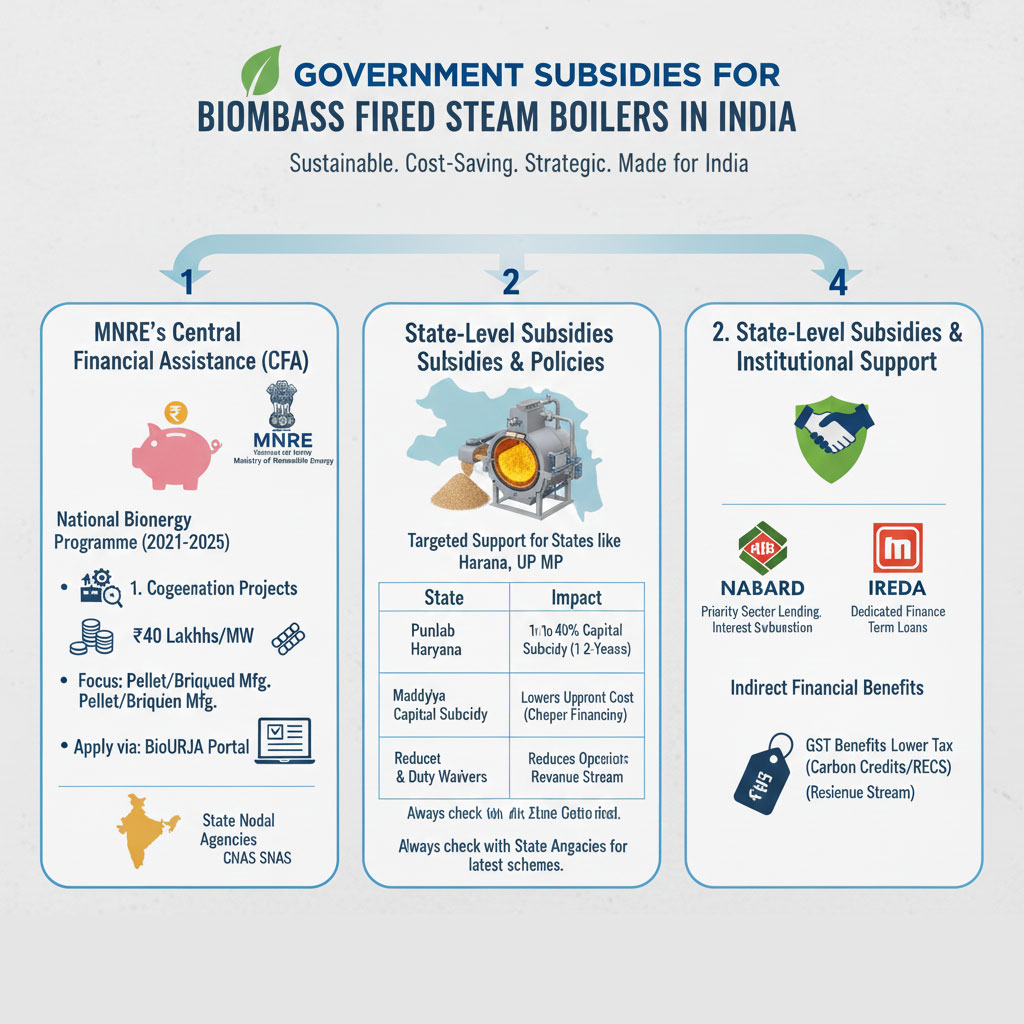
Switching an industrial plant from coal or diesel to biomass is one of the smartest financial decisions an Indian manufacturer can make in 2026 — but the upfront capital cost still stops many plant owners from pulling the trigger. What most buyers don’t realize is that the Government of India, individual state governments, and several public financial institutions have built an entire funding ecosystem specifically to make this switch affordable. If you are evaluating a biomass fired steam boiler for your factory, understanding this funding landscape isn’t optional — it’s the difference between a 4-year payback and an 18-month payback.
This guide breaks down every major subsidy, tax benefit, and financing route available to Indian industries in 2026, and shows exactly how they apply to real boiler purchases like the HUSKPOWER – Rice Husk Fired Steam Boiler, the COMCUBE – Biomass Steam Boiler, and the VTFH-SERIES – Biomass Fired Hot Water Boiler.
Why Subsidies Matter More Than Ever in 2026
As covered in our earlier post on how biomass boilers help reduce carbon emissions, regulatory pressure on fossil-fuel-fired plants is only increasing. Pollution Control Boards across states are tightening emission norms, and several industrial clusters now face outright restrictions on coal-fired boilers. This regulatory push, combined with the fact that coal costs three to five times more than biomass fuel, has made the switch to biomass less of a choice and more of an inevitability.
The government’s response has been to de-risk that transition financially. Rather than leaving industries to absorb the full capital cost alone, a layered system of central schemes, state incentives, and low-cost institutional financing has been built to accelerate adoption — particularly in agriculture-heavy states struggling with crop-residue burning.
1. MNRE’s National Bioenergy Programme: The Central Pillar
The Ministry of New and Renewable Energy (MNRE) remains the nodal central agency driving biomass adoption through the National Bioenergy Programme, which continues into its extended phase covering FY 2021-22 through 2025-26 and beyond.
What the Programme Actually Funds
The scheme’s industrial component is built around biomass (non-bagasse) based cogeneration projects — plants that use agricultural residue to generate both heat and electricity simultaneously.
- Who Qualifies: Industrial units burning rice husk, mustard straw, cotton stalk, wood waste, or similar agro-residues for cogeneration purposes are the primary target group.
- A Practical Note for Boiler-Only Buyers: A standalone unit like our HUSKPOWER or COMCUBE steam boiler may not directly tick the “cogeneration” box on day one. However, many of our clients install the boiler first and add a back-pressure turbine later, which brings the entire project under the cogeneration umbrella and unlocks eligibility retroactively during expansion.
- Funding Quantum: Central Financial Assistance (CFA) is disbursed against installed electrical capacity, generally in the range of ₹40 lakh per MW, capped at ₹5 crore per project.
- Pellet & Briquette Manufacturing Support: A parallel CFA window (up to ₹45 lakh per unit) supports the setup of biomass pellet and briquette manufacturing plants. This matters even if you never apply for it directly — it stabilizes the price and supply of the processed fuel that feeds systems like COMCUBE.
- Performance-Linked Disbursement: Recent revisions tie subsidy release to actual plant performance (commonly an 80%+ plant load factor requirement), which pushes buyers toward well-engineered, high-uptime equipment rather than the cheapest available unit.
- Application Route: Applications for in-principle CFA approval go through the BioURJA Portal, routed via State Nodal Agencies (SNAs) such as PEDA in Punjab or HAREDA in Haryana — and must be filed before commissioning, not after.
If your project involves a thermic fluid heater running on biomass rather than a pure steam system, the same central framework applies, since MNRE support is fuel-based rather than equipment-based.
2. State-Level Incentives: Where the Real Money Often Sits
While MNRE sets the national framework, individual states — especially those with large agricultural residue surpluses — layer their own incentives on top. These vary constantly, but the pattern below is broadly representative of what’s active in 2026.
| State | Typical Incentive | Practical Effect on a Boiler Purchase |
|---|---|---|
| Punjab & Haryana | 30–40% capital subsidy on biomass equipment, SGST reimbursement | Directly cuts upfront cost of a HUSKPOWER or COMCUBE unit |
| Madhya Pradesh | Interest subvention, concessional industrial land | Lowers the effective financing cost of the project |
| Uttar Pradesh | Electricity duty waiver, stamp duty relief on land/equipment | Reduces both operating cost and registration overhead |
| Gujarat & Maharashtra | Capital investment subsidy under state industrial policy, GST reimbursement schemes | Improves project IRR for textile, chemical, and food-processing plants |
Important: These figures move frequently as state budgets are revised. Before finalizing your boiler specification, always cross-check the live scheme with your State Nodal Agency — our project engineering team at IndianBoilers.com can help you identify which state window applies to your specific plant location and fuel type.
3. Institutional Financing: NABARD, IREDA, and Priority Sector Lending
Beyond outright grants, a second — and arguably more powerful — layer of support comes from India’s development finance institutions.
NABARD
The National Bank for Agriculture and Rural Development refinances commercial, regional rural, and cooperative banks for agriculture-linked infrastructure, which explicitly includes biomass energy projects. For rice mills and agro-processing units already banking with rural or cooperative institutions, this often means priority sector lending status and meaningfully lower interest rates than a standard industrial term loan.
IREDA
The Indian Renewable Energy Development Agency channels MNRE funding and independently offers term loans for renewable energy assets, including the financing needed to set up a complete industrial boiler installation — covering equipment, civil work, and commissioning.
The Indirect Financial Stack
| Benefit | What It Means in Practice |
|---|---|
| GST Differential | Biomass pellets and briquettes typically attract 5% GST versus 28% on coal — a structural, permanent cost advantage |
| Carbon Credits & RECs | Biomass projects can generate and sell Renewable Energy Certificates and carbon credits, creating a non-fuel revenue stream |
| Priority Sector Lending | Many biomass projects qualify automatically, easing access to working capital and term loans |
Together, these three layers — MNRE grants, state incentives, and institutional financing — mean that a well-structured biomass project rarely pays full sticker price out of pocket.
4. How Subsidies Change the ROI Math
Our earlier analysis on reducing carbon emissions with biomass boilers already showed that fuel savings alone can repay a biomass boiler investment in 1–2 years. Layer in a 30–40% state capital subsidy, GST-linked fuel savings, and cheaper institutional financing, and that payback window frequently compresses further.
Consider a mid-sized rice mill installing a HUSKPOWER boiler:
- Fuel cost drops to near-zero, since rice husk is a mill by-product rather than a purchased input.
- Capital subsidy (where the state scheme applies) reduces the equipment outlay by a third or more.
- Ash byproduct, particularly Rice Husk Ash, has resale value to the construction/silica industry — turning a disposal cost into a revenue line, as detailed in our guide on biomass boilers fueling growth with rice husk power.
- Lower financing cost, if routed through NABARD-refinanced credit, reduces the interest burden over the loan tenure.
The net effect: many industrial buyers now treat subsidy eligibility as a core part of boiler selection, not an afterthought pursued after purchase.
5. Choosing the Right Equipment for Subsidy Eligibility
Subsidy schemes are fuel- and technology-specific, so equipment selection has real financial consequences. A few practical pointers:
- For rice mills: the HUSKPOWER boiler is purpose-built for the high-silica ash content of rice husk and aligns well with cogeneration-linked MNRE schemes if a turbine is added at any stage. See our step-by-step installation guide for what the commissioning process looks like.
- For general agro-waste (bagasse, pellets, briquettes): the COMCUBE compact multi-pass design suits most state incentive structures targeting “biomass-based industrial heating.”
- For process heating and utility hot water: the VTFH-SERIES hot water system qualifies under the same fuel-based incentive umbrella while directly displacing diesel-fired hot water generation.
- For chemical, pharma, and textile plants needing thermal oil rather than steam, our thermic fluid heater range runs on the same eligible biomass fuels.
If you already operate on Balkrishna Boilers’ broader product range, the equivalent models — HUSKPOWER, COMCUBE, and VTFH SERIES — carry the same fuel-eligibility profile under central and state schemes, since subsidy eligibility is determined by fuel type and combustion technology rather than brand.
6. Common Mistakes Applicants Make
Having guided dozens of industrial clients through this process, our project team sees the same avoidable errors repeatedly:
- Applying after commissioning. Most CFA windows require in-principle approval before the plant is commissioned — applying afterward usually disqualifies the project entirely.
- Ignoring state-specific windows. Many buyers only research the central MNRE scheme and miss larger state-level capital subsidies that could be worth more.
- Underestimating performance conditions. With performance-linked disbursement now common, plants that don’t sustain the required load factor risk partial or delayed subsidy release — another reason equipment quality and correct sizing matter, a topic we cover in our guide on choosing the right biomass boiler capacity.
- Not documenting fuel source properly. Since incentives are fuel-linked, maintaining clear records of biomass sourcing (own mill waste vs. purchased pellets) is essential for audit and disbursement.
7. Frequently Asked Questions
Q1. Can a small or medium industrial unit apply for MNRE subsidies, or is the scheme only for large cogeneration plants? Small and medium units can apply, but the cogeneration-linked CFA is easiest to access once a turbine component exists. Many SMEs start with a standalone biomass steam boiler and plan the turbine add-on as a phase two, structuring the project so it becomes subsidy-eligible at expansion.
Q2. How long does subsidy approval typically take? Timelines vary by state and by how complete the application documentation is, but in-principle approval through the BioURJA Portal generally needs to be secured before commissioning, so plant owners should start the paperwork as soon as boiler specifications are finalized — not after installation begins.
Q3. Do subsidies cover thermic fluid heaters as well as steam boilers? Yes. Since eligibility is fuel-based rather than equipment-based, a biomass-fired thermic fluid heater used for process heating in textile, chemical, or pharma plants qualifies under the same broad framework as a steam boiler.
Q4. What documentation should we prepare in advance? Keep fuel-sourcing records (own agro-waste vs. purchased pellets/briquettes), boiler technical specifications and efficiency ratings, projected plant load factor calculations, and land/industrial registration documents ready — these are the recurring requirements across most central and state schemes.
Q5. Is it worth applying for both central and state incentives simultaneously? In most cases, yes — the two are structured to be complementary rather than mutually exclusive, though the exact stacking rules depend on the specific state policy in force. This is precisely why checking with your State Nodal Agency before finalizing the project is essential.
8. A Practical Checklist Before You Apply
Before approaching MNRE or your State Nodal Agency, industrial buyers should have the following in place:
- A finalized boiler specification and capacity, ideally sized using our guide on choosing the right biomass boiler capacity for your plant
- Confirmed fuel source and projected annual consumption
- A vendor-issued efficiency and emissions performance certificate
- Land and factory registration documents for the installation site
- A financing plan showing how capital subsidy, term loan, and internal funds will combine to cover the project cost
Working through this checklist with an experienced manufacturer — rather than after signing a purchase order — is what separates projects that receive smooth, on-time subsidy disbursement from those that get stuck in documentation delays.
Conclusion: Don’t Leave Government Money on the Table
The subsidy architecture available to Indian industry in 2026 — MNRE’s CFA, state capital incentives, NABARD refinancing, IREDA term loans, and the structural GST advantage of biomass fuel — is specifically designed to remove the affordability barrier to going green. Combined with the operational savings a biomass system delivers over its lifetime, often cutting fuel bills by 50–90%, the decision moves from “environmentally responsible” to “financially unavoidable.”
Ready to identify which subsidies your plant qualifies for?
Contact IndianBoilers.com today. Our engineering and project finance team can help you select the right system — whether that’s the HUSKPOWER, COMCUBE, or VTFH-SERIES — and navigate the central and state subsidy application process to maximize your return on investment. You can also explore our complete steam boiler range, hot water boiler range, or reach out to our sister brand Balkrishna Boilers for the same technology under our core manufacturing line.
Related reading: Coal vs Biomass Boilers: A Complete Cost Comparison | Biomass Boiler Installation: Step-by-Step for Indian Plants | From Waste to Power: Biomass Boilers for Bagasse and Pellets