
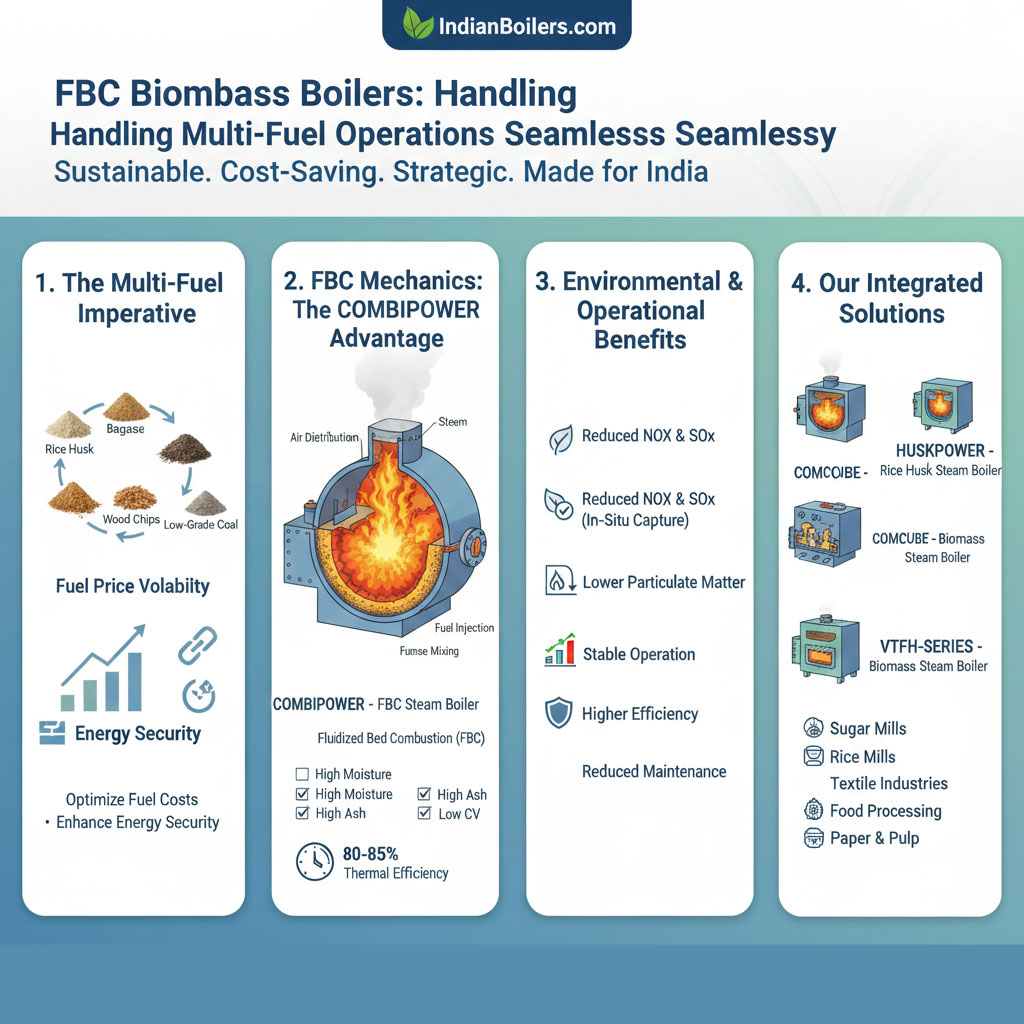
Introduction: One Boiler, Any Fuel, No Compromise
Indian industry runs on unpredictable fuel supply. Rice husk is abundant during the harvest season and scarce afterward. Coal prices swing with global demand. Bagasse is free during crushing season at a sugar mill but unavailable the rest of the year. A boiler built to burn only one fuel is a boiler built to fail the moment that fuel becomes expensive or unavailable.
This is exactly the problem that Fluidized Bed Combustion (FBC) technology was designed to solve. Instead of locking a plant into a single fuel type, FBC boilers create a combustion environment so thermally stable and so efficient at mixing fuel and air that they can burn almost anything solid — rice husk, bagasse, wood chips, briquettes, agro-waste blends, and even low-grade coal — without a drop in performance.
At IndianBoilers.com, our COMBIPOWER – FBC Steam Boiler brings this technology to Indian factories in a rugged, field-proven package. This guide explains how FBC works, why it is uniquely suited to multi-fuel operations, and how to decide whether it’s the right investment for your plant.
1. Why Multi-Fuel Capability Has Become Non-Negotiable
A. The Volatility Problem
Three forces are pushing Indian manufacturers toward multi-fuel boiler systems:
- Price swings – A plant dependent on one fuel has no negotiating leverage. When that fuel’s price spikes, operating costs spike with it.
- Seasonal supply – Agro-residues like bagasse, mustard straw, and cotton stalk are harvested on a calendar, not on demand. A single-fuel boiler sits idle or runs on expensive substitutes in the off-season.
- Regional availability – What’s cheap and abundant in Punjab may be scarce in Gujarat. A boiler that can only burn one specific residue limits where a plant can even be built.
B. What Fuel Flexibility Actually Buys You
- Cost optimization – Always burn whatever is cheapest that week or month.
- Energy security – No single supplier or crop failure can shut down production.
- Lower disposal costs – Multiple agro-wastes can be consumed as they become available, instead of stockpiled or burned in the open.
This is precisely the gap that FBC Biomass Boilers were engineered to close, and it’s why COMBIPOWER has become a go-to choice for plants that refuse to be held hostage by a single fuel source.
2. Inside Fluidized Bed Combustion: How It Actually Works
To understand why FBC handles multiple fuels so well, it helps to understand what makes it fundamentally different from a conventional grate-fired boiler.
A. The Fluidized Bed
At the base of the furnace sits a bed of inert granular material — typically sand or alumina. High-velocity air is forced upward through a specially designed distribution plate beneath this bed. As airflow increases, the solid particles lift, separate, and begin behaving like a turbulent, boiling liquid. This suspended, churning state is what gives the technology its name.
B. Combustion in the Bed
Fuel is fed directly into this fluidized, high-temperature bed, where the constant turbulence produces three critical effects:
- Intense fuel-air mixing — every fuel particle, regardless of size or moisture content, is surrounded by hot bed material and oxygen.
- Excellent heat transfer — the churning bed transfers heat extremely efficiently to the immersed heat-exchange tubes.
- Near-complete combustion — bed temperatures of roughly 800–950°C, combined with long fuel residence time, burn out almost all combustible material, minimizing unburnt losses.
Because FBC operates at far lower temperatures than pulverized-fuel combustion (which can reach 1,500–1,700°C), it avoids many of the problems — like ash slagging and high NOx formation — that plague other combustion methods when fuel quality varies.
3. Why FBC Is Naturally Suited to Multi-Fuel Operation
A. Handles Wide Swings in Fuel Quality
- Variable calorific value — The bed’s large thermal mass acts like a flywheel, smoothing out combustion even when a low-CV fuel like rice husk is swapped for a higher-CV fuel like wood chips.
- High moisture tolerance — The intense heat and turbulence flash off moisture rapidly, so damp or freshly harvested biomass doesn’t choke combustion the way it would in a grate system.
- High ash content — Fuels like rice husk (18–25% ash) would cause slagging in many boiler designs. In an FBC bed, the inert material dilutes and absorbs the ash, so it drains cleanly instead of fusing onto surfaces.
- Abrasive particles — Because combustion happens in a fluid-like suspension rather than direct impact on a grate, abrasive fuels cause far less wear on internal components.
B. Lower Emissions Across Fuel Types
- Reduced NOx — Lower combustion temperatures suppress thermal NOx formation regardless of which fuel is burning.
- In-situ SOx capture — When sulfur-bearing fuel is used, limestone added to the bed reacts with SO₂ directly, cutting sulfur emissions without external scrubbing equipment.
- Lower particulate matter — Complete combustion plus effective multi-cyclone dust collection keeps PM emissions well inside regulatory limits.
C. Operational Stability
- Consistent steam output even as fuel feed quality varies batch to batch.
- Thermal efficiencies of 80–85%, well above typical grate-fired performance.
- Lower maintenance load, since minimal slagging and reduced abrasion extend component life.
- Automated ash handling, reducing manual intervention during continuous operation.
4. COMBIPOWER: Engineered for India’s Fuel Reality
Our COMBIPOWER – FBC Steam Boiler takes these FBC principles and packages them for the specific conditions Indian plants operate under — inconsistent fuel supply, high ash agro-residues, and demanding duty cycles.
Key engineering features:
- Water-tube construction built for durability at high pressure and large-scale steam demand.
- Precision air distribution — nozzles and plates engineered for stable fluidization across different fuel types.
- In-bed heat exchange surfaces that maximize heat recovery directly from the combustion zone.
- Automated multi-fuel feeding systems for continuous operation with minimal manual handling.
- Integrated economisers and air preheaters as standard, adding another 5–10% to overall thermal efficiency.
- Robust ash management for continuous bed-ash and fly-ash removal.
Where COMBIPOWER Fits
| Industry | Typical Fuel | Why COMBIPOWER Works |
|---|---|---|
| Sugar mills | Bagasse | Handles seasonal bagasse volumes for co-generation |
| Rice mills | Rice husk (large scale) | Complements our dedicated HUSKPOWER – Rice Husk Fired Steam Boiler for higher capacity needs |
| Textiles | Wood chips, briquettes | Keeps energy costs stable despite fuel-market swings |
| Food processing | Mixed agro-waste | Reliable steam for cooking, sterilizing, drying |
| Paper & pulp | High steam volumes | Consistent high-output steam generation |
| Chemical plants | Varied solid fuels | Steady thermal supply regardless of fuel batch quality |
5. Building a Complete Biomass Energy Strategy
COMBIPOWER doesn’t have to work alone. Depending on scale and fuel type, it pairs naturally with the rest of our biomass product line:
- HUSKPOWER – Rice Husk Fired Steam Boiler — purpose-built for rice husk at smaller and mid-range capacities.
- COMCUBE – Biomass Steam Boiler — a compact, multi-pass grate-fired option for general agro-waste at smaller capacities.
- VTFH-SERIES – Biomass Fired Hot Water Boiler — for hot water and utility heating needs rather than steam.
Browse the full range under our Steam Boiler and Hot Water Boiler categories, or explore Thermic Fluid Heater and Hot Air Generator options if your process needs go beyond steam and hot water.
If you’d rather explore our complete manufacturing catalogue directly, our sister site Balkrishna Boilers lists the full COMBIPOWER-class range under Steam Boiler, along with related models like HUSKPOWER, COMCUBE, STEAMPOWER, and ENERPOWER. For hot water applications, see VTFH SERIES under the Hot Water Boiler range.
Every biomass system we build also fits within a plant’s broader emissions strategy — for a deeper look at how these choices affect a factory’s carbon footprint, see our related article on Reducing Carbon Emissions with Biomass Fired Steam Boilers. If you’re weighing which biomass fuel makes the most financial sense for your region, our guide comparing Rice Husk vs. Mustard Straw breaks down the ROI differences in detail, and our piece on Multi-Fuel Boilers: The Future of Industrial Heating in India expands on the broader industry shift toward flexible-fuel systems.
6. Emissions Control and Compliance
Multi-fuel operation isn’t just about cost — it’s increasingly a compliance requirement as Indian pollution norms tighten. FBC’s ability to keep NOx, SOx, and particulate output low across varying fuel batches gives plants a built-in advantage when facing inspection or renewal of environmental clearances. For a full breakdown of the control systems (cyclones, bag filters, ESPs) that typically accompany a boiler like COMBIPOWER, see our detailed guide on Biomass Boiler Emission Control Systems.
If your plant already has an FBC or grate-fired system and is troubleshooting inconsistent output, our article on Common Biomass Boiler Problems and Their Solutions covers the most frequent operational issues and how to resolve them.
7. Choosing Between FBC and Grate-Fired Systems
Not every plant needs FBC. Smaller operations with a single, consistent fuel source may be better served by a grate-fired unit like COMCUBE, which costs less upfront and is simpler to operate. FBC earns its premium when:
- Fuel supply genuinely varies month to month or season to season.
- Ash content is consistently high (18%+).
- The plant wants headroom to add or switch fuel types in the future without a boiler replacement.
- Emissions compliance margins need to be wider, not just adequate.
If you’re still deciding on scale before technology, our guide on How to Choose the Right Biomass Boiler Capacity for Your Plant is a useful starting point.
Conclusion: Flexibility Is the New Efficiency
The old model — one boiler, one fuel, hope the price stays low — no longer holds up in a market where fuel costs and availability shift constantly. FBC Biomass Boilers, and specifically our COMBIPOWER – FBC Steam Boiler, give Indian manufacturers the ability to:
- Burn whatever solid fuel is cheapest and most available at any given time.
- Maintain thermal efficiencies of 80–85% regardless of fuel-quality swings.
- Keep NOx, SOx, and particulate emissions within tightening regulatory limits.
- Reduce maintenance costs through minimal slagging and abrasion.
Choosing COMBIPOWER isn’t just a boiler purchase — it’s a hedge against fuel-market volatility and a step toward a more resilient, compliant plant.
Ready to explore whether an FBC multi-fuel boiler is right for your operation?
Contact IndianBoilers.com for a consultation, or explore our full Steam Boiler range and sister-site catalogue at Balkrishna Boilers to compare specifications side by side.