
Introduction: A Quiet Revolution in the Boiler House
Walk into most Indian factories today and you’ll still hear the hiss of a coal-fired grate or smell the faint diesel tang of a furnace oil burner. But a quieter, cleaner shift is underway. Plant managers who once measured performance purely in tonnes of steam per hour are now being asked a different question by their boards, their auditors, and their customers: how clean is your heat?
That single question is pushing electric boilers from a niche laboratory tool into a mainstream industrial heating strategy. Unlike combustion-based systems — even efficient biomass boilers running on agro-waste — electric boilers produce no flame, no flue gas, and no on-site emissions whatsoever. For pharmaceutical plants, food processing units, textile finishing houses, and chemical manufacturers chasing net-zero targets, that’s not a marginal improvement. It’s a fundamentally different category of heating equipment.
At Balkrishna Boilers Pvt Ltd, marketed through IndianBoilers.com and Balkrishn.com, we design and manufacture a complete electric heating portfolio — steam, thermic fluid, hot water, and hot air — built to Indian industrial standards and backed by decades of thermal engineering experience. This guide walks through why electric heating has moved from “alternative” to “default” for a growing number of industries, how the technology actually works, and how to evaluate whether it’s the right fit for your plant.
1. Why Electric Heating Is Having Its Moment
Three forces are converging at the same time, and together they explain why electric boiler enquiries have grown so sharply over the past few years.
A. Net-Zero Commitments Are No Longer Optional
Large manufacturers, and increasingly their mid-sized suppliers, are being asked to report Scope 1 emissions — the direct emissions from fuel burned on-site. A combustion boiler, however efficient, always has a number attached to it. An electric boiler has none at the point of use. As India’s grid mix keeps adding solar, wind, and hydro capacity, that number effectively keeps shrinking every year without the plant doing anything differently — something no fossil-fuel system can claim. Facilities that also install rooftop solar can, in effect, run a genuinely carbon-free boiler house.
B. Compliance Is Getting Stricter, Not Looser
Emission norms for industrial furnaces and boilers have tightened steadily, and enforcement has followed. Combustion systems increasingly need bag filters, scrubbers, ESPs, or cyclone separators just to stay compliant — equipment that adds capital cost, maintenance burden, and floor space. If you’re currently evaluating pollution control equipment such as a bag filter or wet scrubber for an existing combustion system, it’s worth first asking whether an electric unit removes the need for that investment entirely.
C. Electric Boilers Are Simply Easier to Run
Beyond the environmental case, electric heating is operationally attractive on its own merits:
- No fuel storage or handling — no coal yards, no husk silos, no diesel tanks, no ash disposal.
- No combustion safety risk — no flame, no flue gas, no explosion hazard from fuel-air mixtures.
- Faster start-up — many electric units can reach working pressure in minutes rather than the hour-plus warm-up cycle typical of solid-fuel systems.
- Smaller footprint — without a furnace, chimney, or fuel yard, an electric boiler house can fit into far less plant real estate.
- Precision control — electronic thermostats and PLC-based controls hold temperature and pressure within very tight bands, which matters enormously for processes like pharmaceutical sterilization or dye-fixing in textiles.
2. Two Technologies Under One Umbrella: Resistance vs. Induction Heating
Not all electric boilers work the same way, and understanding the distinction helps in choosing the right one.
Resistance Heating
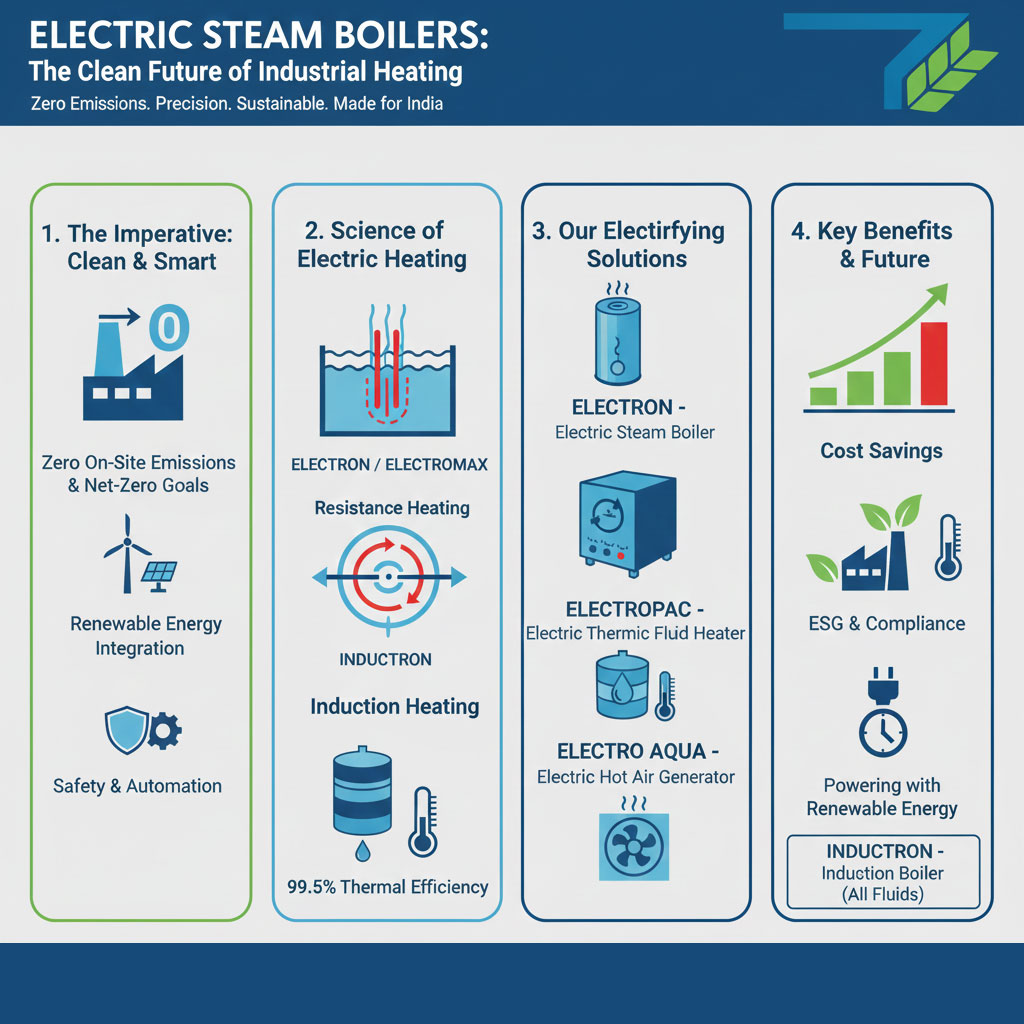
This is the more familiar approach, used in our ELECTRON and ELECTROMAX steam ranges, the ELECTROPAC thermic fluid heater, the ELECTRO AQUA hot water system, and the ELECTROAIR hot air generator. Immersed heating elements convert electrical current directly into heat, which transfers straight into the surrounding water or thermic fluid. It’s a mature, proven, and highly efficient method — resistance-based electric boilers routinely achieve close to 99.5% thermal efficiency, since almost none of the input energy is lost the way it would be up a flue stack.
Induction Heating
Our INDUCTRON induction boiler takes a different route. Rather than immersing a resistance element in the fluid, an electromagnetic coil induces eddy currents in a non-ferrous metallic core, which heats up and transfers that heat to the fluid flowing around it. Because the coil itself never touches the process fluid, there’s no direct scaling on the heating surface, which typically means a longer service life and lower long-term maintenance — a meaningful advantage in hard-water regions where scaling is a persistent headache for conventional systems.
Both approaches sit comfortably alongside the rest of our conventional range — you can browse the full steam boiler, thermic fluid heater, hot water boiler, and hot air generator categories to compare electric options against biomass and multi-fuel equivalents for your specific application.
3. Matching the Right Electric System to Your Process
Every industrial heating requirement is different, and Balkrishna Boilers builds electric variants across the full thermal spectrum.
Steam Generation. For laboratories, hospitals, small pharma batches, and light processing lines, the compact ELECTRON electric steam boiler delivers rapid, high-purity steam from as little as 5 kW upward. When demand scales into higher-pressure, IBR-regulated territory, the ELECTROMAX electric IBR steam boiler — also available as ELECTROMAX on Balkrishn.com — handles continuous industrial duty up to 2,000 kW and beyond, fully certified for heavy use.
Thermic Fluid Heating. Industries like paint manufacturing, chemical processing, and textile dyeing often need precise heat at high temperature without the pressure risks of steam. The ELECTROPAC electric thermic fluid heater (also listed as ELECTROPAC) delivers flameless, uniform heating up to 300°C and beyond, in capacities from 10 kW to 1,000 kW.
Hot Water Generation. Hotels, hospitals, laundries, and process lines needing clean, instant hot water rely on the ELECTRO AQUA electric hot water boiler (also on Balkrishn.com), which produces water up to 90°C in capacities from 5 kW to 500 kW.
Hot Air Generation. Drying, curing, and space-heating applications that can’t tolerate flame contact or combustion by-products are well served by the ELECTROAIR electric hot air generator (also ELECTROAIR), delivering clean, quiet, precisely controlled hot air from 10 kW to 500 kW.
Induction-Based Steam and Thermic Fluid. Where longevity and minimal scaling matter most, the INDUCTRON induction boiler — also available as INDUCTRON — can be configured for either steam or thermic fluid duty, and is fully customizable to capacity.
You can explore the complete electric range on either site: Electric Boiler category on IndianBoilers.com or Electric Boiler range on Balkrishn.com, including the ELECTRON model for smaller applications.
4. What to Check Before You Switch to Electric
Electric heating isn’t a drop-in replacement for every plant, and a good supplier will walk you through the trade-offs honestly before quoting a system.
Electrical Infrastructure
The single biggest question is whether your plant’s electrical supply — transformer capacity, switchgear, and cabling — can support the boiler’s load. Larger electric systems, particularly IBR-rated steam units, can require a genuine power infrastructure upgrade. This is worth assessing early, ideally alongside your electrical contractor and your boiler supplier together, rather than after equipment has already been ordered.
The Electricity Cost Question
Per unit of energy, electricity is usually more expensive than coal, biomass, or furnace oil. That’s the honest trade-off. But the comparison isn’t just fuel cost versus fuel cost — it has to include the near-99.5% thermal efficiency, the elimination of fuel handling labour, the removal of ash disposal and emissions-control costs, and generally lower maintenance overhead. For smaller and mid-sized loads, especially where continuous fuel supply chains (like husk or briquette logistics) are already a headache, the total cost of ownership often narrows the gap considerably, or even favours electric outright.
Water Treatment Still Matters
It’s a common misconception that electric boilers eliminate the need for water treatment. They don’t. Resistance-element systems in particular remain vulnerable to scaling on the heating surface, exactly like any other steam or hot water boiler, and untreated feedwater will shorten element life. Even induction systems, which resist scaling on the core itself, still need properly treated water to protect the broader piping and system components.
Sourcing Genuinely Clean Power
An electric boiler is only as clean as the electricity feeding it. Plants drawing purely from a coal-heavy grid still cut on-site emissions but haven’t fully decarbonized their heat. Pairing an electric boiler with rooftop solar, a renewable power purchase agreement, or simply a grid that’s steadily greening over time is what turns “zero on-site emissions” into genuine, verifiable decarbonization.
5. Electric Heating in the Context of a Broader Fuel Strategy
Very few plants make an overnight, all-or-nothing switch. In practice, most of our clients run electric units alongside conventional systems — using electric boilers for smaller, precision-critical loads (like a pharma clean-steam requirement or a lab-scale thermic fluid circuit) while continuing to rely on biomass or multi-fuel boilers for their bulk process steam. If you’re weighing fuel flexibility more broadly, our guide on multi-fuel boilers and the future of industrial heating in India covers how hybrid fuel strategies are playing out across Indian industry, and our piece on why electric boilers are the best choice for low-emission plants goes deeper into the emissions-compliance angle specifically.
For plants in regulated sectors, it’s also worth reading our sector-specific breakdown of the best boiler choices for textile, pharma, and food industries, since the right electric or hybrid configuration often depends heavily on the process itself rather than a one-size-fits-all recommendation.
Digitalization is another thread worth pulling on. Electric systems pair particularly well with modern monitoring — our article on digital twin technology for boiler efficiency and reliability explains how real-time simulation is helping plants extract more performance from precisely the kind of electronically controlled systems that electric boilers represent, and our note on smart sensors in thermic fluid heaters is directly relevant if you’re considering the ELECTROPAC or INDUCTRON thermic fluid ranges.
6. Frequently Asked Questions
Are electric boilers suitable for continuous, heavy industrial duty? Yes. The ELECTROMAX electric IBR steam boiler is purpose-built for continuous operation at higher pressures and larger capacities, meeting IBR certification requirements for heavy industrial use.
Do electric boilers need less maintenance than combustion boilers? Generally, yes — there’s no fuel handling system, no ash removal, no burner servicing, and no flue-gas path to clean. Induction models like INDUCTRON reduce maintenance further by avoiding direct scaling on the heating surface.
Can an electric boiler replace my existing biomass or coal-fired system entirely? It depends on load size, available power infrastructure, and electricity cost in your region. Many plants use electric units for smaller or precision loads while retaining combustion systems for bulk steam demand — our team can help model this out for your specific site.
What’s the typical capacity range available? Across our range, capacities span from around 5 kW (compact steam, hot water) up to 2,000 kW and beyond for IBR-rated steam systems, with thermic fluid and hot air units customizable in between.
Conclusion: Electrifying Industrial Heat, One Process at a Time
The move toward electric boilers isn’t a passing trend driven by regulation alone — it’s a genuine operational upgrade for the industries that adopt it thoughtfully. Zero on-site emissions, near-99.5% efficiency, minimal footprint, and precision control are advantages that stand on their own, even before counting the sustainability benefit.
At Balkrishna Boilers Pvt Ltd, we manufacture the full electric spectrum — ELECTRON for compact steam, ELECTROMAX for IBR-rated industrial steam, ELECTROPAC for thermic fluid, ELECTRO AQUA for hot water, ELECTROAIR for hot air, and INDUCTRON for advanced induction heating — engineered in Ahmedabad and installed across India and overseas.
Ready to explore whether electric heating fits your process? Get in touch with our team at IndianBoilers.com or reach out via Balkrishn.com for a consultation tailored to your plant’s load, infrastructure, and sustainability goals.