
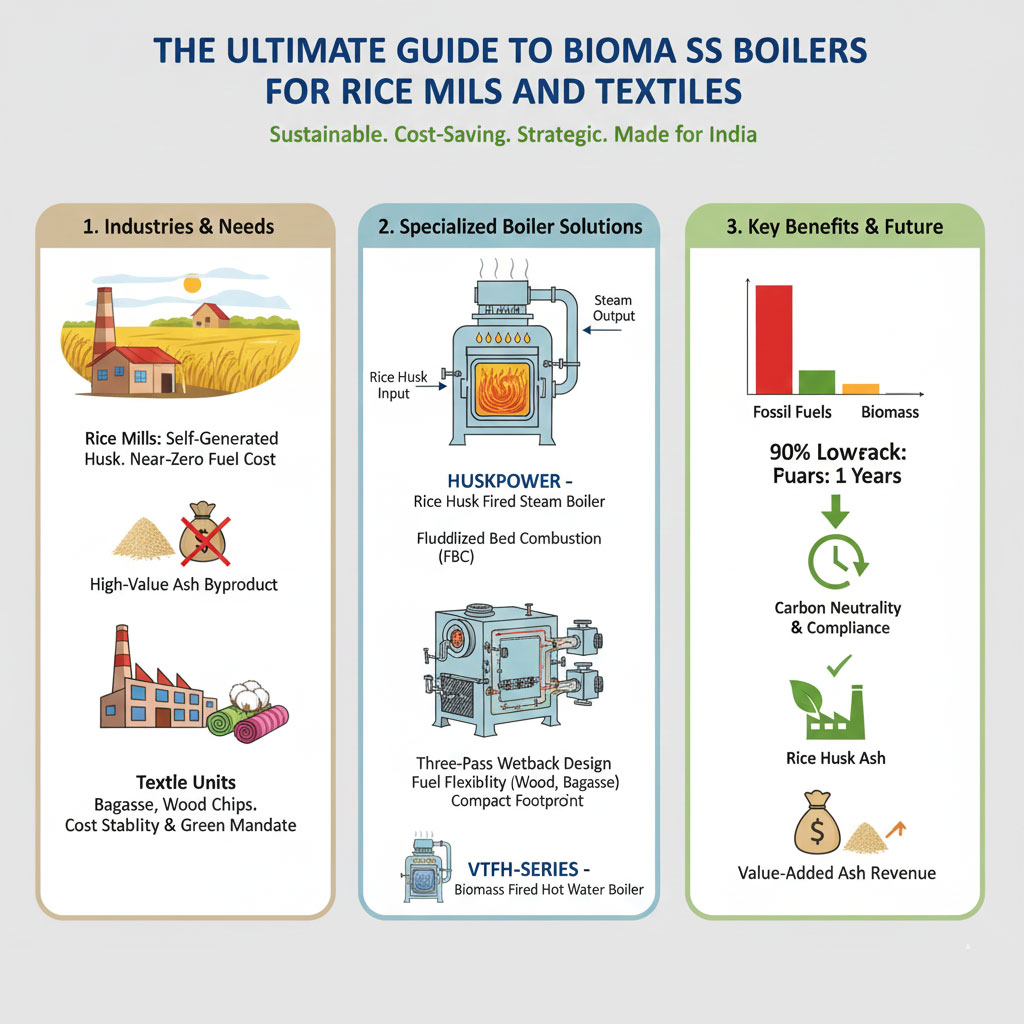
India’s rice milling and textile processing industries run on the same lifeline: a constant, dependable supply of steam. Whether it is parboiling paddy at a mill in Gujarat or dyeing fabric at a processing unit in Tamil Nadu, steam cost is one of the biggest line items on the balance sheet. For decades, that steam came from coal or diesel-fired boilers — fuels that are getting more expensive, more regulated, and harder to justify every year.
That is exactly why biomass-fired steam boilers have become the default choice for forward-looking rice mills and textile units across the country. At Balkrishna Boilers Pvt Ltd, we design and manufacture dedicated biomass steam boilers for exactly this purpose, and this guide walks through why the switch makes sense, which technology fits which industry, and how to choose the right system for your plant.
1. Why Rice Mills and Textile Units Both Depend on Biomass Steam
At first glance, a rice mill and a textile dyeing unit look nothing alike. But both share three characteristics that make biomass the natural fuel choice:
- High, continuous steam demand — parboiling, drying, sizing, dyeing, and finishing all run for long hours, every day of the year.
- Thin operating margins — fuel is often the second-largest cost after raw material, so any saving drops straight to profit.
- Access to agro-residue — rice husk, bagasse, wood chips, and biomass pellets are locally available, renewable, and dramatically cheaper than coal or furnace oil.
The table below summarises how the two sectors typically use steam and which fuel suits them best.
| Sector | Primary Steam Application | Best-Fit Fuel | Why It Matters |
|---|---|---|---|
| Rice Mills | Parboiling, drying, tempering, conditioning | Rice husk (self-generated) | Converts a waste disposal cost into a near-zero fuel cost |
| Textile Units | Dyeing, sizing, printing, stenter finishing | Bagasse, wood chips, pellets, briquettes | Keeps energy cost stable and meets export-market sustainability norms |
Because rice mills already generate husk as a milling by-product, the fuel decision is almost automatic. Textile units, on the other hand, usually source biomass from nearby sugar mills, agro-processors, or pellet suppliers — which is why fuel flexibility matters more for them than for rice mills. We cover this comparison in more depth in our post on Rice Husk vs. Mustard Straw: Which Biomass Fuel Offers Better ROI for Indian Factories? and in Biomass Pellet vs. Biomass Briquette: Which Fuel Gives Better Boiler Performance?
2. Rice Mills: Turning Husk Into Nearly Free Steam
The Economics Are Simple
Every tonne of paddy milled produces roughly 200–220 kg of rice husk. Most mills without a dedicated boiler either sell this husk cheaply or pay to dispose of it. A rice-husk-fired boiler flips that equation: the “waste” becomes the primary fuel, and the disposal cost disappears entirely. For many mills, this brings the effective fuel cost close to zero, and payback on the boiler investment is often achieved in a single milling season.
The Silica Ash Challenge
Rice husk is not an easy fuel to burn. It contains 18–25% silica ash, which is abrasive and prone to fusing into slag at high combustion temperatures. A boiler not designed for husk will clog, erode, and shut down frequently — which is why generic multi-fuel boilers underperform badly on this fuel.
How HUSKPOWER Solves It
Our HUSKPOWER – Rice Husk Fired Steam Boiler (listed under balkrishn.com’s HUSKPOWER series) is purpose-built around the husk-combustion problem:
- Fluidized Bed Combustion (FBC): A turbulent bed of inert sand keeps combustion temperatures in the 800–900°C range — hot enough for complete burnout, cool enough to avoid ash fusion.
- Controlled air staging: Precisely metered primary and secondary air limits fly-ash carryover and reduces tube erosion, extending boiler life significantly.
- Marketable ash by-product: The resulting Rice Husk Ash (RHA) is high-purity silica, which many mills sell on to the cement and construction industry — turning an old disposal problem into a small secondary revenue stream.
For mills weighing husk against other locally available residues, our guide on Best Biomass Fuels for Reciprocating Grate Boilers is a useful companion read.
3. Textile Units: Flexibility, Compact Footprint, and Steady Steam Pressure
A Different Set of Priorities
Textile processing units rarely generate their own fuel the way rice mills do. Instead, they need a boiler that can run efficiently on whatever biomass is locally cheapest — bagasse in sugarcane belts, wood chips near forestry hubs, or pellets/briquettes where agri-residue aggregation is well organised. Steam pressure also needs to stay steady through dyeing and finishing cycles, since fluctuations directly affect fabric quality.
The COMCUBE Advantage
Our COMCUBE – Biomass Steam Boiler (also available as COMCUBE on balkrishn.com) is engineered specifically for this fuel-flexible, space-constrained use case:
- Three-pass, fully wetback design: Maximises heat-transfer surface area, typically pushing thermal efficiency above 80%, while the wetback furnace minimises radiant heat loss.
- Robust, adaptable grate: Handles medium-density biomass — briquettes, pellets, chopped wood — so the plant can always switch to whichever fuel is cheapest that season.
- Compact footprint: Fits into the tight boiler-house space typical of textile industrial estates without sacrificing output.
Textile clusters that also run auxiliary thermal-oil processes for stenter machines may want to pair this with our Thermic Fluid Heater range — see also balkrishn.com’s Thermic Fluid Heater series for models like DELTAPAC and THERMPAC.
4. Don’t Overlook Hot Water Requirements
Steam gets most of the attention, but both sectors also consume significant hot water — rice mills for conditioning and washing, textile units for lower-temperature dyeing baths and general utility heating. Running these loads off a steam boiler through a heat exchanger adds cost and complexity.
Our VTFH-SERIES – Biomass Fired Hot Water Boiler (also listed as VTFH SERIES on balkrishn.com) generates hot water directly from biomass, removing the need for a separate heat-exchange loop and cutting both capital cost and ongoing losses. Browse the full range under our Hot Water Boiler category, or the equivalent Hot Water Boiler section on balkrishn.com, which also includes AQUAJET, AQUAMAX, and VST SERIES models.
5. Sizing the Right Boiler for Your Plant
Undersizing leaves you short of steam during peak production; oversizing wastes capital and runs inefficiently at partial load. Before finalising a boiler, plants should map out:
- Peak steam demand across all connected process loads, not just the average.
- Fuel moisture content, since wetter biomass reduces effective calorific value — our post on Fuel Moisture vs Boiler Efficiency explains this trade-off in detail.
- Future expansion plans, so the boiler house has room to scale without a full replacement.
For a step-by-step approach, see our detailed guide: How to Choose the Right Biomass Boiler Capacity for Your Plant.
6. Heat Recovery: Squeezing Out the Last 5–10% Efficiency
Every HUSKPOWER and COMCUBE installation can be fitted with an economiser and air preheater to recover heat from flue gas before it exits the stack. This typically lifts overall thermal efficiency by an additional 5–10%, which compounds meaningfully over a year of continuous operation — and directly reduces both fuel bills and carbon emissions. We cover the emissions side of this in our related article, Reduce Carbon Emissions with Biomass Fired Steam Boilers in 2025.
7. The Financial Case: Fast Payback, Long-Term Protection
| Benefit | Rice Mills | Textile Units |
|---|---|---|
| Fuel cost | Near-zero (self-generated husk) | Low, stable (local agro-waste) |
| Typical payback | Often within one milling season to 2 years | Typically 1–2 years |
| Additional revenue | Sale of Rice Husk Ash (RHA) | N/A |
| Regulatory upside | Avoids husk-burning/landfill penalties | Meets buyer/export sustainability audits |
Beyond the direct fuel savings, biomass boilers insulate a plant from future carbon taxes, coal price volatility, and tightening pollution norms — a point we expand on in Government Subsidies for Biomass Fired Steam Boilers in India, which many rice mills and textile units can also tap into to further shorten payback.
8. Emission Control: Meeting Pollution Norms Without Compromise
Biomass combustion still generates particulate matter, which state pollution control boards regulate closely. Both HUSKPOWER and COMCUBE systems can be paired with appropriate control equipment — multi-cyclones, bag filters, or wet scrubbers depending on plant size and local norms. If you’re evaluating add-on emission control systems, our guide Biomass Boiler Emission Control Systems: A Complete Guide breaks down which system fits which boiler size, and balkrishn.com’s Pollution Control Equipment range — including BAG FILTER, ESP, FGD, and WET SCRUBBER units — lists the hardware options directly.
9. Choosing Between HUSKPOWER and COMCUBE: A Quick Decision Guide
- Choose HUSKPOWER if: your plant is a rice mill (or co-located agro-processor) with a steady in-house supply of rice husk and you want the lowest possible fuel cost.
- Choose COMCUBE if: your plant is a textile unit, food processor, or general industrial facility that needs to burn whichever biomass is cheapest and most available at any given time, in a compact boiler house.
- Add VTFH-SERIES if: your process also needs a dedicated hot water stream alongside steam.
Many multi-process plants — those handling textile, pharma, or food operations together — actually benefit from combining more than one of these systems. Our article Best Boiler for Textile, Pharma, and Food Industry: An Industry-wise Guide goes deeper into these combinations, and Boiler Selection for Food Processing Units is a useful reference for mills that also run food-processing lines.
Conclusion: A Strategic, Not Just Operational, Decision
For rice mills, a HUSKPOWER boiler converts a waste-disposal headache into one of the cheapest fuel sources in Indian industry. For textile units, a COMCUBE boiler delivers the fuel flexibility and steady steam pressure that dyeing and finishing operations demand — all while meeting the sustainability expectations of global buyers.
Whichever fuel or fabrication your plant runs on, the underlying logic is the same: biomass steam is cheaper, more stable, and better positioned for the regulatory environment India is heading into. Explore our complete Steam Boiler range, or view the equivalent Steam Boiler category on balkrishn.com — which also includes COMBIPOWER, ENERPOWER, PELLETAX, STEAMAX, and STEAMGEN models for other fuel and capacity requirements.
Ready to size the right biomass boiler for your rice mill or textile unit? Contact IndianBoilers.com today for a consultation tailored to your fuel source, steam demand, and plant layout.