
Every plant head who has signed a fuel purchase order in the last three years already knows the pattern: the coal truck arrives a little later than promised, the rate on the invoice has crept up again, and the diesel-fired standby boiler is only switched on when there is absolutely no alternative — because running it feels like burning currency notes in the furnace. Fuel is no longer a background cost in Indian manufacturing; for most process industries it is now the single largest line item on the factory’s monthly expense sheet, often larger than power, water and maintenance combined.
That is precisely why rice husk fired boilers have moved from being a “rice mill specialty” to becoming the default recommendation for textile units, food processing plants, chemical units, dyes and pharma intermediates manufacturers, and dozens of other industries across Gujarat, Punjab, Haryana, Andhra Pradesh and Chhattisgarh. Husk is abundant, it is priced in rupees per kilogram rather than dollars per barrel, and it does not carry the same regulatory pressure that coal now faces.
This guide walks through the three numbers that actually decide a boiler purchase — operating cost, maintenance load, and payback period — using real-world ranges from installations across India, not brochure claims. If you are evaluating a new steam generation system, or wondering whether it is time to retire an ageing coal fired boiler or diesel/oil fired boiler, this is the comparison to read before you approach any vendor.
Why This Comparison Matters More in 2026 Than Ever Before
Three forces have converged on Indian industrial boiler owners:
- Fossil fuel volatility. Coal linkage supply is inconsistent for smaller consumers, forcing many plants onto the open e-auction market where prices swing sharply with each cycle. Furnace oil and HSD track international crude, which nobody in a factory can control or forecast.
- Tightening emission norms. State Pollution Control Boards are steadily lowering permissible particulate matter and SOx limits for coal-fired units, which pushes up compliance capital expenditure for ESPs, bag filters and FGD systems.
- Biomass availability and policy support. Agricultural residue utilisation is being actively encouraged, and husk, in particular, is a genuinely carbon-neutral, locally sourced fuel with year-round availability near most rice-growing belts.
Put together, these three trends explain why husk-fired steam generation, once seen mainly in rice mills that had husk as a free by-product, is now being specified by plants that have to purchase their husk and still find it economically superior to coal or diesel.
Section 1: Operating Cost — Where the Real Money Is Won or Lost
Operating cost has three components that matter for a fair comparison: fuel cost, auxiliary power consumption (APC), and manpower. Fuel dominates by a wide margin, but the other two shift the picture enough to be worth understanding before you finalise a boiler type.
1.1 Fuel Cost Per Tonne of Steam
Take a common reference case: a 4 TPH boiler running 20 hours a day for 300 days a year, producing roughly 24,000 tonnes of steam annually. The table below uses representative Indian market fuel prices; your actual landed rate will vary by state, season and freight distance.
| Parameter | Rice Husk (Biomass) | Non-Coking Coal | Furnace Oil / HSD |
|---|---|---|---|
| Typical fuel price | ₹1,000–2,000/tonne (near-zero for rice mills using own husk) | ₹8,000–12,000/tonne | ₹50–70/litre |
| Thermal efficiency | 75–80% | 70–75% | 85–90% |
| Fuel consumption per TPH steam | ~270–300 kg | ~150–180 kg | ~80–90 litres |
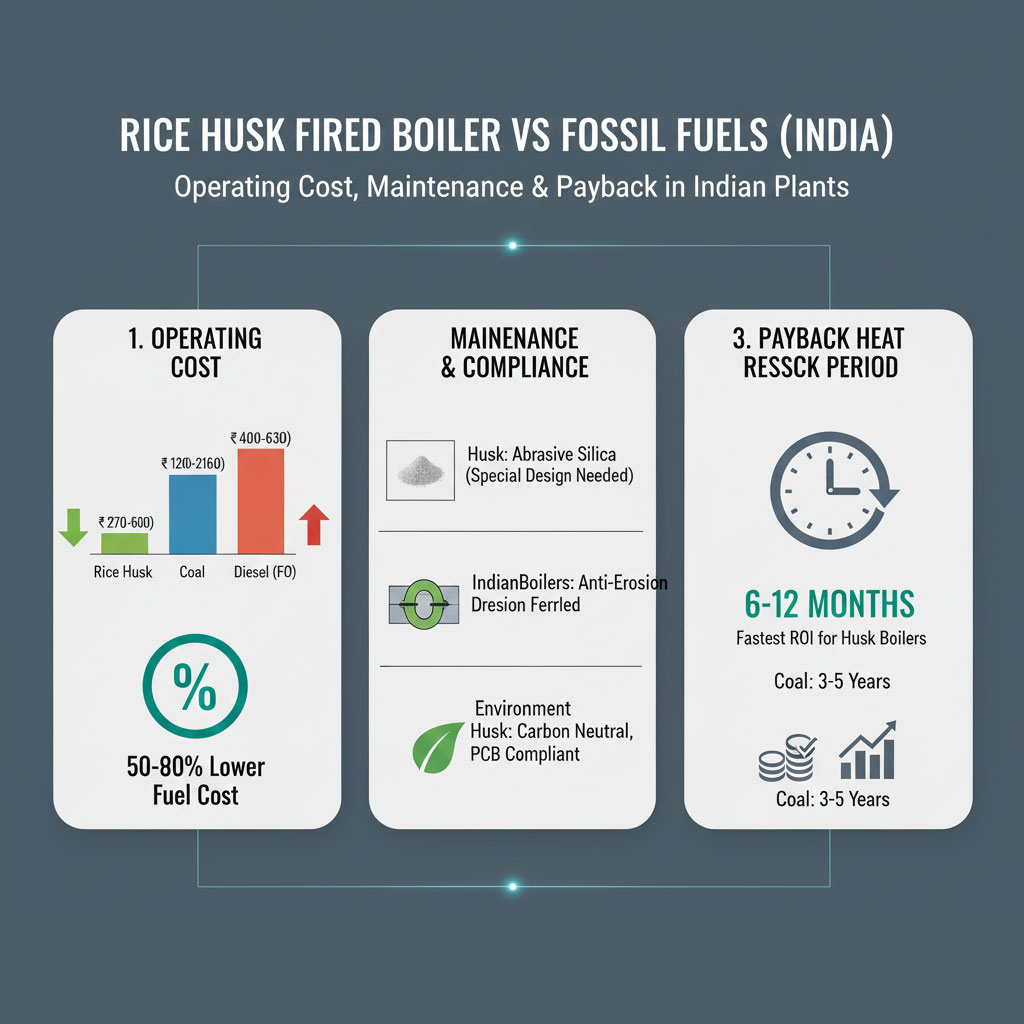
| Fuel cost per TPH steam | ₹270–600 | ₹1,200–2,160 | ₹4,000–6,300 |
| Annual fuel cost (24,000 T steam) | ₹65 Lacs – 1.44 Cr | ₹2.88 Cr – 5.18 Cr | ₹9.6 Cr – 15.12 Cr |
Even at the upper end of husk pricing, annual fuel expenditure on a husk-fired system runs 50–90% lower than coal, and a fraction of what a diesel/furnace-oil boiler would cost to run continuously. For a rice mill or agro-processing unit that generates its own husk as a by-product, fuel cost approaches zero — the boiler effectively converts a waste stream into usable steam.
This is the single biggest reason plants request a detailed quote for a Rice Husk Fired Steam Boiler — sometimes sold under the HUSKPOWER range on balkrishn.com — before even shortlisting coal-based alternatives.
1.2 Auxiliary Power Consumption (APC)
Fuel cost is only half the operating-cost picture. Auxiliary power — the electricity consumed by ID/FD fans, feeders and conveying systems — behaves differently across the three fuels:
- Rice husk needs higher APC because pneumatic or screw conveying systems move bulky, low-density fuel into the furnace, and larger ID/FD fans are required to handle the higher flue gas volume that biomass combustion produces.
- Coal sits in the middle — moderate APC for feeders and draft fans, lower than husk but higher than oil.
- Diesel/furnace oil has the lowest APC of the three, since fuel is pumped rather than mechanically conveyed, and air requirements are comparatively modest.
In practice, the extra electricity a husk system draws is a rounding error next to the fuel savings it delivers. Many plants go a step further and pair their husk boiler with a back-pressure turbine to generate captive power from the same steam flow, effectively neutralising the APC difference — sometimes turning the boiler house into a net power contributor rather than a consumer.
1.3 Manpower
- Rice husk systems with automatic pneumatic or screw feeding, plus automated ash handling, need minimal manual fuel-loading labour once commissioned.
- Older coal-fired boilers with manual stoking and ash removal are far more labour-intensive; modern AFBC coal boilers automate much of this but still lag husk systems in labour efficiency.
- Diesel-fired boilers need the least manpower of all three, since there is no solid fuel handling at all.
Across all three cost components, the conclusion is consistent: fuel savings on husk overwhelm the modest APC and manpower disadvantages, and the net operating cost advantage is large enough to change capital allocation decisions across an entire plant.
Section 2: Maintenance and Operational Realities
Cheaper fuel means nothing if the boiler spends half the year in the workshop. Maintenance load differs meaningfully across fuel types, and this is where boiler design quality — not just fuel choice — starts to matter.
2.1 Ash Handling and Tube Erosion
Rice husk produces a high volume of silica-rich ash that is more abrasive than coal ash. Left unmanaged, this abrasiveness accelerates tube wear in the convection zone and increases the frequency of tube cleaning. This is the one area where a poorly engineered husk boiler can genuinely underperform a coal unit.
The fix is design, not fuel avoidance: boilers built specifically for Indian husk — with robust Multi-Cyclone Dust Collectors (MCDC), anti-erosion ferrules on vulnerable tube banks, and carefully controlled flue gas velocity — bring erosion and ash-related downtime down to levels comparable with, or better than, a coal-fired unit. This is exactly the engineering approach covered in more depth in our guide on Husk Fired Boiler Efficiency: How to Achieve Stable Steam, Lower Fuel Cost & Cleaner Combustion.
| Factor | Rice Husk Boiler | Coal Boiler | Diesel Boiler |
|---|---|---|---|
| Ash handling | High volume, abrasive silica ash — needs MCDC + tube protection | High volume, less abrasive | Minimal — easiest to manage |
| Tube erosion risk | Higher if not engineered correctly; well-controlled in purpose-built husk boilers | Moderate | Very low |
| Scaling/sooting | Low with good water treatment; regular soot blowing needed | Moderate; regular soot blowing | Low, easiest to clean |
| Refractory life | Good with proper operation despite high furnace temperature | Good | Excellent |
2.2 Environmental Compliance
- Rice husk is carbon-neutral, produces minimal SOx, and its NOx and particulate output is easily managed with an MCDC — keeping it comfortably within current and upcoming emission norms.
- Coal carries high CO2, SOx, NOx and particulate loads, and increasingly requires expensive pollution control add-ons — ESP or bag filters, and sometimes FGD — to stay compliant, particularly for larger-capacity units.
- Diesel/furnace oil produces moderate emissions and is usually easier to keep compliant for smaller units, but it remains a fossil fuel exposed to future regulatory tightening.
For plants that want to go further on emissions control, it’s worth reading our dedicated breakdown of Biomass Boiler Emission Control Systems: A Complete Guide, which covers MCDC, bag filter and ESP selection in detail.
If your maintenance team is troubleshooting an existing biomass system rather than specifying a new one, our practical guide to Common Biomass Boiler Problems and Their Solutions is a useful companion to this article.
Section 3: Payback Period — The Number That Actually Closes the Deal
Everything above feeds into one decision-making number: how quickly does the additional or comparative investment pay for itself?
3.1 Indicative Capital Cost (4 TPH Boiler)
| Boiler Type | Indicative Capital Cost |
|---|---|
| Rice Husk Fired Boiler | ₹80 Lacs – 1.2 Crore |
| Coal Fired Boiler | ₹70 Lacs – 1.1 Crore |
| Diesel Fired Boiler | ₹60 Lacs – 90 Lacs |
Capital cost varies with automation level, working pressure, and the specific ash/erosion-control features built into the design, so treat these as planning ranges rather than quotations.
3.2 Working Out the Payback
Consider a rice mill using its own husk (effectively zero fuel cost) evaluating a husk boiler against buying a new coal-fired unit instead:
- Annual fuel savings (husk vs coal): roughly ₹2.88 Cr – ₹5.18 Cr, drawn straight from the fuel cost table in Section 1.
- Incremental capital cost of the husk boiler over coal: roughly ₹10 Lacs, reflecting the extra investment in feeding and ash-handling systems.
Set those two numbers against each other and the answer is stark: the incremental capital is typically recovered in as little as 6 months to 1 year. Even plants that must purchase husk on the open market — rather than generate it as a by-product — generally see payback within 1 to 2 years, which is still fast by industrial capital equipment standards.
For plants comparing husk against other agricultural residues rather than against coal, our article on Rice Husk vs Mustard Straw: Which Biomass Fuel Offers Better ROI for Indian Factories? extends this same payback logic to a second fuel option. And if you’re weighing husk against pellets or briquettes rather than raw husk, see Biomass Pellet vs. Biomass Briquette: Which Fuel Gives Better Boiler Performance?
Section 4: Which Boiler Actually Fits Your Plant?
Cost comparisons are useful, but the right choice still depends on your plant’s specific fuel access, load pattern and compliance situation. A few quick decision pointers:
- You run a rice mill or agro-processing unit with husk as a by-product — a husk boiler is close to a non-negotiable choice; fuel cost is near zero and payback is measured in months.
- You currently run coal and face rising e-auction prices or looming ESP/FGD upgrade costs — this is exactly the situation where switching to husk delivers the fastest ROI, even after paying market rates for husk.
- You run diesel or furnace oil purely as backup/standby capacity — it will remain the easiest to operate, but for continuous, high-volume steam demand it is the most expensive option by a wide margin and should not be your primary steam source.
- You need multiple fuel flexibility because husk supply fluctuates seasonally in your region — look at a multi-fuel boiler configuration that can switch between husk, briquettes or coal as availability and pricing shift.
- You’re in food processing, textile, pharma or a similarly compliance-sensitive sector — our Boiler Selection for Food Processing Units and Best Boiler for Textile, Pharma, and Food Industry guides walk through fuel and hygiene considerations specific to those industries.
Across all of these scenarios, the underlying steam-generation technology matters as much as the fuel choice. Explore the full Steam Boiler range to compare capacities and configurations, or browse husk-specific engineering in our Husk Fired Boiler category and broader Biomass Boiler category. On the Balkrishna Boilers product catalogue, the equivalent range sits under Steam Boiler, with the husk-specific HUSKPOWER series detailed at balkrishn.com/huskpower.php.
Section 5: Total Cost of Ownership Over a 10-Year Horizon
Payback period tells you how fast the investment turns positive; total cost of ownership (TCO) tells you how much that decision is worth over the full life of the asset. Boilers are typically designed for 15–25 years of service, so it is worth extending the comparison beyond year one.
5.1 Cumulative Fuel Spend
Using the same 4 TPH reference case and holding fuel prices constant for simplicity (in reality, coal and diesel prices tend to rise faster than husk over a decade, which only widens this gap further):
| Boiler Type | Annual Fuel Cost (mid-range) | 10-Year Cumulative Fuel Cost |
|---|---|---|
| Rice Husk Fired Boiler | ~₹1.0 Crore | ~₹10 Crore |
| Coal Fired Boiler | ~₹4.0 Crore | ~₹40 Crore |
| Diesel/Oil Fired Boiler | ~₹12.4 Crore | ~₹124 Crore |
Even accounting for a higher initial capital outlay and periodic maintenance spend on ash-handling systems, a husk-fired boiler’s 10-year fuel bill can be ₹25–30 Crore lower than an equivalent coal installation, and well over ₹100 Crore lower than running on diesel or furnace oil continuously. Very few plant-level capital decisions carry this scale of long-term financial impact.
5.2 Regulatory Risk Over the Asset’s Life
A boiler purchased today will still be running when emission norms tighten further. Coal-fired systems face a realistic possibility of retrofit costs for ESP upgrades, bag filter replacement, or FGD installation somewhere in their operating life, especially as State Pollution Control Boards continue revising particulate and SOx limits downward. A husk-fired system, being carbon-neutral with comparatively simple particulate control needs, carries materially lower regulatory retrofit risk across the same time horizon — a factor that rarely appears in a first-year payback calculation but matters enormously to a CFO signing off on a 15-year asset.
5.3 Fuel Security
Coal linkage supply for smaller industrial consumers has historically been inconsistent, pushing many plants onto the open e-auction market where both price and availability fluctuate. Diesel and furnace oil track international crude prices, which are entirely outside any plant’s control. Rice husk, by contrast, is sourced locally near rice-growing belts, with supply chains that are shorter, more numerous, and less exposed to global commodity shocks. For plants located within reasonable trucking distance of paddy-processing regions — much of Gujarat, Punjab, Haryana, West Bengal, Andhra Pradesh and Chhattisgarh — husk availability is rarely the constraint that price alone might suggest.
Frequently Asked Questions
Is a rice husk fired boiler suitable for plants that don’t generate their own husk? Yes. Even at open-market husk prices of ₹1,000–2,000 per tonne, fuel cost per tonne of steam remains a fraction of coal or diesel, and payback typically stays within 1–2 years.
Does a husk boiler need more maintenance than a coal boiler? Ash volume and abrasiveness are higher with husk, but a boiler engineered specifically for Indian husk — with proper MCDC, anti-erosion ferrules and flue gas velocity control — brings maintenance load down to levels comparable with a well-run coal-fired unit.
Can a husk boiler meet current pollution control norms without heavy additional investment? Generally yes. Husk combustion is carbon-neutral with minimal SOx, and particulate levels are controlled effectively with a properly sized MCDC — far less capital-intensive than the ESP/bag filter/FGD stack often required for coal compliance.
What capacity range is typically used for this cost comparison? The numbers in this guide are based on a 4 TPH boiler running 20 hours/day, 300 days/year. Larger or smaller capacities scale proportionally, but the relative cost advantage of husk over coal and diesel holds across the typical industrial range.
Should I choose husk, coal, or diesel if I only need standby/backup capacity? Diesel or furnace oil remains the simplest choice for occasional standby use, given its low APC and minimal ash handling. For any boiler running as the primary, continuous steam source, husk (or another biomass fuel) is almost always the stronger economic choice.
The Bottom Line
Coal and diesel built the backbone of Indian industrial steam generation for decades, but the economics have shifted decisively. On fuel cost, rice husk wins by a wide margin. On maintenance, a well-engineered husk boiler closes the gap that raw ash abrasiveness would otherwise create. And on payback, the numbers are hard to argue with — often under a year, rarely more than two.
If you’re evaluating a new installation or planning to replace an ageing coal or diesel unit, the next step is a plant-specific financial projection rather than generic ranges. Contact the Indianboilers.com engineering team for a tailored cost and payback estimate for your exact capacity, fuel access and compliance requirements, or explore the complete Rice Husk Fired Steam Boiler specifications to see how the design addresses the ash and erosion challenges covered in this guide.
Related reading: From Waste to Power: How Husk Fired Boilers Cut Your Fuel Bill | Digital Twin Technology: Revolutionizing Boiler Efficiency and Reliability | How AI and IoT Are Transforming Biomass Boiler Operations in 2026