
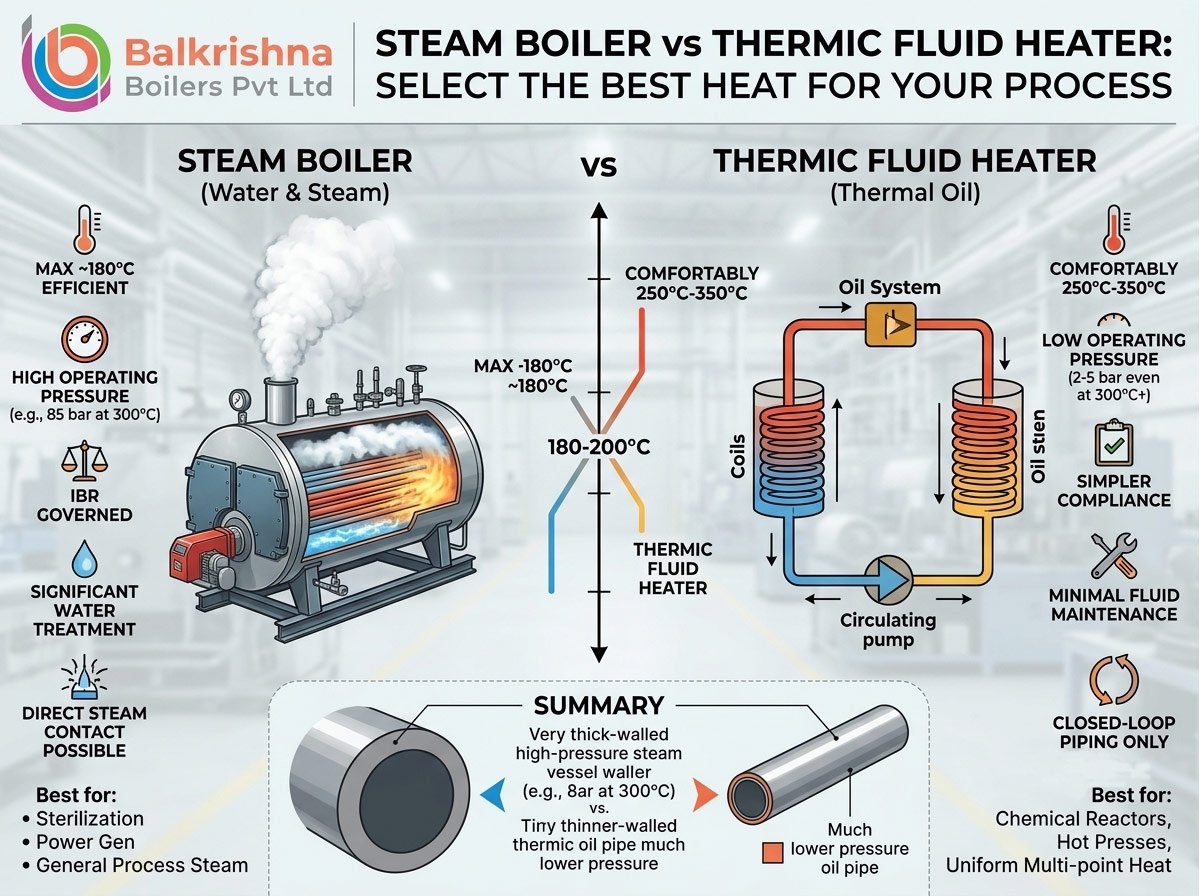
It’s one of the most common questions we field at Balkrishna Boilers Pvt Ltd: “Should this process run on a thermic fluid heater or a steam boiler?” Both technologies deliver reliable industrial heat, both have decades of proven use across Indian manufacturing, and both show up across the same industries — textiles, chemicals, food processing, pharma. But they solve the heating problem in fundamentally different ways, and picking the wrong one for your process temperature and load profile has real cost and safety consequences down the line.
This guide breaks down exactly how the two technologies differ, where each one wins, and how to make the call for your specific process — without the sales pitch either way, since we manufacture both.
The Fundamental Difference: What Each System Actually Heats
A steam boiler heats water past its boiling point to generate steam, which carries thermal energy to the process and condenses back to water after releasing its heat. It’s the technology most people picture when they think “boiler” — a pressure vessel generating steam for everything from sterilization to power generation. Our guide on industrial uses of steam boilers and how they work covers the full mechanics of this cycle, from feedwater treatment through to condensate return.
A thermic fluid heater takes a different approach entirely: instead of generating steam, it heats a specialized heat-transfer oil (thermic fluid) in a closed loop, circulating that hot fluid to process equipment via heat exchangers rather than through direct steam contact. We’ve explained this mechanism step by step in our guide on what a thermic fluid heater is and how it works.
The distinction isn’t cosmetic — it changes the entire pressure and temperature relationship the system operates under, which is the real driver of every practical decision that follows.
Why Pressure Is the Real Story Here
This is the single most important concept in choosing between the two technologies. Water boils at 100°C at atmospheric pressure. To generate steam at 300°C, you need pressure approaching 85 bar — an enormous, expensive engineering challenge involving thick-walled pressure vessels, extensive safety systems, and rigorous IBR compliance. Thermal fluids, by contrast, have a much higher boiling point at atmospheric pressure, so they can deliver that same 300°C at pressures typically between just 2 and 5 bar.
In practice, this means:
- Steam boilers are the natural, well-proven choice for low-to-moderate temperature requirements, where pressure stays manageable.
- Thermic fluid heaters become the more sensible engineering choice once your process needs to move into higher temperature territory, because they deliver that heat without the pressure penalty steam would otherwise demand.
Side-by-Side Comparison
| Parameter | Steam Boiler | Thermic Fluid Heater |
|---|---|---|
| Heat transfer medium | Water/steam | Thermal oil (thermic fluid) |
| Practical temperature range | Efficient up to ~180°C at manageable pressure | Comfortably delivers 250°C to 350°C |
| Operating pressure at high temperature | Very high (approaching 85 bar at 300°C) | Low (typically 2–5 bar) even at 300°C+ |
| Safety profile at high temperature | Higher pressure-vessel failure risk | Lower failure risk due to low operating pressure |
| Multi-point distribution | Requires steam distribution piping and traps | Simple closed-loop piping to multiple heat exchangers |
| Water treatment burden | Significant — hardness, TDS, dissolved gases all matter | Minimal — no water in the heating loop |
| Regulatory framework | IBR-governed for most industrial capacities | Generally simpler compliance at equivalent temperature |
| Typical fuel options | Coal, biomass, oil, gas, electric | Oil, gas, biomass, coal, electric |
| Response to load changes | Fast, especially with modern automation | Fast, with stable temperature across the loop |
| Best suited for | General process steam, sterilization, power generation, moderate-temperature heating | High-temperature reactors, presses, drying/curing lines, uniform multi-point heat |
When a Steam Boiler Is the Right Choice
1. General Process Steam Below ~180°C
For sterilization, cleaning, general utility steam, cooking, and most low-to-moderate temperature process heat, steam remains the most economical, well-understood, and widely serviceable technology in Indian industry.
2. Power Generation and Cogeneration
Where steam is needed to drive turbines, as in sugar mill cogeneration, steam is the only practical choice — thermic fluid heaters have no equivalent role here.
3. Processes Requiring Direct Steam Contact
Some processes — certain sterilization, humidification, or direct-injection applications — genuinely need steam itself as the medium, not just heat delivered indirectly. In these cases, the choice isn’t really a choice at all.
4. High-Volume, Continuous Demand at Moderate Temperature
For large-scale, continuous steam demand within the pressure ranges steam handles comfortably, established steam boiler designs — fire-tube for moderate capacity, water-tube for very high pressure and volume — remain the proven, cost-effective route. Our comparison of fire-tube vs water-tube boilers and our deeper look at water-tube boiler design both walk through how to choose between those two steam configurations once you’ve settled on steam as the right technology.
Recommended range: Balkrishna Boilers’ Steam Boiler line includes the multi-fuel STEAMJET oil/gas-fired boiler, the biomass-fired HUSKPOWER and PELLETAX, the compact COMCUBE for space-constrained plants, and the electric ELECTROMAX for zero-emission steam generation.
When a Thermic Fluid Heater Is the Right Choice
1. High-Temperature Processes Above ~200°C
Polymerization, distillation, reaction heating, hot-pressing, and curing processes that need heat well above what steam can deliver economically are the clearest case for thermic fluid heating. Our guide on thermic fluid heaters in the chemical industry: the ultimate safety guide covers exactly this category of high-temperature reaction heating in depth.
2. Processes Needing Uniform Heat Across Multiple Points
A single thermic fluid loop can feed several process points simultaneously — reactors, dryers, and presses drawing heat through separate heat exchangers — with more consistent temperature control across the system than trying to manage several smaller independent heat sources.
3. Facilities Prioritizing Low-Pressure Safety
Because thermic fluid systems operate at low pressure even at very high temperature, they carry a fundamentally lower catastrophic-failure risk than an equivalent high-temperature steam system, which matters in densely staffed process areas or where regulatory scrutiny on pressure vessels is intense.
4. Applications Where Water Treatment Is a Genuine Burden
Thermic fluid heaters eliminate the water-side maintenance entirely — no hardness, no scaling, no dissolved-gas corrosion to manage — because there’s no water in the heating loop at all. For plants already stretched on water treatment resources, this is a real operational simplification.
Recommended range: Balkrishna Boilers’ Thermic Fluid Heater line includes the coil-type THERMPAC, the compact DELTAPAC, the solid-fuel PELLEPAC, and the electric ELECTROPAC for zero-emission high-temperature heat.
Cost Considerations: What Actually Drives the Decision
Capital cost comparisons between the two technologies are rarely apples-to-apples, because they’re usually sized for different temperature requirements in the first place. The more useful comparison is total cost of ownership at your actual required temperature:
- Below ~180°C: Steam boilers are generally the lower total-cost option, thanks to mature, widely available technology and simpler component sourcing.
- Above ~200°C: Attempting to reach this range with steam means paying for dramatically more expensive pressure-rated components and compliance infrastructure. A thermic fluid heater sized for the same temperature is typically the more economical route once you account for the full pressure-vessel engineering steam would require.
- Multi-point distribution: If your process has several heat-consuming points spread across the plant, a single centralized thermic fluid loop often beats installing and maintaining multiple smaller steam distribution runs with associated traps and condensate return piping.
Our broader discussion on boiler efficiency vs fuel cost: what matters more is a useful companion read here — regardless of which technology you choose, the same efficiency-versus-fuel-cost logic applies to sizing and fuel selection once the core technology decision is made.
A Practical Decision Framework
Walk through these questions before committing:
- What temperature does your process genuinely need? Below 180°C, steam is usually the simpler, cheaper choice. Above 200°C, a thermic fluid heater becomes the more sensible engineering route.
- Does your process need steam itself, or just heat? If direct steam contact is required for the process (certain sterilization or humidification applications), that settles the decision regardless of temperature.
- How many points need heat, and are they spread across the plant? A centralized thermic fluid loop often simplifies multi-point distribution compared to steam piping and traps.
- How much water treatment capacity do you already have, and how much can you support? If water-side management is already stretched thin, a thermic fluid system removes that burden entirely.
- What’s your appetite for pressure-vessel compliance at high temperature? Thermic fluid’s low-pressure profile at high temperature meaningfully simplifies this compared to high-pressure steam.
Can You Use Both?
Many mid-to-large plants genuinely do run both technologies side by side — steam for general utility, sterilization, and moderate-temperature process heat, and a thermic fluid loop dedicated to the specific high-temperature reactors or presses that need it. This isn’t an either-or decision at the plant level, even if it is a clear decision for any individual process line. If you’re weighing this alongside electric options too, our comparison of electric boilers vs thermic fluid heaters covers that third dimension of the decision.
Frequently Asked Questions
At what temperature should I switch from steam to thermic fluid? Roughly 180–200°C is the practical crossover point. Below that, steam remains economical and well understood. Above it, the pressure penalty on steam starts to outweigh its simplicity advantage.
Is a thermic fluid heater more expensive than a steam boiler? At equivalent low-to-moderate temperatures, steam is usually cheaper. At high temperatures, thermic fluid is typically the more economical total-cost choice once you account for the pressure-rated infrastructure steam would otherwise require.
Can a thermic fluid heater replace a steam boiler entirely in my plant? Only if none of your processes specifically require steam as the medium (for direct-contact sterilization, humidification, or power generation). Otherwise, most plants use both technologies for different parts of the process.
Which is safer overall? Both are safe when properly engineered and maintained. Thermic fluid heaters carry lower pressure-related risk at high temperature but require careful fluid-condition monitoring; steam boilers carry higher-pressure risk at high temperature but benefit from a longer track record of standardized safety practice.
Do both technologies require an IBR-certified operator? Requirements vary by capacity, pressure, and state regulation for both technologies — always confirm current requirements with your local boiler inspectorate before finalizing a decision.
Final Word
There’s no universal winner between a thermic fluid heater and a steam boiler — the right choice depends entirely on your process temperature, whether you need steam itself or just delivered heat, and how your plant’s heat demand is distributed. Below roughly 180°C, steam remains the proven, economical default. Above 200°C, thermic fluid heating is usually the smarter engineering choice.
Balkrishna Boilers Pvt Ltd manufactures both product lines — explore our Steam Boiler range and Thermic Fluid Heater range, or contact our engineering team with your process temperature and load requirements, and we’ll help you size the right system for your plant.