
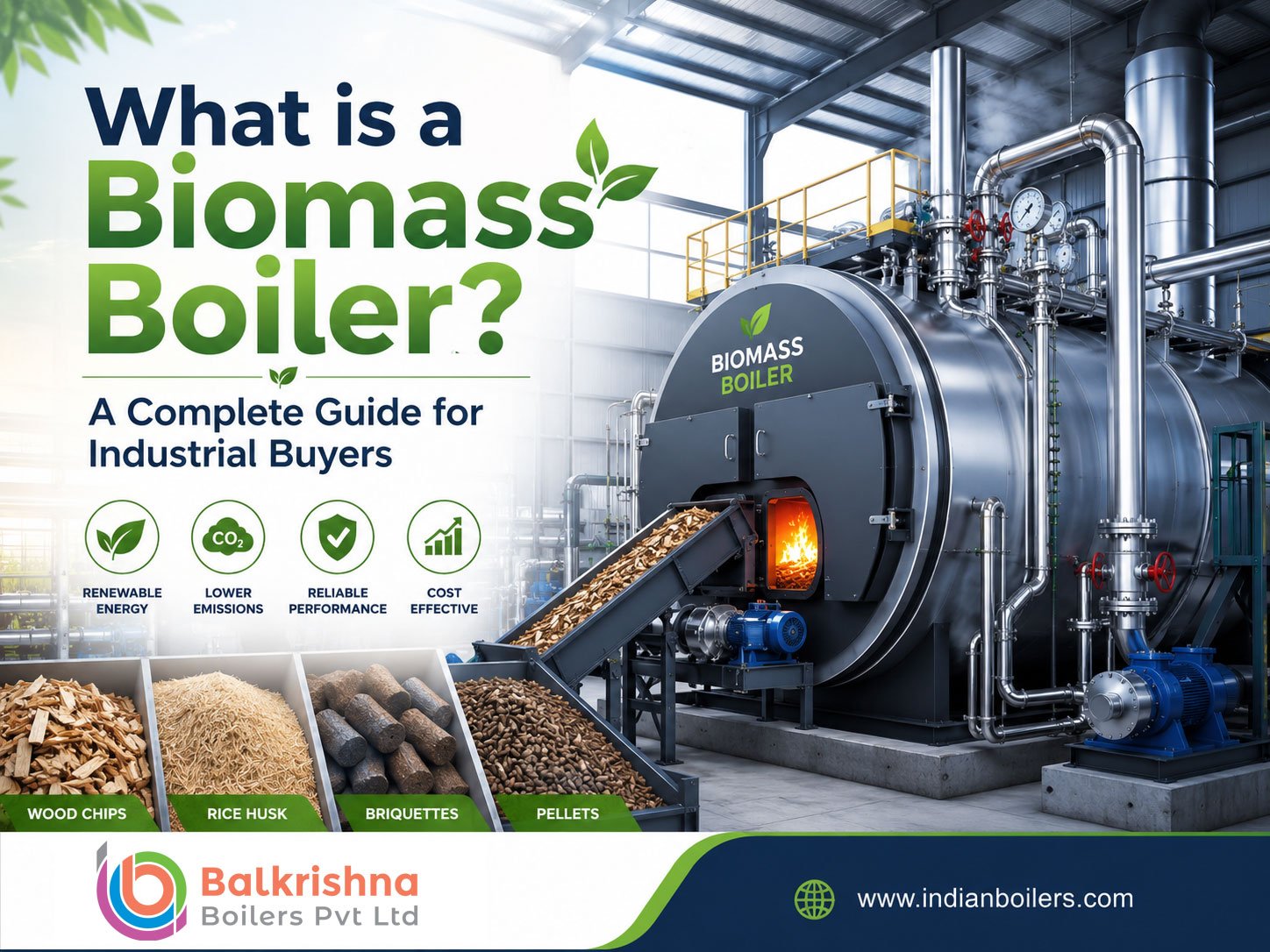
What Is a Biomass Boiler? A Complete Guide for Industrial Buyers
Rising fuel costs, tightening emission norms, and corporate sustainability commitments have pushed Indian manufacturers to genuinely rethink how they generate steam and process heat. Across textiles, food processing, chemicals, pharmaceuticals, and sugar mills, one technology keeps coming up in nearly every cost-reduction and compliance conversation: the biomass boiler.
This guide covers what a biomass boiler actually is, how it works, the grate technologies available, the fuels it burns, and how to think through whether it’s the right investment for your specific plant.
1. What a Biomass Boiler Actually Is
A biomass boiler is an industrial steam or hot water generation system that burns organic, renewable fuel — agricultural residue, wood waste, husk, or briquettes — instead of fossil fuels like coal, furnace oil, or natural gas. The heat released from combustion converts water into steam, or heats water or thermic fluid, which then runs production processes, dryers, or heating systems across the plant.
Because the fuel derives from plant matter that absorbed carbon dioxide during its own growth cycle, biomass combustion is widely treated as carbon-neutral or low-carbon relative to fossil-fuel combustion — a closed carbon loop rather than releasing long-sequestered carbon. This is a genuine part of why biomass boilers have become central to India’s industrial decarbonization efforts, particularly for energy-intensive sectors like textile processing, food and beverage manufacturing, and pharmaceuticals.
2. How a Biomass Boiler Actually Works
At its core, a biomass boiler works on the same basic principle as any combustion-based steam boiler: fuel burns to release thermal energy, and that energy transfers to water or thermic fluid inside a pressure vessel. The genuine difference lies in how solid biomass fuel specifically gets fed, combusted, and controlled.
- Fuel feeding — biomass fuel (husk, wood chips, briquettes, agro-waste) feeds onto a combustion grate through automated or semi-automated systems.
- Combustion on the grate — fuel burns on a mechanically moving grate designed for even fuel distribution, complete combustion, and controlled ash discharge.
- Heat transfer — hot flue gases pass through the boiler’s heat exchange surfaces (furnace, convection zone, economizer), transferring heat to water inside the pressure parts.
- Steam generation — water converts to steam at required pressure and delivers to the plant’s process lines.
- Emission control — flue gases pass through pollution control equipment (multi-cyclones, bag filters, or ESPs) before release, ensuring compliance with current pollution control norms.
The specific grate technology used has a genuinely major impact on combustion efficiency, fuel flexibility, and maintenance requirements — which is exactly why grate selection is one of the most consequential engineering decisions in any biomass boiler project.
3. Grate Technology: Three Genuinely Different Approaches
The grate — the mechanical bed fuel burns on — determines how the boiler handles different fuels, moisture levels, and ash content. Three designs dominate industrial biomass boiler applications:
Chain Grate (Traveling Grate) Boilers
A continuous, moving metal chain carries fuel through the furnace for steady, controlled combustion — well suited to relatively uniform fuels like sugarcane bagasse and coal-biomass blends, valued for straightforward operation and reliable turndown. Grate speed directly affects steam output and fuel consumption, covered in full in our chain grate speed guide. For fuel selection specifics, see our traveling grate fuel guide, and sugar mill operators specifically should read our traveling grate boilers for sugar mills engineering guide.
Reciprocating Grate Boilers
Alternating fixed and movable grate bars push fuel forward while actively tumbling and shearing the fuel bed — genuinely effective at breaking up clinkers as they form, making this design the strongest choice for challenging, high-moisture, or clinker-prone agricultural residue. Our reciprocating grate mechanics guide covers the shearing mechanism in full, alongside our reciprocating grate fuel guide and retrofit guide for existing plants if you’re converting a legacy system rather than specifying new equipment.
Vibrating Grate Boilers
Externally-mounted vibration generators, paired with water-cooled grate tube construction, move fuel and ash across the combustion bed with virtually no moving parts inside the hot furnace zone — genuinely excellent uptime and low maintenance for consistent, high-moisture biomass fuel. Our vibrating grate fuels and operating parameters guide covers fuel matching and vibration tuning in depth. If you’re still deciding between vibrating and reciprocating technology, our head-to-head comparison breaks down which design fits which fuel profile.
4. Common Biomass Fuels Used in Industrial Boilers
Fuel flexibility is one of a biomass boiler’s genuine advantages. Depending on grate technology and local availability, industrial systems commonly run on:
- Rice husk — widely available near rice mills, with fairly consistent calorific value
- Wood chips and wood waste — from sawmills, furniture manufacturing, and plantation residue
- Agricultural residue — cotton stalk, mustard husk, groundnut shell, coconut shell
- Bagasse — sugarcane processing byproduct, the standard fuel across sugar mill boilers
- Biomass briquettes and pellets — densified fuel offering consistent size and moisture for automated feeding
Fuel moisture content, ash percentage, and calorific value all directly influence combustion efficiency and grate selection — matching the right fuel to the right grate technology is genuinely critical for long-term boiler performance, not a minor detail to sort out after purchase.
5. The Real Advantages
- Lower fuel cost relative to furnace oil, diesel, or LPG-fired systems in most regions with reasonable local biomass access
- Reduced carbon footprint, supporting genuine ESG and sustainability commitments
- Fuel security — biomass is often locally sourced, reducing exposure to global fossil fuel price volatility
- Waste utilization — turning agricultural and industrial residue into usable energy rather than a disposal cost
- Compliance support — helping industries move away from high-emission fossil fuels ahead of continually tightening pollution norms
6. Biomass Boilers vs. Other Technology Options
Biomass is one of several technology paths available, and the right choice depends on your process requirements, space constraints, and fuel availability:
- Steam Boilers — for facilities needing high-pressure steam for process or power applications; explore models like HUSKPOWER and SIB, both designed for solid and biomass fuel combustion.
- Electric Boilers — genuinely well suited where fuel handling space is limited or emissions must be near-zero at the point of use; our complete electric boiler guide covers this alternative in full.
- Thermic Fluid Heaters — suited for indirect process heating applications, including biomass-fired options in our range.
- Hot Water Boilers — for facilities needing hot water rather than steam.
- Hot Air Generators — for direct drying applications in food, textile, and agro-processing.
Many industrial plants genuinely run a hybrid setup — pairing a biomass steam boiler with electric or thermic fluid systems for different production stages, rather than committing entirely to one technology. Our full product category range and Balkrishn.com’s complete product lineup are worth comparing before finalizing a decision.
7. Industries That Benefit Most
Biomass boilers deliver the most value in industries with access to agricultural or process residue and steady steam demand:
- Sugar mills — utilizing bagasse as a readily available, essentially free byproduct fuel
- Rice mills — using husk on-site, for near-zero fuel transport cost
- Textile processing — continuous, cost-efficient steam for dyeing and finishing
- Food and beverage plants — reliable process steam with genuine sustainability credentials
- Pharmaceutical manufacturing — consistent, clean steam supply that supports production continuity
8. How to Actually Choose the Right Biomass Boiler
Selecting a biomass boiler goes well beyond capacity (TPH) and pressure rating. Key factors worth evaluating properly:
- Fuel availability and characteristics — what biomass is locally and consistently available, and what’s its actual moisture and ash content?
- Grate technology fit — chain grate for relatively uniform fuel, reciprocating grate for high-moisture and clinker-prone biomass, vibrating grate for consistent fuel with minimal maintenance priority.
- Steam and heat demand — both peak and average load requirements of your actual process, not just a rough estimate.
- Emission compliance — the pollution control equipment needed to meet current state and central board norms under the Boilers Act, 2025.
- Space and layout — fuel storage, handling, and ash disposal infrastructure requirements.
- Automation level — fuel feeding, combustion control, and monitoring systems needed for consistent performance.
Because these variables interact closely — fuel choice affects grate choice, which affects automation needs, which affects space requirements — working through fuel-and-technology selection with an experienced boiler manufacturer genuinely helps avoid costly mismatches discovered only after installation.
9. Why Balkrishna Boilers
Balkrishna Boilers Pvt Ltd designs and manufactures biomass-fired steam boilers, thermic fluid heaters, and hot air generators engineered for real-world fuel conditions — not laboratory-grade biomass assumptions. Our steam boiler range, including models like ENERPOWER, STEAMGEN, and COMBIPOWER, is built to handle husk, agro-waste, and wood-based fuels with strong combustion efficiency, supported by our own pollution control equipment division for complete compliance.
(Note: specific company milestones — years of operation, total installation count, and export markets served — should be confirmed against current, verified figures before publishing, to ensure this page reflects your business’s actual current standing accurately.)
Whether you’re setting up a new plant or replacing an aging fossil-fuel system, our engineering team can help evaluate the right grate technology, fuel strategy, and boiler capacity for your specific operation.
Conclusion: The Right Technology Follows Your Fuel, Not the Other Way Around
A biomass boiler offers a practical, cost-effective, and genuinely lower-carbon way to generate steam and process heat using renewable, often locally available fuel. From chain grate and reciprocating grate to vibrating grate designs, the right technology depends on your specific fuel type, moisture content, and production demand — not a default choice made without that analysis. As emission norms continue tightening and fossil fuel costs remain volatile, biomass boilers are increasingly the default choice for forward-looking manufacturers across textiles, food processing, sugar, pharma, and beyond.
Ready to discuss the right biomass boiler configuration for your plant? Get in touch with our team or explore our complete product range at Balkrishn.com.
Related Reading
- Reciprocating Grates: The Mechanical Engineering Behind Clinker-Proof Biomass Combustion
- Traveling Grate Boilers for Sugar Mills: The Ultimate Engineering Guide
- Vibrating Grate Boiler vs Reciprocating Grate Boiler: Which Technology Delivers Better Performance?
- Biomass Boilers vs. Coal: Which Wins for Indian Businesses
- The Biomass Boiler ROI Calculation: A Framework, Not Just a Percentage