
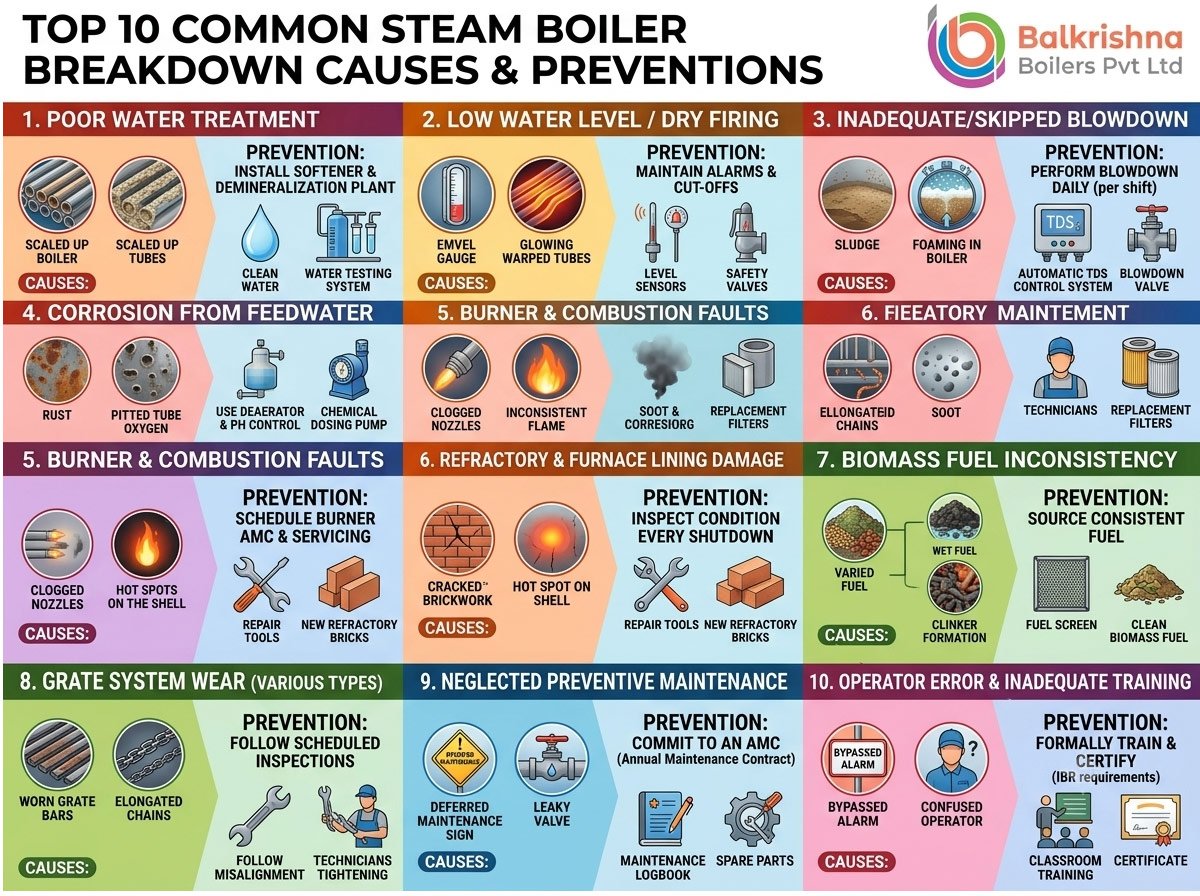
A boiler breakdown doesn’t just mean a repair bill — it means a stopped production line, missed delivery schedules, and in the worst cases, a serious safety incident. The frustrating part is that most boiler failures aren’t sudden or unpredictable. They’re the end result of small, preventable issues that were ignored for weeks or months.
In this guide, we’ll walk through the ten most common causes of industrial steam boiler breakdown in Indian plants, why each one happens, and exactly what you can do to prevent it — so your boiler runs closer to its full 20–25 year design life instead of failing early.
1. Poor Water Treatment and Scale Formation
This is, by far, the single biggest cause of boiler failure across Indian industry. Hard water contains dissolved calcium and magnesium salts that precipitate out as scale when water is heated. That scale deposits on the internal heat-transfer surfaces of the boiler, acting as an insulating layer between the flame/flue gas and the water.
Why it causes breakdown: Once scale builds up, the metal beneath it can no longer transfer heat efficiently to the water. The metal surface overheats, weakens, and eventually blisters or ruptures — sometimes catastrophically. Just 1 mm of scale can increase fuel consumption by 7–10%, and left unaddressed, it’s one of the leading causes of tube failure.
How to prevent it:
- Install a properly sized water softener or demineralization plant before the feedwater tank.
- Test feedwater hardness regularly, not just at commissioning.
- Maintain consistent blowdown schedules to remove concentrated solids before they can deposit as scale.
- Have your boiler internals inspected for scale buildup during every scheduled shutdown.
2. Low Water Level / Dry Firing
Operating a boiler with insufficient water is one of the fastest ways to cause catastrophic tube or shell failure. When water level drops below the heating surface, that surface is no longer being cooled by water contact — it’s exposed directly to flame or hot flue gas temperatures it was never designed to withstand dry.
Why it causes breakdown: Metal that overheats without water contact loses structural strength almost immediately. This can lead to tube rupture, shell deformation, or in severe cases, explosive failure.
How to prevent it:
- Ensure low-water level alarms and cut-off switches are tested regularly, not just installed and forgotten.
- Never bypass or disable safety interlocks to “keep production running.”
- Train operators to respond immediately to low-water alarms rather than resetting and continuing.
- Schedule periodic calibration checks on water level indicators and float switches.
3. Inadequate or Skipped Blowdown
Blowdown removes the sludge, dissolved solids, and suspended particles that accumulate at the bottom of the boiler as water evaporates and leaves concentrated impurities behind. Skipping or reducing blowdown frequency to “save water” is a common false economy.
Why it causes breakdown: Accumulated sludge insulates the boiler’s heating surfaces just like scale does, leading to localized overheating. It also increases the risk of foaming and carryover, where boiler water contaminates the steam line, damaging downstream equipment like valves and turbines.
How to prevent it:
- Perform blowdown at least once per shift (every 8 hours), or as recommended based on your water quality testing.
- Use automatic blowdown control systems (TDS-based) for more consistent, efficient results than manual scheduling alone.
- Log every blowdown event so patterns in water quality degradation can be identified early.
4. Corrosion from Poor Feedwater Quality
Beyond hardness, feedwater also carries dissolved oxygen and carbon dioxide, both of which are highly corrosive to boiler metal at operating temperatures. Corrosion attacks tubes, headers, and the shell from the inside, often invisibly until a leak develops.
Why it causes breakdown: Corrosion thins metal walls over time, reducing their pressure-holding capacity. Pitting corrosion in particular can cause localized weak points that fail well before the boiler’s rated design life.
How to prevent it:
- Use a deaerator to remove dissolved oxygen from feedwater before it enters the boiler.
- Dose appropriate oxygen scavenger and pH-control chemicals as part of a boiler water treatment program.
- Monitor feedwater and boiler water chemistry on a scheduled basis, not just when problems appear.
5. Burner and Combustion System Faults
For oil and gas fired boilers, the burner is one of the most mechanically active components, and it’s also one of the most commonly neglected during routine maintenance. Faulty ignition systems, worn nozzles, clogged fuel filters, or misaligned flame sensors all disrupt clean, consistent combustion.
Why it causes breakdown: Poor combustion leads to incomplete fuel burning, soot deposition on heat-transfer surfaces (which itself insulates and reduces efficiency), and in worse cases, flame failure or delayed ignition that can damage the furnace or trigger a safety shutdown.
How to prevent it:
- Schedule burner servicing as part of your annual maintenance contract, not just when a fault occurs.
- Clean or replace fuel filters and nozzles on a fixed interval.
- Verify flame sensors and ignition sequences during every planned shutdown.
- For our Oil / Gas Fired Steam Boiler range, our AMC packages include scheduled burner inspection as standard.
6. Refractory and Furnace Lining Damage
The refractory lining inside the furnace protects the boiler shell from direct flame contact and extreme combustion temperatures. Over time, thermal cycling, moisture ingress, and mechanical stress cause this lining to crack or spall.
Why it causes breakdown: Once refractory damage exposes the metal shell to direct flame or elevated temperatures, localized overheating and structural damage follow quickly — often requiring an extended, costly repair shutdown.
How to prevent it:
- Inspect refractory condition during every major shutdown, especially after a cold start following an extended outage.
- Avoid rapid heating and cooling cycles wherever operationally possible, since thermal shock is a leading cause of refractory cracking.
- Repair minor cracks immediately rather than waiting for the next scheduled maintenance window.
7. Fuel Quality and Combustion Inconsistency (Biomass Boilers)
Biomass-fired boilers are particularly sensitive to fuel consistency. Variations in moisture content, particle size, or the presence of foreign material (stones, metal, excess ash content) disrupt combustion and grate performance.
Why it causes breakdown: Inconsistent fuel causes uneven combustion, clinker formation on the grate, and unpredictable steam output — all of which place additional mechanical and thermal stress on the boiler and grate system. Our article on fuel moisture vs boiler efficiency for reciprocating grate boilers explains this relationship in more depth.
How to prevent it:
- Source fuel with consistent moisture content within your boiler’s designed range.
- Screen fuel for foreign material before it reaches the feed system.
- Match your fuel type to the correct grate technology — our guides on best biomass fuels for reciprocating grate boilers and best biomass fuels for vibrating grate boilers can help you avoid a fuel-grate mismatch.
- For plants struggling with high-moisture fuel, our piece on how reciprocating grate boilers handle high-moisture biomass is worth reviewing before your next fuel procurement cycle.
8. Grate System Wear (Chain, Reciprocating, Vibrating, Travelling Grates)
For solid-fuel and biomass boilers, the grate is a high-wear mechanical component operating continuously under high heat. Bar wear, chain elongation, or drive misalignment gradually reduces combustion efficiency and can eventually cause mechanical failure.
Why it causes breakdown: A worn or misaligned grate leads to uneven fuel distribution, incomplete combustion, increased clinker formation, and added strain on the grate drive mechanism — often escalating into unplanned downtime if not caught early.
How to prevent it:
- Follow a scheduled grate inspection program, particularly checking bar wear and chain tension.
- Monitor grate speed settings against actual steam demand — our guide on chain grate boiler speed and how it affects steam production and fuel consumption explains why incorrect grate speed accelerates wear.
- If your existing grate system is aging, our reciprocating grate retrofit guide for existing plants outlines how to upgrade without a full boiler replacement.
- When comparing grate technologies for a new installation, see our breakdown of vibrating grate vs reciprocating grate performance.
9. Neglected or Delayed Preventive Maintenance
Many breakdowns aren’t caused by a single dramatic failure — they’re the cumulative result of small maintenance items being postponed repeatedly: a gasket that was “fine for now,” a pressure gauge that wasn’t recalibrated, a valve that was sticking slightly.
Why it causes breakdown: Deferred maintenance compounds. A minor leak left unaddressed becomes a major one; a slightly miscalibrated safety valve eventually fails to trip when it’s needed most. By the time symptoms are obvious, the underlying damage is often already significant.
How to prevent it:
- Commit to a documented Annual Maintenance Contract (AMC) with scheduled inspection intervals rather than reactive, call-when-broken servicing.
- Maintain a maintenance logbook for every boiler, tracking every inspection, part replacement, and anomaly.
- Keep genuine spare parts in stock for wear items (gaskets, valves, sensors) so minor issues can be fixed immediately instead of waiting on procurement.
10. Operator Error and Inadequate Training
Even a well-designed, well-maintained boiler can fail if it’s operated incorrectly — ignoring alarms, overriding interlocks, skipping startup/shutdown procedures, or misreading pressure and water level indicators.
Why it causes breakdown: Boilers have built-in safety systems specifically to prevent operator mistakes from becoming equipment failures, but those systems only work if operators respond to them correctly and don’t attempt to bypass them under production pressure.
How to prevent it:
- Ensure every boiler operator is formally trained and, where applicable, certified under IBR requirements.
- Post clear startup, shutdown, and emergency response procedures at the boiler station.
- Conduct periodic refresher training, especially after any near-miss incident.
- Foster a plant culture where operators are encouraged to report anomalies immediately rather than working around them.
Building a Preventive Maintenance Routine That Actually Works
Preventing breakdown isn’t about any single action — it’s about consistency. A strong preventive maintenance routine typically includes:
- Daily checks: Water level, pressure readings, flame condition, visible leaks.
- Per-shift tasks: Blowdown, log entries, burner flame inspection.
- Weekly/monthly checks: Safety valve testing, water quality testing, filter cleaning.
- Annual/shutdown tasks: Refractory inspection, tube cleaning, grate inspection, full safety system calibration, IBR-mandated inspection where applicable.
Manufacturers offering Annual Maintenance Contracts (AMC) with 24/7 technical support and genuine spare parts availability can significantly reduce both the frequency and severity of breakdowns compared to ad-hoc, reactive servicing.
Choosing a Boiler Built for Reliability From the Start
Prevention starts before installation. A boiler engineered with quality materials, proper heating surface design, and reliable safety mountings will inherently break down less often than a poorly built or mismatched unit. When evaluating new boilers or replacements, look at:
- Steam Boiler range – indianboilers.com for a full lineup across fuel types and capacities.
- Electric Boiler range – indianboilers.com if you want to eliminate combustion-related failure modes entirely.
- Hot Water Boiler range and Thermic Fluid Heater range if your process doesn’t strictly require steam.
Balkrishna Boilers also manufactures a dedicated line of steam boiler models engineered for long-duty reliability, including COMBIPOWER, STEAMGEN, STEAMJET, STEAMPOWER, STEAMAX, HUSKPOWER, COMCUBE, ENERPOWER, PELLETAX, VEPOMAX, and WILLSTEAM. Browse the complete range on our Steam Boiler page at balkrishn.com.
Final Thoughts
Nearly every major boiler breakdown traces back to one of the ten causes above — and nearly every one of them is preventable with consistent water treatment, disciplined maintenance, and trained operators. The plants that get the longest, most reliable service life from their boilers aren’t the ones with the newest equipment; they’re the ones with the most consistent maintenance discipline.
If your boiler has been experiencing recurring issues, or you’re unsure whether your current maintenance routine is sufficient, it’s worth having an engineering team review your setup before a minor issue becomes a major shutdown.
Related reading:
- How to Calculate Steam Boiler Capacity for Your Plant
- What Is an Industrial Steam Boiler?
- What Is a Biomass Boiler?
For AMC packages, spare parts, or a full boiler health assessment, get in touch with our engineering team.
Frequently Asked Questions
What is the most common cause of industrial boiler breakdown? Poor water treatment leading to scale formation is the single most common cause, since scale insulates heating surfaces and leads to overheating and tube failure.
How often should a boiler be blown down? Blowdown should typically be performed at least once per shift (every 8 hours), or more frequently based on feedwater quality testing.
Can operator error really cause a boiler breakdown? Yes. Ignoring alarms, bypassing safety interlocks, or improper startup/shutdown procedures are common contributors to preventable failures, even on well-maintained equipment.
How do I know if my boiler needs a refractory repair? Visible cracking, spalling, or hot spots on the outer shell during operation are signs that refractory lining needs inspection and possible repair.
Is an AMC (Annual Maintenance Contract) worth it for a small plant? Yes. An AMC ensures scheduled inspections happen consistently, catching minor issues before they escalate into costly unplanned downtime — this is typically far cheaper than reactive repairs and lost production time.
How can I extend my boiler’s lifespan closer to its full 20–25 year design life? Consistent water treatment, regular blowdown, scheduled burner and grate maintenance, timely refractory repair, and trained, disciplined operators are the key factors that determine whether a boiler reaches its full design life.