
Pressure is the single most important operating variable on a steam boiler. Get it right, and your plant runs efficiently, safely, and consistently. Get it wrong, either too low or too high, and you risk process failures, equipment damage, wasted fuel, or a serious safety incident.
Yet in many plants, pressure settings are configured once at commissioning and rarely revisited — even as production needs, equipment, or fuel sources change. This guide is written specifically for boiler operators and plant engineers who want a clear, practical understanding of how pressure settings work, how to configure them correctly, and how to avoid the mistakes that lead to downtime or damage.
Why Boiler Pressure Matters
A steam boiler generates steam by heating water inside a sealed vessel. As heating continues, pressure builds because the steam has nowhere to expand. This pressure is what gives steam its ability to do useful work — driving a turbine, heating a jacketed vessel, or sterilizing equipment.
Every piece of downstream equipment connected to your steam line is designed to operate within a specific pressure range. Too little pressure, and your process equipment won’t perform (slower heating, incomplete sterilization, inconsistent drying). Too much pressure, and you risk stressing pipework, valves, and the boiler’s own pressure vessel beyond its safe design limits.
Pressure is measured in kg/cm² (kilograms per square centimeter) in most Indian industrial settings, though you may also see it referenced in bar or psi depending on the equipment manufacturer.
Understanding the Key Pressure Settings on a Steam Boiler
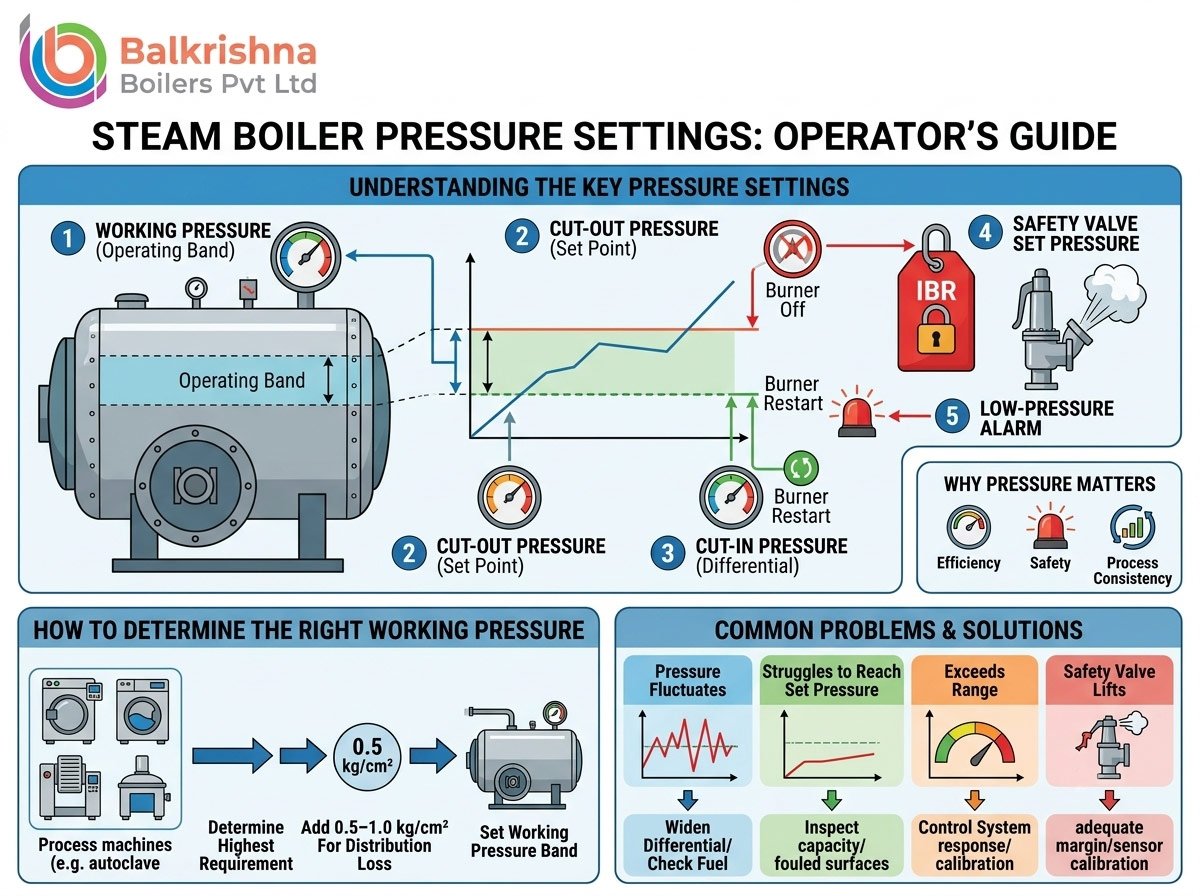
A properly configured boiler doesn’t operate at a single fixed pressure — it works within a controlled band, governed by several distinct settings:
1. Working Pressure (Operating Pressure)
This is the pressure at which the boiler is designed to normally operate, and it should be set based on the highest-pressure requirement among all connected downstream equipment, plus an allowance for pressure drop across the distribution piping.
2. Set Pressure (Cut-Out Pressure)
This is the pressure at which the burner or heating element automatically shuts off because the boiler has reached its target pressure. Once steam is drawn off and pressure drops, the burner re-fires to maintain the band.
3. Cut-In Pressure (Differential)
This is the lower pressure point at which the burner restarts after cutting out. The difference between cut-out and cut-in pressure is called the differential, and it directly affects how often your burner cycles on and off.
4. Safety Valve Set Pressure
This is a hard safety limit, always set higher than the working pressure, at which the spring-loaded safety valve automatically releases steam to prevent the vessel from exceeding its maximum allowable working pressure (MAWP). This value is fixed at commissioning per IBR requirements and should never be adjusted without proper certification and inspection.
5. Low-Pressure Alarm/Cut-Off
Alerts operators (and in most modern systems, automatically halts certain processes) if pressure drops below a safe operating threshold, indicating a fuel supply issue, burner fault, or excessive steam demand.
How to Determine the Right Working Pressure for Your Plant
Setting working pressure correctly starts with understanding your actual process requirements, not simply matching the boiler’s maximum rated pressure.
Step 1: Identify your highest-pressure consumer. Review every piece of steam-consuming equipment in your plant and note its required operating pressure. Autoclaves, certain reactors, and high-temperature drying equipment often require the highest pressures in a facility.
Step 2: Add margin for distribution losses. Steam loses pressure as it travels through piping, especially over long distances or through multiple valves and fittings. A common practice is to add 0.5–1.0 kg/cm² above your highest process requirement to compensate for this drop.
Step 3: Confirm against your boiler’s rated capacity. Your boiler’s TPH output is closely tied to its design pressure. If you’re unsure how capacity and pressure interact for your process load, our guide on how to calculate steam boiler capacity for your plant walks through this relationship in detail.
Step 4: Set the working pressure band with appropriate differential. Work with your boiler manufacturer or service engineer to configure cut-out and cut-in pressures that keep the boiler within an efficient operating range without excessive burner cycling.
Common Pressure-Related Problems and How to Fix Them
Pressure Fluctuates Constantly
Likely causes: Burner cycling too frequently due to a narrow differential setting, inconsistent fuel quality (especially with biomass), or a control system fault. Fix: Widen the differential slightly if cycling is excessive, verify fuel consistency, and have the pressure control system calibrated by a qualified technician. For biomass boilers, our article on fuel moisture vs boiler efficiency explains how inconsistent fuel moisture directly causes unstable combustion and pressure swings.
Boiler Struggles to Reach Set Pressure
Likely causes: Undersized boiler for current demand, fouled heat-transfer surfaces (scale or soot), burner or grate performance issues, or excessive steam draw exceeding boiler capacity. Fix: Confirm your current steam demand against your boiler’s rated capacity, inspect for scale buildup, and check burner or grate condition. If demand has grown since installation, revisit your original capacity calculation to see whether an upgrade is warranted.
Pressure Exceeds Working Range Frequently
Likely causes: Set pressure configured too close to the safety valve set point, sudden drop in steam demand without a corresponding burner response, or a faulty pressure control sensor. Fix: Review your control system’s response time and sensor calibration. Never respond to this issue by disabling or adjusting the safety valve — that is a certified, IBR-regulated component and must only be handled by authorized personnel.
Safety Valve Lifts Unexpectedly
Likely causes: Working pressure set too close to the safety valve threshold, a control system fault allowing pressure to overshoot, or a genuinely faulty/miscalibrated safety valve. Fix: Maintain adequate margin between working pressure and safety valve set pressure (typically 10% or more), and have the safety valve inspected and re-certified as required under IBR regulations. Frequent unexpected lifting is a warning sign that should never be ignored.
Pressure Settings by Fuel and Boiler Type
Different boiler and fuel types come with different practical considerations when it comes to pressure stability:
- Oil / Gas Fired Steam Boilers typically offer the fastest, most precise pressure response due to consistent fuel combustion characteristics and modulating burner controls.
- Biomass-fired boilers (running on rice husk, groundnut husk, or agro waste) require closer attention to fuel consistency and grate speed to maintain stable pressure, since combustion response is inherently slower than gas or oil.
- Electric Steam Boilers generally offer very tight pressure control due to precise electrical heating element modulation, making them a strong option where pressure stability is critical, such as pharmaceutical sterilization.
- FBC Solid Fuel Steam Boilers offer relatively stable combustion across a range of solid fuels, though pressure response still depends on fuel bed consistency.
If your plant runs a grate-based biomass system, grate speed has a direct and often underappreciated effect on pressure stability. Our article on chain grate boiler speed and how it affects steam production and fuel consumption explains this relationship, and our comparison of vibrating grate vs reciprocating grate performance can help you evaluate which grate technology delivers steadier pressure control for your fuel type.
You can browse the complete range of pressure-rated boiler options on our Steam Boiler category page, or explore Balkrishna Boilers’ own engineered steam boiler lineup — including STEAMGEN, STEAMJET, STEAMPOWER, COMBIPOWER, and VEPOMAX — on our Steam Boiler page at balkrishn.com.
Operator Best Practices for Pressure Management
- Monitor pressure gauges every shift, not just when an alarm sounds. A gradual drift often precedes a bigger problem.
- Log pressure readings at regular intervals so trends and anomalies can be identified before they become failures.
- Never manually override or bypass pressure safety interlocks, even temporarily, to keep production running during a fault.
- Recalibrate pressure gauges and sensors periodically — a miscalibrated gauge can mislead operators into thinking pressure is stable when it isn’t.
- Coordinate pressure settings with process teams whenever new equipment is added or process requirements change, rather than assuming the original commissioning settings still apply.
- Test safety valves at scheduled intervals as required under IBR regulations, and document every test.
The Link Between Pressure Settings and Fuel Efficiency
Running a boiler at a higher pressure than your process actually requires wastes fuel — every additional kg/cm² above what’s genuinely needed increases the energy input required to maintain it, with no corresponding process benefit. Conversely, running too close to your minimum required pressure leaves no margin for distribution losses or demand spikes, risking process disruption.
The most fuel-efficient setup is one where working pressure is set as close as possible to your actual highest process requirement, with just enough margin for line losses and demand variability — not a broad, “safe-feeling” buffer that ends up costing fuel every single day of operation.
When to Involve a Professional
While operators can and should monitor day-to-day pressure performance, certain pressure-related tasks should always be handled by qualified, certified technicians:
- Adjusting or re-certifying safety valve set pressure
- Recalibrating pressure transmitters and control systems
- Any modification to working pressure that affects IBR-registered parameters
- Diagnosing recurring pressure instability that isn’t resolved by routine checks
Attempting to resolve persistent pressure issues through workarounds, rather than proper diagnosis, is one of the more common paths toward a larger, more costly breakdown. Our guide on the top causes of steam boiler breakdown and how to prevent them covers several pressure-adjacent failure modes in more depth.
Final Thoughts
Pressure isn’t a “set it and forget it” parameter — it’s an operating variable that deserves regular attention, accurate calibration, and a clear understanding of how it connects to your process requirements, fuel efficiency, and safety systems. Operators who understand not just what the pressure gauge reads, but why each setting exists and how they interact, are far better equipped to catch small issues before they become expensive ones.
Explore our full steam boiler range:
- Steam Boiler Product Range – indianboilers.com
- Steam Boiler Product Range – balkrishn.com
- Electric Boiler Range – indianboilers.com
Related reading:
- How to Calculate Steam Boiler Capacity for Your Plant
- Top 10 Causes of Steam Boiler Breakdown and How to Prevent Them
- What Is an Industrial Steam Boiler?
For help reviewing your current pressure settings or planning a new installation, get in touch with our engineering team for a free technical consultation.
Frequently Asked Questions
What unit is boiler pressure measured in? Most Indian industrial boilers use kg/cm² (kilograms per square centimeter), though bar and psi are also used depending on equipment origin.
What is the difference between working pressure and safety valve set pressure? Working pressure is the normal operating range your boiler runs at to meet process needs. Safety valve set pressure is a fixed, higher safety threshold at which excess steam is automatically released to prevent the vessel from exceeding its maximum allowable working pressure.
How much margin should I leave between working pressure and safety valve set pressure? A margin of at least 10% is standard practice, though the exact figure should be confirmed with your boiler manufacturer and in line with IBR requirements.
Can I adjust the safety valve setting myself? No. Safety valve settings are IBR-regulated and must only be adjusted, tested, or re-certified by authorized personnel.
Why does my boiler pressure fluctuate so much? Common causes include a narrow burner differential setting, inconsistent fuel quality (especially with biomass), or a control system calibration issue. Persistent fluctuation should be diagnosed by a qualified technician rather than worked around.
Does running at higher pressure than necessary waste fuel? Yes. Maintaining pressure above what your process genuinely requires increases fuel consumption without any corresponding benefit, and is one of the more overlooked sources of avoidable operating cost.