
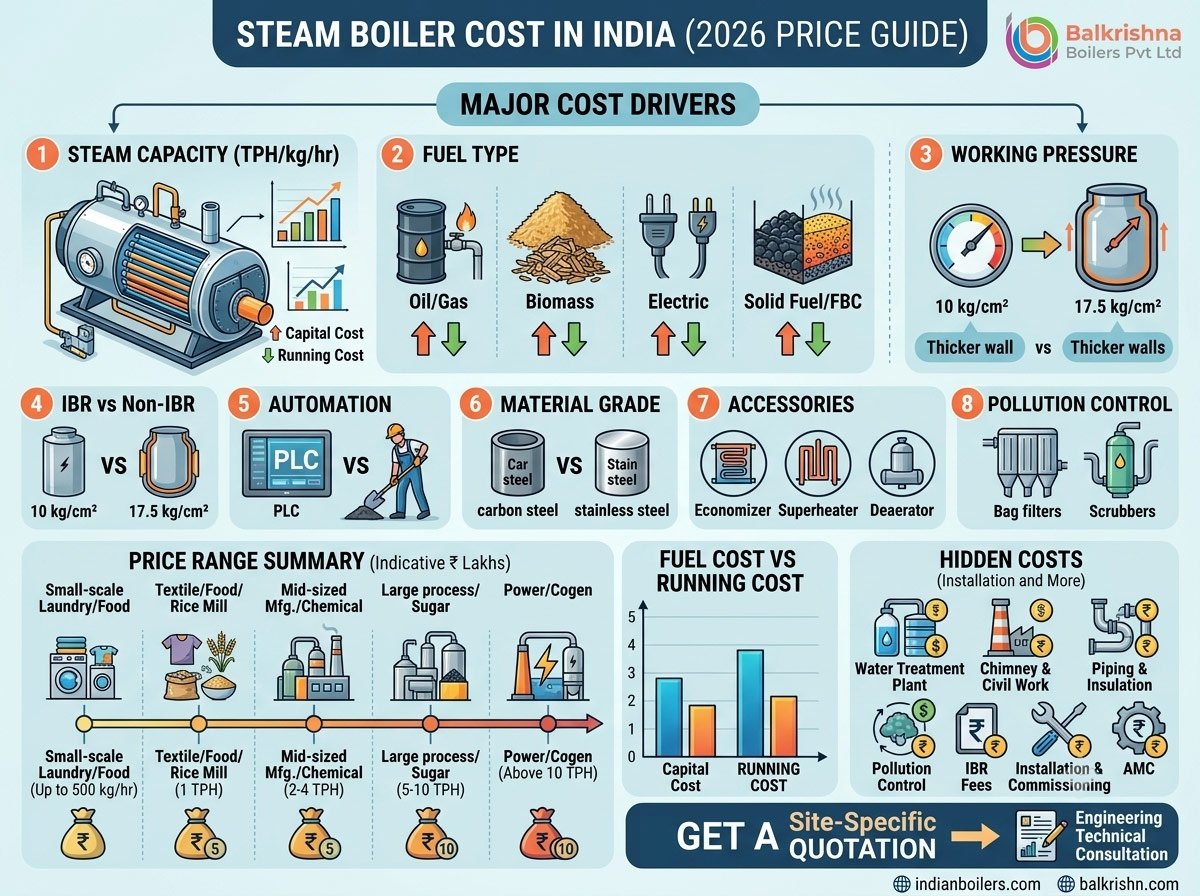
“What’s the price?” is usually the first question every plant owner asks — and the fairest answer is: it depends on a handful of specific factors that can swing the cost by lakhs of rupees. A 500 kg/hr electric steam boiler and a 10 TPH biomass-fired unit with automation and pollution control equipment are not comparable purchases, even though both fall under the broad label “steam boiler.”
This guide breaks down what actually drives steam boiler pricing in India in 2026, gives you realistic price ranges across capacities and fuel types, and explains where the hidden costs usually show up so you can budget accurately — not just for the boiler, but for the full installation.
What Determines the Price of a Steam Boiler?
Before looking at numbers, it helps to understand the variables that make up a boiler quotation. Two boilers rated at the same TPH can differ significantly in price based on:
1. Steam Capacity (TPH / kg/hr)
This is the single biggest driver of base cost. Larger capacity means more heating surface area, a bigger pressure vessel, and higher-rated components throughout. If you haven’t finalized your required capacity yet, our guide on how to calculate steam boiler capacity for your plant walks through the exact method before you start requesting quotes.
2. Fuel Type
Fuel type affects both the burner/combustion system design and the boiler’s structural requirements:
- Oil/Gas fired boilers generally have lower upfront capital cost due to simpler, more compact combustion systems, but higher running costs.
- Biomass fired boilers (husk, agro waste, wood chips) typically cost more upfront due to fuel handling, grate systems, and ash management infrastructure, but offer significantly lower running costs over the boiler’s life.
- Electric boilers are usually the lowest-cost option for smaller capacities but become expensive to run at scale due to electricity tariffs.
- Solid fuel/FBC boilers sit at the higher end of capital cost due to more complex fluidized bed combustion engineering.
3. Working Pressure
Higher pressure ratings require thicker-walled pressure vessels, higher-grade materials, and more robust mountings — all of which add to cost. A boiler rated for 10 kg/cm² will cost noticeably less than an identical capacity unit rated for 17.5 kg/cm² or higher.
4. IBR vs Non-IBR Classification
IBR-certified boilers involve government-regulated design approval, material certification, and inspection processes, which add both cost and lead time compared to smaller Non-IBR (SIB) units that fall below the mandatory registration threshold.
5. Automation Level
A manually operated boiler with basic controls costs significantly less than a fully PLC-automated unit with remote monitoring, automatic blowdown, modulating burners, and data logging. Automation adds upfront cost but typically reduces labor dependency and improves fuel efficiency over time.
6. Material Grade
Standard carbon steel construction is the norm for most industrial applications, but boilers producing clean steam for pharmaceutical or food-grade use may require stainless steel components, which substantially increases cost.
7. Accessories and Mountings
Economizers, air pre-heaters, superheaters, deaerators, and water softening systems are often quoted separately and can meaningfully affect the total project cost, even though they’re not part of the “core” boiler price.
8. Pollution Control Equipment
Depending on your fuel type and local pollution control board requirements, you may need additional equipment such as dust collectors, bag filters, or wet scrubbers, particularly for solid fuel and biomass boilers.
Indicative Price Ranges by Capacity (2026)
The figures below are indicative ranges for standard IBR-certified boilers in India as of 2026, meant to give you a realistic budgeting starting point. Actual quotations will vary based on fuel type, pressure rating, automation level, and site-specific requirements — always request a detailed technical and commercial proposal for an accurate figure.
| Capacity | Approximate Price Range | Typical Use Case |
|---|---|---|
| Up to 500 kg/hr | ₹4 Lakhs – ₹9 Lakhs | Small food processing units, laundries, small pharma labs |
| 1 TPH | ₹8 Lakhs – ₹15 Lakhs | Small-to-mid textile, food, and rice mill operations |
| 2–4 TPH | ₹15 Lakhs – ₹35 Lakhs | Mid-sized manufacturing, dyeing units, chemical plants |
| 5–10 TPH | ₹35 Lakhs – ₹80 Lakhs | Large process plants, sugar mills, large textile units |
| Above 10 TPH | ₹80 Lakhs and above | Cogeneration setups, large industrial and power applications |
Electric steam boilers at the lower capacity end (100–850 kg/hr) tend to sit toward the lower-middle of these ranges due to simpler construction, while high-pressure or stainless-steel clean-steam units can exceed these ranges even at moderate capacity.
Fuel Type Cost Comparison
| Fuel Type | Relative Capital Cost | Relative Running Cost | Best Fit |
|---|---|---|---|
| Biomass (husk, agro waste) | Medium-High | Low | Continuous process plants with access to agricultural residue |
| Oil/Gas | Low-Medium | Medium-High | Plants with reliable pipeline gas or fuel oil supply |
| Electric | Low (small capacity) | High | Small capacity, clean steam, or areas without solid fuel logistics |
| Solid Fuel/FBC | High | Low-Medium | Large plants needing fuel flexibility across multiple solid fuels |
You can explore live product listings across these categories on our Steam Boiler category page and Electric Boiler category page, including options like the 200 KG to 850 KG Gas Fired Steam Boiler, Biomass Fired Steam Boiler – 1 Ton to 6 Ton, Agro Waste Fired Steam Boiler – 5 TPH to 20 TPH, and Electric IBR Steam Boiler.
Balkrishna Boilers offers its own engineered lineup across these fuel categories as well, including COMBIPOWER, HUSKPOWER, STEAMGEN, STEAMJET, STEAMPOWER, STEAMAX, COMCUBE, ENERPOWER, PELLETAX, VEPOMAX, and WILLSTEAM — viewable on the Steam Boiler page at balkrishn.com.
Hidden Costs Buyers Often Miss
The quoted boiler price is rarely the full picture. Budget for these additional line items when planning your total installation cost:
- Water Treatment Plant: A softener or demineralization unit is essential to protect your investment, and its cost scales with your feedwater hardness and boiler capacity.
- Chimney and Civil Work: Foundation, chimney construction, and boiler house structure are typically separate from the equipment cost.
- Piping and Insulation: Steam distribution piping, valves, and insulation across your plant layout can be a significant line item, especially in larger facilities.
- Pollution Control Equipment: Bag filters, dust collectors, or wet scrubbers may be mandatory depending on your fuel type and location — see our range of pollution control equipment for reference.
- IBR Registration and Inspection Fees: Government inspection and certification fees apply for IBR-classified boilers.
- Installation and Commissioning: Labor, crane charges, and commissioning support are usually quoted separately from the equipment price.
- Annual Maintenance Contract (AMC): An ongoing but essential cost to protect your investment and avoid the common causes of boiler breakdown.
A well-prepared budget should account for total project cost, not just the boiler’s ex-works price, to avoid mid-project funding gaps.
Capital Cost vs Running Cost: Why the Cheapest Boiler Isn’t Always the Best Value
It’s tempting to select a boiler based purely on the lowest quoted price, but capital cost is only one part of the total cost of ownership. A biomass boiler may cost more upfront than an equivalent-capacity oil-fired unit, but if biomass fuel is readily available at low cost in your region, the payback period can be remarkably short.
Most well-specified industrial boilers deliver a return on investment within 12 to 18 months when replacing an older, inefficient unit, primarily through fuel savings. When comparing quotations, always calculate:
Total Cost of Ownership = Capital Cost + (Annual Fuel Cost × Expected Lifespan) + Maintenance CostThis calculation, more than the sticker price alone, tells you which option genuinely delivers better value over the boiler’s 20–25 year service life.
Factors That Can Increase or Decrease Your Quote
Cost-increasing factors:
- Stainless steel or food-grade/pharma-grade construction
- High working pressure requirements (above 17.5 kg/cm²)
- Full PLC automation with remote monitoring
- Additional accessories: economizer, air pre-heater, superheater, deaerator
- Site-specific challenges (limited space, difficult foundation conditions, remote location)
Cost-reducing factors:
- Standard carbon steel construction for non-critical applications
- Manual or semi-automatic controls where labor cost allows
- Right-sized capacity based on accurate demand calculation, avoiding oversizing
- Choosing readily available local fuel sources to reduce ongoing fuel logistics costs
How to Get an Accurate Quotation
To receive a precise, comparable quotation rather than a rough estimate, share the following with your boiler manufacturer:
- Required steam capacity (TPH or kg/hr), ideally based on an actual capacity calculation
- Required working pressure (kg/cm²)
- Preferred or available fuel type
- Automation level preference (manual, semi-automatic, or fully automatic)
- Material grade requirement (standard vs stainless steel)
- Site location and any space or civil constraints
- Whether IBR certification is required for your capacity/pressure class
Providing this information upfront typically results in a faster, more accurate proposal and avoids costly revisions later in the process.
Final Thoughts
Steam boiler pricing in India spans a wide range because it’s genuinely driven by your specific requirements — capacity, fuel, pressure, automation, and material grade all move the number significantly. Rather than shopping purely on the lowest quoted price, the more reliable approach is to calculate your actual requirement accurately, compare total cost of ownership across fuel options, and budget for the full installation, not just the equipment.
Explore our full steam boiler range:
- Steam Boiler Product Range – indianboilers.com
- Steam Boiler Product Range – balkrishn.com
- Electric Boiler Range – indianboilers.com
Related reading:
- How to Calculate Steam Boiler Capacity for Your Plant
- Top 10 Causes of Steam Boiler Breakdown and How to Prevent Them
- Steam Boiler Pressure Settings: A Practical Guide for Operators
- What Is an Industrial Steam Boiler?
For a detailed, site-specific quotation, get in touch with our engineering team with your steam requirement and preferred fuel type.
Frequently Asked Questions
What is the price of a 1 TPH industrial steam boiler in India? As of 2026, a standard 1 TPH (1,000 kg/hr) IBR-certified boiler typically ranges from ₹8 Lakhs to ₹15 Lakhs, depending on fuel type, pressure rating, and automation level.
Is a biomass boiler more expensive than a gas-fired boiler? Biomass boilers generally have a higher upfront capital cost due to fuel handling and grate infrastructure, but significantly lower running costs, often resulting in a shorter overall payback period where biomass fuel is locally available.
What additional costs should I budget for beyond the boiler price? Water treatment plant, chimney and civil work, piping and insulation, pollution control equipment, IBR registration fees, installation and commissioning, and an Annual Maintenance Contract should all be budgeted separately from the core equipment cost.
Does automation significantly increase boiler cost? Yes, fully PLC-automated systems with remote monitoring and automatic controls cost more upfront than manual or semi-automatic units, but typically reduce labor dependency and improve fuel efficiency over the boiler’s lifespan.
How long does it take to see ROI on a new steam boiler? Most well-specified industrial boilers deliver a return on investment within 12 to 18 months, primarily through fuel savings compared to older or less efficient equipment.
Why do two boilers with the same TPH rating have different prices? Price differences typically come from working pressure rating, fuel type, material grade, automation level, and included accessories — capacity alone doesn’t determine the final cost.