
When you’re comparing steam boiler quotations, you’ll often see the term “three-pass” mentioned as a selling point — and for good reason. But what does “pass” actually mean in boiler design, and does a single-pass boiler ever make sense over a three-pass one?
This guide breaks down exactly what pass design means, how single-pass and three-pass (and even two-pass) boilers differ in construction and performance, and how to decide which one is right for your plant’s efficiency and budget requirements.
What Does “Pass” Mean in Boiler Design?
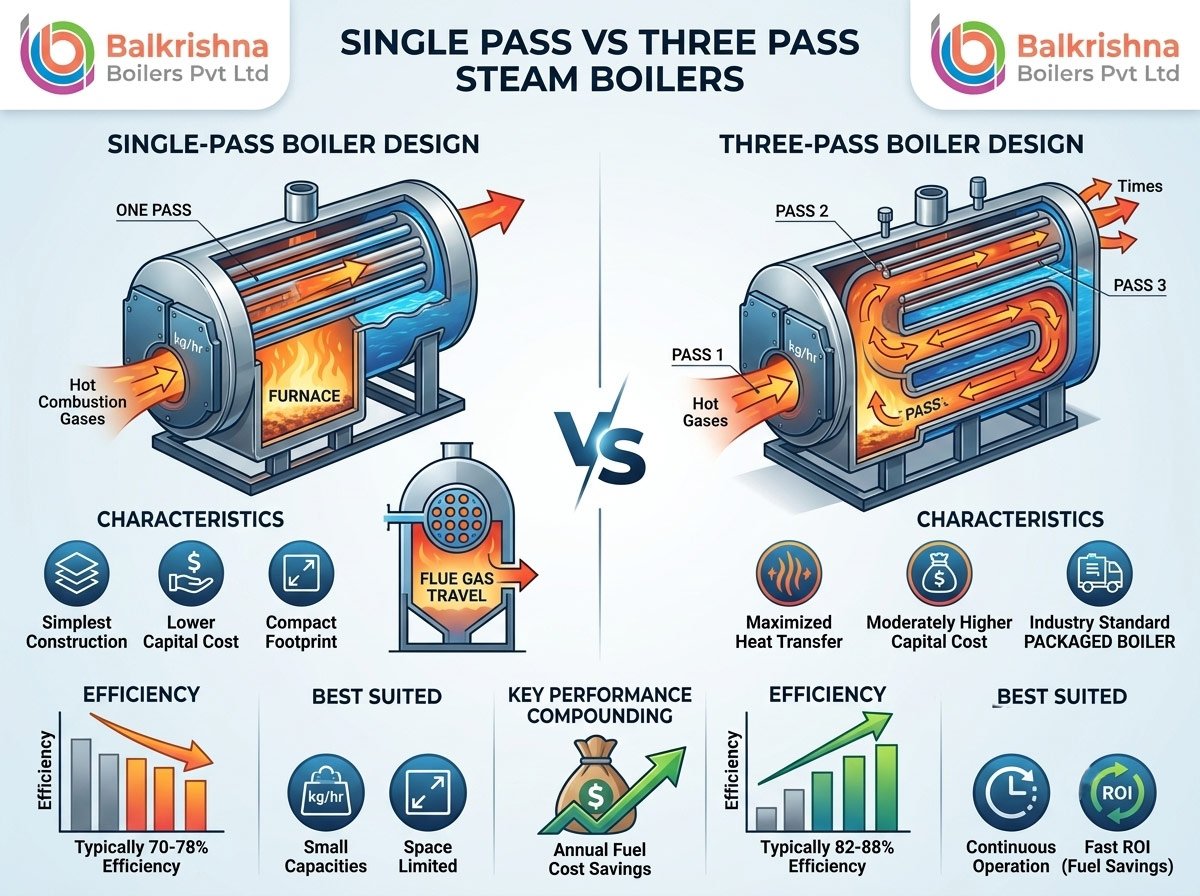
In a fire-tube steam boiler, hot combustion gases travel from the furnace through a series of tubes before exiting through the chimney. A “pass” refers to the number of times these hot flue gases travel the length of the boiler shell before they’re finally released to the atmosphere.
Every time flue gas passes through the boiler, it transfers more of its heat to the surrounding water. The more passes a boiler is designed with, the more opportunities the system has to extract heat from the same volume of fuel before that heat is lost up the chimney — which is exactly why pass design has such a direct impact on fuel efficiency.
Think of it like drying your hands under a hand dryer: one quick pass under the airflow leaves them damp, but three deliberate passes gets them properly dry using the same machine. The heat (or airflow) available doesn’t change — how many times you expose the surface to it does.
Single-Pass Boiler Design
In a single-pass boiler, flue gas travels through the furnace and directly out through the chimney in essentially one direction, with minimal additional heat exchange surface.
Characteristics:
- Simplest construction among fire-tube designs
- Lower fabrication cost
- Compact footprint
- Faster to manufacture and commission
Efficiency profile: Because flue gas exits after a single exposure to the heat exchange surface, a significant portion of usable heat escapes through the chimney unrecovered. Single-pass boilers typically operate at the lower end of the thermal efficiency spectrum compared to multi-pass designs, often requiring supplementary heat recovery equipment to close the efficiency gap.
Best suited for:
- Very small capacity requirements where capital cost is the primary constraint
- Intermittent or non-continuous steam demand
- Applications where space is severely limited
- Situations where a waste heat recovery unit is planned downstream to recapture flue gas heat separately
Two-Pass Boiler Design
A two-pass boiler routes flue gas through the furnace, then back through a second set of tubes before exiting — essentially doubling the heat exchange opportunity compared to a single-pass design.
Characteristics:
- Moderate improvement in efficiency over single-pass
- Slightly larger footprint and higher cost than single-pass
- A reasonable middle ground for specific budget-constrained applications
Two-pass designs are less commonly offered as a standard configuration in the Indian industrial boiler market today, since the jump to three-pass typically delivers a meaningfully better efficiency-to-cost ratio.
Three-Pass Boiler Design
In a three-pass boiler, flue gas travels the length of the boiler shell three separate times before exiting through the chimney — first through the furnace (first pass), then back through a set of tubes (second pass), and forward again through a final set of tubes (third pass) before reaching the flue outlet.
Characteristics:
- Maximizes heat transfer surface area relative to boiler size
- Significantly reduces flue gas exit temperature, meaning less wasted heat
- Higher thermal efficiency, typically in the range of 82–88% depending on fuel and design quality
- Slightly higher fabrication cost and complexity compared to single-pass designs
- Industry-standard configuration for most modern packaged fire-tube boilers
Why three-pass has become the standard: The three-pass configuration strikes a practical balance between manufacturing complexity and efficiency gain. Adding a fourth pass yields diminishing returns relative to the added cost and pressure-drop complexity, which is why three-pass has become the default design across most reputable manufacturers’ packaged boiler ranges — including the majority of models on our own Steam Boiler product category page.
Best suited for:
- Continuous or high-utilization steam demand
- Plants where fuel cost is a significant recurring expense (which is nearly every industrial operation)
- Applications requiring consistent, stable steam output
- Facilities aiming for the fastest possible ROI through fuel savings
Single-Pass vs Three-Pass: Side-by-Side Comparison
| Parameter | Single-Pass | Three-Pass |
|---|---|---|
| Thermal efficiency | Lower (typically 70–78%) | Higher (typically 82–88%) |
| Flue gas exit temperature | Higher (more heat lost) | Lower (more heat recovered) |
| Capital cost | Lower | Moderately higher |
| Fabrication complexity | Simple | Moderate |
| Footprint | Compact | Slightly larger |
| Fuel cost over time | Higher per ton of steam | Lower per ton of steam |
| Payback period on cost difference | N/A | Typically within 12–18 months for continuous operation |
| Best fit | Intermittent, small-scale, budget-constrained use | Continuous industrial operation, most modern applications |
How Pass Design Affects Fuel Consumption
The efficiency difference between single-pass and three-pass boilers isn’t marginal — it compounds significantly over a boiler’s operating life. A boiler running at 75% efficiency requires meaningfully more fuel to produce the same ton of steam as one running at 85% efficiency.
For a plant consuming steam continuously across multiple shifts, this efficiency gap can translate into a substantial annual fuel cost difference — often enough to fully offset the higher upfront cost of a three-pass design within the first year or two of operation. This is precisely why most manufacturers, including Balkrishna Boilers, have shifted their standard packaged boiler range to three-pass construction by default.
If you haven’t yet calculated your plant’s steam demand to determine the right capacity before comparing pass designs, our guide on how to calculate steam boiler capacity for your plant is a useful starting point — pairing accurate capacity sizing with three-pass efficiency typically delivers the strongest overall ROI.
Does Pass Design Apply to Water-Tube Boilers Too?
Pass configuration is primarily a fire-tube boiler concept, since it describes how flue gas travels through tubes surrounded by water. Water-tube boilers, where water flows through the tubes and hot gases circulate around them, use different design principles for heat recovery — typically involving economizers, superheaters, and air pre-heaters arranged in series to extract heat from flue gas before it exits.
That said, the underlying principle is the same: more opportunities for heat exchange between combustion gas and water (or steam) directly translate into higher thermal efficiency, regardless of whether the design is fire-tube or water-tube.
Pass Design Across Different Fuel Types
Pass configuration matters across virtually every fuel type, though its relative efficiency impact varies slightly:
- Oil / Gas Fired Steam Boilers benefit strongly from three-pass design since clean-burning fuels allow for tighter tube spacing and better heat transfer without fouling concerns.
- Biomass-fired boilers, such as those running on rice husk or agro waste, also benefit from three-pass design, though tube spacing must account for slightly higher soot and particulate deposition, requiring more frequent soot blowing to maintain efficiency gains.
- Electric Steam Boilers don’t use pass design in the same sense, since there’s no flue gas to recover heat from — efficiency here is governed by heating element design and insulation instead.
- FBC Solid Fuel Steam Boilers typically incorporate multi-pass principles within their fluidized bed design to maximize heat recovery across a wider range of solid fuels.
You can review capacity and configuration options across our range on the Steam Boiler category page and Electric Boiler category page.
Balkrishna Boilers manufactures three-pass fire-tube designs as standard across most of its steam boiler lineup, including COMBIPOWER, STEAMGEN, STEAMJET, STEAMPOWER, STEAMAX, and HUSKPOWER — you can review the complete range on the Steam Boiler page at balkrishn.com.
Maintenance Considerations for Multi-Pass Boilers
While three-pass boilers deliver better efficiency, the additional tube passes do mean more heat-transfer surface area to keep clean. Soot and scale buildup on any pass reduces the efficiency advantage the design is meant to provide, which makes routine maintenance even more important than on a simpler single-pass unit.
- Schedule regular soot blowing across all tube passes, not just the first.
- Maintain consistent water treatment to prevent scale from negating the efficiency gains of additional heat transfer surface.
- Inspect all pass sections during scheduled shutdowns, since fouling can occur unevenly across passes depending on flue gas flow patterns.
For a broader look at what causes efficiency loss and equipment damage over time, our guide on the top 10 causes of steam boiler breakdown and how to prevent them covers scale, soot, and maintenance discipline in more detail.
Which Should You Choose?
For the overwhelming majority of industrial applications — continuous production, multi-shift operation, and any facility where fuel represents a meaningful ongoing cost — a three-pass boiler is the more sound long-term investment. The higher upfront cost is typically recovered within the first one to two years through fuel savings alone, after which the efficiency advantage continues to compound for the remaining 18+ years of the boiler’s service life.
Single-pass designs still have a place for very small, intermittent, or highly budget-constrained applications, but for most Indian manufacturing, textile, food processing, and pharma operations, three-pass has become the practical default — which is why it’s the standard configuration across most reputable manufacturers’ current product ranges.
Final Thoughts
Pass design might seem like a technical footnote buried in a boiler datasheet, but it has a direct, measurable impact on your fuel bill for the entire lifespan of the equipment. Before finalizing a purchase, always confirm the pass configuration, along with capacity, pressure, and fuel type, since it’s one of the clearest efficiency indicators you can compare across competing quotations.
Explore our full steam boiler range:
- Steam Boiler Product Range – indianboilers.com
- Steam Boiler Product Range – balkrishn.com
- Electric Boiler Range – indianboilers.com
Related reading:
- How to Calculate Steam Boiler Capacity for Your Plant
- How Much Does a Steam Boiler Cost in India? (2026 Price Guide)
- Top 10 Causes of Steam Boiler Breakdown and How to Prevent Them
- What Is an Industrial Steam Boiler?
To discuss which pass configuration and capacity best fits your plant, get in touch with our engineering team for a free technical consultation.
Frequently Asked Questions
What does “three-pass” mean in a steam boiler? It refers to the number of times hot flue gases travel the length of the boiler shell before exiting through the chimney — in a three-pass design, gases pass through three separate tube routes, maximizing heat transfer to the water.
Is a three-pass boiler always more efficient than a single-pass boiler? Generally yes, assuming both are properly maintained. Three-pass boilers typically achieve 82–88% thermal efficiency compared to 70–78% for single-pass designs, since more heat is extracted from the same fuel before flue gas exits.
Is a three-pass boiler more expensive than a single-pass boiler? Yes, three-pass boilers have a moderately higher upfront capital cost due to additional heat exchange surface and construction complexity, but this is typically offset by fuel savings within 12–18 months of continuous operation.
Does pass design apply to water-tube boilers? Pass configuration is primarily a fire-tube boiler concept. Water-tube boilers achieve similar heat recovery goals through economizers, superheaters, and air pre-heaters instead.
Which boiler pass design is best for continuous industrial operation? Three-pass design is generally the better choice for continuous or high-utilization steam demand, since its efficiency advantage compounds significantly over the boiler’s 20+ year service life.
Do electric steam boilers have a pass design? No. Since electric boilers don’t produce flue gas, pass design doesn’t apply — their efficiency depends instead on heating element design and insulation quality.