
Ask any experienced boiler operator what single habit protects a boiler more than anything else, and most will point to one word: blowdown. It’s not glamorous, it doesn’t show up on a spec sheet, and it’s one of the first things to get skipped when a plant is running behind schedule — which is exactly why it’s also one of the most common root causes of preventable boiler damage.
This guide explains what blowdown actually does, the different types of blowdown, how to calculate the right frequency for your plant, and the real cost of skipping it.
What Is Boiler Blowdown?
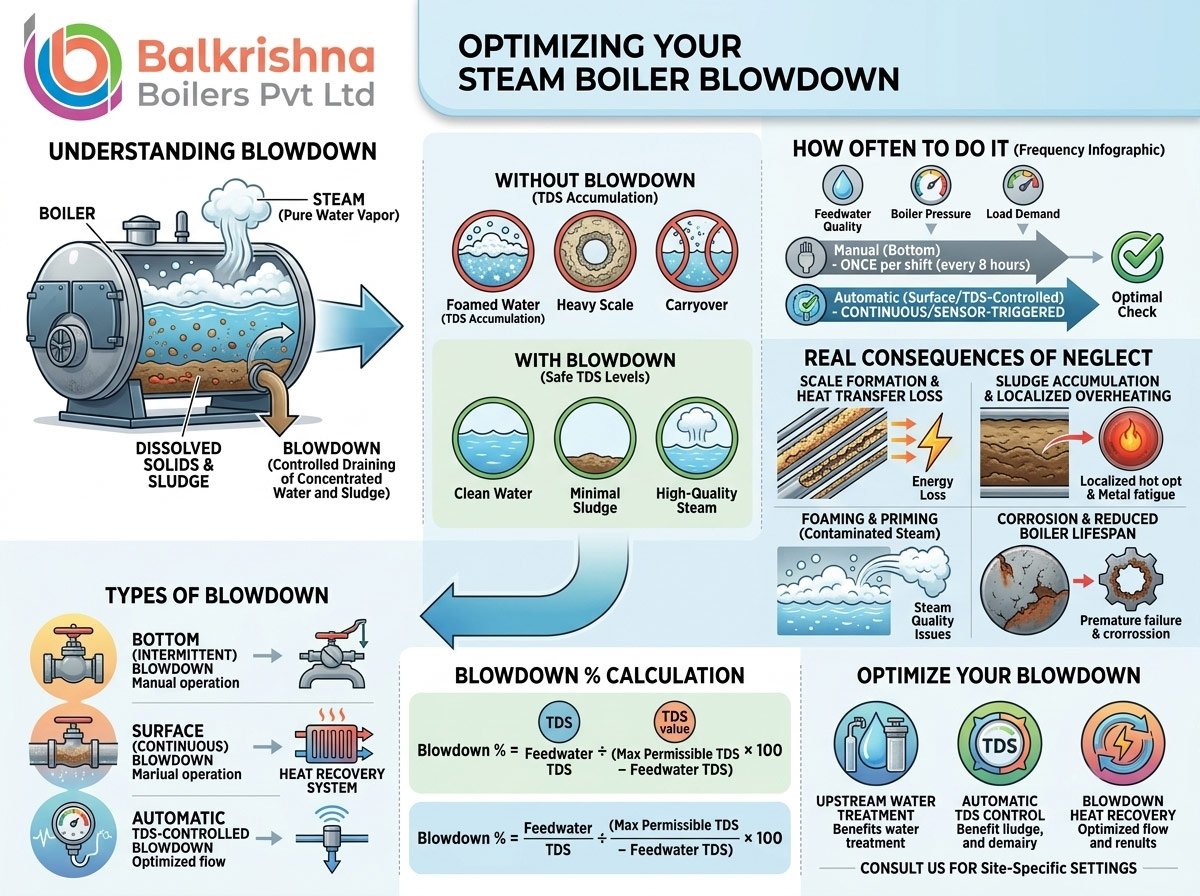
As water inside a boiler evaporates into steam, it leaves behind dissolved solids, suspended particles, and sludge that were present in the original feedwater. Over time, these impurities concentrate in the remaining boiler water, since only pure water vapor leaves as steam while the dissolved minerals stay behind.
Blowdown is the deliberate, controlled process of draining a portion of this concentrated boiler water, along with the sludge that settles at the bottom of the vessel, and replacing it with fresh, treated feedwater. It’s essentially how a boiler “flushes out” the impurities that would otherwise accumulate indefinitely.
Without blowdown, dissolved solids concentration (measured as TDS — Total Dissolved Solids) would keep climbing until it caused foaming, scale formation, corrosion, and carryover into the steam line.
Why Blowdown Matters: The Real Consequences of Skipping It
1. Scale Formation and Heat Transfer Loss
As TDS concentration rises, dissolved minerals are more likely to precipitate out and deposit as scale on heat-transfer surfaces. Scale acts as an insulating layer, forcing the boiler to burn more fuel to achieve the same steam output. Just 1 mm of scale can increase fuel consumption by 7–10%, and persistent scale buildup is one of the most common paths toward tube failure.
2. Sludge Accumulation and Localized Overheating
Suspended solids and sludge settle at the bottom of the boiler shell, particularly around the lowest heat-transfer surfaces. This sludge layer insulates the metal beneath it from the cooling effect of water contact, creating localized hot spots that can lead to metal fatigue and eventual failure.
3. Foaming and Priming
High TDS concentration increases the surface tension characteristics of boiler water, making it more prone to foaming. Foam can carry over into the steam line along with water droplets — a phenomenon called priming or carryover — contaminating downstream equipment, damaging valves and turbine blades, and reducing overall steam quality.
4. Corrosion
Certain dissolved solids and chemical byproducts become more corrosive as they concentrate. Left unmanaged, this accelerates internal corrosion of tubes, headers, and the shell, thinning metal walls over time and reducing the boiler’s safe pressure-holding capacity.
5. Reduced Boiler Lifespan
Every one of the above effects compounds over months and years of operation. A boiler that receives consistent, correctly calculated blowdown can reach its full 20–25 year design life, while one with neglected blowdown often requires major repairs or premature replacement well before that point. Our guide on the top 10 causes of steam boiler breakdown covers blowdown neglect as one of the leading preventable failure causes in more detail.
Types of Boiler Blowdown
Bottom Blowdown (Intermittent Blowdown)
This is the most common form, involving a manual or automated valve at the lowest point of the boiler shell that’s opened periodically to flush out settled sludge and suspended solids. It’s typically performed once or more per shift.
Surface Blowdown (Continuous Blowdown)
Surface blowdown draws water from just below the water’s surface, where dissolved solids concentrate most heavily, and continuously bleeds off a small, steady stream of water. This is more common in larger or higher-pressure boilers and is often paired with a heat recovery system to capture and reuse the heat energy in the blown-down water, improving overall efficiency.
Automatic TDS-Controlled Blowdown
Modern boiler systems can incorporate automatic TDS sensors that continuously monitor dissolved solids concentration and trigger blowdown only when needed, rather than on a fixed manual schedule. This approach optimizes both water and fuel usage compared to a purely time-based routine, since blowdown only occurs when actual water chemistry requires it.
How Often Should You Blow Down Your Boiler?
The right blowdown frequency depends on your feedwater quality, boiler operating pressure, and load pattern — there’s no single universal number, but general industry guidance provides a solid starting point:
General recommendation: Bottom blowdown at least once per shift (every 8 hours) for most industrial boilers running on treated feedwater.
Higher-frequency triggers:
- Feedwater with higher-than-average hardness or TDS content
- Boilers operating at higher pressure, where water chemistry has a proportionally greater impact
- Periods of increased steam demand or load variability
- Facilities without automated softening or demineralization, relying more heavily on blowdown to manage water quality
Lower-frequency scenarios:
- Boilers fed with high-quality, pre-treated demineralized water, which naturally requires less frequent blowdown to maintain safe TDS levels
- Systems with continuous surface blowdown already actively managing TDS, reducing the need for aggressive bottom blowdown
How to Calculate Blowdown Rate
For plants wanting a more precise, engineering-based approach rather than a fixed schedule, blowdown rate can be calculated using feedwater and boiler water TDS values:
Blowdown % = Feedwater TDS ÷ (Maximum Permissible Boiler Water TDS − Feedwater TDS) × 100For example, if your feedwater TDS is 200 ppm and your boiler’s maximum permissible TDS is 3,000 ppm:
Blowdown % = 200 ÷ (3,000 − 200) × 100 = 7.1%This means approximately 7.1% of your feedwater input needs to be blown down to keep boiler water TDS within safe limits. Boilers with poor-quality feedwater will require a significantly higher blowdown percentage — which is exactly why upgrading your water treatment system, rather than simply blowing down more aggressively, is often the more cost-effective long-term solution. Our guide on how to calculate steam boiler capacity for your plant is a useful companion reference if you’re revisiting your overall boiler sizing and water balance at the same time.
The Efficiency Trade-Off: Blowdown vs Fuel and Water Waste
It’s worth acknowledging that blowdown isn’t “free” — every liter of water blown down carries heat energy with it, which represents a real fuel cost if that heat isn’t recovered. This is why the goal isn’t to maximize blowdown frequency, but to calibrate it precisely to what your water chemistry actually requires.
Ways to minimize blowdown-related energy loss:
- Install a blowdown heat recovery system that uses the heat in blown-down water to pre-heat incoming feedwater, recovering a meaningful portion of what would otherwise be wasted energy.
- Improve upstream water treatment (softening or demineralization) to reduce the required blowdown percentage in the first place.
- Switch from fixed-schedule manual blowdown to automatic TDS-controlled blowdown, avoiding both under- and over-blowing.
Plants that combine proper water treatment with a calibrated, TDS-based blowdown approach typically achieve the best balance between boiler protection and fuel efficiency.
Blowdown Considerations by Fuel and Boiler Type
Blowdown discipline matters across every boiler type, though the practical considerations shift slightly:
- Oil / Gas Fired Steam Boilers typically operate at more consistent loads, making scheduled blowdown intervals easier to standardize.
- Biomass-fired boilers, running on fuels like rice husk or agro waste, often see more variable steam demand, which can make automatic TDS-controlled blowdown particularly valuable for maintaining consistent water quality.
- Electric Steam Boilers still require regular blowdown despite having no combustion-related fouling, since dissolved solids concentrate in the water regardless of heat source.
- High-capacity industrial boilers, such as our High Pressure Industrial Steam Boiler – 750 Kg/hr, often benefit most from continuous surface blowdown paired with heat recovery, given the larger absolute volumes of water and heat involved.
You can browse capacity and configuration options across our full lineup on the Steam Boiler category page and Electric Boiler category page.
Balkrishna Boilers’ engineered range — including COMBIPOWER, STEAMGEN, STEAMJET, STEAMPOWER, HUSKPOWER, and VEPOMAX — can be configured with both manual and automated blowdown systems depending on your plant’s requirements. The complete range is available on the Steam Boiler page at balkrishn.com.
Building Blowdown Into Your Maintenance Routine
Blowdown shouldn’t be a task that depends on whether an operator “remembers” during a busy shift — it needs to be a documented, non-negotiable part of your daily operating procedure:
- Assign clear responsibility for blowdown to a specific role per shift, not a general “someone will do it” expectation.
- Log every blowdown event, including time, duration, and any observations about water condition, so patterns and anomalies can be tracked over time.
- Test boiler water TDS regularly, not just when a problem is suspected, to validate whether your current blowdown frequency is actually sufficient.
- Include blowdown valve inspection in your scheduled maintenance, since a sticking or leaking blowdown valve can silently waste water and energy, or fail to function when needed.
- Train new operators specifically on blowdown procedure, including correct duration and technique, since improper technique can be as ineffective as skipping it altogether.
Common Mistakes With Blowdown
- Skipping blowdown during high-production periods to “save time” — this is precisely when boiler water quality needs the most attention, not the least.
- Blowing down for too short a duration, removing only surface water without adequately clearing settled sludge from the bottom.
- Relying purely on a fixed schedule without ever testing actual water TDS, missing situations where feedwater quality has changed.
- Not recovering blowdown heat, leaving fuel savings on the table unnecessarily.
- Ignoring blowdown valve maintenance, leading to valves that stick open (wasting water and heat) or fail to open properly (allowing sludge to accumulate).
Final Thoughts
Blowdown is one of the simplest, lowest-cost habits available to protect a significant capital investment — yet it’s routinely deprioritized under production pressure. The plants that get the longest service life and the most consistent efficiency from their boilers are, without exception, the ones that treat blowdown as a disciplined, logged, non-negotiable part of daily operations rather than an occasional afterthought.
Explore our full steam boiler range:
- Steam Boiler Product Range – indianboilers.com
- Steam Boiler Product Range – balkrishn.com
- Electric Boiler Range – indianboilers.com
Related reading:
- Top 10 Causes of Steam Boiler Breakdown and How to Prevent Them
- Steam Boiler Pressure Settings: A Practical Guide for Operators
- How to Calculate Steam Boiler Capacity for Your Plant
- What Is an Industrial Steam Boiler?
For help setting up the right blowdown and water treatment routine for your plant, get in touch with our engineering team for a free technical consultation.
Frequently Asked Questions
How often should a steam boiler be blown down? Most industrial boilers should be bottom-blown down at least once per shift (every 8 hours), though the exact frequency depends on feedwater quality, operating pressure, and load pattern.
What is the difference between bottom blowdown and surface blowdown? Bottom blowdown removes settled sludge and suspended solids from the lowest point of the boiler and is typically intermittent. Surface blowdown draws water from just below the surface, where dissolved solids concentrate, and is often run continuously in larger or higher-pressure systems.
What happens if I skip boiler blowdown? Skipping blowdown allows dissolved solids and sludge to accumulate, leading to scale formation, localized overheating, foaming and carryover, accelerated corrosion, and ultimately a shortened boiler lifespan.
Does blowdown waste fuel and water? Yes, to some extent, since blown-down water carries heat energy with it. This can be minimized with a blowdown heat recovery system, improved water treatment to reduce required blowdown frequency, and automatic TDS-controlled blowdown instead of a fixed manual schedule.
Can blowdown be automated? Yes. Automatic TDS-controlled blowdown systems monitor dissolved solids concentration in real time and trigger blowdown only when needed, optimizing both water usage and fuel efficiency compared to a fixed schedule.
How do I calculate the correct blowdown percentage for my boiler? Blowdown percentage can be calculated using the formula: Feedwater TDS ÷ (Maximum Permissible Boiler Water TDS − Feedwater TDS) × 100. Your boiler manufacturer or water treatment provider can help apply this to your specific feedwater and boiler design parameters.