
Food processing has a heating requirement most other industries don’t: the heat source has to be indirect, precisely controlled, and never allowed to contaminate the product. Water and steam carry risks of contamination, scaling, and microbial growth if not treated rigorously. That’s a large part of why so many food plants — from edible oil refineries to snack manufacturers — run their frying, baking, and drying lines on thermic fluid heaters instead.
This piece covers where thermic fluid heating fits across food processing, why the technology suits the industry’s hygiene and precision requirements, and what to think through when specifying a system for a food plant.
Why Food Processors Choose Thermic Fluid Over Steam
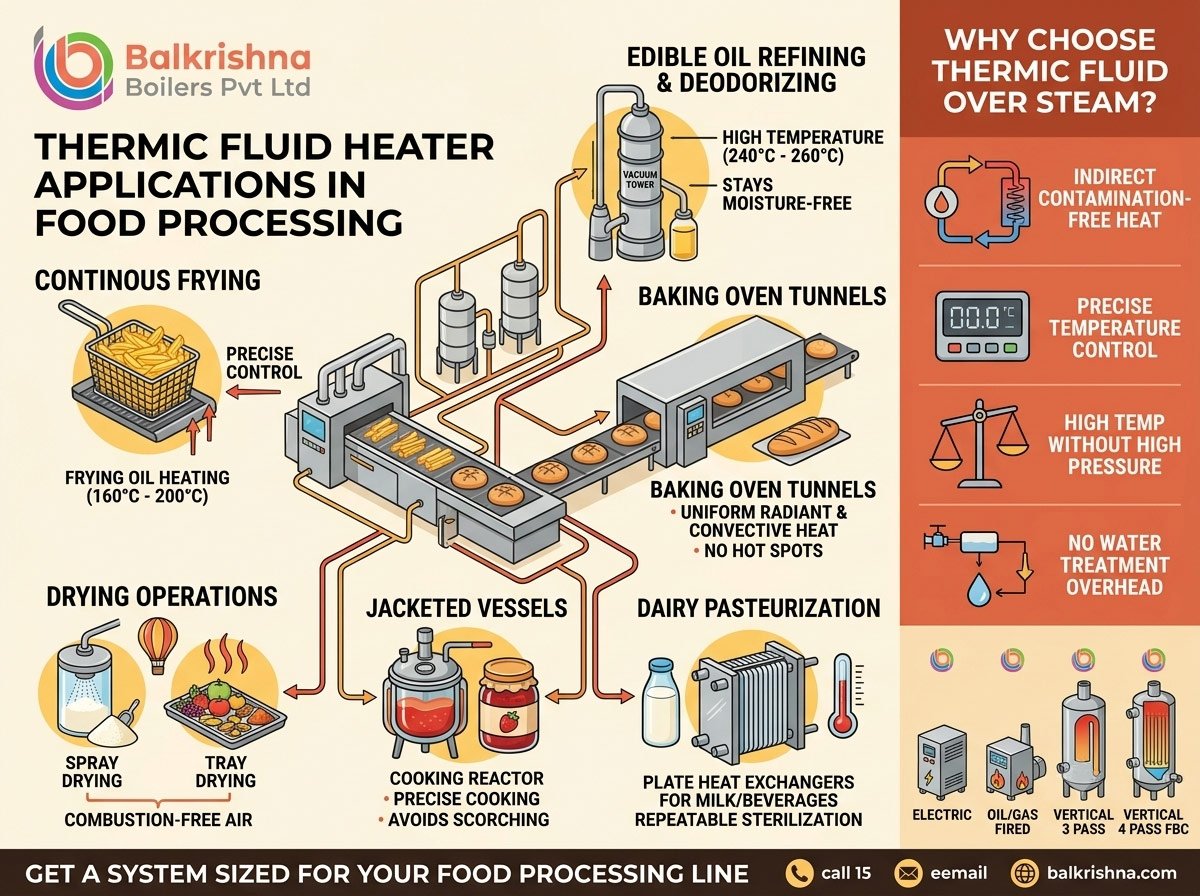
Indirect, contamination-free heat transfer. In a thermic fluid system, the heat transfer fluid never contacts the food product directly — it circulates in a fully closed loop through a jacket, coil, or heat exchanger, transferring heat indirectly to the process medium (oil, air, or water) that actually touches the product. There’s no risk of boiler water treatment chemicals, scale, or condensate reaching food-contact surfaces, which matters enormously under FSSAI and international food-safety audits.
Precise, uniform temperature control. Frying oil that runs even a few degrees too hot degrades faster and darkens the product; a baking oven with uneven heat distribution produces inconsistent color and texture across a batch. Because thermal fluid stays liquid throughout the circuit rather than flashing to steam, it delivers steady, evenly distributed heat without the temperature spikes that can occur as steam condenses unevenly across a heat exchanger.
High temperature without high pressure. Many food processes — deep frying, oil deodorizing, certain drying operations — need sustained temperatures in the 180°C to 260°C range. Reaching those temperatures with steam means operating at very high pressure, with the associated safety systems, IBR compliance, and certified-attendant requirements that come with it. A thermic fluid heater reaches the same range at near-atmospheric pressure. Our detailed explanation of the underlying principle is in what a thermic fluid heater is and how it’s used.
No water treatment overhead. Food plants running steam boilers carry the ongoing cost and complexity of feedwater treatment, blowdown, and softener maintenance. A closed-loop thermal fluid system sidesteps all of that, which is a meaningful operating-cost difference for a plant running continuous shifts.
Deep Frying Systems
Continuous fryers for snacks, namkeen, chips, and similar products are one of the most common thermic fluid applications in Indian food processing. The heater circulates hot thermal fluid through a jacket or coil around the frying vessel, indirectly heating the frying oil to a tightly held setpoint — typically in the 160°C to 200°C range depending on the product.
The precision matters directly to product quality and cost: frying oil held too cool absorbs more oil into the product (raising both cost and calorie count), while oil run too hot degrades faster, darkens, and needs more frequent replacement. A well-controlled thermic fluid circuit holds the frying temperature within a narrow band across a full production run, which is difficult to achieve consistently with direct gas-fired frying.
Edible Oil Refining and Deodorizing
Oil refineries use thermic fluid heaters extensively across the refining process — degumming, bleaching, and particularly deodorization, which requires sustained high temperatures (often 240°C to 260°C) under vacuum to strip off odor compounds without degrading the oil.
Because deodorization runs at temperatures where steam would require dangerously high pressure, thermic fluid is close to the industry standard here. The closed-loop system also avoids introducing any moisture into a process where water contamination in the oil stream is a real quality concern.
Baking and Confectionery Ovens
Industrial biscuit, bread, and confectionery ovens frequently use thermal fluid-heated tubes or panels to deliver even radiant and convective heat across long oven tunnels. Getting uniform color and texture across a wide baking surface depends on eliminating hot and cold zones, and a well-distributed thermal fluid circuit — with the fluid itself staying at a stable, non-fluctuating temperature — supports that consistency better than direct-fired zones that can vary batch to batch.
Drying Operations
Spray drying (for milk powder, instant coffee, and similar products), tray drying for fruits and spices, and rotary drying for grains and pulses all rely on hot air generated from a heat source. Many plants pair a thermic fluid heater with an air-heating battery or heat exchanger to produce the hot air stream, rather than heating air directly over an open flame, which keeps combustion byproducts entirely out of the airstream that will contact the food product — an important consideration for products that will be consumed without further high-heat processing.
Dairy and Beverage Processing
Pasteurization, sterilization, and process heating for dairy products, juices, and other beverages need precise, repeatable temperature control, since both under- and over-heating have direct food-safety and quality consequences. Thermic fluid-heated plate or tubular heat exchangers are used across many dairy and beverage lines for exactly this reason — the fluid circuit maintains a stable heat source that the process control system can regulate tightly against pasteurization or sterilization set points.
Jacketed Vessels and Reactors
Cooking vessels, evaporators, and reaction vessels for sauces, jams, extracts, and other processed food products commonly use thermic fluid-jacketed vessels rather than direct steam jackets. The indirect heat transfer avoids the scorching risk that can come from direct steam contact on vessel walls, and gives finer control over the cooking temperature — important for products where texture and flavor development depend on a controlled, gradual heat profile rather than a sharp temperature spike.
Thermic Fluid vs. Steam for Food Plants: What Actually Decides It
Food processors weighing thermic fluid against a conventional steam boiler are usually deciding based on a few concrete factors:
- Process temperature required. Anything comfortably below 100°C (most washing, low-temperature cooking) often still makes sense on steam or hot water. Once a process needs sustained heat above roughly 150°C — frying, deodorizing, high-temperature drying — thermic fluid’s low-pressure advantage becomes decisive.
- Compliance and safety overhead. Steam systems operating at high pressure fall under IBR requirements, needing certified attendants and regular statutory inspection. Thermic fluid heaters generally sit outside that scope, which matters for plants trying to minimize compliance complexity.
- Water quality and treatment cost. Plants in areas with hard or poor-quality water face a real ongoing cost in steam boiler feedwater treatment. A closed thermal fluid loop makes that cost largely disappear for the processes it serves.
- Multi-process flexibility. A single thermic fluid heater can often serve several different processes — frying, a jacketed vessel, and an air-heating battery — off one common header, where a steam system would need separate pressure-reducing stations for each.
For a full breakdown of these trade-offs, see our comparison: Thermic Fluid Heater vs Steam Boiler: Which Suits Your Process?
Hygiene and Food-Safety Considerations Specific to Thermic Fluid Systems
A few points worth building into your plant’s SOPs when running thermic fluid heating on food lines:
- Choose a food-industry-appropriate thermal fluid grade. While the fluid itself never contacts the food product in a properly designed indirect system, plants should still specify fluid and system design with enough integrity — welded joints, minimal flange count on food-adjacent circuits — that even a hypothetical leak has no path to a food-contact surface.
- Maintain leak-tight jackets and heat exchangers. Because the entire hygiene argument for thermic fluid rests on the closed loop staying closed, leak inspection on any jacket, coil, or heat exchanger touching a food-contact surface should be part of your regular maintenance routine — not just general system upkeep.
- Keep fluid analysis current. Oxidized or degraded thermal fluid doesn’t directly touch the food, but a badly managed fluid circuit is more prone to leaks and reduced heat transfer, both of which have downstream food-safety and quality implications. A fluid analysis every six months, and the daily-to-annual maintenance discipline covered in how to maintain a thermic fluid heater for long service life, keeps the system in the condition food-safety audits expect.
If you’re already seeing inconsistent frying, drying, or process temperatures on a running line, our guide to common thermic fluid heater problems and their solutions is a good starting point for narrowing down the cause before it affects product quality.
Sizing a Thermic Fluid Heater for a Food Plant
A few food-industry-specific factors matter when specifying capacity:
- Batch vs. continuous demand. Continuous fryers and dryers need steady sustained output; batch cooking vessels have peak demand at the start of each heating cycle. Sizing needs to account for realistic peak overlap if multiple processes share one heater.
- Process temperature range. Frying and baking typically sit in the 160°C–220°C range, while deodorizing and some drying operations push to 250°C+. Fluid selection should match the highest temperature any part of the system will see — our thermic fluid heater oil selection guide covers matching fluid grade to operating temperature.
- Fuel availability and cost. Many food plants prefer gas-fired systems for the cleaner combustion profile, though electric and biomass options are increasingly common depending on regional fuel economics and sustainability targets.
Our Thermic Fluid Heater Range for Food Processing
At Balkrishna Boilers Pvt Ltd, we’ve supplied thermic fluid heating systems across frying, baking, drying, and oil refining applications for food processors in India and overseas. Depending on your fuel preference and capacity requirement, our range includes:
- Electric Thermic Fluid Heater — clean, precise heating with no combustion byproducts near the process area.
- Oil / Gas Fired Thermic Fluid Heater — our most widely used configuration for mid-to-large food processing loads.
- Vertical Three Pass Oil / Gas Fired Thermic Fluid Heater — a compact footprint option for space-constrained food plants.
- Vertical Four Pass FBC Thermic Fluid Heater — for processors looking to run on biomass or solid fuel for cost efficiency at scale.
Get a System Sized for Your Food Processing Line
Whether you’re setting up a new frying, baking, or drying line, or replacing an aging steam system to cut compliance overhead, our technical team can size a thermic fluid heater around your actual process temperature and hygiene requirements. Get in touch with your process type, capacity, and target temperature, and we’ll put together a proposal.