
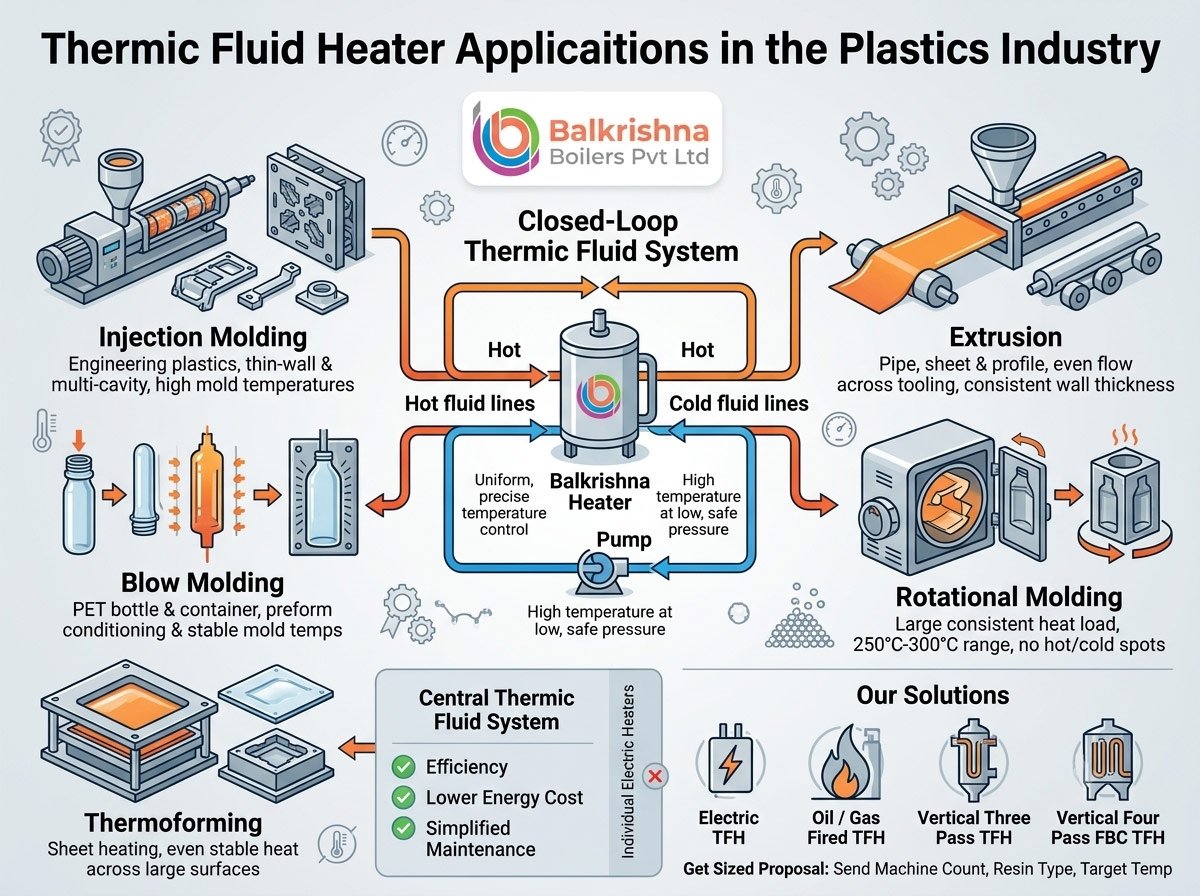
Plastics processing runs on temperature control. A few degrees too hot or too cold at the mold, the die, or the roller, and you’re looking at warping, uneven wall thickness, poor surface finish, or a batch that simply doesn’t hold dimension. It’s one of the few industries where the heating system isn’t a background utility — it’s directly wired into product quality, and that’s exactly why so many plastics processors have moved from electric cartridge heaters and steam to thermic fluid heaters for their core processes.
This piece looks at where thermic fluid heaters fit across plastics manufacturing, why the technology suits the industry’s specific demands, and what to consider when sizing a system for a plastics line.
Why Plastics Processors Choose Thermic Fluid Over Steam or Electric
Three characteristics make thermic fluid heating a natural fit for plastics work, and they show up in almost every application on this page.
Uniform, precise temperature control. Plastics processes are unforgiving about temperature swings — a mold running 8–10°C hotter on one side than the other shows up directly as warping or sink marks in the finished part. Because thermal fluid stays in the liquid phase throughout the circuit, it delivers even, controllable heat to the mold or die without the temperature gradients that steam systems can introduce as condensate forms.
High temperature at low, safe pressure. Many plastics processes — particularly PET preform heating, some engineering polymer extrusion, and certain mold-heating applications — need temperatures in the 180°C to 300°C range. Getting steam to those temperatures means operating at extremely high pressure, with all the safety and compliance overhead that comes with it. A thermic fluid heater reaches the same temperature range at near-atmospheric pressure, which is a large part of why the technology has become close to standard across the industry. We cover the underlying physics of this in our guide on what a thermic fluid heater is and how it’s used.
Closed-loop efficiency. Unlike steam, which loses energy through blowdown and condensate discharge, a closed thermal fluid loop retains nearly all its heat within the circuit, cycling between the heater and the process equipment. For plastics plants running multiple molding or extrusion lines off a common thermal fluid header, that efficiency compounds significantly over a production year.
Injection Molding: Mold Temperature Control
Injection molding is one of the most temperature-sensitive processes in all of manufacturing, and mold temperature control units (often called MTCs) are frequently run on thermal fluid rather than water or electric heating — especially for engineering plastics and any mold running above the practical limit of water-based systems (around 90–95°C).
A thermic fluid heater supplying a central mold-heating circuit lets a plant maintain consistent mold surface temperatures across multiple cavities and multiple machines from a single, well-instrumented source, rather than relying on individual electric heater bands on each mold. This matters for:
- Engineering plastics (polycarbonate, nylon, ABS blends) that require higher mold temperatures than commodity resins to achieve proper flow and surface finish.
- Thin-wall and high-precision parts, where uneven mold temperature translates directly into dimensional variance.
- Multi-cavity tooling, where balancing temperature across cavities by hand with electric heaters becomes impractical at scale.
Extrusion: Die and Roller Heating
In pipe, sheet, and profile extrusion, the die and downstream calibration/roller systems need to hold a steady temperature to keep material flowing evenly and prevent surface defects.
Thermic fluid circuits are widely used to heat extrusion dies and the polishing/calibration rollers in sheet lines, because the fluid can be routed through internal channels in the die body or roller shell to deliver even heat across the full width of the tooling — something far harder to achieve consistently with electric band heaters on wide dies. For PVC, PP, and PE profile and pipe extrusion in particular, thermal-fluid-heated dies are common in mid-to-large scale operations where consistent wall thickness across the profile is a quality requirement, not a nice-to-have.
Blow Molding: Preform and Mold Heating
PET bottle and container manufacturing relies on precise thermal conditioning at two stages — preform reheat (often IR-based, but supported by thermal fluid in some line configurations) and blow mold temperature control, where the mold itself needs to be held at a stable, moderate temperature to set the material correctly as it’s blown into shape.
For extrusion blow molding of HDPE and similar resins, thermal fluid-heated molds help maintain dimensional consistency across long production runs, particularly for larger containers where mold mass makes temperature swings slower to correct if the heating source isn’t stable.
Rotational Molding: Oven and Mold Heating
Rotomolding is one of the plastics processes where thermal mass and even heat distribution matter most — the mold rotates biaxially inside an oven while the resin melts and coats the interior surface, and any hot or cold spot in the oven shows up as thickness variation in the final part.
Thermic fluid-heated rotomolding ovens are common because the technology delivers the large, consistent heat load rotomolding demands (ovens often run in the 250°C–300°C range) without the pressure and safety overhead that steam would require at that temperature, and without the maintenance load of a large bank of electric elements exposed to constant thermal cycling.
Thermoforming: Sheet Heating
Thermoforming needs the plastic sheet heated to a narrow, even temperature window before it’s formed against a mold — too cold and the sheet won’t form correctly, too hot and it sags or degrades. Thermal-fluid-heated platens and radiant panels are used in many thermoforming lines for exactly the same reason they’re used in mold heating elsewhere: even, stable, well-controlled heat across a large surface area.
Calendering and Compounding
For plants that calender PVC or rubber-plastic compounds into sheet, and for compounding lines that mix and heat resin with additives before pelletizing, thermic fluid is used to heat the roll stacks and mixing chambers. The requirement here is similar to extrusion — a large thermal mass that needs to be held at a stable process temperature for hours of continuous running, which plays to the strengths of a closed-loop thermal fluid system rather than intermittent electric heating.
Central Thermal Fluid Systems vs. Standalone Electric Heaters
A question we hear often from plastics processors expanding capacity: is it worth centralizing on a thermic fluid system, or should each machine keep its own electric mold-temperature controller?
The trade-off generally comes down to scale and consistency requirements:
- Standalone electric heaters are simpler to install machine-by-machine and make sense for smaller operations or a single specialized line with unique temperature needs.
- A central thermic fluid system pays off once you’re running multiple molding, extrusion, or forming lines that can share one well-controlled heat source — you get tighter cross-machine consistency, lower total energy cost since one large, efficient heater replaces many smaller resistive elements, and simpler maintenance since there’s one fluid circuit and one heater to service instead of dozens of heater bands and controllers scattered across the shop floor.
If you’re weighing thermal fluid against steam specifically rather than electric, our detailed breakdown in Thermic Fluid Heater vs Steam Boiler: Which Suits Your Process? covers the safety, cost, and operational differences in more depth.
Sizing a Thermic Fluid Heater for a Plastics Line
A few plastics-specific factors matter when sizing and specifying a system, beyond the general capacity (kcal/hr) calculation:
- Peak simultaneous demand across machines. If several molding or extrusion lines draw from a shared header, size for realistic peak overlap, not just the sum of every machine’s nameplate demand — plants rarely run every line at maximum thermal draw at the same instant, and oversizing adds unnecessary capital cost.
- Temperature range required. Mold heating for commodity resins might only need 80–120°C, while engineering plastics, rotomolding ovens, and some die-heating applications push into the 200–300°C range. This affects both heater sizing and fluid selection — a fluid rated for 300°C is a different specification than one suited to 120°C service, and using the wrong grade shortens fluid life significantly. Our thermic fluid heater oil selection guide walks through matching fluid to operating temperature.
- Response time requirements. Processes with frequent temperature setpoint changes (multi-product lines running different resins through the day) benefit from a heater and control system sized with enough headroom to ramp quickly, rather than one running near its maximum output continuously.
- Fuel availability at the plant. Electric, gas, oil, and biomass-fired options each shift the economics differently depending on local utility costs — worth working through with your supplier’s technical team before finalizing a specification.
Keeping a Plastics-Line Thermic Fluid Heater Running Reliably
Plastics processing runs continuous shifts more often than most industries, which means the heater rarely gets a natural pause for inspection. That makes disciplined maintenance even more important than in batch-process industries. Coil fouling, fluid oxidation, and flow imbalance across multiple machines sharing one header are the most common issues we see on plastics-line thermal fluid systems — all of which are covered in detail, with a full daily-to-annual checklist, in how to maintain a thermic fluid heater for long service life. If you’re already troubleshooting inconsistent mold or die temperature on a running line, our guide to common thermic fluid heater problems and their solutions is a good place to start narrowing down the cause.
Our Thermic Fluid Heater Range for Plastics Applications
At Balkrishna Boilers Pvt Ltd, we’ve supplied thermic fluid heating systems to plastics processors running injection molding, extrusion, and rotomolding lines across India. Depending on your fuel preference and capacity requirement, our range includes:
- Electric Thermic Fluid Heater — for plants prioritizing simple installation and no combustion infrastructure.
- Oil / Gas Fired Thermic Fluid Heater — our most common configuration for mid-to-large plastics processing loads.
- Vertical Three Pass Oil / Gas Fired Thermic Fluid Heater — a compact footprint option for plants with limited floor space.
- Vertical Four Pass FBC Thermic Fluid Heater — for processors looking to run on solid fuel for cost efficiency at scale.
Get a System Sized for Your Plastics Line
Whether you’re setting up a new molding or extrusion line, or replacing a bank of electric mold heaters with a centralized thermal fluid system, our technical team can size a heater around your actual process temperature and simultaneous demand rather than a generic capacity chart. Get in touch with your machine count, resin type, and target mold or die temperature, and we’ll put together a proposal.