
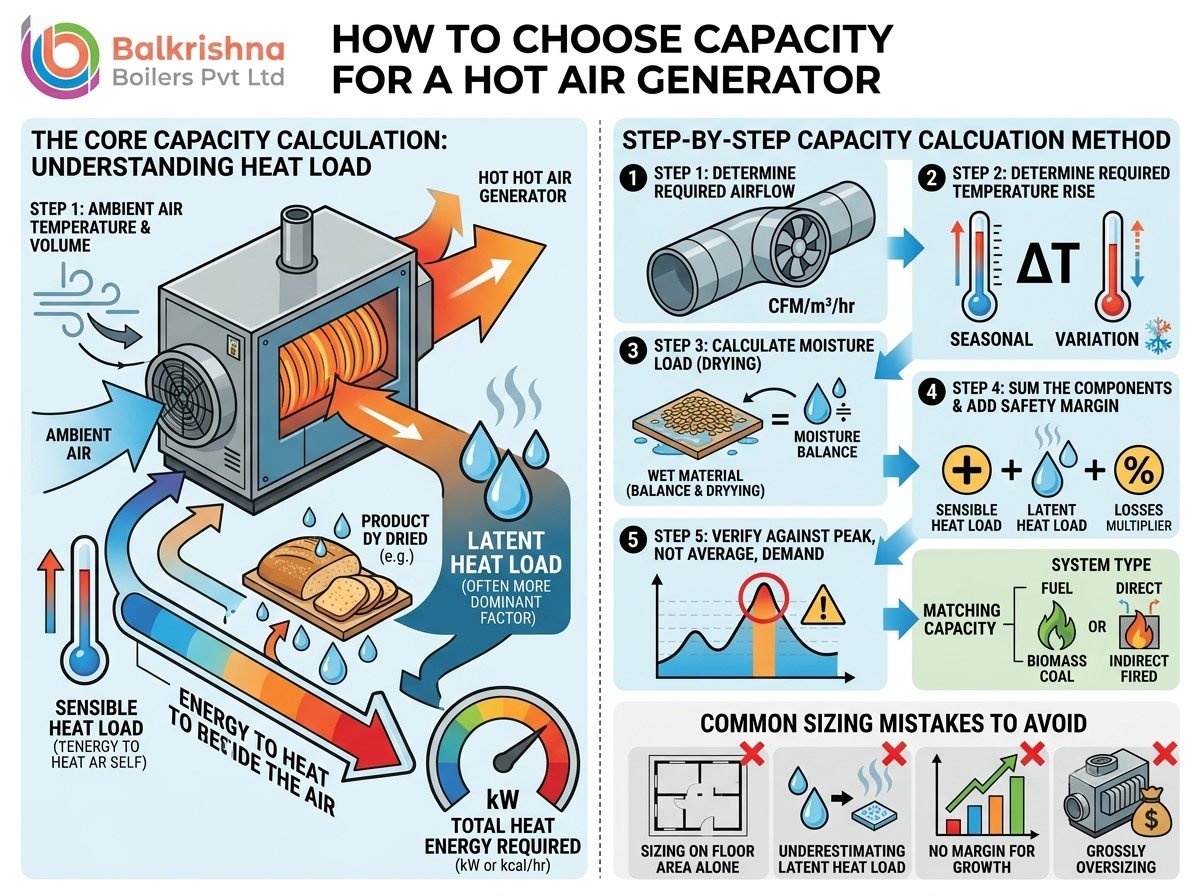
Capacity is the single most consequential specification decision when purchasing a hot air generator — and one of the most commonly gotten wrong. An undersized system can’t meet peak demand, forcing longer processing cycles, inconsistent product quality, and production bottlenecks during your busiest periods. An oversized system runs inefficiently at partial load for most of its life, carries unnecessary upfront capital cost, and can even make precise low-temperature control more difficult.
This guide walks through exactly how to calculate the correct capacity for your application — whether that’s drying, curing, or general process air heating — so you can specify a system sized around your plant’s actual demand, not a rough guess.
1. Why Capacity Sizing Gets Rushed — And Why That’s a Mistake
Many capacity decisions are made based on matching the previous system’s rating, copying a nearby plant’s specification, or accepting a supplier’s recommendation without independently verifying it against actual process data. This approach works fine when conditions haven’t changed — but production volumes grow, product mixes shift, and processes evolve, meaning a specification that worked five years ago may no longer match current or planned future demand.
Correct sizing starts with understanding your actual heat and airflow requirements from first principles, not from historical precedent alone.
2. The Core Capacity Calculation: Understanding Heat Load
At its foundation, hot air generator capacity sizing comes down to calculating the total heat energy required per unit time (typically expressed in kcal/hr or kW) to achieve your process outcome. This has several components:
A. Sensible Heat Load
The energy required to raise the temperature of the air itself (and, indirectly, the product) from ambient to the target process temperature. This depends on the airflow volume required and the temperature rise needed.
B. Latent Heat Load (For Drying Applications)
For any drying, dehydration, or moisture-removal process, a significant additional heat load comes from evaporating moisture from the product — roughly 540-580 kcal per kilogram of water evaporated, depending on the specific evaporation conditions. For most drying applications, this latent heat load is actually larger than the sensible heat load, making it the dominant factor in capacity sizing.
C. System and Distribution Losses
Heat lost through ducting (even when insulated), chamber radiation losses, and air leakage all add to the total capacity the generator needs to supply beyond the theoretical minimum calculated from sensible and latent loads alone.
3. Step-by-Step Capacity Calculation Method
Step 1: Determine Required Airflow Volume
Based on your process requirements — chamber size, air changes per hour needed, or specific process airflow velocity requirements — calculate the total volume of air (typically in cubic meters per hour or CFM) that needs to be heated and delivered.
Step 2: Determine Required Temperature Rise
Calculate the difference between ambient (incoming) air temperature and your target process temperature. Remember to account for seasonal variation — winter ambient temperatures require a larger temperature rise than summer conditions, and sizing should cover your worst-case (coldest) operating scenario.
Step 3: Calculate Moisture Load (For Drying Applications)
Determine the mass of water that needs to be evaporated per hour, based on your product’s incoming moisture content, target final moisture content, and hourly throughput. This is typically the largest single component of total heat load in any drying application.
Step 4: Sum the Components and Add a Safety Margin
Add sensible heat load, latent heat load, and estimated distribution losses together, then apply a safety margin — typically 10-20% — to account for real-world variability, seasonal extremes, and future capacity needs, without going so far as to grossly oversize the system.
Step 5: Verify Against Peak, Not Average, Demand
Size for your actual peak operating scenario — worst-case ambient temperature, maximum throughput, highest incoming moisture content — rather than averaged or typical conditions. A system sized only for average conditions will underperform precisely when you need full capacity most.
4. Common Sizing Mistakes to Avoid
- Sizing on Floor Area or Chamber Volume Alone: Chamber size alone doesn’t determine heat demand — throughput, moisture load, and target temperature matter far more than the physical dimensions of the drying or curing space.
- Ignoring Seasonal Ambient Variation: A system sized only for summer ambient conditions will struggle to reach target temperature during winter months, particularly in northern Indian regions with significant seasonal temperature swings.
- Underestimating Latent Heat Load: Because moisture evaporation demands so much more energy than simply heating dry air, underestimating this component is one of the most common — and most costly — sizing errors in drying applications specifically.
- No Margin for Future Growth: Sizing exactly to current demand with zero headroom often means a costly capacity upgrade within just a few years of production growth.
- Excessive Oversizing “Just to Be Safe”: Oversizing wastes capital, reduces part-load efficiency, and can make precise temperature control more difficult — the goal is accurate sizing with a reasonable margin, not maximum possible capacity.
5. How Application Type Affects Sizing Approach
A. Drying and Dehydration Applications
As covered in our guide on how hot air generators improve drying efficiency in food plants, moisture load calculation is the dominant sizing factor — get this number right, and the rest of the calculation follows relatively directly.
B. Curing and Baking Ovens
For curing applications without significant moisture removal (such as powder coating curing), sensible heat load and maintaining consistent chamber temperature under load become the primary sizing drivers, rather than latent heat.
C. Textile Stenter Applications
Line speed, fabric width, and moisture content after wet processing all factor into sizing — our guide on hot air generators for textile stenter machines covers the specific variables relevant to stenter capacity planning.
D. Agro-Processing (Tea, Rice, Grain)
These applications often have pronounced seasonal peak demand tied to harvest timing, making peak-season sizing — rather than average annual throughput — especially critical. Our guides on hot air generators for the tea processing industry and hot air generators in the rice milling industry explore these seasonal sizing considerations in more depth.
6. Matching Capacity to Fuel and System Type
Once you’ve calculated required capacity, this figure feeds into other specification decisions:
- Direct-Fired vs Indirect-Fired: As explained in direct vs indirect fired hot air generators explained, indirect-fired systems carry a modest efficiency penalty compared to direct-fired designs — worth factoring into capacity sizing if purity requirements dictate an indirect-fired system.
- Fuel Type: Different fuels and combustion designs have different practical capacity ranges and turndown characteristics — our guide on hot air generator fuel options: biomass, coal, and gas compared covers how fuel choice interacts with capacity and operational flexibility.
- Turndown Ratio: Beyond peak capacity, consider how well the system can modulate down for lower-demand periods without cycling inefficiently — a system that can only run at or near full capacity wastes energy during partial-load operation, which is common in real-world production schedules.
7. Multiple Heat Users and Distributed Systems
For plants with multiple drying lines, curing chambers, or process zones, sizing decisions also need to account for:
- Simultaneous Demand: Whether all heat users typically run at the same time, or whether demand is staggered — this significantly affects whether a single large centralized system or multiple smaller dedicated units makes more sense.
- Redundancy Needs: For critical, continuous-duty operations, some plants opt for multiple smaller units rather than one large unit, providing partial capacity redundancy if one unit requires maintenance or experiences a fault.
8. Working With Actual Production Data
The most accurate capacity calculations come from real production data, not theoretical assumptions:
- Measure Actual Throughput: Use real production volumes, including peak periods, rather than nameplate or theoretical maximum capacity of your process line.
- Test Moisture Content: For drying applications, actually measure incoming and target moisture content for your specific product and process, rather than relying on generic published figures that may not match your exact material.
- Account for Product Mix Changes: If your plant processes multiple products with different moisture or temperature requirements, size around the most demanding combination realistically expected to occur simultaneously.
9. Getting a Professional Capacity Assessment
While the calculation framework above provides a solid foundation, working with an experienced technical team to verify sizing — particularly for complex, multi-zone, or highly variable processes — helps avoid costly sizing mistakes before capital is committed. At Indian Boilers.com, our technical team works directly with plants to calculate accurate capacity requirements based on actual production data, not generic assumptions, across drying, curing, and process heating applications.
Our parent company, Balkrishna Boilers Pvt Ltd, brings over 25 years of experience and more than 5,000 installations worldwide, with capacity sizing expertise built on real-world application data across dozens of industries.
- Explore Our Hot Air Generator Range: indianboilers.com/product-category/hot-air-generator
- View the Full Balkrishna Boilers Range: balkrishn.com
- Get a Free Capacity Assessment: Contact our technical team with your throughput, moisture, and temperature requirements for an accurate sizing recommendation.