
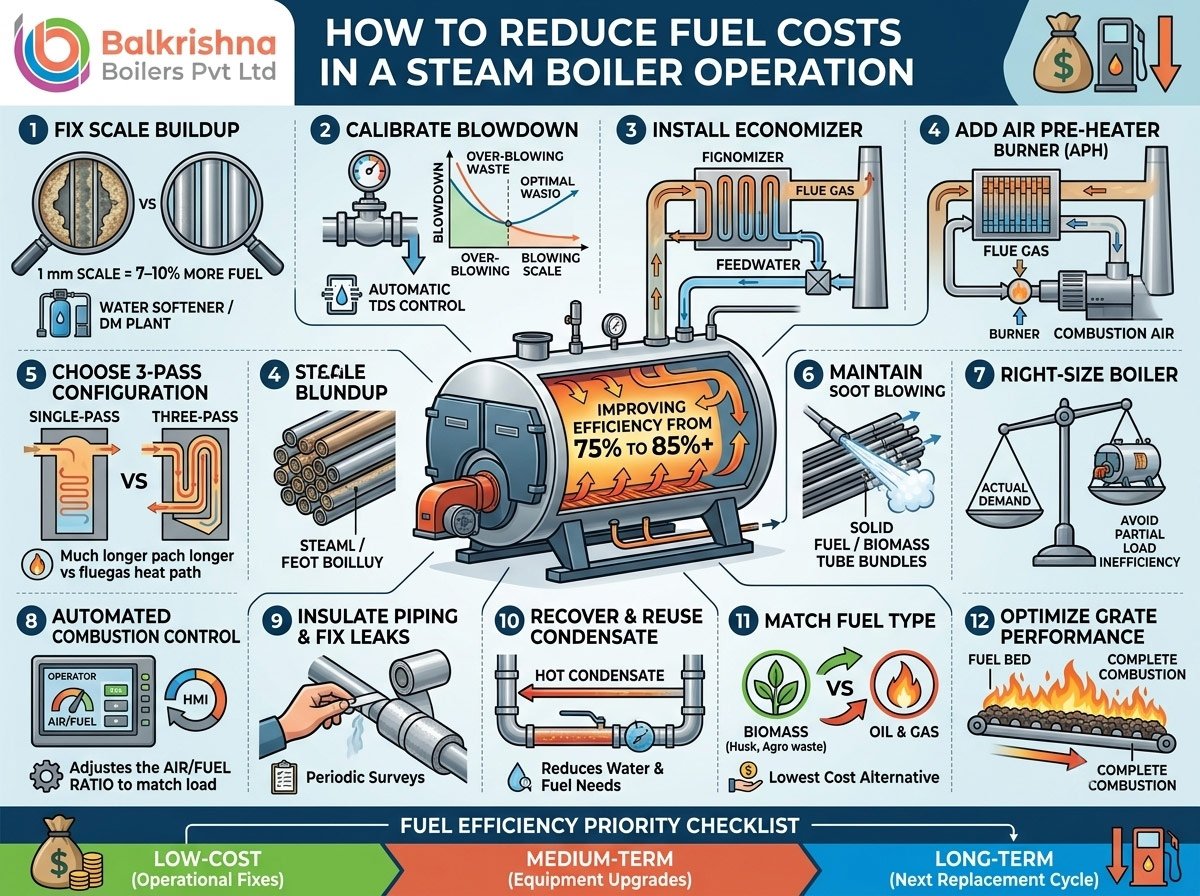
Fuel is almost always the single largest recurring cost in operating a steam boiler — often outweighing capital cost, maintenance, and labor combined over the equipment’s lifetime. Which means even small, consistent efficiency improvements compound into meaningful savings year after year, while neglected inefficiencies quietly drain your operating budget without ever showing up as a single dramatic event.
This guide walks through the practical, proven ways to reduce fuel consumption in an industrial steam boiler operation — from low-cost operational fixes to equipment upgrades worth the capital investment.
Why Fuel Efficiency Deserves Ongoing Attention
A boiler’s fuel efficiency isn’t fixed at the point of purchase — it drifts over time based on maintenance discipline, water quality, combustion tuning, and operating practices. A boiler that achieved 85% efficiency at commissioning can quietly slip to 75% or lower within a few years if scale, soot, and combustion drift go unaddressed — and that 10-point efficiency loss translates directly into a 10%+ increase in fuel cost for the same steam output.
Because fuel is a recurring, compounding cost, even modest efficiency improvements deliver outsized returns compared to a one-time capital expense. Let’s walk through where those improvements come from.
1. Fix Scale Buildup Through Proper Water Treatment
Scale is one of the most common and costly sources of fuel waste in industrial boilers. Just 1 mm of scale on heat-transfer surfaces can increase fuel consumption by 7–10%, since scale insulates the metal and forces the boiler to burn more fuel to transfer the same amount of heat to the water.
What to do:
- Install or upgrade water softening or demineralization equipment appropriate to your boiler’s pressure class.
- Test feedwater and boiler water quality regularly, not just at commissioning.
- Schedule internal inspections during shutdowns specifically to check for scale accumulation.
Our detailed guide on understanding steam boiler feed water treatment covers softening, demineralization, and deaeration in depth if you want to evaluate your current setup against best practice.
2. Calibrate Blowdown — Not Too Little, Not Too Much
Skipping blowdown allows dissolved solids to concentrate and eventually deposit as scale, costing fuel exactly as described above. But over-blowing wastes fuel too, since every liter of blown-down water carries heat energy with it that has to be replaced by burning more fuel to heat fresh feedwater.
What to do:
- Calculate your actual required blowdown percentage based on feedwater and boiler water TDS, rather than relying on a rough guess.
- Consider automatic TDS-controlled blowdown, which triggers only when water chemistry actually requires it.
- Install a blowdown heat recovery system to capture and reuse the heat energy that would otherwise be lost.
Our full guide on steam boiler blowdown: why it matters and how often to do it includes the exact formula for calculating your optimal blowdown rate.
3. Install an Economizer
An economizer captures residual heat from flue gases before they exit the chimney and uses it to pre-heat incoming feedwater. Since flue gases typically still carry substantial usable heat even after passing through the boiler’s main heat-transfer surfaces, an economizer effectively recovers energy that would otherwise be wasted.
Typical impact: Economizers commonly improve overall boiler efficiency by several percentage points, with a payback period that’s often well within 12–18 months for continuously operating boilers, particularly larger capacity units where the absolute fuel savings are more substantial.
4. Add an Air Pre-Heater (APH)
Similar in principle to an economizer, an air pre-heater uses flue gas heat to warm the combustion air entering the furnace, rather than feedwater. Pre-heated combustion air burns more efficiently, requiring less fuel to reach the same flame temperature.
Best paired with: Boilers already fitted with an economizer, since the two devices recover heat from different points in the flue gas stream and can be used together for maximum recovery, particularly on higher-capacity installations.
5. Choose the Right Pass Configuration
If you’re purchasing a new boiler or evaluating a replacement, pass design has a direct and substantial impact on baseline fuel efficiency. Three-pass boilers extract significantly more heat from flue gases before they exit compared to single-pass designs, translating into materially lower fuel consumption per ton of steam over the equipment’s entire operating life.
Our detailed comparison of single-pass vs three-pass steam boilers breaks down the efficiency difference and typical payback period if you’re weighing this decision for a new purchase.
6. Maintain Consistent Soot Blowing
Just as scale insulates heat-transfer surfaces from the water side, soot and particulate buildup insulates them from the flue gas side — particularly relevant for solid fuel and biomass boilers. Regular soot blowing keeps these surfaces clean and heat transfer efficient.
What to do:
- Follow a fixed soot blowing schedule appropriate to your fuel type, rather than reactive cleaning only when efficiency visibly drops.
- For multi-pass boilers, ensure soot blowing addresses all tube passes, not just the most accessible section.
7. Right-Size Your Boiler to Actual Demand
An oversized boiler running consistently at partial load operates less efficiently than a correctly sized one running closer to its optimal rated output. If your current boiler was specified without an accurate demand calculation, or if your production has changed significantly since installation, it may be worth revisiting your sizing.
Our guide on how to calculate steam boiler capacity for your plant walks through the exact method for matching capacity to actual simultaneous steam demand, which is often the single biggest lever for improving fuel efficiency in a new or replacement installation.
8. Upgrade to Automated Combustion Control
Manual burner operation, even with an experienced operator, cannot match the precision of automated combustion modulation. PLC-controlled systems continuously adjust the air-fuel ratio and firing rate to match real-time steam demand, avoiding the fuel waste inherent in manual on/off cycling and delayed operator response.
Our guide on steam boiler automation: is it worth the investment? walks through exactly how much fuel efficiency automation typically delivers and how to calculate whether it makes sense for your specific operating pattern.
9. Insulate Piping and Fix Steam Leaks
Heat lost through poorly insulated steam distribution piping, or through undetected steam leaks at valves, flanges, and fittings, is fuel that’s paid for but never actually delivered to your process.
What to do:
- Conduct a periodic steam leak survey across your distribution network, since small leaks are easy to overlook but add up significantly over continuous operation.
- Insulate all steam and condensate piping, particularly long runs or exposed outdoor sections.
- Repair damaged or missing insulation promptly rather than deferring it to a future maintenance cycle.
- Maintain steam traps properly, since a failed steam trap can waste substantial energy continuously until repaired.
10. Recover and Reuse Condensate
Condensate returning from your process equipment still carries significant heat energy and is already treated water — recovering and returning it to the boiler feedwater system reduces both the fuel needed to heat fresh makeup water and the water treatment load required to condition it.
What to do:
- Install condensate recovery piping wherever process layout allows.
- Ensure condensate return lines are properly insulated to minimize heat loss in transit.
- Monitor condensate quality to ensure contamination from the process side doesn’t introduce new water treatment issues.
11. Match Fuel Type to Local Availability and Cost
Fuel selection itself is one of the most significant levers on your ongoing operating cost, often more impactful than any single efficiency upgrade. Biomass fuels like husk, agro waste, and briquettes typically offer the lowest running cost where locally available, while oil and gas offer cleaner combustion at a higher per-unit fuel cost.
If your plant currently runs on a higher-cost fuel but has access to a more economical biomass alternative, switching fuel type, or installing a dual-fuel capable system, can deliver substantial ongoing savings. Options like our Biomass Fired Steam Boiler (1–6 Ton), Agro Waste Fired Steam Boiler (5–20 TPH), Rice Husk Fired Steam Boiler, and Groundnut Husk & Shell Fired Boiler are worth evaluating against your current fuel cost structure.
12. Optimize Grate Performance (For Biomass Boilers)
For biomass and solid fuel boilers, grate speed and fuel-bed consistency directly affect combustion completeness — incomplete combustion means unburned fuel energy is literally leaving the system as waste. Our guide on chain grate boiler speed and how it affects steam production and fuel consumption explains this relationship, and our comparison of vibrating grate vs reciprocating grate boilers can help identify whether your current grate technology is well matched to your fuel.
Putting It All Together: A Fuel Efficiency Priority Checklist
Not every plant needs every upgrade listed above — here’s a practical way to prioritize:
Start here (low-cost, high-impact):
- Water treatment review and correction
- Blowdown calibration
- Steam leak survey and repair
- Insulation check and repair
- Soot blowing schedule discipline
Medium-term capital upgrades:
- Economizer installation
- Air pre-heater installation
- Condensate recovery system
- Automated combustion control retrofit
Long-term / next replacement cycle:
- Right-sizing capacity to actual demand
- Three-pass (or higher-efficiency) boiler design
- Fuel type reassessment based on local availability and cost
Working through this list roughly in order — fixing operational and maintenance gaps first, then evaluating capital upgrades, then reassessing fundamentals at the next replacement cycle — typically delivers the fastest, most cost-effective path to lower fuel bills.
Explore Fuel-Efficient Boiler Options
If you’re evaluating a new boiler as part of your fuel efficiency strategy, our full range is available on the Steam Boiler category page and Electric Boiler category page, alongside our Thermic Fluid Heater and Hot Air Generator ranges for processes that don’t strictly require steam.
Balkrishna Boilers’ engineered lineup — including COMBIPOWER, STEAMGEN, STEAMJET, STEAMPOWER, HUSKPOWER, STEAMAX, and VEPOMAX — is built with efficiency-focused design as standard, and can be further configured with economizers, air pre-heaters, and automated controls. The complete range is available on the Steam Boiler page at balkrishn.com.
Final Thoughts
Fuel cost reduction in a steam boiler operation rarely comes from a single dramatic change — it comes from consistently addressing the small, compounding inefficiencies that accumulate through water quality, maintenance gaps, combustion tuning, and heat recovery opportunities. Plants that treat fuel efficiency as an ongoing operational discipline, rather than a one-time equipment decision, consistently see the lowest cost per ton of steam over their boiler’s full operating life.
Explore our full steam boiler range:
Related reading:
- Steam Boiler Automation: Is It Worth the Investment?
- Single Pass vs Three Pass Steam Boilers: Key Differences
- Understanding Steam Boiler Feed Water Treatment
- Steam Boiler Blowdown: Why It Matters and How Often to Do It
- How to Calculate Steam Boiler Capacity for Your Plant
For a fuel efficiency review of your current boiler setup, get in touch with our engineering team for a free technical consultation.
Frequently Asked Questions
What is the biggest cause of fuel waste in industrial boilers? Scale buildup from poor water treatment is one of the most common and costly causes, since even a thin layer of scale forces the boiler to burn significantly more fuel to transfer the same amount of heat.
Does an economizer really save meaningful fuel? Yes. Economizers recover residual heat from flue gases to pre-heat incoming feedwater, commonly improving overall efficiency by several percentage points, with a typical payback period well within 12–18 months on continuously operating boilers.
Can switching fuel types reduce operating costs significantly? Yes. Fuel type is often the single largest lever on ongoing operating cost. Biomass fuels typically offer the lowest running cost where locally available, though the right choice depends on your region’s fuel logistics and pricing.
Does boiler automation actually reduce fuel consumption? Yes. Automated combustion control continuously adjusts the air-fuel ratio and firing rate to match real-time demand more precisely than manual operation, reducing fuel waste from cycling and response lag.
How much fuel can steam leaks and poor insulation waste? Even small, individually minor leaks and insulation gaps compound significantly across a continuous steam distribution network, making periodic leak surveys and insulation checks a consistently high-value maintenance practice.
Is condensate recovery worth the investment? Generally yes, where process layout allows. Recovered condensate is both pre-heated and already treated water, reducing the fuel and water treatment cost associated with fresh makeup water.