
Every plant owner evaluating a new boiler eventually hits the same fork in the road: go with a simpler manually operated unit at a lower upfront cost, or invest in a fully automated, PLC-controlled system that costs more today but promises to save on labor, fuel, and downtime over time.
It’s a fair question, and the honest answer is: it depends on your plant’s scale, operating pattern, and labor cost structure. This guide breaks down exactly what boiler automation includes, what it actually saves you, what it costs, and how to decide whether it makes financial sense for your specific operation.
What Does “Boiler Automation” Actually Include?
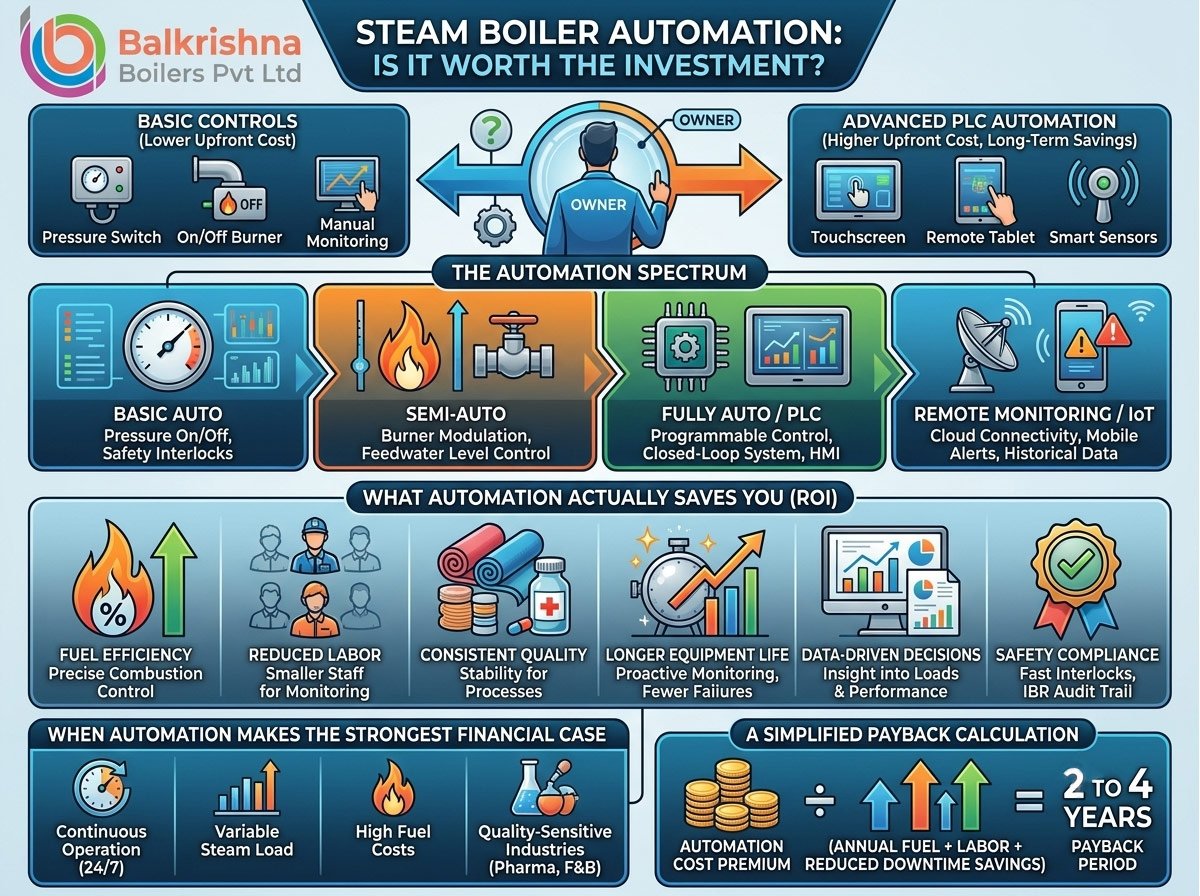
Automation isn’t a single feature — it’s a spectrum, ranging from basic automatic controls to fully integrated, remotely monitored systems. Understanding the levels helps you evaluate what you’re really comparing in a quotation.
Basic Automatic Controls
Even relatively simple boilers typically include automatic burner cut-off/cut-in based on pressure, automatic low-water level shutoff, and basic safety interlocks. This is considered baseline safety equipment on virtually all modern boilers, not a premium automation feature.
Semi-Automatic Systems
These add automatic modulation of burner firing rate (rather than simple on/off cycling), automatic feedwater level control, and often basic automatic blowdown timers. Semi-automatic systems reduce the intensity of manual monitoring required without eliminating the need for a dedicated operator.
Fully Automatic / PLC-Controlled Systems
A fully automated boiler uses a Programmable Logic Controller (PLC) to continuously manage combustion, feedwater, pressure, and blowdown in a closed-loop system, often with a touchscreen HMI (Human-Machine Interface) for monitoring and adjustment. These systems can include automatic TDS-controlled blowdown, oxygen trim control for optimal combustion, and data logging for compliance and performance tracking.
Remote Monitoring and IoT-Enabled Systems
The most advanced tier adds internet connectivity, allowing plant managers or service teams to monitor boiler performance, receive alerts, and review historical data remotely — from a mobile device or central control room, even across multiple plant locations.
What Automation Actually Saves You
1. Fuel Efficiency Gains
Manual burner operation, even with a skilled operator, cannot match the precision of automated modulation and combustion control. PLC systems continuously fine-tune the air-fuel ratio and firing rate to match real-time steam demand, avoiding the fuel waste that comes from manual on/off cycling or operator response lag. Automated systems can meaningfully reduce fuel consumption per ton of steam compared to manually operated equivalents, particularly in plants with variable steam demand throughout the day.
2. Reduced Labor Dependency
A manually operated boiler typically requires a dedicated, trained operator monitoring it closely, especially across multiple shifts. Automation reduces (though doesn’t eliminate) the intensity of hands-on monitoring required, allowing a smaller team to safely oversee multiple boilers or take on additional responsibilities. Over a multi-shift, multi-year operating period, this labor cost reduction is often one of the largest components of automation’s total ROI.
3. More Consistent Product Quality
For process industries where steam directly affects product quality — textile dyeing, pharmaceutical sterilization, food processing — automated pressure and temperature stability reduces the batch-to-batch variability that comes from manual adjustment lag. Our guide on steam boiler pressure settings for operators explains why pressure stability matters so directly to downstream process outcomes.
4. Fewer Breakdowns and Longer Equipment Life
Automated systems continuously monitor parameters that a manual operator might only check periodically — water level, TDS, pressure trends — catching early warning signs before they escalate into failures. Many of the top causes of steam boiler breakdown, including low water level incidents and inconsistent blowdown, are directly mitigated by automated monitoring and control.
5. Better Data for Decision-Making
Automated systems with data logging give plant managers visibility into fuel consumption trends, load patterns, and maintenance needs that simply aren’t available from a manually logged paper record. This data can inform everything from capacity planning to identifying a gradual efficiency decline before it becomes a costly problem.
6. Improved Safety Compliance
Automated safety interlocks respond faster and more consistently than manual oversight, and many automated systems include data logging that supports IBR compliance documentation and audit trails.
What Automation Costs
Automation adds meaningfully to the upfront capital cost of a boiler — the exact premium depends on the level of automation selected:
- Semi-automatic upgrades (modulating burner, automatic feedwater control) typically add a moderate percentage to base equipment cost.
- Fully automatic PLC-controlled systems with HMI, automatic blowdown, and combustion trim represent a more substantial premium, often justified primarily for continuous, high-utilization operations.
- Remote monitoring/IoT capability adds further cost, generally justified for multi-site operations or plants where rapid response to an alert genuinely prevents costly downtime.
Beyond the initial equipment cost, factor in:
- Operator training on the new control interface
- Potential PLC/software maintenance or service contracts
- Sensor calibration and replacement over the system’s lifespan
For a full breakdown of how automation level factors into overall boiler pricing, our guide on how much a steam boiler costs in India covers this alongside capacity, fuel type, and pressure rating as key cost drivers.
When Automation Makes the Strongest Financial Case
Automation delivers the clearest ROI in specific operating contexts:
- Continuous, multi-shift operation — where fuel and labor savings compound daily across 24/7 or near-continuous steam demand.
- Variable or unpredictable steam load — where manual operators struggle to respond quickly enough to changing demand, making automated modulation especially valuable.
- High fuel cost environments — where even a modest percentage improvement in combustion efficiency translates into meaningful absolute savings.
- Multiple boilers or multi-site operations — where remote monitoring allows a smaller central team to oversee more equipment.
- Regulated or quality-sensitive industries — pharma, food & beverage, and similar sectors where consistent process conditions and audit-ready data logging carry additional compliance value beyond pure fuel savings.
When a Simpler, Manually Operated Boiler May Be the Better Choice
Automation isn’t automatically the right answer for every plant. It may make less financial sense when:
- Steam demand is small, intermittent, or highly predictable, offering limited opportunity for automated modulation to outperform manual operation meaningfully.
- Capital budget is the binding constraint, and the labor cost savings wouldn’t be realized in your specific staffing structure (for example, if the same operator already manages other equipment alongside the boiler).
- The plant is very small-scale, where the automation premium represents a disproportionately large percentage of total project cost relative to the achievable savings.
In these cases, a well-maintained manual or semi-automatic boiler, backed by disciplined operator procedures and a proper preventive maintenance routine, can still deliver strong reliability and reasonable efficiency without the added upfront investment.
Calculating Whether Automation Pays Off for Your Plant
A simplified way to evaluate automation ROI:
Automation Payback Period = Automation Cost Premium ÷
(Annual Fuel Savings + Annual Labor Savings + Reduced Downtime Value)
Most plants moving from manual to fully automated control on a continuously operating boiler see the automation premium recovered within 2 to 4 years, primarily through fuel and labor savings — after which those savings continue to accrue for the remaining life of the equipment. Plants with lower utilization or smaller-scale operations should expect a longer payback period and should weigh that against their specific capital planning horizon.
Automation Across Different Boiler and Fuel Types
Automation delivers value differently depending on fuel type and boiler design:
- Oil / Gas Fired Steam Boilers respond particularly well to automated combustion control, since gas and oil combustion can be modulated quickly and precisely, maximizing fuel efficiency gains.
- Biomass-fired boilers, running fuels like rice husk or agro waste, benefit from automated grate speed control paired with combustion monitoring, since biomass combustion is inherently more variable and benefits significantly from consistent automated management. Our article on chain grate boiler speed and how it affects steam production touches on how grate automation directly affects output consistency.
- Electric Steam Boilers are often inherently well-suited to precise automated control, since electrical heating elements respond almost instantly to control signals, offering some of the tightest achievable process stability.
- FBC Solid Fuel Steam Boilers particularly benefit from automated fluidized bed monitoring, given the complexity of maintaining consistent combustion across varied solid fuels.
You can review automation options available across our range on the Steam Boiler category page and Electric Boiler category page.
Balkrishna Boilers offers both manual/semi-automatic and fully PLC-automated configurations across its engineered lineup, including COMBIPOWER, STEAMGEN, STEAMJET, STEAMPOWER, HUSKPOWER, and VEPOMAX — allowing you to select the automation level that matches your operating pattern and budget. The full range is available on the Steam Boiler page at balkrishn.com.
Automation and Water Treatment: A Combined Advantage
One often-overlooked benefit of automation is how well it pairs with a proper feedwater treatment program. Automated TDS-controlled blowdown, in particular, works far more effectively when combined with consistent water quality, since the system can respond precisely to actual water chemistry rather than operating on a fixed manual schedule. Our guides on understanding steam boiler feed water treatment and steam boiler blowdown go deeper into how these systems work together to protect the boiler and minimize waste.
Questions to Ask Before Choosing an Automation Level
- What is our actual daily/shift operating pattern — continuous, or intermittent?
- What does a dedicated boiler operator currently cost us annually, and could that role be reduced or reallocated with automation?
- How significant is fuel cost as a percentage of our overall operating budget?
- Do we operate multiple boilers or multiple sites that would benefit from centralized remote monitoring?
- Does our industry have compliance or quality requirements that benefit from automated data logging?
- What is our realistic capital budget, and how does the automation premium compare to our expected payback period?
Answering these honestly, ideally alongside your boiler manufacturer’s engineering team, will give you a far clearer picture than comparing automation as a generic “yes or no” feature on a quotation.
Final Thoughts
Boiler automation isn’t a universal upgrade that pays off identically for every plant — its value is directly tied to your operating pattern, fuel cost, and labor structure. For continuous, high-utilization operations, particularly in fuel- or quality-sensitive industries, automation typically pays for itself within a few years and continues delivering savings for the remaining life of the equipment. For smaller, intermittent operations, a well-maintained manual or semi-automatic system may remain the more sensible choice. The right call comes from running the numbers for your specific plant, not from defaulting to whichever option sounds more modern.
Explore our full steam boiler range:
- Steam Boiler Product Range – indianboilers.com
- Steam Boiler Product Range – balkrishn.com
- Electric Boiler Range – indianboilers.com
Related reading:
- How Much Does a Steam Boiler Cost in India? (2026 Price Guide)
- Steam Boiler Pressure Settings: A Practical Guide for Operators
- Understanding Steam Boiler Feed Water Treatment
- Top 10 Causes of Steam Boiler Breakdown and How to Prevent Them
To discuss which automation level makes the most financial sense for your plant, get in touch with our engineering team for a free technical consultation.
Frequently Asked Questions
Does boiler automation really save fuel? Yes. Automated combustion control continuously fine-tunes the air-fuel ratio and firing rate to match real-time demand, reducing the fuel waste typical of manual on/off cycling, particularly in plants with variable steam load.
How long does it take for boiler automation to pay for itself? Most continuously operating plants see the automation cost premium recovered within 2 to 4 years through combined fuel and labor savings, though this varies based on utilization and local labor and fuel costs.
Is automation worth it for a small plant with intermittent steam demand? Not always. Smaller, intermittent operations often see a longer payback period, and a well-maintained manual or semi-automatic boiler may be the more cost-effective choice in that context.
Does automation eliminate the need for a boiler operator? No. Automation reduces the intensity of manual monitoring required, but a trained operator is still needed for oversight, response to alerts, and routine tasks that automation doesn’t fully replace.
What is remote monitoring in boiler automation? Remote monitoring uses internet-connected sensors to let plant managers or service teams track boiler performance and receive alerts from a mobile device or central location, particularly useful for multi-site or multi-boiler operations.
Does automation improve safety? Yes. Automated safety interlocks respond faster and more consistently than manual oversight, and many systems include data logging that supports safety audits and IBR compliance documentation.