
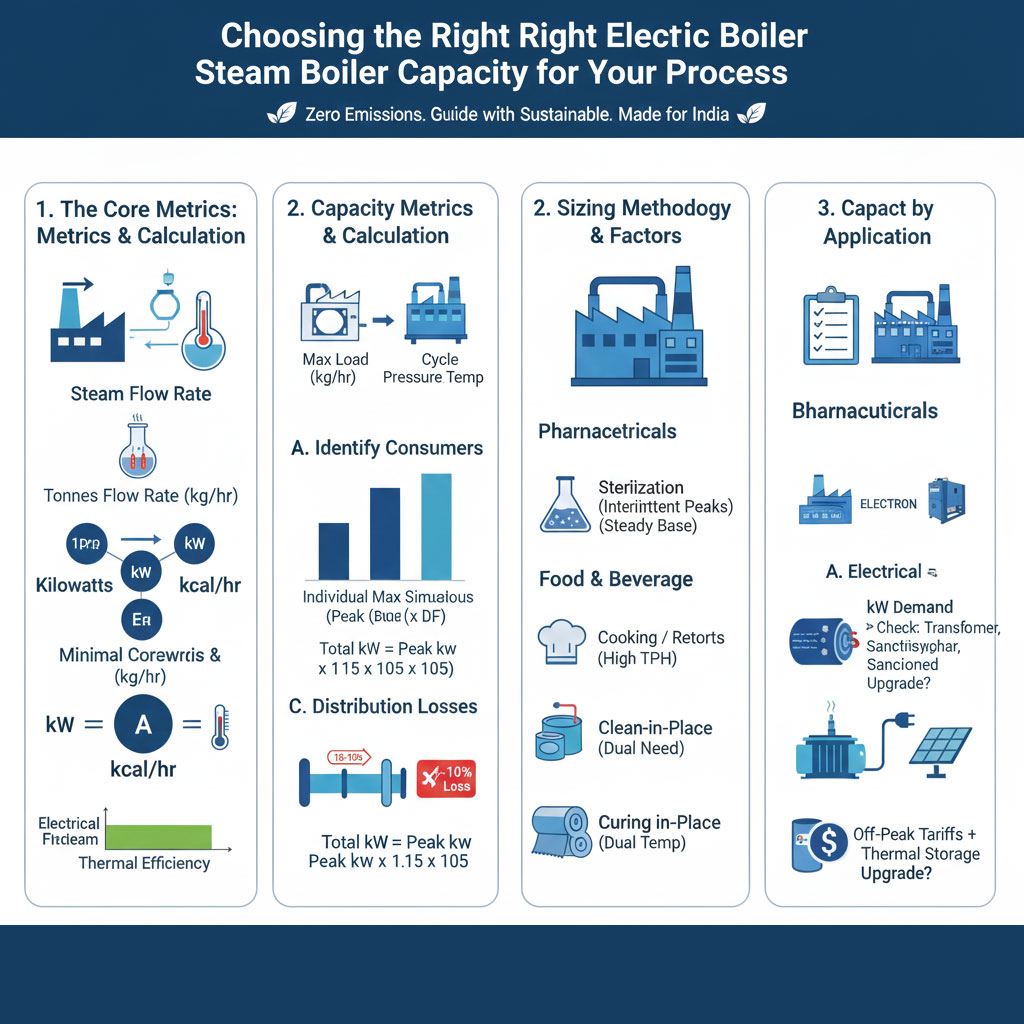
Every electric boiler purchase decision eventually comes down to one number: capacity. Get it wrong in either direction and the mistake follows you for the next 15–20 years.
Undersize it, and you’ll watch pressure sag every time two machines hit peak demand at once — production slows, quality drifts, and someone eventually proposes a second boiler as a patch. Oversize it, and you’ve paid for kilowatts you rarely use, while the unit short-cycles inefficiently against a load that never gets close to its rated output.
This guide walks through how to size an electric boiler properly — the calculation logic, the application-specific patterns, and the electrical infrastructure checks that most sizing guides skip. If you’re still deciding whether electrification is right for your plant at all, our complete guide to industrial electric steam boilers and our post on 7 key benefits of switching to electric boilers are worth reading first.
1. The Units That Actually Matter
Before any calculation, get comfortable with how electric boiler capacity is expressed — it’s not quite the same conversation as with a fuel-fired unit, because every kW of output has a direct, traceable link to your electricity bill.
| Unit | What It Measures | Rough Conversion |
|---|---|---|
| TPH (Tonnes of steam/hour) | Mass flow rate of steam produced | ≈ 640 kW per TPH (saturated steam) |
| kW | Electrical power draw | This is the number your electrical infrastructure has to support |
| kcal/hr | Heat output | ≈ 860 kcal/hr per kW |
The kW figure is the one that determines both your equipment cost and your electrical infrastructure requirement — so unlike fuel-boiler sizing, capacity planning here is inseparable from a conversation with your electrical engineer.
2. Sizing Isn’t Guesswork — It’s a Five-Step Audit
Step 1: List every steam consumer
Walk the plant floor and record every machine that draws steam, hot water, or thermal fluid. For each one, note the maximum instantaneous load, how long that peak lasts, how often it recurs, and the pressure/temperature it needs.
Step 2: Apply a diversity factor
Here’s the mistake most first-time sizing exercises make: adding up every machine’s peak demand and treating that sum as the required boiler capacity. In practice, machines rarely peak simultaneously — one’s heating up, another’s soaking, a third is idle between batches.
A Diversity Factor (DF), typically between 0.6 and 0.9 depending on your process, corrects for this. If ten machines in a dye house have combined peak demand of 5,000 kg/hr, but they never all peak together, a DF of 0.7 puts your realistic simultaneous demand closer to 3,500 kg/hr — a very different number to size around.
Step 3: Add a safety margin
Layer 10–15% on top of your simultaneous peak figure. This isn’t padding for its own sake — it covers unexpected demand surges, minor system leaks, and gives you headroom if the line expands in two years without forcing a boiler replacement.
Step 4: Account for distribution losses
Even well-insulated steam piping loses heat over distance. Add another 5–10% to cover what’s lost between the boiler and the point of use, especially relevant if your plant runs long pipe runs to distant process areas.
Step 5: Confirm against electrical infrastructure
This is the step that gets skipped most often — and it’s the one that can derail a project after the equipment is already ordered. More on this below.
3. Sizing by Industry: What the Load Pattern Actually Looks Like
Generic sizing formulas only get you so far — the shape of your demand curve matters as much as the total volume. Here’s how it typically breaks down by sector, and which product fits each pattern.
Pharmaceutical and Healthcare
Sterilization and autoclave loads are sharp, short, and intermittent — high peaks, then nothing. What matters here is rapid ramp-up and steam purity, not sustained high volume.
- ELECTRON – Electric Steam Boiler in a small-to-medium kW range fits well, especially installed close to the point of use to cut distribution losses.
- INDUCTRON – Induction Boiler is worth considering where steam purity is critical, since its non-contact heating avoids the risk of scale particulates entering the steam path.
- For continuous low-volume humidification loads, a smaller ELECTRON unit with tight turndown control is usually the better fit than an oversized system running well below its efficient range.
Our post on pharma manufacturing precision steam covers this application in more operational detail.
Food and Beverage
Cooking and retort processes need large, high-pressure steam volumes with stable delivery across a batch cycle — this is where IBR compliance and TPH capacity both matter.
- ELECTROMAX – Electric IBR Steam Boiler is the right scale for this — high kW/TPH with the pressure rating batch cooking requires.
- Clean-in-Place (CIP) systems need a different combination entirely: high-volume hot water paired with lower-pressure steam. ELECTRO AQUA – Electric Hot Water Boiler alongside a smaller ELECTRON unit often covers both needs more efficiently than one oversized system trying to do both jobs.
Our boiler selection guide for food processing units goes deeper into this sector-specific sizing logic.
Textiles and Garments
Dyeing and finishing loads pulsate hard — heating a dye bath draws a large spike, then the load drops as the batch soaks. High total volume with cyclical swings is the defining pattern.
- ELECTROMAX handles the load swings while holding IBR-level pressure through the cycle.
- Curing and setting processes, by contrast, need high temperature without pressure — that’s where ELECTROPAC – Electric Thermic Fluid Heater (rated up to roughly 300°C) fits better than a steam-based solution.
4. How the Boiler’s Heating Technology Changes Your Sizing Approach
Resistance Heating (ELECTRON, ELECTROMAX)
Capacity scales directly with the number and rating of immersed heating elements — sizing math here is relatively linear: match required kW to total element rating. The catch is that resistance elements are prone to scale buildup in poor water conditions, and scaling reduces effective output over time. Factor planned element cleaning or replacement into your sizing assumptions, not just day-one capacity.
Induction Heating (INDUCTRON)
Capacity is set by coil size and flow rate through the induction core. Because the heating surface never contacts the fluid directly, scale-related capacity degradation is far less of a concern — which means the rated capacity you size for on day one is much closer to what you’re still getting years later. This sometimes allows slightly tighter sizing margins than a resistance system, provided you still hold a proper safety margin for genuine peak demand.
Hot Air Generation (ELECTROAIR)
Sizing an ELECTROAIR – Electric Hot Air Generator for drying or curing lines works differently again — it’s driven by required airflow (CFM) and the temperature rise (ΔT) your process needs, not steam mass flow at all.
5. The Step Most Sizing Guides Skip: Can Your Electrical System Actually Carry This?
A perfectly calculated kW requirement is worthless if your plant’s electrical infrastructure can’t deliver it. This is the single most common reason electric boiler projects stall after the sizing exercise is already done.
A worked example: A 5 TPH ELECTROMAX installation can require roughly 3,200 kW (3.2 MW) of power — a substantial load that has to be checked against three things before you commit:
- Incoming transformer capacity — does the plant’s main transformer have headroom for this draw?
- Switchgear and feeder rating — can the existing electrical distribution handle it, or does it need upgrading?
- Sanctioned load from the utility — your contracted power supply agreement may need to be revised before a large installation goes live.
If the calculated kW exceeds what’s currently available, the project timeline and budget need to include the electrical upgrade — this is not a detail to discover after equipment has already been ordered. For guidance on staging this kind of transition without disrupting production, see our post on multi-fuel boilers and the future of industrial heating in India, which covers phased infrastructure planning in more detail.
Sizing Around Electricity Tariffs, Not Just Load
Since operating cost for a high-kW electric boiler is tightly linked to your tariff structure, sizing decisions can sometimes work in your favor strategically. Slightly oversizing a boiler — paired with a thermal storage vessel or accumulator — can let the system run mainly during cheap off-peak hours, banking heat for use during expensive peak-tariff windows. This approach can meaningfully lower the effective operating cost of an ELECTROMAX or ELECTROPAC installation over its lifetime, and it’s a conversation worth having with your engineering team at the sizing stage, not after installation.
Our articles on digital twin technology for boiler efficiency and AI and IoT in boiler operations cover how real-time load monitoring is making this kind of tariff-optimized sizing more precise than it used to be.
6. A Quick Sizing Checklist Before You Request a Quote
- Full list of steam/heat consumers with individual peak loads
- Diversity factor applied to combined peak demand
- 10–15% safety margin added
- 5–10% added for distribution losses
- Electrical load audit completed — transformer, switchgear, sanctioned power all confirmed
- Tariff structure reviewed for time-of-day optimization potential
- Water quality assessed — informs resistance vs. induction technology choice
- Future expansion plans factored into headroom, not just current-day load
Conclusion: Sizing Is an Engineering Decision, Not a Guess
The right electric boiler capacity sits at the intersection of your actual process demand, your industry’s specific load pattern, and what your electrical infrastructure can genuinely support. Rushing this step — or sizing purely off a rough total without diversity factors and infrastructure checks — is how plants end up either bottlenecked or overpaying for capacity they never use.
Balkrishna Boilers Pvt Ltd’s engineering team runs full load-profiling assessments before recommending capacity, whether the right fit turns out to be a compact ELECTRON, an IBR-rated ELECTROMAX, a scale-resistant INDUCTRON, or a specialized ELECTROPAC or ELECTRO AQUA system. Explore the complete electric boiler range on IndianBoilers.com or browse the full catalogue on Balkrishn.com.
Want your capacity calculated properly before you commit to a spec? Request a no-obligation steam and heat demand audit from our engineering team.