
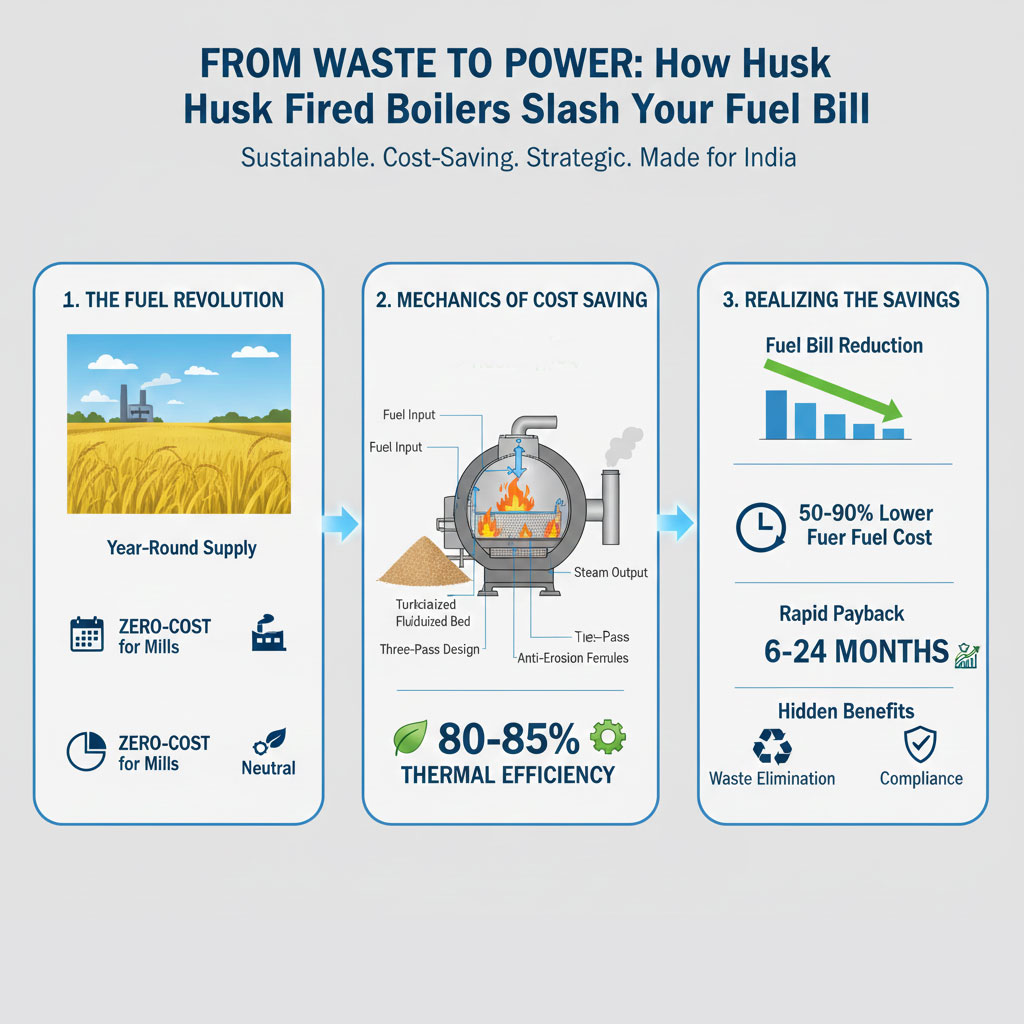
Every industrial plant in India is fighting the same battle: fuel cost. Coal prices swing with global demand, furnace oil is taxed and volatile, and diesel is simply too expensive to run a boiler on for eight or sixteen hours a day. Yet a few kilometres from most industrial belts, tonnes of rice husk sit stockpiled outside rice mills — treated as a disposal headache instead of what it actually is: one of the cheapest, most reliable fuels available to Indian industry.
At Balkrishna Boilers – IndianBoilers.com, we’ve engineered our Husk Fired Boiler range around one goal: help plants convert this “waste” into dependable, low-cost steam. This article breaks down the real economics of husk-fired steam generation — why it works, how much it actually saves, and how to choose the right system for your plant.
1. Why Rice Husk Deserves a Second Look as Fuel
India generates well over 100 million tonnes of rice husk every year. For rice mills, it’s a by-product they often pay to dispose of. For everyone else — textile units, food processing plants, chemical manufacturers, pharma units — it’s an underused local fuel sitting right next door to a coal or diesel bill that keeps climbing.
Three things make husk different from conventional fuel:
- It’s essentially free at the source. Rice mills produce it as waste; buying it locally from a mill is almost always cheaper than trucking in imported coal or paying for furnace oil.
- It’s biomass, so it’s treated as carbon-neutral. The CO₂ released on combustion roughly equals what the paddy crop absorbed while growing, which helps plants meet emission norms without cutting output.
- Its price doesn’t move with global markets. Coal and FO prices are tied to international benchmarks and currency swings. Local husk pricing is far more stable, which makes budgeting predictable.
If you’re comparing this to other agro-residue options, our detailed comparison — Rice Husk vs. Mustard Straw: Which Biomass Fuel Offers Better ROI for Indian Factories? — walks through calorific value, ash behaviour, and regional availability in more depth.
2. Rice Husk Is a Difficult Fuel — Here’s Why Boiler Design Matters
Husk isn’t a “drop-in” replacement for coal. It has low bulk density, burns fast, and carries 18–25% silica ash — enough to erode poorly designed tubes within a couple of years. A boiler built for coal or biomass pellets will underperform badly on husk. This is precisely where the savings are made or lost.
A. Combustion technology built for husk
- Internal Furnace Top-Feed Design (0.5–6 TPH): Husk is pneumatically fed into a large enclosed internal furnace, giving it enough residence time to burn completely instead of exiting as unburnt fuel. Controlled primary and secondary air delivers thermal efficiency in the 78–80% range.
- Fluidized Bed Combustion, FBC (4 TPH and above): A turbulent bed of inert sand burns husk rapidly and evenly, even when fuel quality varies — moisture content, particle size, and mix with other agro-waste. FBC systems typically reach 80–85%+ efficiency, and pair well when a plant is also evaluating multi-fuel flexibility (see our guide on Multi-Fuel Boilers: The Future of Industrial Heating in India).
B. Getting every unit of heat out of the fuel
- Three-pass flue gas travel maximises contact time between hot gases and boiler water.
- Wet-back furnace design wraps every heat-exposed surface in water, cutting radiation losses that dry-back designs lose.
- Air preheaters and economisers recover waste heat from the flue gas to warm combustion air or feedwater, adding another 5–10% to overall efficiency.
C. Managing husk’s abrasive silica ash without downtime
- Multi-Cyclone Dust Collectors (MCDC) capture up to 99% of fly ash before it reaches the chimney or erodes tubes.
- Anti-erosion ferrules protect smoke tube inlets from silica abrasion, extending tube life significantly.
- Automatic ash removal keeps the boiler running without manual clearing, protecting uptime and labour cost.
If ash and grate wear are a recurring headache on your current setup, our piece on Best Biomass Fuels for Reciprocating Grate Boilers: An Industrial Guide is worth a read alongside this one.
3. What the Fuel Bill Actually Looks Like
Numbers convince faster than theory. Here’s a rough per-tonne-of-steam cost comparison Indian plants typically see when switching to husk:
| Fuel | Typical Cost Behaviour | Fuel Bill Impact vs Husk |
|---|---|---|
| Furnace Oil / Diesel | High, import-linked, volatile | Husk can cut cost by 70–90% |
| Imported/Domestic Coal | Moderate-high, freight-sensitive | Husk can cut cost by 50–70% |
| Rice Husk (local) | Low, stable, no import exposure | Baseline |
For rice mills that already generate husk on-site, the fuel bill can drop to nearly zero, since the “fuel” is a by-product they were previously paying to dispose of.
Payback is usually fast. Even with a higher upfront cost than a basic fossil-fuel boiler, the fuel savings typically deliver a payback period of 6 months to 2 years — a return most other capital equipment in a plant can’t match.
Savings don’t stop at the fuel line either:
- No landfill fees or disposal penalties for husk-generating units.
- Fewer compliance headaches and a genuine emissions story for customers who audit their supply chain.
- Insulation from the kind of price shocks that come with global coal and crude markets.
For a side-by-side operating cost, maintenance, and payback breakdown against fossil fuels, see Rice Husk Boiler vs Coal/Diesel Boiler – Cost, Maintenance & Payback (2026 Guide).
4. Who Gets the Most Out of a Husk-Fired Boiler
Husk-fired steam generation isn’t limited to rice mills. Plants across several sectors are switching for the same reason — steam is a huge recurring cost, and husk cuts it without cutting output.
- Rice mills and agro-processing units — the obvious fit, since the fuel is generated on-site.
- Textile processing plants that run continuous steam for dyeing and finishing.
- Food and beverage processing units with steady, round-the-clock steam demand — see Boiler Selection for Food Processing Units for capacity and hygiene considerations specific to this sector.
- Chemical and pharma plants, where steam reliability matters as much as cost — our guide to Thermic Fluid Heaters in the Chemical Industry covers a related heating option worth comparing for indirect-heating processes.
- Sugar mills and pulp/paper units, where biomass residue is already part of the site’s waste stream.
For a broader industry-wide view of where biomass steam generation is headed, read Biomass & Husk Fired Boilers: The Future of Industrial Steam in India.
5. Choosing the Right Husk-Fired System for Your Plant
Before finalising a boiler, it helps to work through a few practical questions:
- What’s your steam demand? Small and mid-size loads (0.5–6 TPH) are usually best served by an internal furnace top-feed design; larger, more variable loads (4 TPH+) benefit from FBC technology.
- How consistent is your husk supply? If you’ll be blending husk with other agro-residues — mustard straw, briquettes, pellets — make sure the combustion system is rated for mixed fuel. Our comparison of Biomass Pellet vs. Biomass Briquette: Which Fuel Gives Better Boiler Performance? is a useful companion read here.
- Do you need heat recovery add-ons? Air preheaters and economisers cost more upfront but shorten payback further if your plant runs long, continuous shifts.
- What’s your ash handling plan? Confirm MCDC and automatic ash removal are included — this is the single biggest driver of unplanned downtime on husk-fired systems that aren’t engineered for high-silica fuel.
Our full Steam Boiler range includes husk-fired models across these capacities, engineered specifically for Indian biomass conditions rather than adapted from coal-fired designs. If you’re evaluating options directly by model, Balkrishna Boilers’ HUSKPOWER series on our main manufacturing site, balkrishn.com, covers the same husk-fired technology alongside our broader Steam Boiler lineup — useful if you’re also comparing against our COMBIPOWER, STEAMPOWER, or ENERPOWER ranges for multi-fuel flexibility.
6. Conclusion: Turn a Waste Problem Into a Profit Line
Husk-fired boilers aren’t a niche or experimental choice anymore — they’re one of the most dependable ways an Indian industrial plant can cut its single largest recurring cost. The fuel is local, the price is stable, and with the right combustion, heat-recovery, and ash-management design, the efficiency numbers hold up against — and often beat — fossil-fuel alternatives.
The technology has matured to the point where the real decision isn’t whether husk makes sense, but which capacity and combustion design fits your steam load. That’s a conversation worth having before your next fuel contract renewal.
Ready to see what a custom-engineered Husk Fired Boiler could save your plant? Get in touch with our team for a capacity and fuel-cost assessment, or explore our complete Husk Fired Boiler and Biomass Boiler range to find the right fit.