
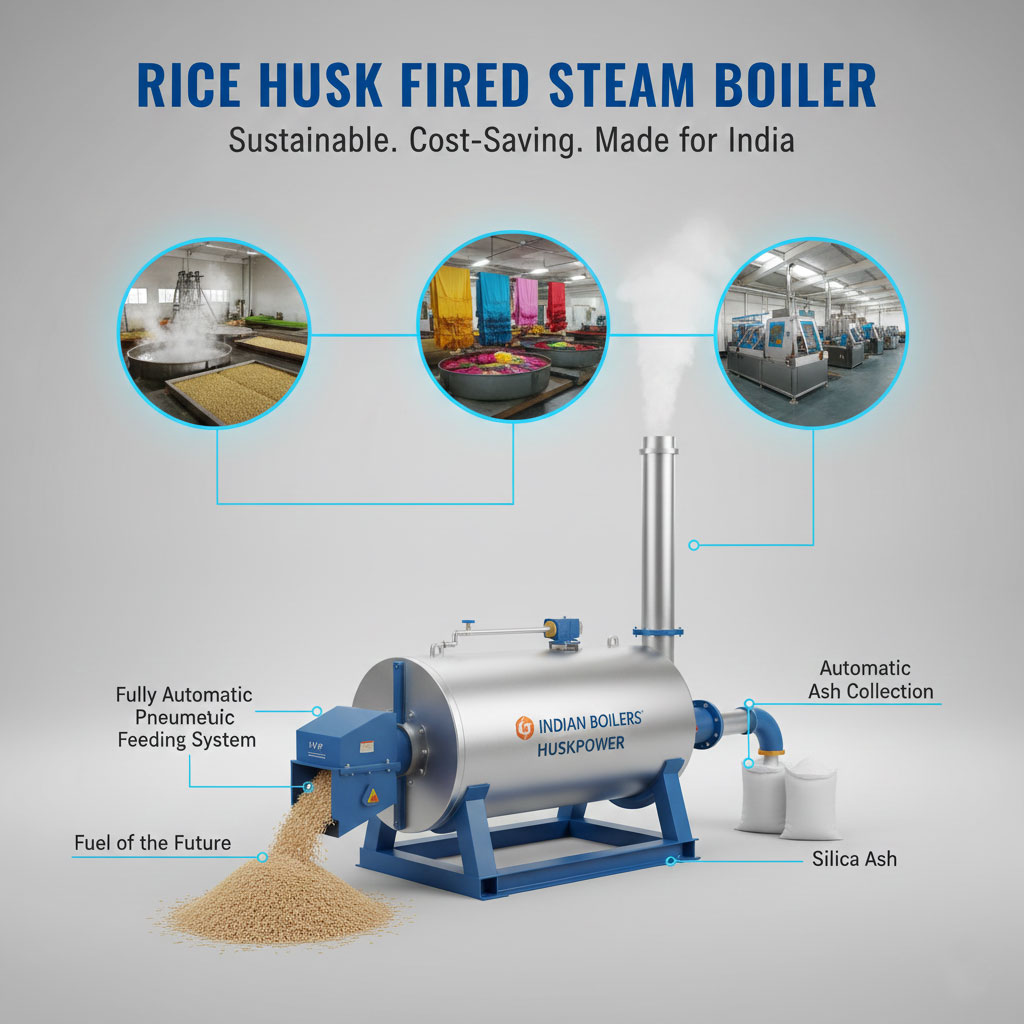
Rice husk is one of the few fuels where India has a genuine home-field advantage. Every rice mill, every parboiling unit, and every agro cluster in the country generates it in bulk, usually for next to nothing. Yet a huge number of Indian factories are still buying coal or furnace oil at market rates while sacks of husk pile up in their own backyard. A Rice Husk Fired Steam Boiler is the piece of equipment that closes that gap — it turns an agricultural residue that would otherwise be dumped or burned in the open into pressurised steam that runs your process.
This guide walks through what husk actually is as a fuel, how a husk-fired system is engineered to handle it, where the real savings show up on your energy bill, and the practical checks a plant should make before signing a purchase order.
1. Why Rice Husk Behaves Differently From Coal or Oil
Husk is not a drop-in replacement fuel — a boiler built for coal will choke on it if it isn’t re-engineered around husk’s specific properties. Four characteristics define how a husk boiler has to be designed:
- Calorific value in the 12,000–14,000 kcal/kg range — enough energy density for continuous steam generation, provided the moisture is controlled.
- Moisture between 10–15% — anything wetter drags down combustion efficiency and needs a bigger, hotter furnace to compensate.
- Ash content of 18–25%, which is unusually high next to coal. This single factor drives most of the design differences you’ll see in a husk-specific unit — from furnace volume to ash removal systems.
- Silica-dominant ash (over 90% SiO₂) — silica is abrasive, and left unmanaged it erodes heat-exchange tubes far faster than coal ash does.
- Low bulk density (90–150 kg/m³) — husk is bulky for the energy it carries, so the furnace and feeding system both need to be sized for volume, not just weight.
None of this makes husk a difficult fuel — it just means it needs purpose-built combustion engineering rather than a generic biomass grate. This is the same reasoning that separates fuel-specific systems across biomass types; if you’re comparing husk against alternatives, our breakdown of best biomass fuels for reciprocating grate boilers and the direct comparison in Rice Husk vs. Mustard Straw: Which Biomass Fuel Offers Better ROI are worth reading alongside this one.
The environmental case is straightforward too: husk is carbon-neutral. The CO₂ released on combustion is the same CO₂ the paddy plant absorbed while growing, so there’s no net addition of fossil carbon — a materially different story from coal or furnace oil.
2. How a Husk-Fired Boiler Is Actually Built to Handle This Fuel
A. Feeding and combustion
Because husk is voluminous and light, it can’t be shovelled or stoked the way coal is. Most modern systems use an automatic pneumatic or mechanical feed — typically driven by a forced-draft fan — that delivers a steady, metered stream of husk into the furnace from the top. This keeps the fuel bed even and prevents the surges in steam pressure that come from inconsistent feeding.
Two combustion technologies dominate the Indian market:
- Internal furnace / top-feed combustion — husk is layered onto a burning bed inside a large furnace chamber, with primary air fed from below the grate and secondary air introduced above it to burn off volatile gases completely. Well-designed units in this category reach thermal efficiencies approaching 80%.
- Fluidised Bed Combustion (FBC) — an air blower suspends an inert bed material (usually sand) along with the fuel particles, creating turbulent mixing that burns the fuel faster and more completely. FBC is generally the preferred route for larger installed capacities.
Related grate technologies — chain grate, reciprocating grate, and travelling grate systems — handle biomass combustion with their own trade-offs in fuel flexibility and turndown. If you’re deciding between combustion platforms, see our guides on chain grate boiler speed and its effect on steam output, how reciprocating grates handle high-moisture biomass, and selecting the right fuel for a travelling grate boiler.
Once combustion happens, heat exchange typically runs through a three-pass smoke tube or water-tube arrangement, where flue gases transfer their heat to water surrounding the tubes, generating high-pressure steam.
B. Ash and erosion management — the part most buyers underestimate
Given husk’s 18–25% ash content and its abrasive silica composition, ash handling isn’t an afterthought — it’s a core design pillar:
- A Multi-Cyclone Dust Collector (MCDC) sits downstream of the furnace to capture fine silica ash before it reaches and erodes the convection tubes.
- Ferrules or protective caps are fitted at tube inlets in the smoke path specifically to resist silica abrasion — a detail that directly extends tube life and reduces unplanned maintenance.
- Ash removal from hoppers is automated in most modern designs, keeping the plant running without manual intervention, and the collected Rice Husk Ash (RHA) itself has resale value in cement and construction applications.
For readers dealing with existing husk or biomass units that are underperforming, our guides on common biomass boiler problems and their solutions and biomass boiler emission control systems cover the operational side in more depth. On the equipment side, IndianBoilers.com and Balkrishna Boilers also supply standalone Dust Collectors and a full range of Pollution Control Equipment — bag filters, ESPs, cyclones, and wet scrubbers — for plants that need to retrofit ash and emission handling onto an existing boiler house.
3. The Cost-Saving Case: Where the Numbers Actually Come From
The single biggest reason Indian manufacturers switch to husk is fuel cost — and the gap versus coal or furnace oil is large enough that it changes payback math entirely.
| Fuel Type | Typical Price Position in India | Approx. Consumption per Tonne of Steam | Cost Impact |
|---|---|---|---|
| Husk / Biomass | Very low to near-free (for rice millers) | ~250–300 kg | Substantial savings |
| Coal (non-coking) | High, volatile pricing | ~140–180 kg | High |
| Furnace Oil (FO) | Highest, fully market-linked | ~80–90 litres | Highest |
For a rice mill, husk is often a genuine waste product with zero acquisition cost — the “fuel cost” is really just handling and storage. For textile units, food processors, or paper mills located near agricultural clusters, husk is a stable, locally sourced input that isn’t exposed to the same price swings as imported coal or crude-linked furnace oil.
Beyond the headline fuel saving, three secondary benefits matter for a full ROI picture:
- Waste disposal cost elimination — rice millers no longer pay to dispose of husk or manage the environmental liability of open dumping.
- Stable, predictable budgeting — husk pricing tracks local agricultural supply, not global commodity markets, which makes multi-year energy cost forecasting far more reliable.
- Sustainability positioning — a carbon-neutral fuel source strengthens ESG reporting and can support eligibility for green financing or future carbon-credit mechanisms.
Payback periods for a well-specified husk system frequently come in under a year where husk is available near-free, which is a payback timeline coal or oil systems simply cannot match.
4. Where Husk-Fired Steam Actually Gets Used
| Industry | What Steam Is Used For | Why Husk Makes Sense Here |
|---|---|---|
| Rice mills & agro-processing | Parboiling, drying, sterilising paddy | Closes the loop — the mill’s own waste becomes its fuel |
| Textiles | Dyeing, printing, washing, finishing | Stable low-cost steam protects export margins from oil price swings |
| Food & beverage, dairy | Cooking, sterilisation, pasteurisation | Meets renewable-energy sourcing requirements in supply chains |
| Pulp & paper | Drying and process heating | High-volume steam demand matches husk’s bulky, locally available supply |
This lines up closely with the client base IndianBoilers.com and Balkrishna Boilers already serve across rice mills, textile processing, dairy and food processing, and pulp and paper — sectors where fuel cost per tonne of steam is a constant operating pressure.
5. What to Check Before You Buy a Husk-Fired Boiler
A few practical questions separate a boiler that performs for a decade from one that becomes a maintenance headache within two years:
- Is the furnace sized for husk’s bulk density, or borrowed from a coal design? A furnace too small for husk’s volume will struggle with incomplete combustion and lower efficiency.
- Does the ash handling system match husk’s silica content specifically, with an MCDC and ferrule protection, rather than a generic ash system rated for lower-abrasion fuels?
- Is the fuel feeding system automated? Manual feeding of a low-density fuel like husk is labour-intensive and produces inconsistent combustion.
- What’s the quoted thermal efficiency, and is it based on husk at your actual local moisture content — not a lab-ideal fuel sample?
- Can the same unit run husk in blends with other biomass — mustard straw, bagasse, briquettes — if your husk supply fluctuates seasonally? Multi-fuel flexibility protects you from single-source risk.
For readers evaluating multi-fuel flexibility further, see Multi-Fuel Boilers: The Future of Industrial Heating in India.
Conclusion: Turning a By-Product Into a Bottom-Line Advantage
A rice husk fired boiler isn’t a compromise fuel choice — it’s a purpose-engineered system that converts one of India’s most abundant agricultural residues into dependable, low-cost steam. Done right, it delivers a rare combination: a drastically lower fuel bill, a shorter payback period than almost any other steam-generation upgrade, and a genuine sustainability story for customers and regulators alike.
IndianBoilers.com designs and manufactures husk-fired systems under our Steam Boiler range, alongside the wider Biomass Boiler portfolio covering multiple agricultural and industrial residues. On the Balkrishna Boilers side, the same engineering is available through the HUSKPOWER series and the broader Steam Boiler range, backed by over 25 years of manufacturing experience and 5,000+ installations across India and 30+ countries.
If you’re weighing husk against another biomass fuel for your specific process, our follow-up guide — Rice Husk Fired Steam Boiler for Rice Mills, Textiles & Food Units: Complete Buyer Guide — goes deeper into capacity selection and sizing by industry.
Ready to size a husk-fired system for your plant? Contact IndianBoilers.com for a fuel assessment and ROI projection, or reach the Balkrishna Boilers team directly via their contact page.