
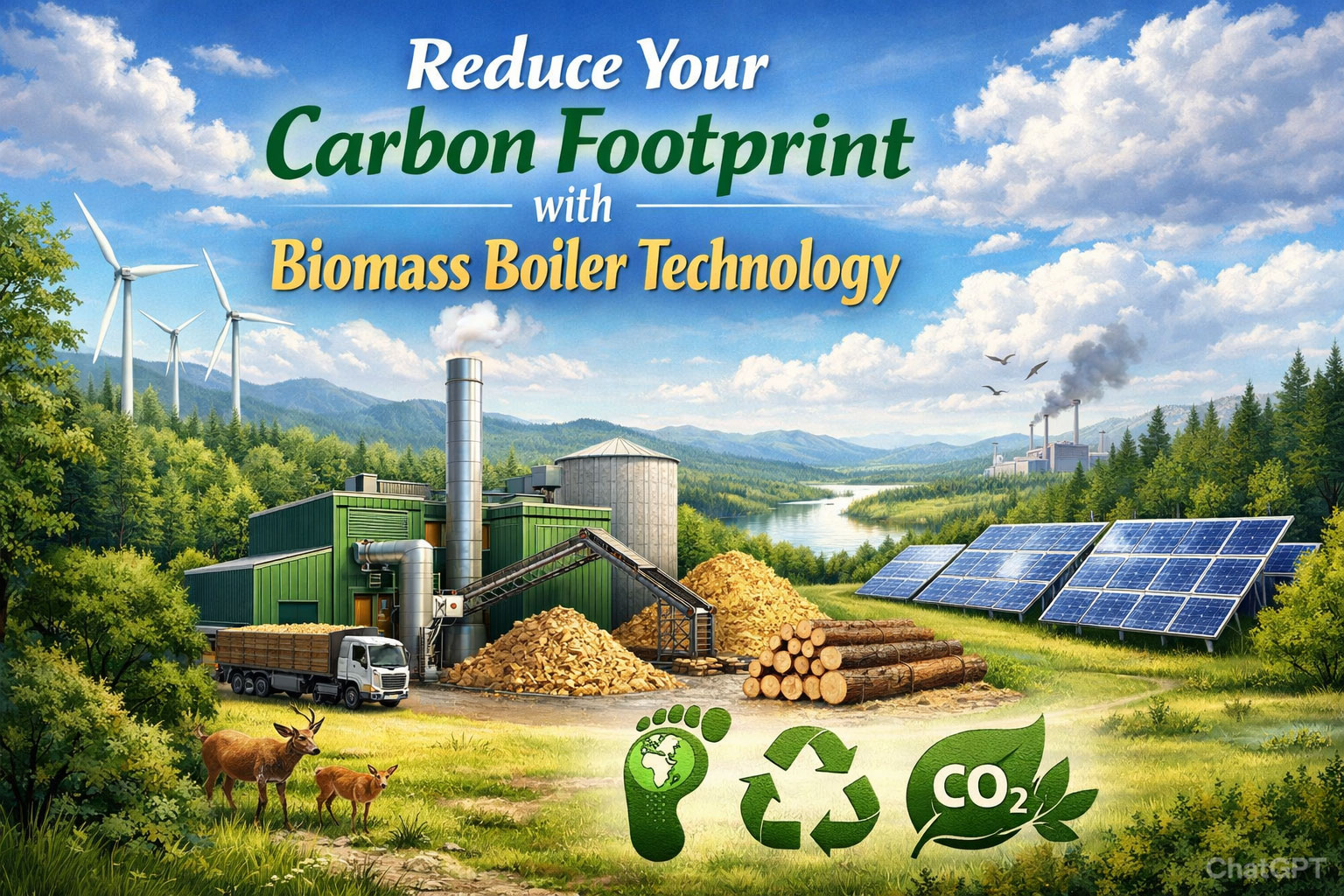
Reduce Your Carbon Footprint with Biomass Boiler Technology
In 2026, the phrase “Carbon Footprint” has moved from the CSR brochure to the balance sheet. With the full implementation of the Indian Carbon Market (ICM) and tightening emission norms from the Central Pollution Control Board (CPCB), reducing CO2 emissions is no longer just “environmentally friendly”—it is a core requirement for industrial profitability.
At IndianBoilers.com, we believe that the transition to green energy shouldn’t come at the cost of your bottom line. Biomass boiler technology represents the most viable, “plug-and-play” solution for Indian manufacturers to slash their carbon footprint while simultaneously reducing operational costs.
1. The Carbon Reality of 2026: Why Now?
The industrial sector in India accounts for a significant portion of the country’s greenhouse gas emissions. For decades, coal and Furnace Oil (FO) were the lifeblood of Indian manufacturing. However, the landscape has changed:
- Carbon Taxes & Credits: In 2026, many export-oriented sectors (Textiles, Steel, Chemicals) face “Carbon Border Adjustment Mechanisms” (CBAM) from international buyers. High carbon intensity now means higher export duties.
- The Fossil Fuel Volatility: Geopolitical shifts have made imported coal and oil prices unpredictable.
- Net Zero Commitments: Large Indian corporations are now mandating that their supply chain partners (SMEs) show a documented reduction in carbon intensity.
The “Carbon Neutral” Loop
Unlike coal, which releases sequestered carbon from millions of years ago into today’s atmosphere, biomass is part of a Short-Term Carbon Cycle. The CO2 released during the combustion of a rice husk or wood pellet is roughly equivalent to the CO2 that the plant absorbed during its growth.
Scientific Fact: Switching from a coal-fired boiler to a high-efficiency biomass boiler can reduce a factory’s net carbon emissions by up to 90%.
2. Transforming Waste into Watts: How Biomass Technology Works
Modern biomass boilers are a far cry from the inefficient “chulhas” of the past. At IndianBoilers.com, our 2026 lineup uses advanced engineering to ensure complete combustion, which is the key to both efficiency and low emissions.
The Combustion Science
To reduce carbon footprints, a boiler must achieve Complete Combustion. If combustion is incomplete, the system produces Carbon Monoxide (CO) and particulate matter, which are harmful pollutants.
Our 2026 systems, such as the STEAMAX and COMCUBE, utilize:
- Staged Air Injection: Precisely controlled primary and secondary air to ensure every carbon molecule finds an oxygen partner.
- Turbulence Management: Internal furnace designs that keep flue gases in the high-temperature zone longer (Residence Time), ensuring “Total Burn.”
- Low-Moisture Fuel Processing: Utilizing briquettes and pellets with <10% moisture, which prevents energy loss during the evaporation phase.
3. Product Spotlight: Engineering a Greener Future
Every industry has a different “thermal signature.” Here is how our technology helps diverse sectors reduce their footprint:
A. The COMCUBE: Small Footprint, Big Impact
For urban-based SMEs or food processing units where space is a constraint, the COMCUBE offers a compact, biomass-fired solution. It allows small units to move away from expensive, high-carbon Diesel (HSD) generators and boilers toward localized agricultural waste.
B. STEAMAX: The Industrial Workhorse
The STEAMAX is engineered for high-pressure steam requirements. By utilizing a “reciprocating grate” or “bubbling bed” technology, it can handle varying qualities of biomass (sawdust, groundnut shells, bagasse) without losing efficiency. This versatility ensures that your green transition isn’t halted by seasonal fuel shortages.
C. AIRMAX & AQUAMAX: Direct Thermal Efficiency
In many drying processes (Tea, Spices, Pharma), using a boiler to create steam just to heat air is inefficient. The AIRMAX (Air Generator) and AQUAMAX (Water Heater) provide direct heating.
- Carbon Saving: By removing the “middle-man” (steam), these units operate at higher system-wide efficiency, requiring less fuel and thus emitting less carbon per unit of product.
4. The “Economics of Green”: Savings Revealed
Reducing your carbon footprint is often perceived as an “expensive” move. In 2026, the math suggests the opposite.
Comparative Emission and Cost Analysis (Estimated)
| Parameter | Coal-Fired Boiler | FO-Fired Boiler | Biomass Boiler (2026 Tech) |
| CO2 per Ton of Steam | ~900 kg | ~650 kg | ~50 kg (Net) |
| Fuel Cost (₹/kg) | ₹12 – ₹15 | ₹75 – ₹85 | ₹7 – ₹10 |
| Environmental Compliance | High Cost (Scrubbers) | Moderate | Built-in (Low Ash) |
The ROI Factor: Most IndianBoilers.com clients report a “Payback Period” of 12 to 18 months. After that, the fuel savings become pure profit, and the carbon credits earned become a tradable asset.
5. Overcoming the “Biomass Barriers”
We understand that manufacturers have concerns about switching to biomass. In 2026, we have solved these legacy issues:
- Fuel Consistency: Through our partner networks, we help clients secure long-term contracts for standardized Briquettes and Pellets, ensuring the boiler operates at peak “Green” efficiency.
- Ash Management: Biomass ash is rich in potash. Many of our clients now sell their boiler ash to local fertilizer manufacturers, turning a waste stream into a secondary revenue stream.
- Automation: Gone are the days of manual feeding. Our 2026 systems feature PLC-based automated feeding, ensuring that the “Green” operation is also a “Smart” operation.
6. Case Study: The Textile Hub Transition (Tirupur/Surat)
In 2025-2026, several textile units in South and West India transitioned from Furnace Oil to STEAMAX Biomass Boilers.
- The Result: A 65% reduction in energy costs and a 4,000-ton annual reduction in CO2 emissions per unit.
- The Benefit: These units were able to secure “Green Label” certifications, allowing them to charge a premium for their exports to European and North American markets.
Conclusion: Your Roadmap to Net Zero
Reducing your carbon footprint is no longer a futuristic goal—it is a 2026 business imperative. Biomass technology offers the most direct, cost-effective, and technologically mature path to decarbonizing Indian industry.
At IndianBoilers.com, we don’t just sell hardware; we provide thermal architecture. We help you audit your current emissions, calculate your potential savings, and install the technology that fits your specific needs.
The future is renewable. The fuel is local. The technology is here.
