
How to Finance Your Green Switch
The financial commitment to transition from fossil fuels to clean, high-efficiency biomass can be significant. Recognizing this, the Indian Government—through the Ministry of New and Renewable Energy (MNRE) and various state-level bodies—has put forth robust subsidy schemes and financial incentives to drastically lower the initial investment cost for industries.
This is a strategic move to encourage the adoption of technologies like the HUSKPOWER – Rice Husk Fired Steam Boiler, COMCUBE – Biomass Steam Boiler, and VTFH-SERIES – Biomass Fired Hot Water Boiler. Understanding these subsidies is key to accelerating your ROI.
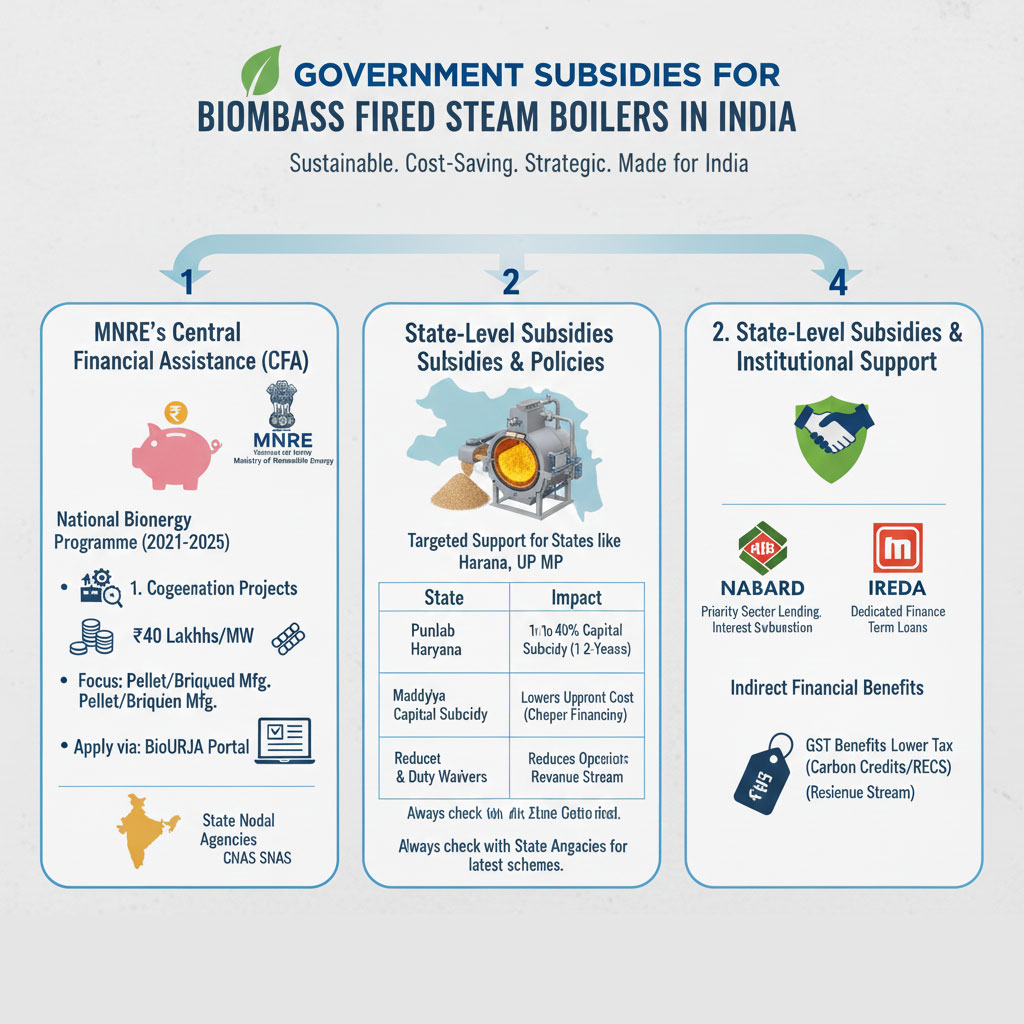
1. MNRE’s Central Financial Assistance (CFA): The Foundation
The Ministry of New and Renewable Energy (MNRE) is the central nodal agency, driving the transition through the National Bioenergy Programme (Phase-I: FY 2021-22 to 2025-26).
Key MNRE Support for Industries:
The primary objective of the program relevant to industrial boiler users is to support Biomass (non-bagasse) based cogeneration projects in Industries.
- Eligibility: Industrial projects using biomass (such as rice husk, crop residues, wood waste, etc.) for cogeneration (simultaneous production of heat and electricity) are eligible.
- Note: While a pure steam boiler (like HUSKPOWER or COMCUBE) might not directly qualify for the cogeneration scheme, it paves the way for a simple turbine add-on in the future, making the entire project eligible.
- Funding Pattern (Cogeneration): Central Financial Assistance (CFA) is provided on the installed electrical capacity of the cogeneration unit, typically around ₹40 Lakhs per MW, with a maximum limit of ₹5 Crores per project.
- Focus on Pellet/Briquette Manufacturing: The MNRE also provides CFA for establishing biomass pellet/briquette manufacturing plants (up to ₹45 Lakhs per plant). This support indirectly benefits boiler users by stabilizing and lowering the cost of processed biomass fuels used in COMCUBE and other systems.
- Performance Linked: Subsidy disbursement has become performance-based, encouraging the efficient operation of the biomass plant (e.g., above 80% plant load factor).
- How to Apply: Applications for “In-Principle” approval of CFA are typically made through the BioURJA Portal and processed by the State Nodal Agencies (SNAs) like PEDA (Punjab), HAREDA (Haryana), etc., before the project commissioning.
2. State-Level Subsidies and Policy Advantages
In addition to central support, many states offer aggressive incentives to promote biomass adoption, particularly in regions struggling with crop residue burning (e.g., Punjab and Haryana).
| State | Typical Incentives | Impact on Boiler Purchase |
| Punjab, Haryana | Up to 30%-40% Capital Subsidy (for biomass plants), SGST Reimbursement. | Substantially reduces the upfront cost of purchasing a HUSKPOWER or COMCUBE unit. |
| Madhya Pradesh | Interest Subsidies, Concessional Land Allotment. | Lowers the effective cost of financing the boiler project. |
| Uttar Pradesh | Waiver of Electricity Duty, Stamp Duty Benefits. | Reduces operational costs and administrative burden post-installation. |
Action Point: Always consult the respective State Nodal Agency (SNA) for the latest and most specific schemes, as eligibility and rates change frequently based on the state’s biomass policy.
3. Financial and Institutional Support (NABARD & IREDA)
Beyond direct capital subsidies, key financial institutions provide crucial support, making financing easier and cheaper.
- NABARD (National Bank for Agriculture and Rural Development): NABARD provides refinance assistance to commercial banks, regional rural banks, and cooperative banks for projects related to agricultural infrastructure and rural enterprise, including biomass energy projects. This often translates to priority sector lending status and interest subvention for biomass plants.
- IREDA (Indian Renewable Energy Development Agency): IREDA is instrumental in channeling MNRE’s funds and provides dedicated financial assistance for renewable energy projects, including term loans for setting up industrial boiler systems.
Indirect Financial Benefits:
| Incentive Type | Description |
| GST Benefits | Biomass pellets and briquettes often attract a lower GST rate (typically 5%) compared to coal (28%). |
| Carbon Credits/RECs | Biomass projects are eligible to earn and sell Carbon Credits and Renewable Energy Certificates (RECs) in the energy market, creating a persistent, non-fuel revenue stream. |
| Priority Lending | Biomass projects are often categorized under Priority Sector Lending, ensuring smoother access to credit from lending institutions. |
Conclusion: Subsidies Make the Green Switch Unmissable
Government subsidies and financial support systems are deliberately designed to narrow the gap between the initial capital cost of a biomass boiler (like the HUSKPOWER or COMCUBE) and a traditional fossil fuel boiler. When these incentives are combined with the long-term operational savings of biomass—often reducing the fuel bill by 50% to 90%—the decision becomes not just environmental, but overwhelmingly financial.
Don’t leave government money on the table.
Contact IndianBoilers.com today. Our project team can assist you not only in selecting the right boiler (HUSKPOWER, COMCUBE, or VTFH-SERIES) but also in navigating the application process for central and state subsidies to maximize your ROI.
