
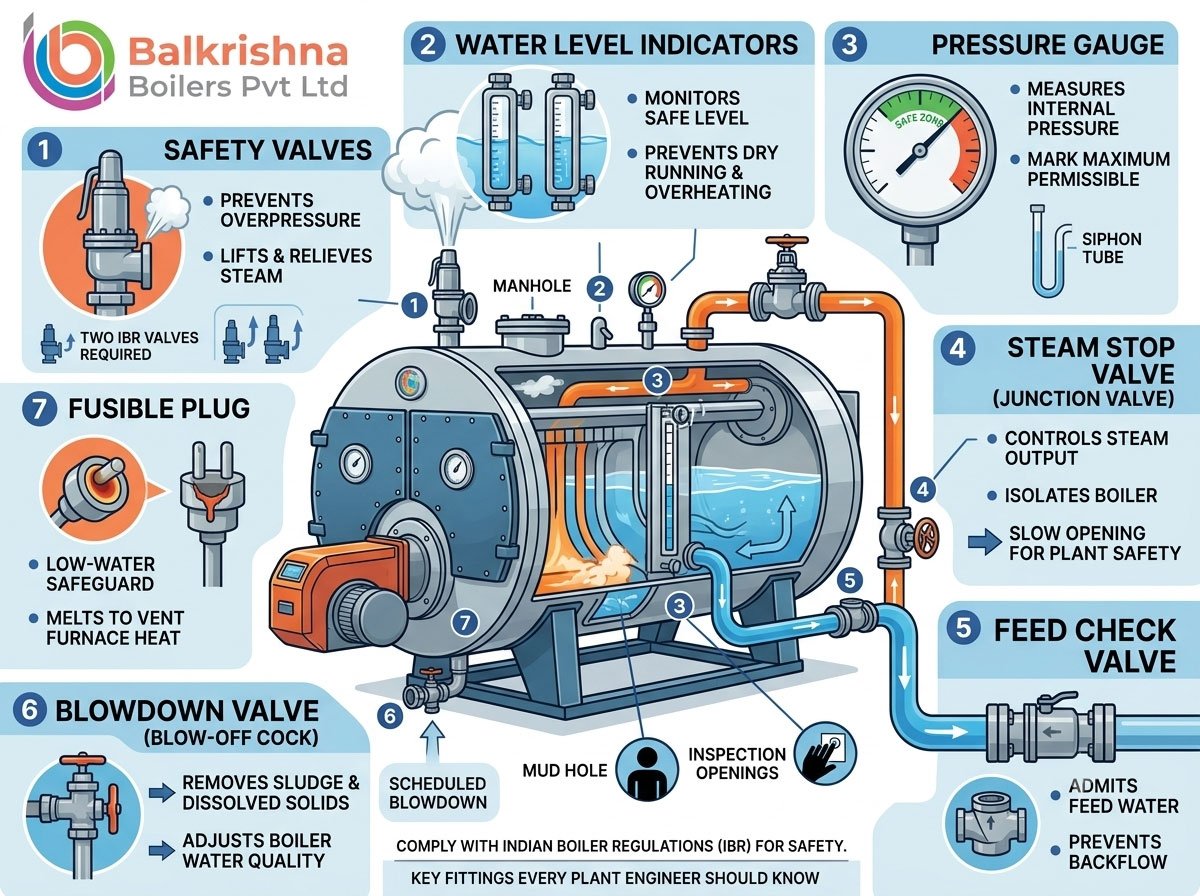
A boiler is only as safe as the small devices bolted onto it. The shell, tubes and furnace generate steam, but the fittings on top and around the shell decide whether that steam is produced safely, delivered in a controlled way and shut down when something goes wrong. These fittings are called boiler mountings.
For a plant engineer, knowing mountings is not optional. They are the first things an Inspector of Boilers checks, the first things to fail when water quality or maintenance slips, and the first line of defence against overpressure and low-water accidents. This guide covers the key mountings, what each one does, where it sits, and what to watch for during daily operation.
What Are Boiler Mountings?
Boiler mountings are the fittings and devices mounted directly on the boiler shell or drum. They exist for two reasons:
- Safety: preventing overpressure, overheating and low-water conditions.
- Control: letting the operator monitor and regulate steam generation, feed water and blowdown.
Under the Indian Boilers Act and Indian Boiler Regulations (IBR), a boiler can’t be put into service unless the prescribed mountings are fitted, tested and certified. Skipping or bypassing any of them is a statutory violation as well as an engineering risk.
Boiler Mountings vs Boiler Accessories
The two terms are often mixed up, so it helps to separate them.
- Mountings are mounted on the boiler itself and are essential for safe operation. Examples: safety valve, water level indicator, pressure gauge.
- Accessories are auxiliary systems connected to the boiler that improve efficiency. Examples: economizer, air pre-heater, superheater, feed pump.
Mountings protect the boiler from failure. Accessories improve how efficiently it runs. If you want a broader view of how the two groups fit together with the fuel and combustion system, read our guide to core boiler components, from the fuel system to safety valves.
The Key Boiler Mountings Every Engineer Should Know
1. Safety Valves
The safety valve is the last mechanical defence against overpressure. When steam pressure rises above the set value, the valve lifts automatically, vents the excess steam and reseats once pressure falls back to normal.
Why it matters: if pressure keeps rising with nothing to relieve it, the shell can rupture. This is the failure mode behind the most serious boiler accidents.
Key points for engineers:
- IBR requires two safety valves on a boiler, usually mounted on top of the shell, with a combined capacity that can discharge the boiler’s full steam output.
- Valves are set and sealed by the Inspector of Boilers. Operators must never adjust the spring or add weight to stop a valve “popping”.
- Test the valve by hand-lifting it as the schedule requires, to confirm it isn’t stuck from scale or corrosion.
- Discharge piping should be free of restrictions and routed to a safe location.
A valve that is sticking, simmering or leaking at normal operating pressure needs attention straight away, because it may not open when needed.
2. Water Level Indicators
Water level is the single most important operating parameter on a steam boiler. Too low, and the tubes and furnace crown overheat and can fail. Too high, and water carries over into the steam line, causing wet steam and risking water hammer.
The water level indicator (gauge glass) shows the level inside the shell so the operator can see it at a glance.
Key points:
- Two independent indicators are normally provided, so one can be checked against the other.
- Gauge glass cocks and drain valves should be blown through regularly to confirm passages aren’t choked with sludge.
- Keep glasses clean and well lit. A dirty glass can show a false level.
- Many modern boilers add low-water cut-off controls and alarms. These are an additional layer, not a replacement for the visible glass.
If the level can’t be confirmed, the correct response is to shut off the fuel supply and investigate, not to wait and hope.
3. Pressure Gauge
The pressure gauge tells the operator the steam pressure inside the boiler. It looks like a simple dial, but every operating decision depends on it.
Key points:
- Fit it where the operator can read it easily, usually at the front of the boiler.
- A syphon tube (a loop of pipe) holds a small water seal so hot steam doesn’t reach the gauge’s Bourdon tube directly.
- The dial range should comfortably exceed the working pressure, and the maximum permissible pressure should be clearly marked in red.
- Calibrate against a test gauge at the intervals your inspector and internal procedures require. A gauge that reads low can let the boiler run above its safe pressure without anyone noticing.
IBR also requires a connection for the inspector’s test gauge, so the plant gauge can be verified against a reference during inspection.
4. Steam Stop Valve
The steam stop valve (also called the junction valve) sits on the highest point of the steam space and connects the boiler to the main steam line. It lets the operator isolate the boiler from the plant, for example when starting up, shutting down, or when several boilers feed a common header.
Key points:
- It should be opened slowly during start-up so the line warms evenly and condensate is cleared, which prevents water hammer.
- On multi-boiler installations, a non-return arrangement stops steam from a live boiler flowing back into one that is offline.
- A leaking or passing stop valve is both a safety issue and a source of continuous energy loss.
We’ve covered this fitting in more detail in our article on the steam stop valve and how it controls steam safely without energy loss.
5. Feed Check Valve
The feed check valve is a non-return valve fitted on the feed water line where it enters the boiler. It does two jobs:
- It lets feed water enter the boiler under pressure from the feed pump.
- It automatically closes if the feed pump stops or feed pressure drops, so boiler water and steam can’t flow back into the feed line.
Key points:
- It is normally paired with a separate stop valve so the check valve can be isolated for maintenance without shutting down the whole system.
- Scale, wear or a damaged seat will make it pass. A passing check valve can flood the feed line with hot water or steam, leading to feed pump damage.
- If feed water can’t enter the boiler at the rate it leaves as steam, the level will drop. The feed check valve is one of the first places to look when it does.
6. Blowdown Valve (Blow-Off Cock)
Even with treated feed water, dissolved solids and sludge concentrate inside a boiler over time. The blowdown valve removes them.
There are two types:
- Bottom blowdown removes settled sludge and sediment from the lowest point of the boiler.
- Surface (continuous) blowdown removes dissolved solids concentrated near the water surface and can be paired with heat recovery.
Key points:
- Use the blowdown schedule agreed with your water treatment specialist. Too little leads to scale and carryover. Too much wastes heat and treated water.
- Open and close blowdown valves gradually and under observation. Never leave them unattended during blowdown.
- Valves that don’t seat fully after blowdown are a common hidden source of water and heat loss.
Good blowdown practice is also tied to the quality of your feed water. If you’re setting up a new system, it’s worth reading our steam boiler commissioning checklist for new installations, which explains how mountings are verified before the first firing.
7. Fusible Plug
The fusible plug is a last-resort device for low-water conditions. It is a threaded plug with a core of a low-melting alloy. Normally, water on one side keeps the core cool. If the water level falls and the plug is exposed to furnace heat, the core melts, and the opening releases steam and water into the furnace, which warns the operator and can help dampen the fire.
Key points:
- Fitted on the crown of the furnace or in a position directly exposed to heat on certain boiler designs, as specified by the regulations.
- The alloy core degrades with time. Replace plugs at the intervals recommended in the standards and by the manufacturer, even if they appear fine.
- It does not replace proper level control. It is a last warning.
8. Manhole, Mud Hole and Inspection Openings
These are not “fittings” in the sense of moving parts, but they are essential mountings.
- Manhole: large enough for a person to enter the shell for internal inspection, cleaning and repair.
- Mud holes and sight holes: smaller openings, placed low on the boiler, for removing sludge and inspecting areas that a person can’t enter.
Key points:
- Gaskets and covers must be in good condition. Weeping joints can corrode the surrounding plate over time.
- Always follow confined space entry permits, isolation, ventilation and tagging procedures before anyone enters.
Typical Mounting Layout on a Shell-Type Boiler
A simplified mental map helps in daily rounds:
| Location | Mounting |
|---|---|
| Top of shell | Safety valves, steam stop valve, pressure gauge connection |
| Front or side of shell | Water level indicators, low-water cut-off |
| Feed line entry | Feed check valve and stop valve |
| Lowest point | Blowdown valve, mud hole |
| Furnace crown (where applicable) | Fusible plug |
| Shell access | Manhole, inspection openings |
Exact positions vary between designs, such as shell-type, water-tube or coil-type, so always follow the manufacturer’s drawing and your inspector’s requirements.
Daily, Weekly and Periodic Checks
Mountings only protect the plant if they work when called on. A practical routine looks like this:
Every shift:
- Blow down the gauge glass and confirm the level returns quickly and steadily.
- Compare the two level indicators.
- Check the pressure gauge against operating pressure and look for needle flutter or sticking.
- Look for leaks at valves, flanges and gland packing.
Weekly:
- Hand-test safety valves where your procedure allows, and record the result.
- Check feed pump and feed check valve operation.
- Review the blowdown log against the water analysis.
Periodically (as per inspection and statutory requirements):
- Calibrate pressure gauges against a test gauge.
- Overhaul safety valves and have them re-set and sealed by the authorised person.
- Replace fusible plugs on schedule.
- Open up, clean and inspect the boiler internally during the annual statutory inspection.
Keep a logbook. Inspectors, insurers and auditors look for evidence of regular testing as much as the fittings themselves.
Common Mounting Problems and What They Usually Mean
| Symptom | Likely cause | What to do |
|---|---|---|
| Safety valve leaks below set pressure | Dirt or scale on seat, worn disc | Isolate and overhaul. Do not tighten the spring. |
| Gauge glass level sluggish | Choked cocks or passages | Blow through, clean, and verify with the second indicator |
| Pressure gauge reads erratically | Choked syphon, damaged Bourdon tube | Replace or recalibrate |
| Level drops despite feed pump running | Passing or stuck feed check valve | Inspect and repair the valve and feed line |
| Wet steam or carryover | High level, high TDS | Check level, adjust blowdown, review water treatment |
| Steam stop valve passes when closed | Worn seat or disc | Schedule repair, since leakage wastes energy |
Why Mounting Quality Matters at Purchase
When you buy a boiler, the mountings are part of the safety package. Low-grade valves or untested gauges save little money and cost far more in downtime, inspection failures and risk. Ask any manufacturer about:
- IBR-approved, properly tested safety valves with certificates
- Mounting makes and ratings suited to the working pressure
- Provision for low-water cut-off, high-pressure cut-off and alarms
- Documentation for the inspector, including drawings and test certificates
At Indian Boilers.com, every steam boiler is supplied with the IBR-required mountings, and the same applies across the range from gas and oil fired units such as the STEAMJET series to biomass-fired boilers, water-tube boilers and IBR electric steam boilers. If you need steam without the registration requirements, we also offer a 100 kg/hr Non-IBR electric steam boiler, where requirements differ from IBR boilers.
For plants that run on thermal oil rather than steam, Balkrishna Boilers manufactures a complete thermic fluid heater range, including the VTF series vertical four-pass FBC-fired heater. If you already run a thermic fluid heater and also need process steam, the STEAMGEN thermic fluid steam generator produces steam from your hot oil without a separate burner or chimney. You can see the full range on our products page.
Mountings and Industry Needs
The mountings you specify should reflect your process. A chemical plant, for example, often needs more redundancy and tighter safety specification than the standard set, which we’ve discussed in boilers for the chemical industry: what to look for. Food, pharma and textile plants have their own needs for steam quality, cut-off systems and monitoring. If your plant is moving toward automated operation, our guide to boiler automation systems shows how sensors and controls work together with the mountings described here.
Frequently Asked Questions
Which boiler mountings are mandatory under IBR?
The commonly required set includes two safety valves, two water level indicators, a pressure gauge, a steam stop valve, a feed check valve, a blow-off valve, a fusible plug where applicable, an attachment for the inspector’s test gauge, a manhole and a mud hole or sight hole. The exact requirement depends on boiler type and the regulation version, so confirm with your inspector.
What is the difference between a boiler mounting and a boiler accessory?
A mounting is fitted on the boiler for safety and control. An accessory is an auxiliary unit, such as an economizer or feed pump, that improves efficiency or supports operation.
How often should safety valves be tested?
Hand-lift tests are done as part of regular operating routines. A full set-pressure test and sealing is done by the authorised person during statutory inspection or after any overhaul.
Can a boiler run if the water level indicator is faulty?
No. Without a reliable level indication, the boiler should be taken out of service until it is repaired.
Do electric boilers need the same mountings?
Electric steam boilers still need safety valves, level control and pressure gauges. The set can differ because there’s no furnace or flue, so a fusible plug and some other fittings are not always applicable.
Key Takeaways
- Boiler mountings are the safety and control fittings that make a boiler legal and safe to run.
- Safety valves, water level indicators and the pressure gauge are the three that protect against the most severe failures.
- The steam stop valve, feed check valve and blowdown valve control flow and water quality.
- Regular testing, calibration and record-keeping matter as much as the fittings themselves.
- Buy from a manufacturer that supplies tested, certified mountings and documentation.
Talk to Our Engineers
Planning a new boiler, auditing the mountings on an existing one, or unsure whether you need an IBR or non-IBR unit? Contact the team at Indian Boilers.com or Balkrishna Boilers Pvt Ltd for a specification and quote that matches your plant’s steam or thermal oil requirement.