
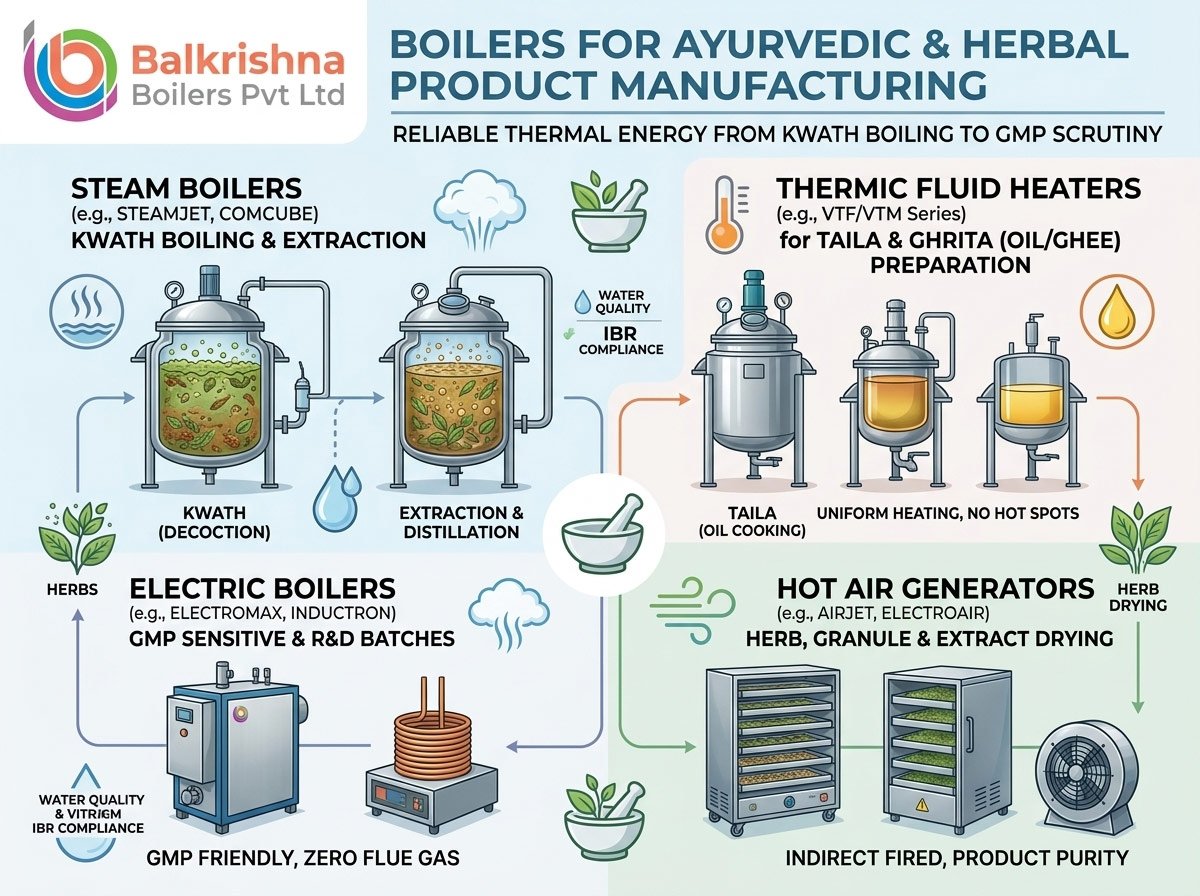
India’s Ayurvedic and herbal products industry is one of the few sectors where an ancient manufacturing tradition and modern GMP compliance sit side by side in the same production hall. A Kwath (decoction) boiling vessel that traces its process logic back centuries now has to run under Schedule T requirements, deliver batch-to-batch consistency, and pass the same kind of documentation scrutiny a pharmaceutical plant would face. The one thing that hasn’t changed is that almost every stage of Ayurvedic manufacturing — decoction, extraction, distillation, concentration, calcination, oil preparation, and drying — depends entirely on controlled thermal energy.
At Balkrishna Boilers Pvt Ltd, we design steam boilers, electric boilers, thermic fluid heaters, hot water boilers, and hot air generators that are already running inside Ayurvedic manufacturing units across India. This guide walks through where each of these fits into a herbal product plant, and how to choose between them based on your specific processes.
Understanding the Thermal Demands of Ayurvedic Manufacturing
Unlike a single-product factory, most Ayurvedic and herbal manufacturing units run several very different thermal processes under one roof:
- Kwath/Kashayam preparation — boiling herb material in water for hours to extract active constituents, typically in large steam-jacketed vessels.
- Swarasa and hydro-alcoholic extraction — extracting active compounds using water, ethanol, or hydro-alcoholic solvent systems, often under reflux or at controlled temperature.
- Distillation (Arka/Asava-Arishta processes) — steam distillation of aromatic herbs, and controlled fermentation-distillation for Asava and Arishta preparations.
- Concentration and evaporation — reducing large decoction volumes down to a concentrated extract, frequently under vacuum to protect heat-sensitive phytochemicals.
- Bhasma and Rasashastra processes — calcination (Puta) of herbo-mineral preparations at high, tightly controlled temperatures.
- Taila and Ghrita (oil and ghee-based) preparation — cooking herbal decoctions into medicated oils and ghee at closely monitored temperatures to avoid degrading active compounds.
- Drying and granulation — drying herbs, extracts, and granules before tableting, capsule filling, or powder (Churna) packing.
- Sterilization and clean utilities — GMP-compliant clean steam for autoclaves, CIP (clean-in-place) systems, and general plant sanitation.
Each of these processes has a different ideal heat source, and that’s exactly why most Ayurvedic manufacturing plants — much like the pharmaceutical facilities we cover in our guide on Steam Quality in Pharmaceuticals — end up running a combination of equipment rather than a single boiler for the entire plant.
Steam Boilers: The Core Utility for Decoction and Extraction
For most Ayurvedic manufacturers, a properly sized steam boiler remains the backbone of the plant. Steam-jacketed Kwath vessels, extraction tanks, and Asava-Arishta fermentation-distillation setups all rely on indirect steam heating to bring large batches of herbal material to a controlled boil without scorching the botanical content — a critical difference from direct-fire heating, which risks localized overheating and destroying active constituents.
Because most Ayurvedic plants run multiple batch vessels simultaneously across a shift, load-following capacity matters. A biomass or agro-waste fired steam boiler is a cost-effective choice for larger manufacturers processing high volumes of dried herb, while an oil/gas fired steam boiler offers faster load response for plants running variable batch schedules. Smaller-capacity Ayurvedic units, particularly those making classical formulations in limited batch sizes, often find a 200 KG to 850 KG Gas Fired Steam Boiler sufficient for their Kwath and distillation vessels. On the Balkrishn.com side, this equivalent range is available under the Steam Boiler category, including our STEAMJET, STEAMAX, and COMCUBE series.
Electric Boilers: The GMP-Friendly Choice for Sensitive Batches
A growing number of Ayurvedic manufacturers, especially those exporting internationally or operating under strict GMP/WHO-GMP certification, are moving toward electric boilers for exactly the same reasons pharmaceutical plants do. As we cover in Electric Boilers in the Pharmaceutical Industry: Why They’re Preferred, electric heating eliminates combustion by-products, flue gas contamination risk, and fuel storage requirements entirely — all of which matter when your product is destined for oral or topical human consumption.
Electric heating is particularly well suited to:
- Small-batch, high-value formulations, where a single contaminated batch is costly to discard.
- Clean room-adjacent utilities, where zero flue gas and zero fuel handling significantly simplify compliance documentation.
- R&D and pilot batch production, where precise, repeatable temperature control matters more than raw throughput.
Our Electric Non-IBR Steam Boiler (100–400 Kg/hr) is a common fit for pilot lines and smaller manufacturing units, while larger, continuous production facilities often move to the IBR Electric Steam Boiler or the Electric Induction Boiler, which uses electromagnetic heating for minimal scaling on the heat transfer surface — a real advantage when working with mineral-rich decoctions and Bhasma-adjacent processes. As we explain in our article on electric steam boiler applications beyond laundries and hospitals, distillation, evaporation, and reactor heating in pharma-adjacent industries are exactly where this equipment earns its keep. On Balkrishn.com, the equivalent lineup includes the ELECTRON, INDUCTRON, and ELECTROMAX series, browsable on the Electric Boiler category page.
Thermic Fluid Heaters: Precision Heat for Taila and Ghrita Preparation
Medicated oil (Taila) and ghee (Ghrita) preparation is one of the most temperature-sensitive processes in Ayurvedic manufacturing. The Sneha Kalpana process requires slow, closely monitored cooking of herbal decoctions into oil or ghee over extended periods, and even a small hot-spot on the vessel wall can scorch the oil or degrade the very phytoconstituents the formulation is meant to deliver.
This is exactly the problem a thermic fluid heater is built to solve. As explained in our guide on what a thermic fluid heater is and how it’s used, these systems circulate a closed-loop thermal fluid at high temperature but near-atmospheric pressure, giving jacketed Taila and Ghrita vessels uniform, low-heat-flux heating without the hot-spot risk of direct flame or high-pressure steam coils. Our Vertical Three Pass Oil/Gas Fired Thermic Fluid Heater is a strong fit for plants with a dedicated oil-cooking section, while the Electric Thermic Fluid Heater suits manufacturers who want zero combustion risk in an oil-handling area. If you’re deciding between thermal fluid and steam for your extraction or oil-cooking vessels, our comparison piece on Thermic Fluid Heater vs Steam Boiler walks through the trade-offs in detail. The equivalent range on Balkrishn.com — including DELTAPAC, THERMPAC, and the VTF/VTM Series — is available on the Thermic Fluid Heater category page.
Hot Water Boilers: For Extraction, Washing, and General Process Use
Not every process needs steam or thermal fluid. Herb washing, hydro-alcoholic extraction at moderate temperatures, and general utility hot water for CIP systems are usually better served by a dedicated hot water boiler, which avoids the cost and complexity of generating full steam pressure for a task that only needs 60–95°C water.
Our Oil/Gas Fired Hot Water Boiler (AQUAJET series) is a common choice for plants running continuous extraction lines, while the Electric Hot Water Boiler (ELECTROAQUA series) is popular where zero-emission, precisely controlled hot water is a compliance priority — a genuine advantage for facilities pursuing WHO-GMP or export certification. Manufacturers with access to biomass residue from herb processing can also consider a Biomass Fired Hot Water Boiler for lower-cost general utility heating. The Hot Water Boiler category on Balkrishn.com covers the equivalent AQUAJET, AQUAMAX, and VST Series range.
Hot Air Generators: Drying Herbs, Extracts, and Granules
Before raw herbs enter extraction, and again after extract concentration, drying is unavoidable — and it’s a step where product quality is won or lost. Over-drying at high, uneven temperatures destroys volatile oils and heat-sensitive actives; under-drying leaves moisture that compromises shelf life and invites microbial growth. This is where an indirect-fired hot air generator earns its place in an Ayurvedic plant.
Indirect designs, like our Oil/Gas Fired Hot Air Generator (AIRJET series), keep combustion gases fully isolated from the process air stream, so dried herbs, granules, or spray-dried extract powders never come into contact with flue by-products — a non-negotiable requirement for oral-consumption products. Where zero-emission, food/pharma-grade air purity is the priority, the Electric Hot Air Generator (ELECTROAIR series) removes any combustion path entirely. This same category is available on Balkrishn.com’s Hot Air Generator page, featuring the AIRJET, AIRPAC, and AIRTHERM models.
GMP, Documentation, and Water Quality: Non-Negotiables in This Industry
Ayurvedic manufacturing regulated under Schedule T shares far more with pharmaceutical utility design than most plant owners initially expect:
- Feedwater treatment is critical, especially for electric boilers and any equipment feeding Bhasma or mineral-heavy processes, where scale buildup on heating elements directly affects both equipment life and product purity.
- IBR compliance applies to any steam-generating pressure vessel above the regulatory threshold, and documentation for this is typically requested during GMP audits.
- Batch traceability benefits from PLC-controlled, repeatable heating cycles — a manual, inconsistent heat source makes validated Standard Operating Procedures (SOPs) much harder to defend during inspection.
- Zero cross-contamination between fuel-side combustion and product-side heating is essential across every piece of equipment that touches herb material, extract, oil, or finished product, which is why indirect heating designs dominate this sector.
Sizing Your Utility Block for an Ayurvedic Manufacturing Plant
A few questions our engineering team works through with every Ayurvedic client:
- What’s your primary product mix? A plant focused on Kwath/Churna production has very different steam demand than one centered on Taila/Ghrita preparation or Asava-Arishta fermentation-distillation.
- How many batch vessels run concurrently? Simultaneous Kwath boiling across multiple jacketed vessels drives peak steam demand more than average daily consumption does.
- Are you pursuing export or WHO-GMP certification? This often tips the decision toward electric heating for at least part of the plant, even where fuel-fired equipment is more economical.
- What’s your extraction method? Hydro-alcoholic or solvent-based extraction changes both the temperature profile and the safety requirements compared to plain aqueous decoction.
- What’s your expansion timeline? Ayurvedic and herbal product demand has grown quickly in recent years; sizing utilities 15–20% above current peak avoids a disruptive retrofit later.
Why Ayurvedic Manufacturers Choose Balkrishna Boilers
With over 25 years of experience and more than 5,000 installations across pharmaceuticals, chemical, and food processing sectors, Balkrishna Boilers Pvt Ltd brings the same engineering discipline used in pharmaceutical utility design to Ayurvedic and herbal manufacturing:
- Indirect heating across every product line, from steam and thermal fluid to hot air, protecting botanical actives and finished product purity.
- Electric and induction options for manufacturers pursuing GMP/WHO-GMP or export-grade compliance.
- IBR-approved steam boiler manufacturing, with full documentation support for regulatory audits.
- End-to-end project engineering, from capacity calculation through piping, insulation, and commissioning across multi-process plants.
Whether you need a single electric steam boiler for a GMP-compliant pilot line or a fully integrated utility block covering Kwath vessels, Taila cooking, extraction, and drying, our team can engineer a system around your specific formulations and batch sizes.
Frequently Asked Questions
Which is better for Kwath and decoction preparation — steam or thermal fluid? Steam is the standard choice for most Kwath and Kashayam vessels, since jacketed steam heating provides reliable, controllable boiling for aqueous decoctions. Thermal fluid heaters become the better fit specifically for oil and ghee-based (Taila/Ghrita) preparation, where uniform, low-heat-flux heating is essential to prevent scorching.
Why do GMP-certified Ayurvedic plants prefer electric boilers? Electric boilers eliminate combustion by-products, flue gas contamination risk, and fuel storage requirements — all of which simplify GMP and WHO-GMP compliance documentation, as detailed in our guide on electric boilers for food, pharma, and dairy applications.
Can hot air generators be used for drying herbal extracts and Churna powders? Yes, provided they’re indirect-fired. Indirect designs like our AIRJET series keep the process air completely separate from combustion gases, which is essential for any product intended for oral consumption.
Is IBR approval required for Ayurvedic manufacturing steam boilers? Any pressure vessel above the regulatory capacity threshold requires IBR certification, regardless of the industry it serves. This is a standard requirement your equipment supplier should build into the proposal from the outset.
What capacity boiler does a small Ayurvedic manufacturing unit typically need? It depends heavily on batch size and vessel count, but many smaller classical-formulation manufacturers start with a 200 KG to 850 KG gas fired steam boiler or an electric non-IBR steam boiler and scale up as production volumes grow.
Ready to design the right heating system for your Ayurvedic or herbal manufacturing plant? Get in touch with our engineering team or request a quote from Balkrishna Boilers with your process details, batch sizes, and compliance requirements, and we’ll propose a solution built for your production line.