
Every tyre that rolls off a production line has spent time under intense, tightly controlled heat. Vulcanization — the chemical reaction that turns raw, pliable rubber into the durable, elastic material we drive on — doesn’t happen at room temperature. It happens inside a curing press, under sustained heat and pressure, and getting that heat wrong by even a few degrees or a few minutes can mean a tyre that fails quality inspection, or worse, fails on the road.
For rubber and tyre manufacturers, the boiler house is as central to product quality as the mixing and moulding equipment on the shop floor. In this guide, we’ll look at where heat is actually used across a rubber or tyre plant, which boiler and heater types fit each stage, and what to prioritize when specifying a thermal system for this industry.
Where Heat Is Used in Rubber and Tyre Manufacturing
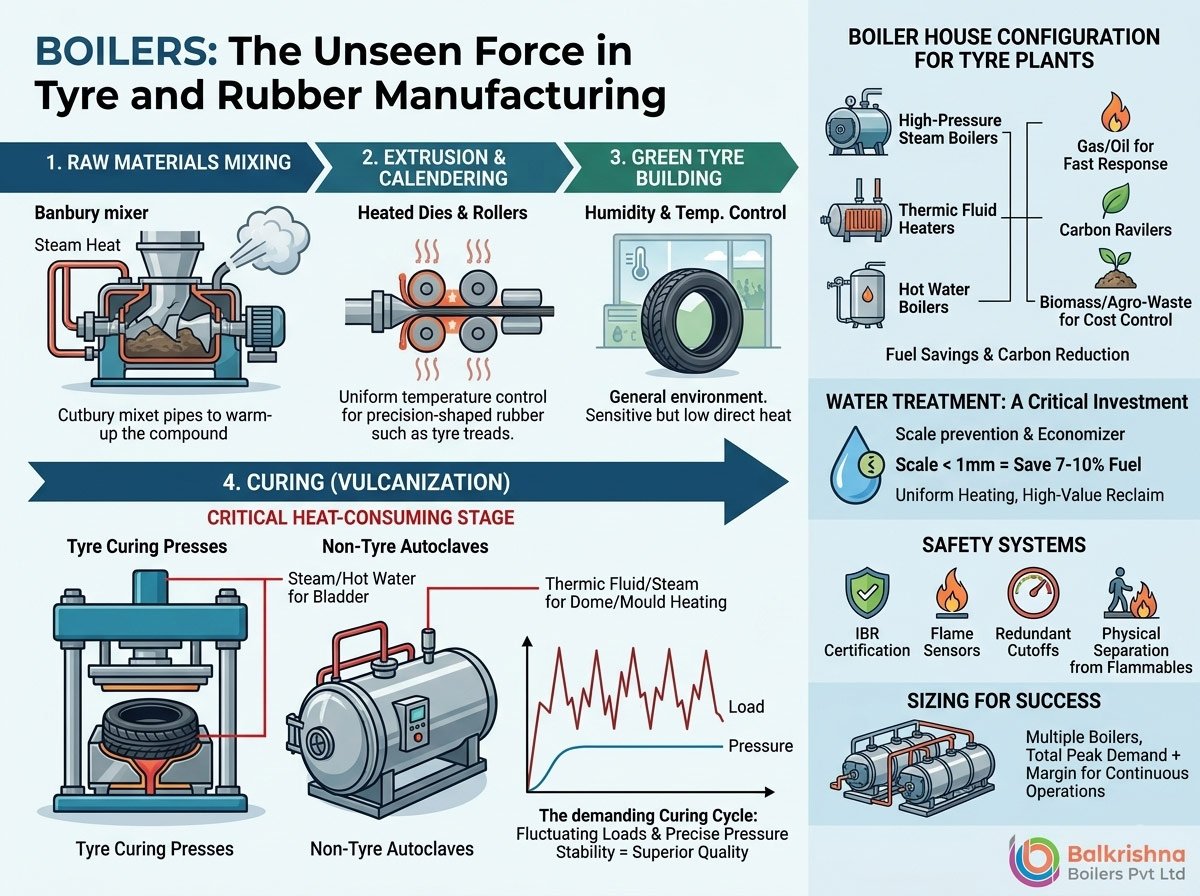
A tyre or rubber-goods plant uses heat at several distinct stages, each with a different temperature, pressure, and consistency requirement:
- Mixing (Banbury/internal mixers): While mixing itself generates friction heat, many plants use steam-heated or hot-water-jacketed systems to pre-condition compounds and control mixing temperature.
- Extrusion and calendering: Rubber compound is shaped into tread, sidewall, or sheet form, often through heated rollers or dies that need stable, uniform temperature to avoid inconsistent gauge or surface defects.
- Building: The “green tyre” is assembled from multiple rubber and fabric/steel components — this stage doesn’t need much direct heat but does benefit from a controlled ambient environment in humidity-sensitive plants.
- Curing (vulcanization): This is by far the largest and most critical heat-consuming stage. The green tyre is loaded into a mould, and heat — delivered via steam or hot water circulated through an internal bladder, plus steam or thermal fluid heating the mould itself (“dome” heating) — is combined with pressure to cross-link the rubber compound and lock the tyre into its final shape and tread pattern.
- Autoclave curing for non-tyre rubber goods: Hoses, belts, gaskets, and moulded rubber components are often cured in steam autoclaves, which need precise, repeatable temperature ramps to hit cure specifications consistently across a batch.
- Retreading: Tyre retreading operations run their own curing cycles, with similar heat requirements to original tyre manufacturing but often at smaller scale.
Because curing dominates both the energy bill and the product-quality outcome, it’s the stage that should drive your boiler specification.
Why Curing Is So Demanding on Your Steam System
Vulcanization is a time-temperature-pressure relationship — the compound needs to spend a specific amount of time at a specific temperature under specific pressure for the cure to be complete and uniform. Two things make this hard on a boiler system:
- Multiple curing presses running simultaneously, each drawing steam or hot water on its own cycle, create a fluctuating, high-frequency demand pattern rather than a smooth, steady load. A boiler system that can’t respond quickly to these swings shows up as inconsistent cure quality between presses, or even between different zones of the same mould.
- Cure time is directly tied to steam pressure stability. If dome or bladder steam pressure drops mid-cycle, the cure can be incomplete, forcing scrap or rework. This is one of the few applications where steam pressure consistency has a direct, measurable link to finished-product yield.
This is why tyre and large rubber-goods plants typically run on high-capacity, multi-boiler configurations rather than a single unit — very similar in principle to how dye houses depend on consistent boiler output to hold colour consistency, where our team has written about how steam pressure fluctuations translate directly into quality defects on the shop floor.
Boiler and Heater Types for Rubber and Tyre Plants
High-Pressure Steam Boilers for Curing Presses
Most tyre curing presses use dome steam and bladder steam/hot water at pressures well above what a light-duty boiler can sustain reliably. A high-pressure industrial steam boiler built for continuous, heavy-duty output is the standard choice here, particularly in plants running dozens of presses on staggered cycles.
Oil and Gas Fired Boilers for Fast, Precise Response
Because curing demand fluctuates rapidly as presses open and close throughout a shift, many tyre plants prefer an oil/gas fired steam boiler for its fast burner response and tight pressure control — important when a pressure dip of even a short duration can affect an in-progress cure cycle.
Thermic Fluid Heaters for Mould and Platen Heating
Where a process needs sustained high temperature at low operating pressure — heating curing press platens indirectly, or supporting extrusion die heating — a thermic fluid heater is often a better fit than direct steam. It also reduces the number of high-pressure steam lines running through the press floor, which can be a meaningful safety and maintenance simplification in a plant already handling flammable rubber compounds and solvents.
Hot Water Boilers for Bladder Circulation
Many modern tyre curing systems use circulating hot water rather than steam inside the bladder, since it offers steadier heat transfer and easier temperature control than saturated steam. A dedicated hot water boiler sized for this closed-loop circulation duty is a common complement to the main steam system.
Biomass and Agro-Waste Fired Boilers for Cost Control
Rubber and tyre manufacturing is fuel-intensive, and plants looking to control running costs increasingly evaluate biomass fired steam boilers or agro-waste fired steam boilers as an alternative to coal or oil. We’ve documented a similar switch in the chemical sector — a Vatva GIDC manufacturer that moved from coal to biomass and cut its carbon footprint by 75%, with fuel savings paying back the investment in 14 months — in our post on how boilers impact carbon emissions and how to reduce them. The same economics apply to a rubber or tyre plant’s boiler house, provided the fuel-switch doesn’t compromise the pressure stability curing demands.
Water Treatment: More Critical Than Most Plants Realize
Scale build-up inside a boiler doesn’t just waste fuel (as little as 1mm of scale can raise fuel consumption by 7–10%) — in a curing application, inconsistent heat transfer caused by scale or fouling can translate directly into uneven cure across a batch of tyres or rubber components. A rigorous water softening program, combined with disciplined blowdown routines, is one of the highest-value investments a rubber or tyre plant can make in protecting both fuel cost and cure consistency.
An economizer to recover flue-gas heat for feedwater pre-heating is close to standard on any boiler running continuous multi-shift production, which describes most tyre plants.
Safety Considerations Specific to Rubber and Tyre Plants
Rubber compounding and curing operations typically store solvents, uncured rubber stock, and other combustible materials on-site, which raises the bar on boiler-house safety design:
- Redundant safety systems — high-pressure cutoffs, low-water alarms, flame sensors, and spring-loaded safety valves — should be treated as mandatory, not optional, in a plant with this risk profile.
- IBR certification for any boiler operating above the regulatory capacity or pressure threshold ensures the unit has been inspected and certified for continuous industrial duty.
- Physical separation between the boiler house and areas storing flammable rubber compounds or solvents should be part of your plant layout planning from day one, not an afterthought.
Sizing for Continuous, Multi-Press Operation
Because tyre and rubber-goods plants run many curing presses on independent, overlapping cycles, capacity planning needs to account for peak simultaneous demand — not average demand. The standard approach is to total the peak steam or hot water draw across every press and autoclave running at once, then add a 10–15% margin for future line expansion and demand variability. Most plants of any real scale also install more than one boiler, so a single unit going offline for maintenance doesn’t force a shutdown of the curing floor — a costly outcome given how much production value sits mid-cure at any given moment.
Choosing a Boiler Partner for Rubber and Tyre Manufacturing
Given how directly steam quality affects finished-product quality in this industry, the supplier you choose matters as much as the boiler model itself. Look for a partner who can show:
- Experience sizing boilers for high-frequency, fluctuating-load applications like curing presses — not just steady industrial demand.
- The ability to recommend the right combination of steam, hot water, and thermic fluid systems for your specific curing technology, rather than a single default solution.
- IBR certification and full documentation support.
- End-to-end service from site layout and fuel train design through installation, commissioning, and after-sales AMC support.
- A track record across similarly demanding, quality-sensitive process industries — our guides on boilers for the textile industry and boilers for pharmaceutical manufacturing cover two other sectors where steam consistency is directly tied to product outcome, much like rubber curing.
Indian Boilers.com and Balkrishna Boilers Pvt Ltd manufacture steam boilers, thermic fluid heaters, and hot water boilers engineered for high-frequency, quality-critical industrial processes. Our engineering team can help you map curing-press demand across your production floor and recommend the right boiler configuration — including pollution control equipment suited to your fuel choice — for reliable, consistent cure quality.
Frequently Asked Questions
What type of boiler is best for tyre curing presses? Most tyre plants run high-pressure steam boilers for dome and bladder steam, often paired with a dedicated hot water boiler for bladder circulation and a thermic fluid heater for indirect mould or platen heating. The right combination depends on your specific press technology.
Why is steam pressure stability so important in tyre manufacturing? Vulcanization is a time-temperature-pressure process. A drop in steam pressure during a curing cycle can result in an incomplete or inconsistent cure, directly affecting product quality and yield.
Can a rubber or tyre plant run on biomass fuel instead of coal or oil? Yes, provided the boiler is sized and controlled to maintain the pressure stability curing demands. Many manufacturers have cut fuel costs and emissions significantly by switching to biomass or agro-waste fuel without compromising cure quality.
How many boilers does a tyre plant typically need? Most plants of meaningful scale install more than one boiler so a single unit going offline for maintenance doesn’t halt the curing floor, since production value sitting mid-cure is costly to lose.
Why does water treatment matter so much for rubber curing? Scale and fouling reduce heat transfer efficiency and can cause uneven heating across a curing cycle, which shows up as inconsistent cure quality — in addition to the fuel-cost impact scale has on any boiler.
What safety measures are especially important for a rubber or tyre plant boiler house? Given the presence of solvents and combustible rubber stock on-site, redundant safety interlocks, IBR certification, and physical separation between the boiler house and material storage areas are essential.
Planning a new boiler system or upgrading your curing-press steam supply? Contact our engineering team for a capacity and configuration recommendation tailored to your production line.