
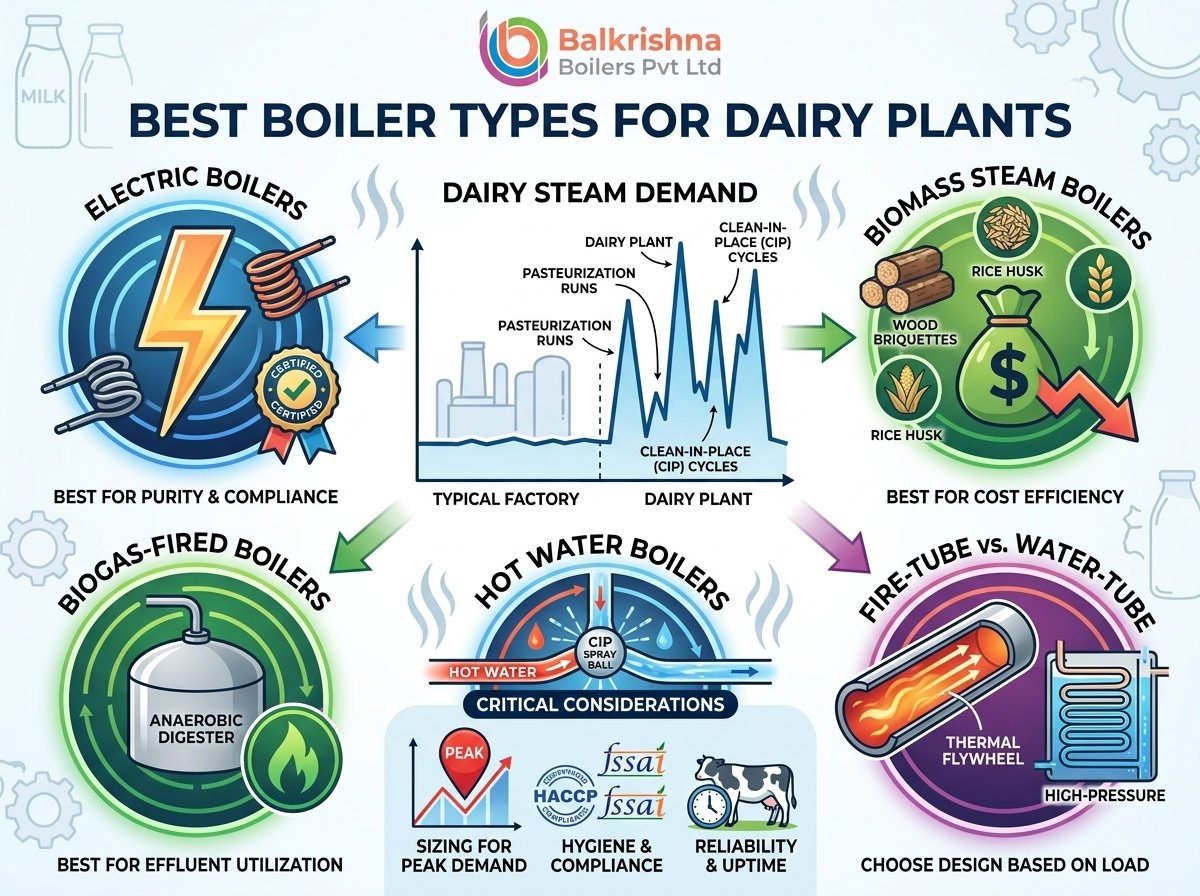
A dairy plant’s steam demand looks nothing like a typical factory’s. It isn’t a steady, predictable load — it’s intermittent and spiky, with huge peaks during pasteurization runs and Clean-in-Place (CIP) cycles, followed by lulls between batches. On top of that, milk is one of the most hygiene-sensitive products a boiler will ever indirectly touch, which means purity and pressure stability aren’t nice-to-haves — they’re the entire point of the system.
Choosing the wrong boiler type for a dairy plant shows up fast: pasteurization temperatures that drift, CIP cycles that take longer than they should, or a fuel bill that doesn’t match the plant’s actual output. This guide walks through the boiler types best suited to dairy operations, how sizing should account for peak-demand spikes rather than averages, and what hygiene and compliance factors should shape the final decision.
Why Dairy Plants Have Unique Steam Requirements
Dairy processing runs on two heavy, recurring steam demands: pasteurization, which needs huge volumes of stable heat delivered consistently, and Clean-in-Place (CIP) procedures, which require large amounts of hot water and steam on a tight schedule between production runs. Both are characterized by intermittent, high-peak demand rather than a flat, continuous load — very different from, say, a textile dye house running machines around the clock.
That combination — purity, peak-load responsiveness, and hygiene compliance — means dairy plants need to evaluate boilers differently than most other industrial buyers. The core principle is covered in more depth here: Electric Boilers for Food, Pharma & Dairy: Safe, Clean Steam Solutions, which breaks down exactly why dairy’s demand profile pushes many plants toward specific boiler configurations.
The Best Boiler Types for Dairy Plants
1. Electric Boilers — Best for Purity-Critical, Compliance-Heavy Operations
For dairy plants under close regulatory scrutiny — infant nutrition, UHT milk, export-grade dairy products — electric boilers are increasingly the default recommendation. Because they’re zero-emission at the point of use, they eliminate combustion byproducts, soot, and flue gas concerns near the processing area entirely, which matters a great deal in an environment governed by GMP, HACCP, and FSSAI standards. Electric systems also respond almost instantly to load changes, which suits dairy’s spiky pasteurization-then-CIP demand pattern far better than a slow-responding fuel-fired unit.
Explore the electric boiler category, including the IBR Electric Steam Boiler for larger, certified dairy installations and the Electric Steam Boiler 100 Kg/hr to 400 Kg/hr for smaller processing units. On Balkrishna Boilers, the ELECTRON series is engineered specifically for ultra-pure, contamination-free steam, while ELECTROMAX and INDUCTRON suit plants needing higher-capacity electric steam generation.
2. Biomass Steam Boilers — Best for Cost-Efficient, High-Volume Plants
Large dairy operations running continuous pasteurization lines often lean toward biomass steam boilers, primarily because the fuel cost advantage compounds significantly at scale — a 24/7 plant switching from coal to rice husk-based biomass, for instance, can see steam cost savings that run into crores annually. Biomass is also treated as carbon-neutral, which increasingly matters for dairy cooperatives and exporters facing sustainability commitments from their buyers.
The COMCUBE Biomass Fired Steam Boiler suits dairy plants where floor space is limited but demand is high, and the STEAMAX Briquette Fired Steam Boiler is built to hold a steady pressure profile even during peak CIP or pasteurization loads — a genuinely important detail, since pressure swings during pasteurization can affect both product safety and consistency. More detail on how biomass fits dairy and food operations specifically is here: Biomass Boilers for Food Processing: Unlocking Green Energy, and the broader economics are covered in The Complete Guide to Biomass Boilers for Steam Generation.
Browse the full steam boiler range for capacity and configuration comparisons.
3. Biogas-Fired Boilers — Best for Dairies with On-Site Effluent Treatment
Dairy plants generate significant organic wash-water and effluent, and many now run anaerobic digesters or ETPs as part of their environmental compliance. That waste stream can be converted directly into fuel: a Biogas Fired Boiler uses methane-rich biogas generated from wash-water and food scraps to produce clean steam for pasteurization, effectively turning a waste-disposal cost into a fuel source. This is a particularly strong fit for larger dairy cooperatives and processing hubs already running effluent treatment infrastructure, since it reduces both fuel spend and disposal costs simultaneously.
4. Hot Water Boilers — Best for CIP and Non-Steam Processes
Not every dairy process needs steam. CIP cycles, wash-down, and certain pre-heating stages are often more efficiently served by a dedicated hot water system. For continuous, high-hygiene hot water demand — exactly the profile a dairy plant has — the AQUAMAX wood briquette-fired hot water boiler is built around a high-efficiency heat exchanger designed to minimise thermal wastage during continuous operation. The VTFH SERIES, also available in a biomass-fired configuration, is worth considering for dairies running frying or thermal-fluid-adjacent processes alongside standard CIP demand.
Explore the hot water boiler category for the full range.
Fire-Tube vs. Water-Tube: Which Design Fits a Dairy Plant?
Most mid-sized dairy plants are well served by fire-tube boilers, which offer a large water storage capacity — effectively a “thermal flywheel” — that helps absorb sudden demand spikes without a dramatic pressure drop. This matters directly for dairy, where pasteurization and CIP cycles create exactly that kind of intermittent, high-peak load. Fire-tube designs are commonly recommended for food processing and small-to-mid-scale dairy operations specifically.
Larger dairy processing hubs running high-pressure requirements, however, may need to consider a water-tube design instead, since fire-tube boilers become structurally limited above roughly 20 bar. The full technical comparison, including a direct reference to dairy plant sizing, is covered here: Water Tube vs Fire Tube Boilers: Which Is Better for Your Plant?
Sizing for Peak Demand, Not Average Demand
The single most common sizing mistake in dairy plants is designing around average daily steam consumption rather than the peak spike that happens when pasteurization and CIP overlap, or when multiple lines hit their heat-up phase together. A dairy boiler needs enough reserve capacity — or fast enough response time — to absorb that spike without a pressure dip that could compromise a pasteurization hold.
Practical sizing steps for dairy plants:
- Map your peak overlap window — the period when pasteurization, CIP, and any secondary hot water demand are most likely to run simultaneously
- Size to that peak, with a 10–15% margin for future line additions or seasonal production increases
- Weight response speed alongside raw capacity — a boiler that reaches full pressure quickly (electric or water-tube designs) may outperform a larger but slower-responding unit for spiky dairy loads
- Separate steam and hot water demand where practical, so a dedicated hot water system handles CIP without competing with pasteurization for the same boiler’s output
Hygiene, Purity, and Compliance Considerations
Because dairy product safety depends heavily on precise, contamination-free heat delivery, a few compliance-related factors deserve specific attention when buying:
- Zero tolerance for steam carryover in any process where steam has direct or near-direct product contact
- GMP, HACCP, and FSSAI alignment, particularly for export-grade or infant-nutrition dairy products
- Water treatment quality, since scale and impurities in feedwater directly threaten steam purity — a detailed breakdown of requirements, especially relevant for electric systems, is here: Electric Boiler Water Quality Requirements Explained
- Auditing simplicity — electric systems, with no fuel train or combustion byproducts, are generally easier to defend during a hygiene audit than fuel-fired alternatives
For a broader look at how boiler selection changes across food, pharma, and textile sectors — useful context if your dairy plant also runs adjacent food processing lines — see Best Boiler for Textile, Pharma, and Food Industry: An Industry-wise Guide.
Reliability: Why Uptime Matters More in Dairy
Milk is perishable on a tighter clock than almost any other raw material a boiler will support. A pasteurization line that goes down mid-shift doesn’t just lose production time — it risks an entire day’s raw milk intake. That makes supplier reliability as important as the boiler specification itself.
Before finalising a supplier, confirm:
- AMC coverage with defined response times, not just a general service agreement
- Spare parts availability, ideally from local stock rather than import lead times
- Installation and commissioning support, including operator training so your team can run the system safely from day one — the general process and sequencing is covered here: Electric Boiler Installation: What to Expect
- Documented water treatment and blowdown logs, since these are frequently requested during dairy-sector hygiene audits
A Practical Buying Checklist for Dairy Plant Boilers
- Peak simultaneous demand across pasteurization, CIP, and any secondary hot water needs — not just average daily load
- Boiler type fit — electric for maximum purity and compliance, biomass for cost-efficient high-volume plants, biogas where effluent treatment infrastructure already exists, hot water systems for CIP-specific loads
- Fire-tube vs. water-tube, based on your pressure requirements and how much “thermal flywheel” reserve you need against demand spikes
- Water treatment plan, sized for dairy-grade steam purity, not just general scale prevention
- IBR classification and safety systems, confirmed and documented before commissioning
- AMC terms and spare parts access, given how costly downtime is with perishable raw milk in the system
Why Dairy Processors Choose Balkrishna Boilers
Balkrishna Boilers Pvt Ltd has spent over 25 years engineering steam boilers, electric boilers, biomass systems, and hot water boilers for hygiene-critical industries, with dairy processing among our most consistently served sectors. Our steam boiler, electric boiler, and hot water boiler ranges are engineered for the purity, peak-load responsiveness, and reliability that pasteurization and CIP demand, and every IBR-rated unit is inspected and tested before it leaves the factory.
If you’re evaluating a new boiler for a dairy processing line, our engineering team can help match your pasteurization and CIP load profile to the right boiler type, capacity, and fuel combination — reach out through the contact page or browse the full product range to compare specifications directly.
Frequently Asked Questions
What’s the best boiler type for a small dairy plant? For small-to-mid-sized dairies, a fire-tube steam boiler or a compact electric boiler generally offers the best balance of capacity, purity, and simplicity, particularly where floor space and operator skill availability are limited.
Are electric boilers better than fuel-fired boilers for dairy hygiene? Electric boilers eliminate combustion-related contamination risk entirely, which makes them the safer default for hygiene-critical or export-grade dairy operations, though the running-cost comparison depends on your local electricity tariff versus fuel costs.
How should a dairy plant size its boiler for CIP and pasteurization together? Map the period when both processes are most likely to overlap and size to that combined peak, with a 10–15% margin — sizing to average daily demand alone commonly leads to pressure drops during simultaneous operation.
Can biogas from dairy effluent actually power a boiler? Yes — dairies with anaerobic digesters or ETPs can convert organic wash-water and food scraps into biogas, which can fuel a dedicated biogas-fired boiler for pasteurization steam, reducing both fuel and effluent disposal costs.
How often should water treatment be checked in a dairy plant boiler? Given how directly feedwater quality affects steam purity in near-direct-contact applications like pasteurization, a full water treatment review is generally recommended monthly, alongside routine per-shift blowdown.
Planning a new boiler installation for a dairy processing line? Get in touch with our engineering team for a load profile and capacity assessment.