
Most of the practical guidance around thermic fluid heaters — sizing, maintenance, troubleshooting — sits on top of a small set of heat transfer principles. Once you understand how heat actually moves from flame to fluid to process, a lot of the “why” behind maintenance schedules, fluid selection, and coil design stops being a list of rules to follow and starts being straightforward engineering logic.
This piece walks through the heat transfer fundamentals that govern how a thermic fluid heater actually works — useful whether you’re specifying a new system, troubleshooting an underperforming one, or just want to understand what’s happening inside the coil.
The Three Heat Transfer Mechanisms at Work
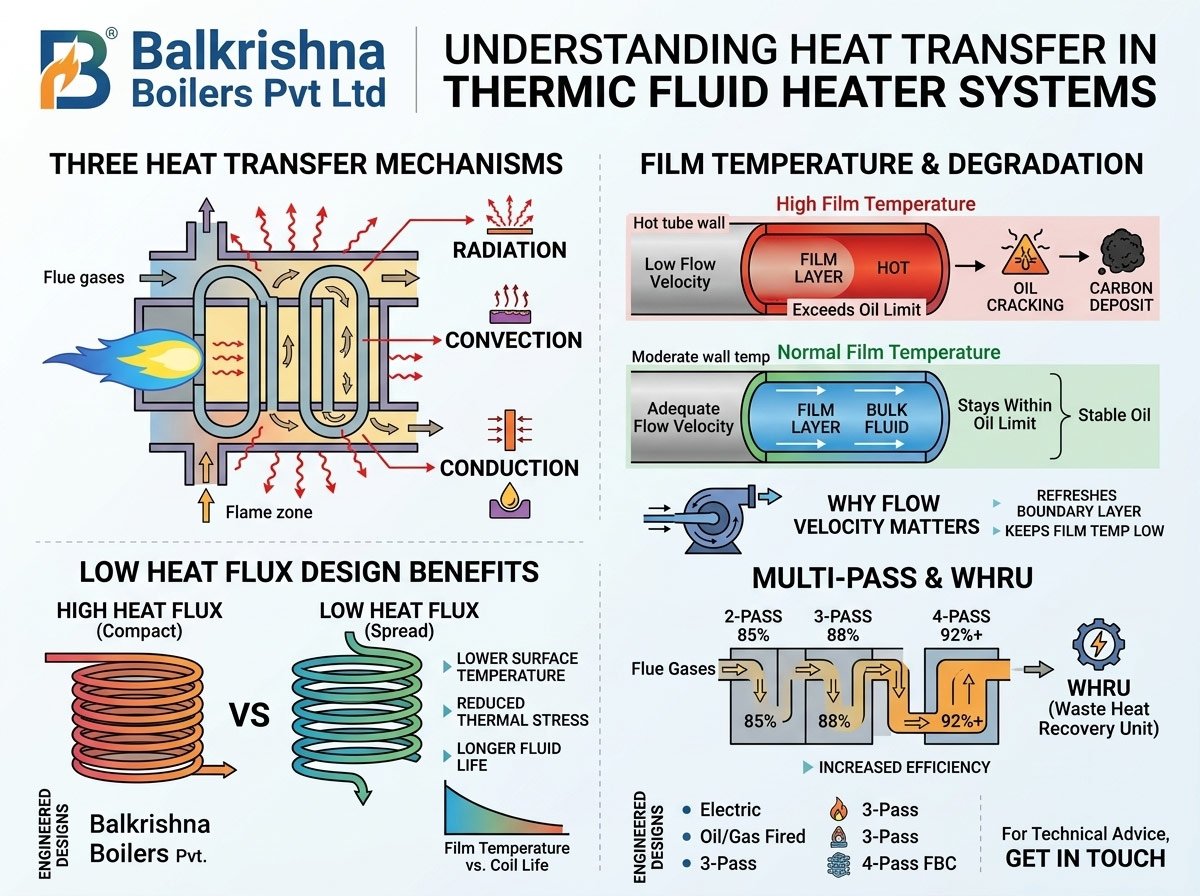
Every thermic fluid heater relies on all three classical modes of heat transfer, at different stages of the process:
Radiation dominates in the combustion chamber, where the flame radiates heat directly to the coil surface facing it. This is the most intense heat transfer zone in the entire system — radiant heat flux at the flame-facing coil surface is many times higher than what the coil experiences further along the flue gas path.
Convection carries heat from the hot flue gases to the coil surface as those gases travel through the heater’s passes (the “three-pass” or “four-pass” designation refers to how many times the flue gas path folds back across coil surfaces before exiting). Convective transfer is generally less intense per unit area than radiant transfer but happens over a much larger total surface area, which is why multi-pass designs recover meaningfully more heat than a single-pass configuration.
Conduction moves heat through the coil tube wall itself, from the fire-side surface to the fluid-side surface, and then into the thermal fluid via the boundary layer immediately adjacent to the tube wall. This is the step where coil material, tube thickness, and — critically — flow velocity inside the tube all matter enormously to system performance and safety.
Film Temperature: The Concept That Governs Almost Everything
If there’s one concept worth understanding thoroughly, it’s film temperature — the temperature of the thin layer of fluid immediately in contact with the inside coil wall, as distinct from the bulk fluid temperature flowing through the center of the tube.
Because the tube wall on the fire side is being heated intensely by radiation and convection, the fluid layer touching that wall runs hotter than the bulk fluid average — sometimes significantly hotter. If flow velocity through the tube is too low, that boundary layer doesn’t get refreshed quickly enough, and the film temperature can climb well past the bulk fluid’s indicated temperature, potentially exceeding the fluid’s safe thermal limit even when your control panel shows a perfectly normal bulk outlet temperature.
This is exactly why thermal cracking and carbonization — covered in depth in signs of thermic fluid degradation and when to replace it — can occur even when bulk temperature readings look fine. The degradation happens at the film layer, invisible to a standard outlet temperature sensor, which is part of why fluid analysis (checking for cracking byproducts directly in the fluid) matters as much as temperature monitoring.
Low Heat Flux Design: Engineering Around the Film Temperature Problem
Heat flux is the rate of heat transfer per unit of coil surface area — essentially, how hard each square meter of tube is working. A low heat flux coil design deliberately spreads the same total heat load across more coil surface area, and maintains higher fluid velocity through the tubes, both of which keep the film temperature closer to the bulk fluid temperature rather than letting it spike locally.
This is a genuine design trade-off: a low heat flux coil is physically larger (more tube length, more surface area) than a high heat flux design delivering the same kcal/hr output, which means more material cost. The payoff is a system that protects the fluid from localized overheating even when running at its rated capacity continuously — extending fluid life and reducing the risk of carbonization dramatically compared to a more compact, higher heat flux design running the same duty. This is one of the most important differentiators between a well-engineered thermic fluid heater and a cheaper, undersized coil design, and it directly affects the efficiency gains covered in how thermic fluid heaters improve energy efficiency.
Why Flow Velocity Matters So Much
Flow velocity through the coil affects heat transfer in two connected ways:
It determines how quickly the heated boundary layer is replaced. Higher velocity means fresh, cooler bulk fluid continuously sweeps past the tube wall, keeping the film temperature closer to bulk temperature. Lower velocity means that boundary layer sits in contact with the hot wall longer, absorbing more heat and running hotter before it’s replaced.
It affects the convective heat transfer coefficient itself. Turbulent flow (which requires adequate velocity) transfers heat far more effectively from the tube wall into the fluid than laminar, slow-moving flow does. A poorly circulating system doesn’t just risk film overheating — it also transfers heat less efficiently overall, meaning the burner has to work harder to achieve the same bulk outlet temperature.
This is why a falling flow rate — from a worn pump, a partially closed valve, or coil fouling restricting the flow path — is one of the earliest and most reliable warning signs covered throughout our maintenance and troubleshooting content, including common thermic fluid heater problems and their solutions. It’s not just an efficiency symptom; it’s a direct threat to fluid integrity through the film temperature mechanism described above.
Multi-Pass Design and Heat Recovery
The “pass” count in a thermic fluid heater’s design (three-pass, four-pass) refers to how many times the flue gas is routed across heat-absorbing coil surfaces before exiting through the stack. Each additional pass extracts more heat from the flue gas that would otherwise be lost, which is why multi-pass designs achieve meaningfully higher thermal efficiency than simpler single-pass configurations — typically 85% to 88% (NCV) for well-designed three- and four-pass units.
Beyond the pass count itself, a Waste Heat Recovery Unit (WHRU) extracts additional heat from the flue gas after it has already passed through the primary coil passes, using it to preheat combustion air or incoming fluid — pushing overall system efficiency as high as 92%. This is essentially applying the same heat transfer logic (don’t let usable heat exit through the stack) one step further than the base heater design already does.
How Fluid Properties Affect Heat Transfer Performance
Not all thermal fluids transfer heat equally well, and this is a factor worth understanding when selecting a fluid grade:
- Thermal conductivity determines how effectively heat moves through the fluid itself, from the boundary layer at the tube wall into the bulk flow.
- Viscosity affects how easily the fluid flows and how much pump energy is needed to maintain adequate velocity — a more viscous fluid, especially at lower temperatures during startup, requires more pump work to achieve the same flow velocity, directly affecting the film temperature protection described above.
- Specific heat capacity determines how much energy the fluid can carry per degree of temperature rise, which factors directly into the sizing calculation covered in thermic fluid heater capacity: how to choose the right size.
As fluid degrades through oxidation or cracking, these properties shift — typically in a direction that reduces heat transfer efficiency, which is part of why a plant running degraded fluid often needs a higher firing rate to hit the same process temperature it used to reach more easily. Selecting the right fluid grade for your operating temperature from the start, covered in our thermic fluid heater oil selection guide, is the foundation that good heat transfer performance is built on.
Heat Transfer at the Process Side
Everything above covers heat transfer inside the heater itself, but the same principles apply again at the process end — wherever the hot thermal fluid gives up its heat to a reactor jacket, a mold, a stenter chamber, or a drying oven. The same film-temperature and flow-velocity logic governs how effectively and evenly heat transfers out of the fluid at the process equipment, which is why balanced flow distribution across multiple heat users matters so much in multi-process systems — a starved branch doesn’t just run cooler, it can also develop its own local film-temperature issues at whatever heat exchanger or jacket it serves.
This connects directly to why uneven process heating (covered as a distinct problem in our troubleshooting guide) is often a flow-distribution issue rather than a fault with the heater itself — the same underlying physics applies at both ends of the circuit.
Why This Matters for Buyers, Not Just Engineers
Understanding these principles helps explain a few things that otherwise look like arbitrary specifications on a heater datasheet:
- Why two heaters with the same kcal/hr rating can have very different coil surface areas — and why the one with more surface area (lower heat flux) is generally the better long-term investment for fluid life and reliability, even at a higher upfront cost.
- Why flow rate and pump sizing deserve as much attention in a specification as the burner and coil themselves — a well-designed coil paired with an undersized pump still risks film overheating.
- Why fluid analysis catches problems that temperature monitoring alone misses — because degradation happens at the film layer, not the bulk fluid your outlet sensor is reading.
Engineering Heat Transfer Right, From Design Through Operation
At Balkrishna Boilers Pvt Ltd, our thermic fluid heaters are engineered with low heat flux coil design as standard across the range, specifically to protect fluid life and system reliability rather than minimizing upfront material cost at the expense of long-term performance:
- Electric Thermic Fluid Heater
- Oil / Gas Fired Thermic Fluid Heater
- Vertical Three Pass Oil / Gas Fired Thermic Fluid Heater
- Vertical Four Pass FBC Thermic Fluid Heater
Have Questions About Your System’s Heat Transfer Performance?
If you’re evaluating a specification, troubleshooting an underperforming system, or just want a technical second opinion on a coil design, get in touch with your system details and our technical team can walk through it with you.