
Not every process needs 300°C. A lot of industrial heating — washing, low-temperature process water, space heating, moderate-temperature cleaning and sterilization — sits comfortably in a range that a hot water boiler handles perfectly well, without reaching for the higher capability (and higher cost) of a thermic fluid heater. The two technologies overlap at the edges but are built for genuinely different jobs, and picking the wrong one for your temperature requirement either wastes capital or leaves your process short of what it needs.
This comparison walks through where each technology fits, the real differences in temperature range, pressure, and running cost, and how to decide between them for a new installation.
The Core Difference: What’s Circulating and How Hot It Gets
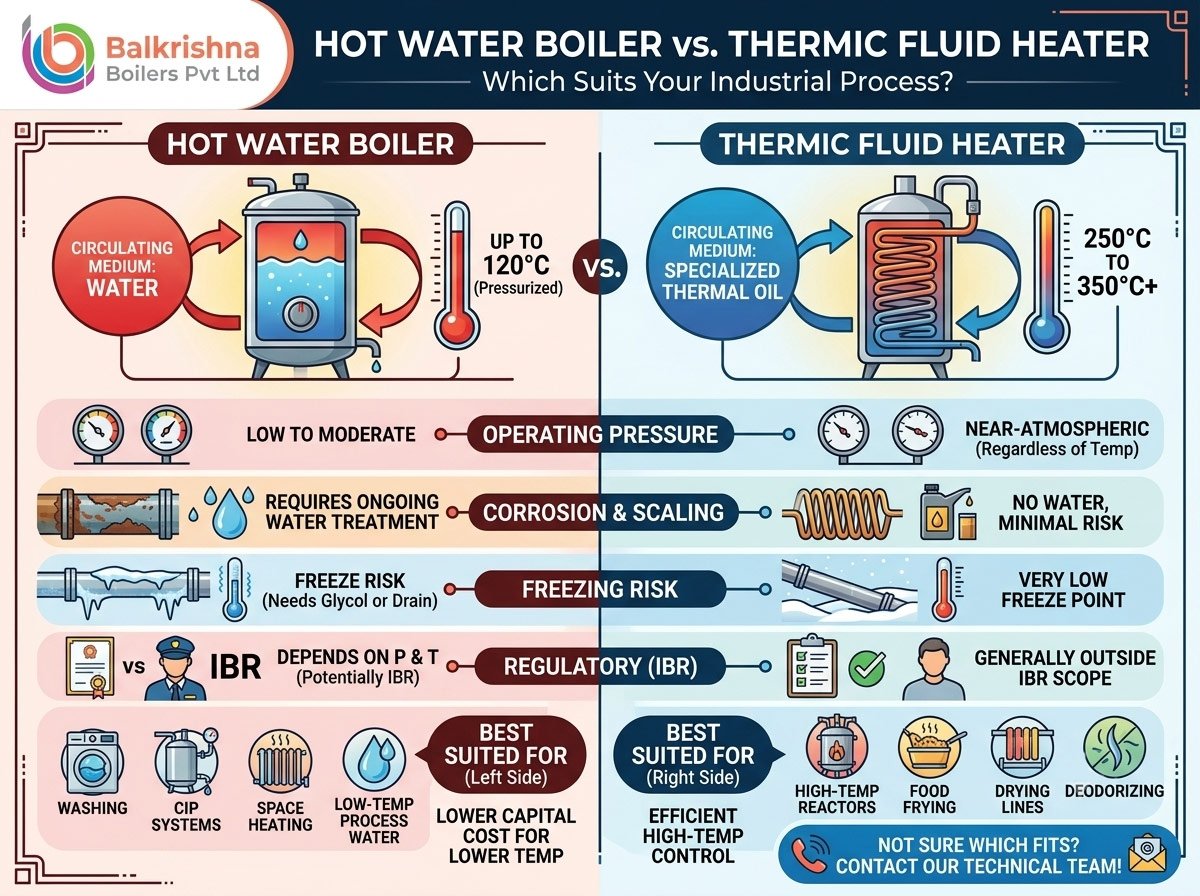
A hot water boiler heats water and circulates it through a closed or open loop, staying in the liquid phase throughout — but water’s practical ceiling for low-pressure operation is well below what many industrial processes need. Hot water boilers typically top out around 95°C for standard low-pressure, non-pressurized systems, with medium-temperature pressurized designs extending to roughly 110°C to 120°C.
A thermic fluid heater uses a specialized thermal oil instead of water, circulated in a fully closed loop. Because the fluid’s boiling point at atmospheric pressure is far higher than water’s, it can be heated to 250°C to over 350°C while remaining liquid, at only modest pump pressure. This is the entire reason thermic fluid heaters exist as a separate category — they solve the problem of needing high temperature without the pressure penalty that pushing water or steam to those temperatures would require. Our detailed explanation of this principle is in what a thermic fluid heater is and how it’s used.
Side-by-Side Comparison
| Factor | Hot Water Boiler | Thermic Fluid Heater |
|---|---|---|
| Typical temperature range | Up to 95°C (110–120°C for pressurized designs) | 250°C to 350°C+ |
| Operating pressure | Low to moderate | Near-atmospheric (low, regardless of temperature) |
| Heat transfer medium | Water | Specialized thermal oil |
| Corrosion/scaling risk | Present — needs water treatment | Minimal — no water chemistry involved |
| Freezing risk | Present in cold climates without treatment | Very low — thermal fluids have low freeze points |
| IBR applicability | Depends on pressure and temperature | Generally outside IBR scope |
| Typical fluid life | Water treated and topped up continuously | 3–10 years depending on fluid grade, then replaced |
| Best suited for | Washing, sterilization, space heating, low-temp process water | High-temperature reactors, frying, drying, presses, deodorizing |
Where a Hot Water Boiler Is the Right Choice
Washing and cleaning processes. Many industrial washing, CIP (clean-in-place), and general cleaning applications need consistent hot water in the 60°C to 90°C range — well within a standard hot water boiler’s comfortable operating window, without the added cost of a thermal fluid system built for a temperature the process will never use.
Space heating. For facility heating — offices, warehouses in cold climates, or process areas needing ambient temperature control — hot water boilers are the standard, cost-effective solution, distributing heat through radiators, baseboard heaters, or hydronic radiant floor systems.
Sterilization and moderate-temperature process water. Certain sterilization and pasteurization-adjacent processes that don’t require the higher temperatures of true steam sterilization can run effectively on hot water in the 90–110°C range using a pressurized hot water system.
Lower capital cost for lower-temperature needs. Where a process genuinely doesn’t need high temperature, a hot water boiler is typically the lower capital cost option — there’s no reason to pay for thermic fluid heating capability the process will never use.
Where a Thermic Fluid Heater Is the Right Choice
Any process above roughly 120°C. Once a process genuinely needs sustained temperatures beyond what a hot water boiler can deliver — reactor heating, frying, deodorizing, drying, presses — thermic fluid becomes the practical option, since pushing water or steam to those temperatures means operating at pressures that carry significant safety, compliance, and capital cost implications.
Processes needing precise, uniform high-temperature control. Applications like plastics mold heating and food frying and deodorizing depend on tight, even temperature control at high heat — exactly where thermic fluid’s liquid-phase, low-pressure design delivers its clearest advantage.
Plants wanting to minimize water treatment overhead. Because thermic fluid runs in a sealed loop with no water chemistry involved, it avoids the ongoing cost and complexity of feedwater treatment that a hot water (or steam) system carries — a meaningful operating-cost consideration even for processes that could technically run on hot water at the lower end of the thermic fluid range.
Corrosion, Scaling, and Water Chemistry
This is one of the most practical differences between the two technologies day to day. Hot water boilers need ongoing water treatment — softening, dosing, and periodic blowdown — to manage scale formation and corrosion, particularly in areas with hard water. Skipping or under-managing water treatment on a hot water boiler is one of the most common causes of premature tube failure and efficiency loss in the field.
Thermic fluid heaters sidestep this entirely — there’s no water in the circuit, so there’s no scaling and minimal corrosion risk from the fluid itself. The trade-off is that thermal fluid itself degrades over time through oxidation and thermal cracking rather than through water chemistry, which is its own maintenance discipline. Our guide on signs of thermic fluid degradation and when to replace it covers that side of the comparison in depth.
Freeze Protection
In colder climates or unheated plant areas, hot water systems carry a freeze risk that needs active management — either through glycol treatment, freeze protection controls, or careful system draining during shutdowns. Thermal fluids generally have much lower freezing points than water, which removes this as a practical concern for thermic fluid systems, even in facilities with unheated pipe runs.
Regulatory and Compliance Considerations
Depending on the specific pressure and temperature a hot water system operates at, it may fall under IBR (Indian Boiler Regulations) requirements, particularly for higher-pressure, higher-temperature designs. Thermic fluid heaters, operating at near-atmospheric pressure regardless of their high temperature, generally sit outside IBR’s scope — meaning no certified boiler attendant or the associated annual government inspection burden that pressurized systems carry. For plants trying to minimize compliance overhead, this is a real, practical factor in the decision, separate from the pure technical fit.
Running Cost Considerations
Both technologies’ running costs depend heavily on fuel choice and local utility pricing, but a few structural differences matter:
- Hot water boilers carry ongoing water treatment cost that thermic fluid systems don’t.
- Thermic fluid heaters need periodic fluid replacement (every several years, not annually) as a capital-adjacent cost that hot water systems don’t have in the same form.
- Thermic fluid systems avoid blowdown and condensate losses in the way steam does, giving them a genuine efficiency edge over comparable steam systems — though this specific advantage is less relevant when comparing against hot water rather than steam, since hot water systems also avoid phase-change losses. Our piece on how thermic fluid heaters improve energy efficiency covers this in more depth for readers weighing thermic fluid against steam specifically.
Can One Plant Use Both?
Yes, and many do. It’s common for a plant to run a hot water boiler for washing, CIP, and space heating needs, alongside a thermic fluid heater serving high-temperature process equipment like reactors, dryers, or a frying line. Rather than treating the choice as either/or across an entire facility, the more useful question is which technology fits each specific process — and sizing each system for the loads it’s actually meant to serve. For processes on the edge — say, a wash process that occasionally needs to push past 100°C — it’s worth a direct conversation with your supplier’s technical team rather than defaulting to whichever system the plant already has installed.
How to Decide for a New Installation
A short checklist for making the call:
- What’s your actual required process temperature? Below roughly 100–110°C, hot water is almost always the simpler and more economical choice. Above that, and especially above 150°C, thermic fluid becomes the practical option.
- How much do you want to invest in water treatment infrastructure and ongoing chemistry management? If minimizing that overhead matters to your operation, thermic fluid’s sealed-loop design has a real advantage even for processes at the lower end of its temperature range.
- What’s your appetite for regulatory/compliance overhead? If avoiding IBR-related requirements is a priority, thermic fluid’s low-pressure operation is generally the simpler path.
- Is this a single process or a multi-process facility? Larger plants often end up running both technologies for different areas rather than forcing one system to serve every need.
Our Range Across Both Technologies
At Balkrishna Boilers Pvt Ltd, we manufacture both hot water boilers and thermic fluid heaters, so our technical team can recommend the right technology for your actual process rather than steering you toward whichever product line we happen to be discussing. Our thermic fluid heater range includes:
- Electric Thermic Fluid Heater
- Oil / Gas Fired Thermic Fluid Heater
- Vertical Three Pass Oil / Gas Fired Thermic Fluid Heater
- Vertical Four Pass FBC Thermic Fluid Heater
Not Sure Which Fits Your Process?
If you’re weighing a hot water boiler against a thermic fluid heater for a new line, or your process temperature sits close to the line between the two, get in touch with your required temperature, flow, and application, and our technical team will help you land on the right technology before you commit to either.