
Sizing a thermic fluid heater wrong is one of the more expensive mistakes a plant can make — and it’s easy to make in either direction. Undersize the unit and the process never quite hits its required temperature, especially at peak demand, leaving you retrofitting a second heater within a year or two. Oversize it and you’ve spent capital on capacity you’ll rarely use, while the burner spends more time cycling on and off at partial load, which is harder on both efficiency and equipment life than running closer to its designed output.
This guide walks through how capacity is actually calculated, the specific factors that push a sizing estimate up or down, and the mistakes we see most often when plants size a system themselves without walking through the full picture.
How Thermic Fluid Heater Capacity Is Measured
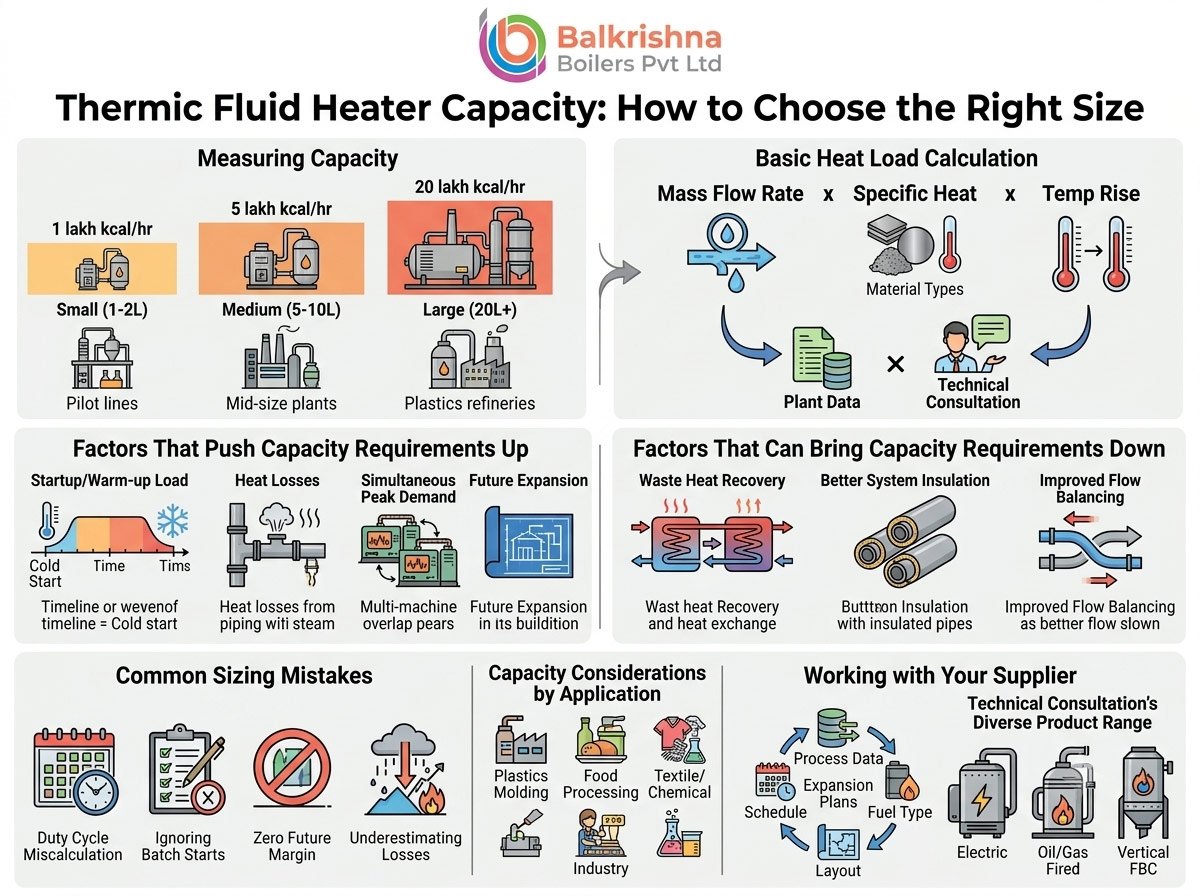
Capacity is expressed in kcal/hr (kilocalories per hour) in the Indian market — the amount of heat energy the unit can deliver per hour at rated output. This differs from steam boiler ratings, which are typically expressed in kg/hr of steam generation; thermic fluid heaters skip that conversion and rate output directly in thermal energy terms, since there’s no phase change involved.
Typical ranges you’ll see in the market:
- Small systems: 1 lakh to 2 lakh kcal/hr — suited to smaller batch processes, pilot lines, or single-machine applications.
- Medium systems: 5 lakh to 10 lakh kcal/hr — common for mid-size plants running several process lines off a shared header.
- Large systems: 20 lakh kcal/hr and above — for large continuous-process plants like plastics extrusion complexes, edible oil refineries, or large textile processing units.
The Basic Heat Load Calculation
At its core, sizing a thermic fluid heater comes down to answering one question: how much heat energy does your process actually need to absorb per hour, at your required temperature?
The calculation generally starts from:
Heat Load (kcal/hr) = Mass Flow Rate × Specific Heat × Temperature Rise
In practical terms, this means working out:
- How much material or fluid needs heating — the mass or volume flow through your process per hour.
- The specific heat of that material — different materials absorb different amounts of energy per degree of temperature rise.
- The temperature rise required — the difference between your process inlet and outlet (or setpoint) temperature.
For most plants, this calculation is done in partnership with the equipment supplier rather than independently, because getting the input data right — particularly for complex or multi-stage processes — usually benefits from technical input on both sides. What a plant can usefully bring to that conversation is accurate data on flow rates, target temperatures, and process schedule, which is where sizing conversations most often go wrong if the underlying numbers are estimated rather than measured.
Factors That Push Capacity Requirements Up
A few factors commonly get underestimated in a first-pass sizing exercise:
Startup and warm-up load. The heat required to bring a cold system up to operating temperature from ambient is significantly higher than the heat required to simply maintain that temperature once running. If your process has frequent cold starts — a batch operation that shuts down overnight, for instance — sizing purely for steady-state running load can leave you with a heater that takes far too long to reach working temperature each morning.
Heat losses across the distribution system. Every meter of thermal fluid piping, every heat exchanger, and every process vessel loses some heat to ambient, even with good insulation. For plants with long piping runs between the heater and the process equipment, these losses need to be added to the process heat load itself, not assumed away.
Simultaneous peak demand across multiple users. When one heater serves several pieces of process equipment — several molding machines, multiple jacketed vessels — the sizing needs to reflect realistic peak overlap. This cuts both ways: undersizing for genuine simultaneous peak leaves the system unable to hit temperature when multiple lines run together, but oversizing for the theoretical sum of every machine’s nameplate demand (assuming everything runs flat-out simultaneously, which rarely happens in practice) wastes capital. Getting this balance right is one of the most valuable things a good technical consultation adds over a rough back-of-envelope estimate.
Future expansion plans. If you know a second production line is coming within a planned horizon, it’s often more economical to size the heater with that expansion in mind from the start, rather than adding a second standalone unit later. This is a genuine trade-off against upfront capital cost, and worth discussing explicitly with your supplier rather than deciding by default in either direction.
Factors That Can Bring Capacity Requirements Down
Waste Heat Recovery. If your process or plant has a source of waste heat that can be integrated into the thermal fluid system’s overall energy balance, it can reduce the fresh-fired capacity required. This is more relevant to overall plant energy strategy than pure heater sizing, but worth flagging to your supplier if applicable. Our piece on how thermic fluid heaters improve energy efficiency covers Waste Heat Recovery Units in more depth.
Better system insulation. Reducing distribution losses through better-insulated piping and vessels lowers the net heat load the heater actually has to supply, which can matter meaningfully for plants with extensive piping runs.
Improved flow balancing. A well-balanced distribution system, where every heat user gets exactly the flow it needs rather than some being over-supplied to compensate for others being under-supplied, can allow the whole system to run efficiently at a lower overall circuit temperature — indirectly reducing the practical capacity margin needed.
Temperature Range and Its Effect on Sizing
The required operating temperature affects sizing in two ways beyond the basic heat load calculation:
- Fluid selection. Higher-temperature processes need thermal fluid rated for that temperature range, and different fluid grades have different heat transfer properties that factor into the final coil and heater design. Our thermic fluid heater oil selection guide covers matching fluid grade to your operating range.
- Coil design margin. Heaters designed for very high outlet temperatures need more conservative coil design (lower heat flux) to keep the film temperature within the fluid’s safe limit, which affects the physical size and configuration of the coil for a given kcal/hr rating.
Common Sizing Mistakes We See in the Field
Sizing off nameplate ratings of downstream equipment without accounting for actual duty cycle. A machine’s rated maximum demand and its typical running demand are often quite different — sizing purely off nameplate figures across every piece of connected equipment tends to produce an oversized system.
Ignoring startup load in batch operations. Plants that run continuous processes rarely have this problem, but batch operations with frequent cold starts — common in food processing and some chemical batch work — often discover post-installation that steady-state sizing left them with unacceptably long warm-up times each shift.
Not accounting for future capacity needs at all. The opposite problem to over-planning for expansion: sizing exactly to current-day demand with zero margin, then facing a full second-heater purchase the moment the plant adds even modest additional capacity.
Underestimating distribution losses on long piping runs. Particularly relevant for plants with the heater located at some distance from the process area — a design decision sometimes made for space or safety reasons that then needs to be reflected honestly in the capacity calculation.
Choosing capacity without confirming the fuel supply can actually deliver it. A heater sized correctly on paper still needs adequate fuel supply — gas line capacity, biomass storage and handling capability, or electrical supply capacity — to actually reach its rated output. This is a common gap between design capacity and delivered capacity in the field.
Capacity Considerations by Application
Different industries tend to have characteristic sizing patterns worth knowing going in:
- Plastics processing (injection molding, extrusion) often centralizes multiple machines on one thermal fluid header — see our piece on thermic fluid heater applications in the plastics industry for how central sizing works across multiple machines.
- Food processing frequently mixes continuous demand (fryers, dryers) with batch demand (cooking vessels), which needs careful peak-overlap analysis — covered in our guide on thermic fluid heater applications in food processing plants.
- Textile and chemical processing often runs large, relatively steady continuous loads, which simplifies sizing compared to industries with more variable batch demand.
Working with Your Supplier on Sizing
The most reliable path to correct sizing is a proper technical consultation rather than a self-service calculation, because a supplier’s engineering team can factor in coil design, fluid selection, and real-world duty cycle data in ways a simple formula can’t fully capture. What speeds up that process and gets you a more accurate first proposal:
- Accurate flow rates and target temperatures for every process the heater will serve.
- A realistic picture of your operating schedule — continuous vs. batch, shift pattern, startup frequency.
- Known future expansion plans, even if not yet finalized.
- Available fuel type and supply capacity at your site.
- Any distance or layout constraints between the heater location and process equipment.
Get Your System Sized Correctly
At Balkrishna Boilers Pvt Ltd, our technical team sizes every proposal around your actual process data rather than a generic capacity chart, across our full range:
- Electric Thermic Fluid Heater
- Oil / Gas Fired Thermic Fluid Heater
- Vertical Four Pass FBC Thermic Fluid Heater
- Vertical Three Pass Oil / Gas Fired Thermic Fluid Heater
If you’re planning a new installation or evaluating whether an existing heater is correctly sized for your current demand, get in touch with your process details — flow rates, target temperature, and operating schedule — and we’ll work through the sizing with you before recommending a capacity.