
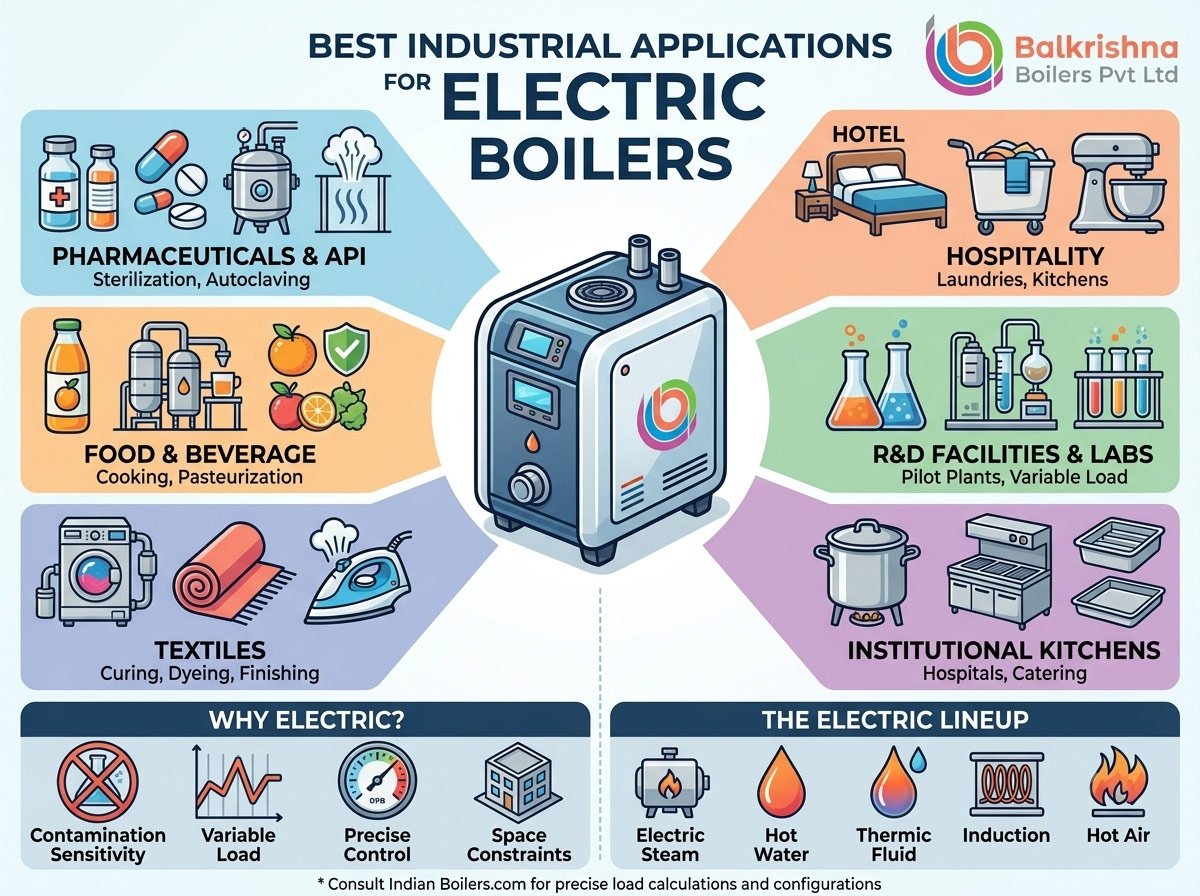
Not every plant needs the same kind of boiler, and not every process is a good fit for electric heating. What makes an electric boiler the right choice in one industry can make it the wrong choice in another — it depends entirely on load pattern, product sensitivity, capacity requirements, and how much fuel-fired infrastructure a facility can realistically accommodate.
At Indian Boilers.com, part of Balkrishna Boilers Pvt Ltd, we supply electric boilers across a wide range of industries, and the pattern in our order book is consistent: the strongest fits are processes that value cleanliness, precision, and responsiveness over raw continuous capacity. This guide walks through exactly where electric boilers perform best in Indian industry, and why, so you can judge whether your own process fits the profile.
What Makes a Process a Good Fit for Electric Heating
Before going industry by industry, it helps to understand the underlying pattern. Electric boilers tend to be the strongest choice when a process has one or more of these characteristics:
- Intermittent or variable steam demand, where a fuel-fired system would waste energy holding a fire bed for low or irregular load.
- Contamination sensitivity, where combustion by-products or flue gas anywhere near the process is unacceptable.
- Space constraints, where there’s no room for a boiler house, chimney, or fuel yard.
- Precise temperature or pressure control requirements, where instant response and fine modulation matter more than bulk capacity.
- Emissions or compliance pressure, where PCB consent, ISO 14001, or customer audits push toward zero on-site combustion.
With that framework in mind, here’s where electric boilers consistently perform best across Indian industry.
1. Pharmaceuticals and API Manufacturing
Pharma is one of the strongest application areas for electric steam generation, and for good reason. Sterilization, autoclaving, and clean-in-place systems demand high-purity, contamination-free steam — and any combustion by-product anywhere near a clean-room-adjacent process is a regulatory and quality risk, not just an environmental one.
Electric boilers eliminate that risk at the source. There’s no flue gas, no fuel storage, and no combustion by-products that could migrate toward a sensitive production zone. Our IBR Electric Steam Boiler range is commonly specified for larger pharma sterilization loads, while smaller R&D and pilot batches often use our Electric Induction Boiler for its precise, responsive control.
2. Food and Beverage Processing
Cooking, pasteurization, blanching, and CIP (clean-in-place) cleaning cycles all demand clean, reliable steam or hot water — and increasingly, export-facing food manufacturers face carbon and emissions reporting requirements from international buyers that a fuel-fired boiler makes harder to satisfy.
Electric boilers fit this sector well on two fronts: hygiene (no combustion by-products near food-contact processes) and compliance (zero on-site emissions simplifies audit reporting). Our Electric Hot Water Boiler is widely used for washing and CIP applications, while the Electric Steam Boiler range covers cooking and processing loads.
3. Textile Processing
Textile finishing — ironing, curing, drying, and dyeing — has traditionally run on coal or biomass-fired thermic fluid heaters, largely because of the high continuous heat demand involved. But a meaningful share of textile processes, particularly smaller job-work units and finishing lines with variable batch sizes, are better served by electric heating.
An Electric Thermic Fluid Heater delivers the same high-temperature heat transfer required for curing and finishing without a combustion source — a genuine advantage for units operating in shared industrial sheds where fire risk and emissions are tightly regulated. Larger, continuous-demand textile units may still be better served by a fuel-fired system; our post on selecting the right fuel for a traveling grate boiler covers that scale of operation.
4. Hospitality — Hotels, Resorts, and Commercial Laundries
Hotel laundry and kitchen operations need steady but relatively modest steam demand within a footprint that usually has no room for a boiler house, chimney, or fuel yard. Noise is also a real constraint — guests and staff are close by, and the quiet operation of an electric boiler (no burners, no draft fans) is a genuine operational benefit, not just a technical footnote.
Electric boilers are consistently the preferred choice in this sector for exactly these reasons — compact footprint, silent operation, and no combustion risk in a building full of people.
5. Chemicals and Specialty Manufacturing
Chemical processing covers an enormous range of heat requirements, but a specific subset — smaller-batch, high-purity, or process-sensitive chemical manufacturing — benefits strongly from electric heating’s precision and cleanliness. Where a process reaction is sensitive to temperature overshoot or contamination, the responsive, tightly controllable output of an electric boiler is often a better match than the steadier, less finely modulated output of a combustion system.
Larger-scale bulk chemical manufacturing with continuous, high-volume steam demand tends to lean toward fuel-fired or biomass systems instead, where the running-cost advantage at scale outweighs electric’s precision benefits — a trade-off covered in more depth in our comparison of electric vs. biomass boilers on cost and efficiency.
6. Dairy and Small-Scale Food Manufacturing
Dairy processing — pasteurization, cleaning cycles, and packaging line heating — often runs on a batch schedule rather than continuous demand, which plays directly to electric heating’s strength: instant start-up with no energy wasted during idle periods between batches. Smaller dairy units in particular benefit from the lower infrastructure cost and simpler compliance profile electric boilers offer compared to a fuel-fired alternative sized for a much larger, continuous operation.
7. R&D Facilities, Laboratories, and Pilot Plants
Research and pilot-scale facilities rarely need large, continuous steam capacity — what they need is precise, on-demand heat with a compact footprint and minimal infrastructure overhead. Electric boilers are consistently the default choice here, since installing a fuel-fired system for a pilot line’s intermittent demand rarely makes economic or practical sense. Our smaller-capacity Electric Induction Boiler and entry-level 0.5 Ton Electric Steam Boiler are common choices for exactly this kind of application, and are covered in more depth in our SME buyer’s guide to electric boilers.
8. Rubber and Plastics Processing
Certain rubber and plastics processes — particularly smaller molding, curing, and vulcanization operations — benefit from electric heating’s fast response and precise temperature control, where consistent, well-regulated heat directly affects product quality. As with chemicals, larger continuous-process operations in this sector often still favour fuel-fired or biomass systems for scale economics.
9. Institutional and Commercial Kitchens
Large institutional kitchens — hospitals, educational campuses, corporate catering facilities — need reliable steam for cooking equipment without the space, noise, or emissions footprint of a combustion boiler. This is functionally similar to the hospitality use case, and electric boilers are increasingly the default specification for new institutional kitchen installations for the same reasons: compact footprint, quiet operation, and simplified compliance.
Where Electric Boilers Are Usually Not the First Choice
For balance, it’s worth being direct about where electric typically isn’t the best fit: very high, continuous steam demand at industrial scale — sugar mills, large pulp and paper operations, bulk chemical plants running 24/7 — where fuel cost at volume outweighs electric’s efficiency and simplicity advantages. Our posts on travelling grate boilers for sugar mills and general industrial boiler fuel selection cover these higher-capacity, fuel-fired scenarios in detail.
Matching Your Industry to the Right Electric Boiler Type
Once you’ve confirmed electric heating fits your process profile, the next step is matching the right product type to your specific requirement:
- Steam for sterilization, cooking, or general process heating: the Electric Steam Boiler range, including IBR and Non-IBR configurations depending on pressure requirements.
- Hot water for washing, CIP, or laundry: the Electric Hot Water Boiler.
- High-temperature heat transfer for curing or finishing: the Electric Thermic Fluid Heater.
- Compact, responsive steam for variable or smaller loads: the Electric Induction Boiler.
- Hot air for drying or curing applications: the Electric Hot Air Generator.
On the Balkrishna Boilers side, the equivalent lineup runs through our Electric Boiler series — ELECTROMAX for steam, ELECTROAQUA for hot water, ELECTROAIR for hot air generation, ELECTROPAC for compact packaged systems, and INDUCTRON for induction-based steam generation.
How to Confirm Electric Is Right for Your Specific Facility
The industry patterns above are a strong starting guide, but the right answer for any individual plant still comes down to actual load data — peak demand, duty cycle, available electrical supply, and how contamination-sensitive or space-constrained the specific process is. Our engineers work through this calculation directly with plant owners, comparing real operating requirements against both electric and fuel-fired options rather than assuming one technology fits every application in a given sector.
Final Thoughts
Electric boilers aren’t a universal replacement for combustion systems, but across pharmaceuticals, food and beverage, textiles, hospitality, chemicals, dairy, R&D, and institutional kitchens, they’ve become the clear default choice — driven by cleanliness, compact footprint, precise control, and simplified compliance rather than efficiency numbers alone. Understanding where your own process fits this profile is the first step toward deciding whether an electric boiler is the right investment for your plant.
Explore the full Electric Boiler range on Indian Boilers.com, browse the complete lineup on Balkrishna Boilers, or get in touch with our team to discuss which configuration fits your specific industry and process.