
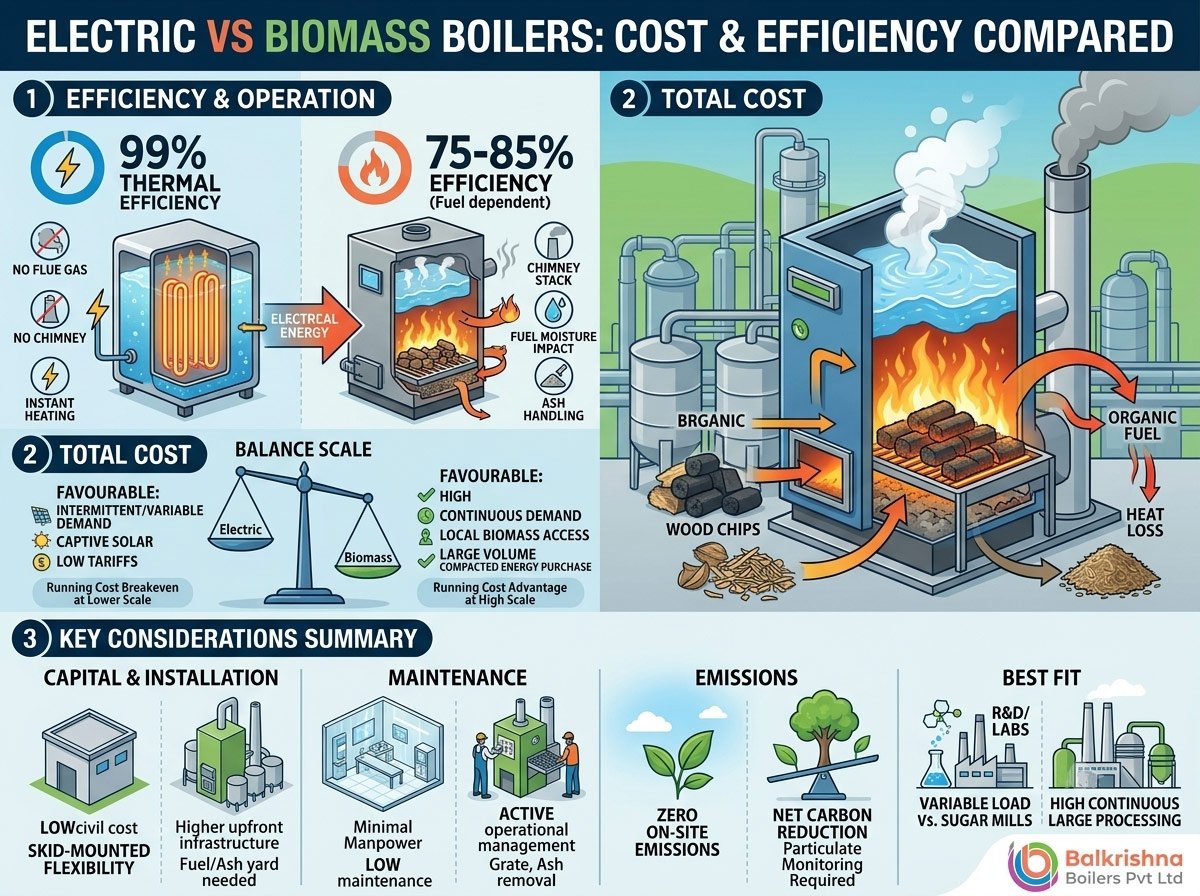
Of all the boiler comparisons plant owners ask us about, electric versus biomass comes up the most often — and for good reason. Both are positioned as cleaner alternatives to coal, both get referenced in sustainability conversations, and both are genuinely strong technologies. But they solve the heating problem in almost opposite ways: one eliminates combustion entirely, the other makes combustion cleaner and renewable. Choosing between them isn’t about which is universally “better” — it’s about which one matches your capacity, fuel access, and priorities.
At Indian Boilers.com, part of Balkrishna Boilers Pvt Ltd, we manufacture and install both technologies, so this comparison isn’t written to steer you toward one product line. It’s written to help you make the right call for your specific plant.
The Fundamental Difference
An electric boiler generates steam or hot water using resistance heating elements immersed directly in water — there is no combustion, no fuel, no flue gas.
A biomass boiler burns organic fuel — husk, wood chips, briquettes, or agricultural residue — to heat water into steam, using the same combustion principle as a coal-fired boiler but with a renewable, lower-net-carbon fuel source. If you want the deeper engineering picture, our earlier post on what a biomass boiler actually is covers grate types, fuel handling, and combustion design in detail.
That single difference — combustion versus no combustion — drives almost every other point of comparison between the two.
Efficiency: How They Actually Compare
Electric Boiler Efficiency
Because there’s no combustion, there’s no flue-gas heat loss, no chimney stack loss, and no incomplete-burn losses. Electrical energy converts almost directly into thermal energy, giving electric boilers thermal efficiency close to 99%.
Biomass Boiler Efficiency
A well-designed, well-maintained biomass boiler with the right grate technology for its fuel typically runs in the 75–85% efficiency range. Efficiency depends heavily on fuel moisture content, grate type (traveling, reciprocating, or vibrating), and combustion tuning — topics we’ve covered extensively in posts like fuel moisture vs. boiler efficiency and how reciprocating grate boilers handle high-moisture biomass. Poor fuel quality or an undersized grate for the fuel type can pull efficiency down significantly below this range.
On efficiency alone, electric wins clearly — but efficiency is only one input into total operating cost, and it’s where biomass starts to close the gap.
Running Cost: Where Biomass Often Pulls Ahead
This is the part of the comparison plant owners care about most, and it’s genuinely fuel- and scale-dependent.
Fuel cost per unit of energy. Biomass fuel — rice husk, agricultural waste, wood chips — is typically far cheaper per unit of energy delivered than grid electricity, especially in regions with local biomass availability. Even accounting for biomass’s lower combustion efficiency, the raw fuel cost gap is usually large enough that biomass wins on running cost at high, continuous capacity.
Electricity tariffs vary by region and load profile. Industrial electricity tariffs, demand charges, and time-of-day pricing all affect where the breakeven point sits. Facilities with access to captive solar, favourable industrial tariffs, or off-peak pricing narrow this gap considerably.
Scale changes the calculation. At high, continuous steam demand — the kind found in sugar mills, large textile units, or bulk chemical processing — biomass’s lower fuel cost per unit typically outweighs electric’s efficiency advantage, because the volume of energy being purchased is large enough that even a small per-unit cost difference compounds significantly. Our post on traveling grate boilers for sugar mills is a good example of where biomass is the clear scale-driven choice.
At lower or intermittent demand, the calculation flips. Electric boilers avoid the fixed costs biomass carries regardless of load — fuel storage, handling labour, ash disposal — so for smaller or variable-demand facilities, electric frequently wins on total cost even with a higher per-unit electricity price. This is covered in more depth in our SME buyer’s guide to electric boilers.
Capital and Installation Cost
Electric boilers cost less to install. No chimney, no fuel yard, no ash-handling infrastructure, and often no dedicated boiler house — the unit can frequently sit close to the point of use. This significantly reduces civil and infrastructure cost compared to a biomass system of similar capacity.
Biomass boilers carry higher upfront infrastructure cost. Fuel storage and handling systems, ash removal, a properly designed chimney, and often a larger footprint all add to the initial project cost, on top of the boiler itself.
For plants with limited capital or limited space — a common constraint for SMEs — this upfront cost gap is often as decisive as the running-cost comparison.
Maintenance Comparison
Electric boilers are lower maintenance by a clear margin. No burners to clean, no fuel-handling equipment, no ash removal, no grate wear. Maintenance is largely limited to water treatment and periodic electrical checks — details covered in our guide to electric boiler maintenance.
Biomass boilers require more active operational management. Fuel quality control, grate maintenance, ash disposal, and combustion tuning all demand ongoing attention and typically a trained operator. This isn’t a flaw in the technology — it’s the operational reality of running a combustion system — but it’s a real, ongoing labour cost that electric boilers largely avoid.
Emissions: A Real but Different Comparison
Biomass is often marketed as carbon-neutral because the CO2 released during combustion is broadly offset by the CO2 absorbed while the biomass fuel was growing. This makes it a genuinely strong option for reducing net carbon footprint compared to coal. However, biomass combustion still produces on-site particulate matter and flue gas requiring monitoring, stack testing, and PCB consent — it reduces net carbon impact without eliminating on-site emissions.
Electric boilers produce zero on-site combustion emissions, full stop — no stack, no flue gas, no particulate matter. Whether the electricity itself is low-carbon depends on your power source, but the on-site emissions profile is unambiguous. We cover this distinction in more depth in our piece on how electric boilers support zero-emission manufacturing.
If your priority is eliminating on-site emissions — for contamination-sensitive processes, urban PCB restrictions, or clean-room-adjacent facilities — electric is the more direct answer.
If your priority is lowering net carbon footprint at high volume with cost efficiency — and on-site particulate emissions aren’t a binding constraint — biomass remains a strong, genuinely sustainable choice.
Space and Installation Flexibility
Electric boilers have a clear advantage here. Their compact, skid-mounted design and lack of fuel storage or ash handling mean they can often be installed directly on the shop floor, close to the point of use. Biomass systems need dedicated space for fuel storage, handling equipment, and ash removal, in addition to the boiler itself — a real constraint for facilities operating in shared industrial sheds or space-limited sites.
Side-by-Side Summary
Choose an electric boiler if:
- Your steam or hot water demand is intermittent, moderate, or highly variable
- Floor space and installation simplicity matter
- On-site emissions, contamination risk, or urban PCB consent are binding constraints
- You want minimal operational manpower and low ongoing maintenance
- You have access to favourable electricity tariffs or captive renewable power
Choose a biomass boiler if:
- You run high, continuous steam demand at industrial scale
- You have reliable, low-cost local access to biomass fuel
- Net carbon reduction is the priority, and on-site particulate emissions are manageable within your consent conditions
- You have the operational capacity to manage fuel quality, ash handling, and a trained boiler operator
Can You Use Both?
Many of our clients don’t choose one exclusively — they run a hybrid setup. A biomass or steam boiler handles high, continuous base-load demand where its fuel-cost advantage matters most, while an electric unit covers smaller, intermittent, or emissions-sensitive process steps where precision and cleanliness matter more than raw fuel economics. This approach is increasingly common in pharmaceutical and food processing plants that need both bulk process steam and a contamination-sensitive clean steam supply from separate systems.
Making the Right Choice for Your Plant
The right decision depends on three questions: How much steam or hot water do you actually need, and how continuous is that demand? What does your fuel and electricity access look like in your specific location? And how much does eliminating on-site emissions matter to your compliance, certification, or customer requirements?
Our engineers work through exactly this calculation with plant owners regularly, sizing both electric and biomass options against real load data rather than rated capacity assumptions. If you’re unsure which technology fits your facility, that’s worth a conversation before committing capital either way.
How Balkrishna Boilers Can Help
We manufacture both technologies, which means our recommendation is based on your process data, not a single product line we’re trying to sell. Explore our Electric Boiler range and Steam Boiler range on Indian Boilers.com, or the equivalent Electric Boiler and Steam Boiler series on Balkrishna Boilers — including the ELECTROMAX electric range and the HUSKPOWER biomass series, both engineered for Indian industrial conditions.
Final Thoughts
Electric and biomass boilers aren’t competing for the same job in every plant — they’re optimised for different operating profiles. Electric wins decisively on efficiency, installation simplicity, on-site emissions, and low maintenance, making it the stronger fit for intermittent, space-constrained, or emissions-sensitive applications. Biomass wins on raw fuel economics at high, continuous industrial scale, provided you have reliable fuel access and the operational capacity to manage a combustion system properly.
If you’d like our engineers to run the numbers for your specific plant — comparing real operating cost, not just headline efficiency — get in touch with our team, or browse our full industrial boiler blog section for more detailed technical comparisons.