
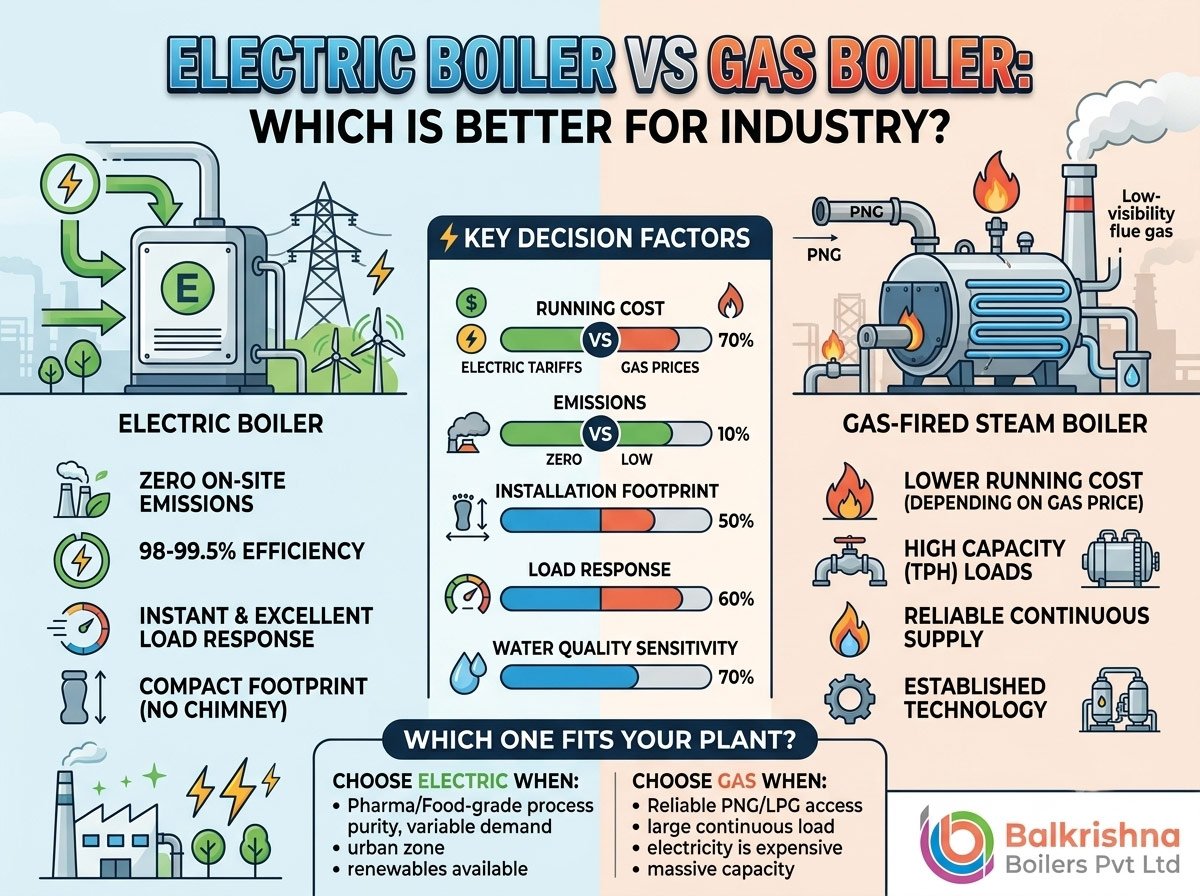
Once a plant decides against solid fuel, the choice usually narrows to two genuinely strong contenders: an electric boiler or a gas-fired steam boiler. Both are clean, automated, and capable of high thermal efficiency — which is exactly why the decision is harder than it looks. The right answer depends less on which technology is “better” in the abstract, and more on your electricity tariff, gas access, load pattern, and process requirements.
This guide breaks the comparison down honestly, across the factors that actually determine total cost of ownership and operational fit — not just headline efficiency numbers.
How Each Technology Actually Works
An electric boiler converts electrical energy directly into heat — through immersed resistance elements, conductive electrodes, or an induction coil — with no combustion involved at all, as covered in detail in our guide to what an electric boiler is and how it works. A gas-fired boiler, by contrast, burns Piped Natural Gas (PNG), LPG, or biogas in a burner to heat flue gases, which then transfer heat to water as they pass through the boiler’s fire-tube or water-tube passages — the same combustion principle used across our PNG-fired boiler range, just using a cleaner-burning fuel than coal, diesel, or biomass.
Both are considered “clean” relative to solid fuel — gas combustion produces no soot and significantly lower particulate matter than oil or coal, while electric boilers eliminate combustion entirely.
Side-by-Side Comparison
| Factor | Electric Boiler | Gas Boiler (PNG/LPG) |
|---|---|---|
| Thermal efficiency | 98–99.5% | 88–95% (with economizer/heat recovery) |
| On-site emissions | Zero — no combustion | Low, but not zero — CO₂, some NOx |
| Chimney required | No | Yes, though shorter than solid fuel |
| Startup/cold-start time | Minutes, near-instant | 3–6 minutes typically |
| Load response/turndown | Excellent, especially electrode/induction | Good, especially with modern burners |
| Fuel storage needed | None | None for PNG; tank/cylinder bank for LPG |
| Running cost driver | Electricity tariff | Gas price, which fluctuates with global markets |
| Footprint | Very compact | Compact, but larger than electric |
| Water quality sensitivity | High — scaling directly affects elements/electrodes | Moderate — scaling affects tubes, less critical component |
| Typical capacity range | Small to large (kW to several TPH) | Wide range, well suited to large continuous TPH loads |
| Best suited for | Cleanroom, urban, pharma, food, variable/instant demand | Large continuous industrial demand, gas-grid areas |
| Regulatory classification | IBR or Non-IBR depending on capacity/pressure | IBR for most industrial-scale units |
Efficiency: The Headline Number vs. The Real Story
Electric boilers convert nearly all electrical input into usable heat — commonly cited at 98–99.5% — because there’s no stack loss, no unburned fuel, and minimal radiation loss from a combustion chamber that doesn’t exist. Gas boilers achieve genuinely strong efficiency too, typically 88–92% as standard, rising to 95–98% when fitted with a condensing economizer that recovers heat from the flue gas before it exits the chimney.
The gap looks large on paper, but it doesn’t automatically translate into a cost advantage for electric — because efficiency measures how much of the input energy becomes useful heat, not how much that input energy costs. This is precisely the distinction we explore in our comparison of boiler efficiency vs. fuel cost: the more efficient technology on paper isn’t always the cheaper one to actually operate, once local energy pricing enters the picture.
Running Cost: Where the Real Decision Gets Made
This is the factor that most often decides the outcome in practice, and it’s entirely dependent on your location and utility rates.
For gas-fired boilers: Piped Natural Gas (PNG) is often significantly cheaper than diesel or furnace oil per unit of heat delivered, and in many industrial zones with pipeline access, gas remains one of the most cost-effective fuel options for continuous, high-capacity steam generation, as reflected in the economics of units like the 5 Ton PNG/LPG-fired steam boiler.
For electric boilers: Running cost depends almost entirely on your industrial electricity tariff, which varies significantly by state and by time-of-day pricing structures in India. In regions with favourable industrial power tariffs — or for plants with access to captive renewable generation — electric boilers can be highly cost-competitive despite a higher headline per-unit energy cost than gas.
The practical takeaway: there’s no universal “cheaper” answer. A plant in a gas-grid industrial zone with moderate power tariffs will likely find gas more economical for large, continuous loads. A plant with strong renewable power access, high gas transportation costs, or genuinely variable/small-batch demand may find electric the more sensible choice.
Emissions and Environmental Compliance
Gas is the cleanest-burning fossil fuel option available for industrial boilers — it eliminates the soot buildup common with oil and solid fuel, and comfortably meets current pollution control board norms for NOx and SOx when properly calibrated. But it is still a combustion process, meaning it still produces CO₂ and requires a chimney and emissions monitoring.
Electric boilers go a step further: zero on-site combustion means zero on-site emissions, full stop. As covered in our guide on why electric boilers are the best choice for low-emission plants, this also comes with a genuine future-proofing advantage — as India’s power grid integrates more renewable generation, an electric boiler’s emissions footprint improves automatically over time, without any equipment change required. Gas boilers, by contrast, will always carry the fixed emissions profile of the fuel itself, regardless of grid decarbonization. Our broader guide to reducing boiler carbon emissions covers this distinction in more depth.
Load Response and Demand Flexibility
Both technologies respond well to load changes compared to solid-fuel boilers, but there are real differences. Gas-fired units with modern burners and 3-element control systems modulate combustion rate effectively and reach full pressure in 3–6 minutes from cold. Electric boilers — particularly electrode and induction designs — offer near-instant response and, in the case of thyristor-controlled electrode systems, true stepless 0–100% modulation.
For plants with genuinely sharp, unpredictable demand swings — the kind of pattern discussed in our guide to managing steam boiler load variation — electric technology generally has the edge in pure responsiveness. For plants with large, steady, continuous demand, a well-sized gas boiler performs just as reliably without the electrical infrastructure investment electric capacity at scale can require.
Installation, Footprint, and Infrastructure
Gas boilers still need a chimney (though typically shorter than solid-fuel stacks), a gas train with safety shutoff valves, and — for LPG — either a cylinder bank or bullet tank on site. Electric boilers eliminate all of this: no chimney, no fuel storage, no gas train, which is why they can often be installed directly adjacent to the process line they serve, saving both floor space and piping cost.
The trade-off runs the other way on the electrical side — a large electric boiler requires substantial electrical supply capacity and transformer/switchgear infrastructure that a gas-fired equivalent simply doesn’t need. For large-capacity installations, this electrical infrastructure cost is a real factor worth including in any comparison.
Water Quality and Maintenance
Both technologies need properly treated feedwater, but the consequences of poor water quality differ. In a gas boiler, scale forms on the fire-tube or water-tube walls, reducing heat transfer efficiency and requiring blowdown and periodic descaling — a risk covered thoroughly in our guide to steam boiler scaling causes, signs, and prevention. In an electric boiler, scale forms directly on the heating element or electrode surface — the single most critical component in the system — meaning inadequate water treatment causes efficiency loss and outright component failure faster than in a comparably scaled gas unit.
On the combustion side, gas boilers do require periodic burner calibration (commonly every six months) to maintain peak efficiency and stay within emissions norms, along with gas train and safety valve checks — maintenance categories that simply don’t exist for an electric unit.
Fuel Security and the Case for Dual-Fuel Flexibility
One factor worth considering seriously: gas supply, whether PNG or LPG, carries a dependency risk that electricity generally doesn’t share in the same way. Plants overly reliant on a single gas source can face production risk during supply disruptions or price spikes. For plants that want the economics of gas without that single-point dependency, dual-fuel boilers — capable of switching between gas and liquid fuel — offer a middle path, though they don’t fully replicate the fuel independence an electric boiler provides.
Which One Actually Fits Your Plant?
Choose gas when:
- You have reliable PNG pipeline access or an efficient LPG supply chain
- Steam demand is large, continuous, and relatively steady
- Your industrial electricity tariff is comparatively high
- You’re running a large-capacity operation where electrical infrastructure upgrade costs would be significant
Choose electric when:
- Process purity matters — cleanroom, pharma, food-grade environments where even trace combustion byproducts are unacceptable
- Steam demand is genuinely variable or unpredictable, and rapid response matters
- You’re in an urban or environmentally sensitive zone with strict emissions requirements
- You have favourable electricity tariffs or renewable power access
- Installation footprint and simplicity are a priority
Many larger plants don’t actually choose one exclusively — they run electric boilers for sensitive, lower-volume process lines and gas-fired capacity for their main continuous steam header, getting the best characteristics of each technology where they matter most.
How Indian Boilers and Balkrishna Boilers Support Both Technologies
Both companies manufacture across the full spectrum, so the decision is based on your actual process economics rather than what’s easiest to sell. Indianboilers.com’s electric boiler range covers everything from compact electrode units to heavy-duty IBR-certified systems, while the gas-fired lineup spans the 200 Kg/hr Gas-Fired Industrial Boiler up to the 5 Ton PNG/LPG-fired steam boiler, all within the broader industrial boiler category.
Balkrishna Boilers mirrors this range across its electric boiler line — including ELECTROMAX and INDUCTRON — and its gas- and oil-fired STEAMJET series, giving plant engineers a genuine side-by-side technical consultation rather than a one-technology pitch.
Frequently Asked Questions
Is an electric boiler always more expensive to run than a gas boiler? Not always — it depends entirely on your local electricity tariff versus gas price. In regions with favourable industrial power rates, electric can be cost-competitive despite gas’s typically lower per-unit fuel cost.
Can I switch from gas to electric without replacing my entire boiler house? Generally, no — the two technologies use fundamentally different heating mechanisms and infrastructure (gas train and chimney vs. electrical supply and control panel), so switching means installing a new boiler rather than retrofitting the existing one.
Which is safer, electric or gas? Both are safe when properly designed, installed, and maintained to IBR standards. Gas boilers carry combustion-related risks (flame failure, gas leaks) mitigated by burner interlocks and gas trains; electric boilers carry electrical risks mitigated by low-water cutoffs and circuit protection. Neither has an inherent safety disadvantage when built to standard.
Do both technologies require IBR certification? Both can fall under IBR jurisdiction depending on water capacity and operating pressure — our IBR vs. Non-IBR guide explains exactly where that threshold sits, and it applies the same way regardless of heating technology.
Is gas boiler efficiency really lower than electric, or is that a misleading comparison? The efficiency numbers are accurate as stated, but efficiency alone doesn’t determine total operating cost — a gas boiler at 92% efficiency burning cheap PNG can still cost less to run per tonne of steam than an electric boiler at 99% efficiency on a high electricity tariff. Always compare cost per tonne of steam, not just the efficiency percentage.
Weighing electric against gas for your next boiler? Talk to the Indian Boilers engineering team or contact Balkrishna Boilers for a side-by-side cost and technology assessment based on your actual tariffs, fuel access, and load profile.