
“What’s the running cost?” is almost always the first question a buyer asks about an electric boiler — and it’s usually answered with a vague comparison to gas or a generic efficiency percentage that doesn’t actually tell you what you’ll pay each month. The honest answer is that electric steam boiler running cost is genuinely calculable, down to the rupee per kilogram of steam, once you know your electricity tariff, your feedwater temperature, and your boiler’s real-world efficiency — not just its rated efficiency on a spec sheet.
This guide walks through the actual formula, the variables that move the number up or down, and a worked example, so you can estimate your own running cost with real numbers rather than a marketing claim.
The Core Formula: What Determines Running Cost?
At its foundation, electric steam boiler running cost comes down to three inputs:
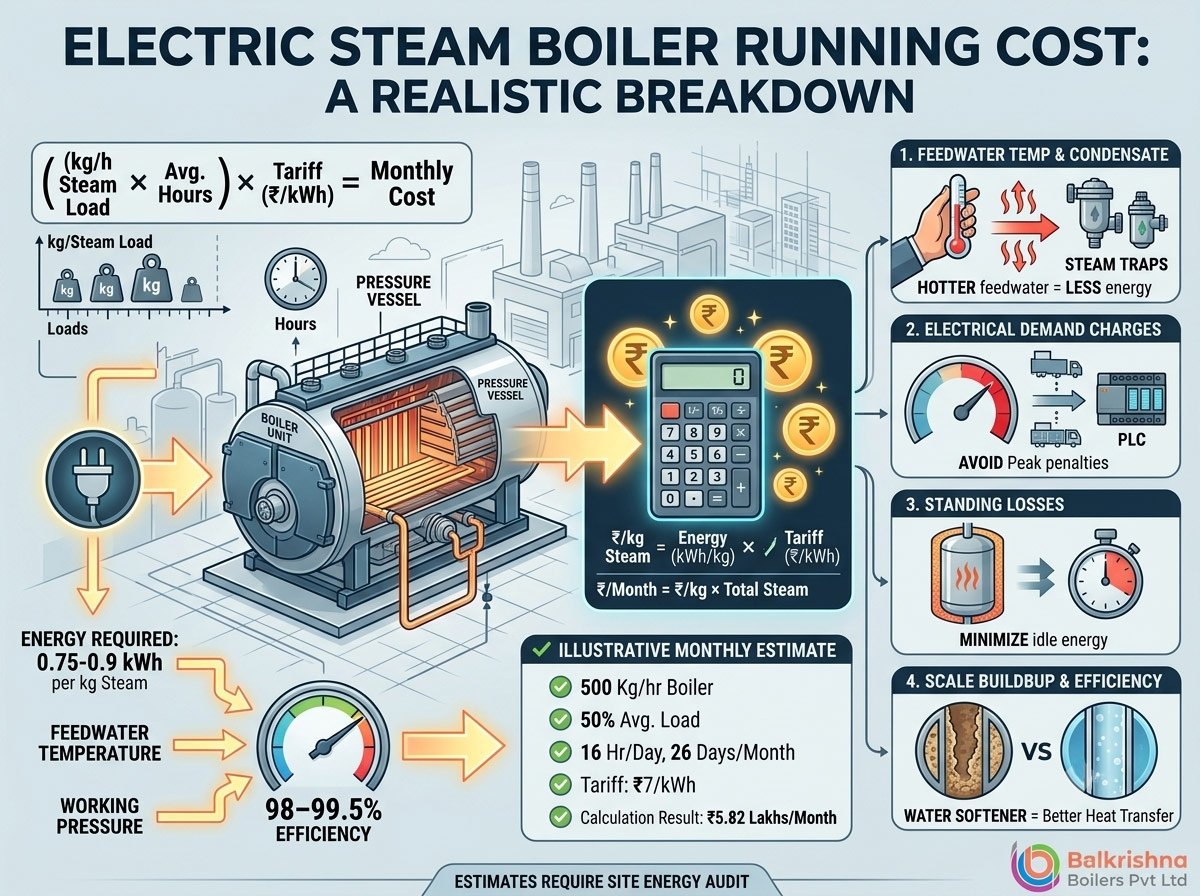
Running cost per kg of steam = Energy required per kg of steam (kWh) × Electricity tariff (₹/kWh)
The energy required per kilogram of steam depends on how much heat is needed to take your feedwater from its incoming temperature up to saturation temperature, and then convert it fully into steam at your required working pressure — the same underlying physics covered in our explainer on how an electric boiler works. Because electric boilers convert electrical energy almost entirely into usable heat — commonly cited at 98–99.5% actual conversion efficiency — the theoretical energy requirement and the real-world electricity draw are very close together, which is precisely what makes electric boiler running cost so straightforward to calculate compared to combustion boilers, where stack losses and burner efficiency introduce far more variability.
As a practical planning range, industrial electric boilers commonly require somewhere in the region of 0.75 to 0.9 kWh of electricity per kilogram of steam produced, depending on your specific feedwater temperature, working pressure, and condensate return ratio. This is a working estimate for planning purposes — your actual figure should always be confirmed against your specific process parameters, since even small changes in feedwater temperature meaningfully shift the number.
Worked Example: Estimating Your Cost Per Kilogram of Steam
Let’s walk through an illustrative calculation using a mid-range assumption of 0.8 kWh required per kg of steam:
| Industrial Electricity Tariff (₹/kWh) | Estimated Cost per kg of Steam |
|---|---|
| ₹6/kWh | ₹4.80 |
| ₹7/kWh | ₹5.60 |
| ₹8/kWh | ₹6.40 |
| ₹9/kWh | ₹7.20 |
| ₹10/kWh | ₹8.00 |
To convert this into a monthly or annual figure, multiply your cost per kg by your actual steam consumption over that period. For example, a plant running a 500 Kg/hr electric boiler like the 1000 Kg/hr Electric Steam Boiler (ELECTROMAX EM-648) at 50% average load for 16 hours a day, 26 days a month, consumes roughly 104,000 kg of steam monthly — at ₹7/kWh and 0.8 kWh/kg, that works out to approximately ₹5.82 lakhs per month in electricity cost for steam generation alone.
These figures are illustrative starting points, not a substitute for a proper site-specific energy audit — your actual industrial tariff, time-of-day pricing structure, and process-specific feedwater conditions will shift the real number, sometimes significantly.
The Variables That Actually Move Your Running Cost
1. Feedwater Temperature (and Condensate Recovery)
This is one of the biggest levers available to reduce running cost, and one of the most overlooked. The colder your incoming feedwater, the more energy is needed to bring it up to steaming temperature. Recovering hot condensate and returning it to the feedwater tank — rather than discharging it and using only fresh, cold makeup water — can meaningfully cut the energy required per kg of steam, because you’re starting from a much higher baseline temperature. Well-maintained steam traps are what make this recovery possible in practice, a topic we cover in detail in how steam traps improve boiler system efficiency.
2. Boiler Technology (Resistance vs. Electrode vs. Induction)
While all three main electric boiler technologies convert electricity to heat at similarly high efficiency, their real-world running cost can differ based on standby losses, power factor, and scale-related degradation over time. Electrode boilers reach full pressure in just 4–6 minutes and maintain near-99% efficiency consistently, since heat is generated directly within the water itself with essentially nothing standing between the electrical input and the water being heated. Induction technology, detailed on our Electric Induction Boiler product page, involves more complex power electronics with a higher upfront cost, but often delivers lower lifecycle electricity consumption and reduced maintenance — meaning the “sticker price” comparison alone can be misleading if you’re evaluating total running cost over the boiler’s service life.
3. Electrical Infrastructure and Demand Charges
Industrial electricity billing in India typically includes not just a per-unit (kWh) energy charge but also a demand charge based on peak kW drawn. A large electric boiler running at full load can meaningfully affect your plant’s peak demand profile, particularly if it starts up simultaneously with other heavy equipment. Staggering boiler startup, using PLC-based load management, or selecting technology with better turndown and staged element control — a topic explored in our guide to managing steam boiler load variation — can help avoid unnecessary demand-charge penalties that don’t show up in a simple per-kWh calculation.
4. Standing (Idle) Losses
Even when not actively producing steam, a boiler holding pressure loses some heat through radiation and any standby element cycling required to maintain temperature. Well-insulated, modern electric boiler designs minimize this, but it’s worth factoring into your running cost model if your process involves long idle periods between batches rather than continuous operation.
5. Water Quality and Scale-Related Efficiency Loss
Scale forming on heating elements or electrodes directly reduces the effective heat transfer surface, meaning the boiler has to draw more electricity to deliver the same steam output — a real, measurable running cost increase that compounds over time if water treatment isn’t maintained. Our detailed guide on steam boiler scaling causes, signs, and prevention explains exactly how even a thin scale layer meaningfully cuts heat transfer efficiency — for an electric boiler, that inefficiency shows up directly on your electricity bill, not just as a maintenance issue.
Electric vs. Gas Running Cost: How to Compare Fairly
It’s tempting to compare electric and gas boilers purely on efficiency percentage, but that comparison is incomplete without factoring in fuel and tariff pricing. Our dedicated comparison, comparing efficiency and running costs of electric steam boilers with gas or oil-fired boilers, covers this in depth — electric boilers offer significantly higher operational efficiency on paper, but electricity can cost more per unit of energy than the thermal equivalent of some fossil fuels, meaning the true comparison depends on your specific tariff structure and local gas access. Our broader guide on electric boiler vs. gas boiler walks through the full side-by-side comparison across efficiency, emissions, and total cost of ownership.
As a rough industry benchmark, well-run solid-fuel and gas boilers can achieve operating costs in the range of ₹3–4 per kg of steam using efficient fuels, which is a useful reference point when comparing against your calculated electric running cost per kg — though this too varies significantly with fuel type, price, and boiler efficiency.
Beyond Per-Unit Cost: Total Cost of Ownership
Running cost per kg of steam is only part of the financial picture. A fair comparison should also weigh:
Lower capital and installation cost in some cases Compact electric units, such as the 50 Kg/hr Electrode Boiler, avoid chimney construction, fuel storage infrastructure, and — for Non-IBR units — the ongoing cost of a certified boiler attendant and annual statutory inspection, all of which offset a portion of any higher per-unit energy cost.
No pollution control clearances or emissions monitoring Since electric boilers produce zero on-site emissions, the administrative and compliance cost associated with pollution control board clearances is significantly reduced or eliminated entirely — a real, if less visible, running cost saving over the life of the equipment.
Reduced maintenance overhead No burner tuning, no soot cleaning, no fuel handling logistics — maintenance costs for electric boilers are generally lower and more predictable than for combustion equivalents, particularly for induction and electrode designs less prone to scale-driven component failure.
Footprint and floor space value Electric boilers commonly occupy significantly less floor space than an equivalent fuel-fired boiler plant, which has a real opportunity cost in facilities where floor space is at a premium for production.
How to Get an Accurate Running Cost Estimate for Your Plant
A reliable running cost projection needs four specific inputs:
- Your required steam output (Kg/hr and average daily operating hours)
- Your actual industrial electricity tariff, including any time-of-day or demand charge structure
- Your feedwater temperature and condensate return ratio
- Your target working pressure, since higher pressures require marginally more energy per kg of steam
With these four inputs, a boiler engineer can calculate a running cost figure specific to your plant, rather than relying on a generic industry average that may not reflect your actual conditions.
How Indian Boilers and Balkrishna Boilers Help You Budget Accurately
Both companies provide detailed energy consumption data and running cost projections as part of their quotation process, rather than leaving buyers to work from generic industry figures. Indianboilers.com’s electric boiler range — spanning the Electric Steam Generator, 50 Kg/hr Electrode Boiler, 1000 Kg/hr ELECTROMAX, and Electric Induction Boiler — is backed by engineering teams who can model your specific running cost based on your actual tariff and process parameters before you commit to a purchase.
Balkrishna Boilers offers the same detailed cost modeling across its electric boiler line, including ELECTRON, ELECTROMAX, and the induction-based INDUCTRON — ensuring you’re budgeting against real numbers, not a generic industry estimate.
Frequently Asked Questions
Is 0.8 kWh per kg of steam accurate for all electric boilers? It’s a reasonable planning range for most industrial applications, but the actual figure depends on your feedwater temperature, working pressure, and condensate recovery ratio. A proper site assessment will give you a more precise figure specific to your process.
Do standby or idle periods add much to running cost? Generally a modest amount for well-insulated modern boilers, but it’s worth including in your calculation if your process has long gaps between steam demand, since some energy is used to maintain pressure even without active steam draw.
Does condensate recovery really make a measurable difference to running cost? Yes — because it raises the starting temperature of your feedwater, reducing the energy needed to reach steaming temperature. The exact savings depend on your condensate return ratio and the temperature differential recovered.
How does demand charge billing affect electric boiler running cost? Beyond the per-unit energy charge, many industrial tariffs include a demand charge based on peak kW drawn. A large electric boiler starting at full load can increase your peak demand, so staggered startup and staged element control are worth factoring into your true running cost.
Is it worth comparing electric boiler running cost against gas even if I don’t have gas access? It’s still useful context for understanding where your specific tariff and process put you relative to the broader market — but if gas isn’t accessible at your site, your practical comparison should really be electric against your current fuel option, whichever that is.
Want an accurate running cost projection for your specific plant? Talk to the Indian Boilers engineering team or contact Balkrishna Boilers with your steam requirement and tariff details for a detailed cost breakdown.