
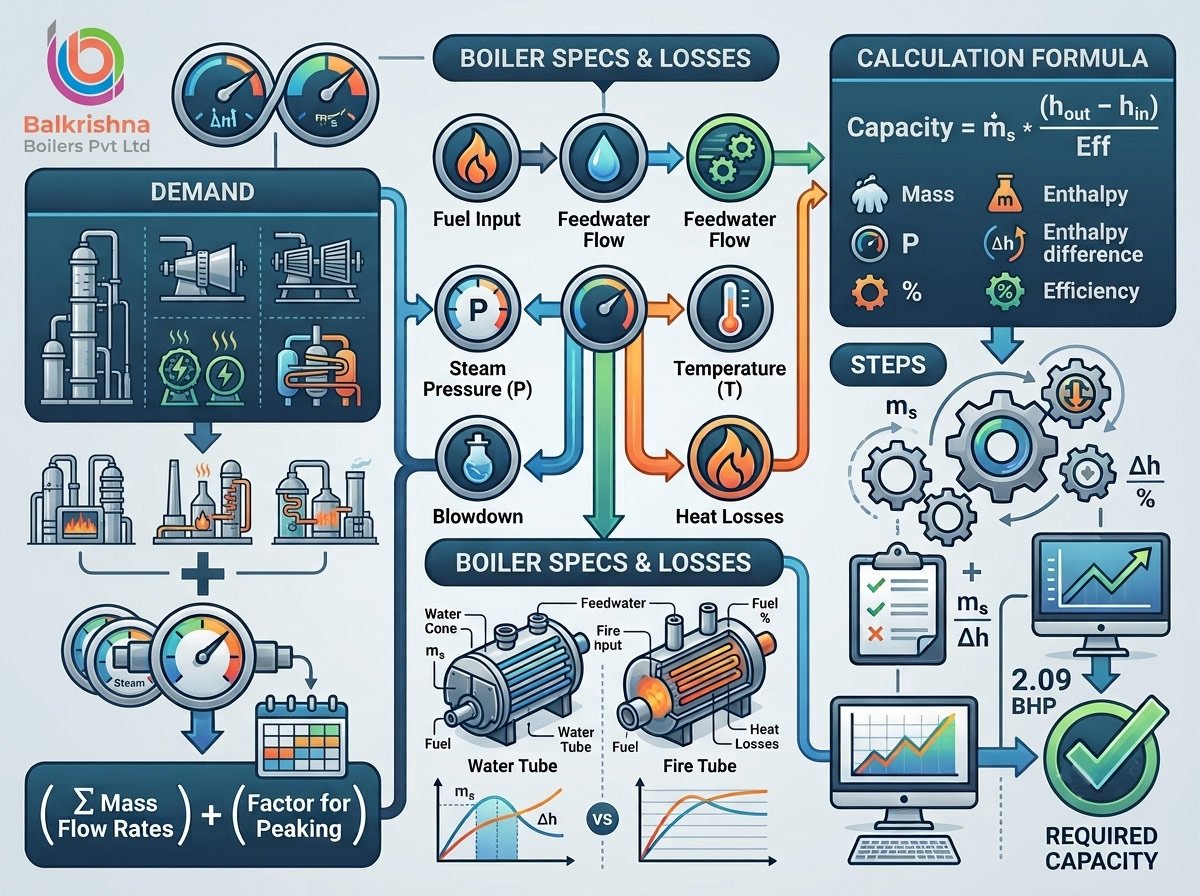
Buying the wrong boiler capacity is one of the most expensive mistakes a plant can make. Undersize it, and your production lines choke during peak load. Oversize it, and you’re stuck paying for fuel, water treatment, and maintenance on capacity you never use — every single day, for the next 20+ years.
The good news is that calculating the right steam boiler capacity isn’t guesswork. It follows a clear, engineering-based process. In this guide, we’ll walk you through exactly how to calculate the steam capacity your plant needs, the units involved, the safety margins to build in, and the mistakes most first-time buyers make.
What Does “Boiler Capacity” Actually Mean?
Boiler capacity refers to the maximum amount of steam a boiler can generate in a given period, usually expressed as:
- kg/hr (kilograms per hour) — common for smaller units
- TPH (Tons Per Hour) — standard for medium and large industrial boilers
- BHP (Boiler Horsepower) — occasionally used, especially in older equipment specs
1 TPH is equal to 1,000 kg/hr, and roughly 15.65 BHP is equal to 1,000 lbs of steam per hour. For most Indian industrial applications, TPH and kg/hr are what you’ll see on datasheets and quotations, so we’ll use those throughout this guide.
Capacity alone, however, doesn’t tell the full story — pressure (kg/cm²) and temperature also matter, since the same TPH rating at a higher pressure requires more energy input and a different vessel design. Capacity and pressure need to be calculated together, not in isolation.
Step 1: List Every Steam-Consuming Equipment in Your Plant
Start with a complete equipment audit. Every machine, vessel, or process that consumes steam needs to be listed individually, along with its steam consumption rate. This typically includes:
- Dyeing and finishing machines (textile plants)
- Autoclaves and sterilizers (pharma, food processing)
- Cooking vessels, jacketed kettles, retorts (food & beverage)
- Dryers and evaporators (chemical, rice milling)
- Reactors and distillation columns (chemical processing)
- Space heating or radiator loops (large facilities)
Most equipment manufacturers specify steam consumption in kg/hr on the machine’s technical datasheet. If this data isn’t available, your boiler supplier’s engineering team can help estimate it based on the equipment’s heat load and operating parameters.
Step 2: Calculate Total Simultaneous Steam Demand
This is the step most buyers get wrong. You don’t simply add up the maximum rating of every machine in your plant — you calculate the steam demand of everything that runs simultaneously during your peak production period.
For example, if your plant has five dyeing machines rated at 200 kg/hr each, but only three ever run at the same time during peak shift, your simultaneous demand is 600 kg/hr, not 1,000 kg/hr.
Formula:
Total Simultaneous Steam Demand (kg/hr) = Sum of steam consumption
of all equipment operating at the same time during peak load
Map out your actual production schedule and shift patterns to identify the true peak — this single step often prevents plants from over-specifying their boiler by 20–30%.
Step 3: Add a Safety and Growth Margin
Once you have your peak simultaneous demand, add a safety margin of 10–15% to account for:
- Heat losses in piping and distribution
- Minor process variations
- Wear-related efficiency drop over the boiler’s lifespan
- Future capacity expansion or added machinery
Formula:
Required Boiler Capacity = Peak Simultaneous Demand × 1.10 to 1.15If your calculated peak demand is 2,000 kg/hr, your required boiler capacity would fall between 2,200 kg/hr and 2,300 kg/hr — which typically rounds up to the nearest standard boiler size offered by your manufacturer, such as a 2.5 TPH unit.
Avoid the temptation to add a much larger margin “just in case.” Oversized boilers run at partial load more often, which reduces combustion efficiency and increases fuel cost per unit of steam produced.
Step 4: Factor in Working Pressure
Steam capacity and working pressure go hand in hand. Your required working pressure (kg/cm²) is dictated by the highest-pressure equipment or process connected to the boiler — not the average.
For instance, if your plant runs mostly at 5 kg/cm² but one reactor requires 10 kg/cm², your boiler must be rated to deliver at least 10 kg/cm², plus margin for pressure drop across the distribution line.
This matters because a boiler rated for a given TPH at low pressure will not deliver the same output at higher pressure — the design, heating surface area, and fuel input requirements change accordingly. Always specify capacity and pressure together when requesting a quotation.
Step 5: Choose the Right Boiler Type for the Calculated Capacity
Once you know your required TPH and pressure, the next decision is boiler design and fuel type:
- Fire-tube boilers are typically used up to 20–25 TPH and are the most common choice for textile, food processing, and rice milling plants due to lower cost and simpler operation.
- Water-tube boilers are used for higher capacities and pressures, particularly in power generation and large cogeneration setups.
You can review live capacity ranges across our full lineup on the Steam Boiler product category page, which lists everything from compact units to high-capacity industrial systems.
Matching Capacity to Fuel Type
Your fuel choice also interacts with capacity planning:
- Oil / Gas Fired Steam Boilers (500 kg/hr to 10 TPH/hr) — ideal for plants with reliable gas or fuel oil supply needing fast response and clean combustion.
- Agro Waste Fired Steam Boiler (5 TPH to 20 TPH) — suited for larger continuous-process plants using crop residue as fuel.
- Biomass Fired Steam Boiler (1 Ton to 6 Ton) — a common entry point for small and mid-sized manufacturers switching to renewable fuel.
- 1–10 TPH Solid Fuel Fired FBC Steam Boiler — for plants needing fuel flexibility across a wider range of solid fuels.
- High Pressure Industrial Steam Boiler – 750 Kg/hr — built for facilities where pressure, not just capacity, is the limiting factor.
- Electric IBR Steam Boiler and Electric Steam Boiler (100–400 kg/hr) — for smaller, precise-capacity requirements where flameless steam is preferred.
If you’re comparing biomass-specific fuels for your calculated capacity, our guides on best biomass fuels for reciprocating grate boilers and best biomass fuels for vibrating grate boilers can help you match fuel availability with the capacity range you’ve calculated.
Balkrishna Boilers also manufactures a full range of steam boiler models engineered to specific capacity bands, including COMBIPOWER, STEAMGEN, STEAMJET, STEAMPOWER, STEAMAX, HUSKPOWER, COMCUBE, ENERPOWER, and VEPOMAX. The complete range is available on our Steam Boiler page at balkrishn.com.
Step 6: Account for Grate Speed and Fuel-Feed Rate (For Biomass Boilers)
If you’re calculating capacity for a biomass-fired boiler, the grate design directly affects how consistently the boiler can hit its rated TPH. Grate speed controls how much fuel is exposed to combustion air at any given moment, which in turn determines steam output stability.
We’ve covered this relationship in detail in our article on chain grate boiler speed and how it affects steam production and fuel consumption. If you’re retrofitting an older plant to a new grate system to hit a higher calculated capacity, our reciprocating grate retrofit guide for existing plants walks through the engineering path without requiring a full boiler replacement.
For plants comparing grate technologies at the capacity-planning stage, our guide on vibrating grate vs reciprocating grate boilers breaks down which technology delivers better performance for different fuel and capacity profiles.
A Worked Example
Let’s put the formula together with real numbers:
Plant: Mid-sized textile dyeing unit Equipment steam demand:
- 3 dyeing machines running simultaneously at 250 kg/hr each = 750 kg/hr
- 1 finishing unit at 150 kg/hr = 150 kg/hr
- Space heating loop at 100 kg/hr = 100 kg/hr
Peak Simultaneous Demand = 750 + 150 + 100 = 1,000 kg/hr
Add 12% safety margin: 1,000 × 1.12 = 1,120 kg/hr
Required boiler capacity ≈ 1.1 to 1.2 TPH, rounded up to the nearest standard model — typically a 1.5 TPH unit, giving comfortable headroom for future machine additions without needing a second boiler in the near term.
Common Mistakes When Calculating Boiler Capacity
- Adding up nameplate ratings of all machines instead of calculating true simultaneous demand — this alone causes most oversizing.
- Ignoring pressure requirements and sizing only for TPH, leading to a boiler that can’t actually meet process pressure needs.
- Skipping the growth margin entirely, forcing a second boiler purchase within a few years of expansion.
- Overestimating the safety margin (25%+), which leads to chronic part-load operation and higher fuel cost per ton of steam.
- Not accounting for piping and distribution losses in older or sprawling plant layouts, where steam has to travel significant distances before reaching the point of use.
- Choosing fuel type before finalizing capacity, when in practice, capacity and fuel selection should be evaluated together for the best ROI.
Why Getting Capacity Right Matters for ROI
An accurately sized boiler runs closer to its optimal load point more consistently, which directly improves combustion efficiency and reduces fuel cost per ton of steam produced. Most well-sized industrial boilers deliver a return on investment within 12 to 18 months through fuel savings alone, particularly when replacing an older, mismatched unit. Oversizing erodes this ROI by keeping the boiler in inefficient partial-load operation for the majority of its duty cycle, while undersizing forces premature capital expenditure on a second unit or a costly upgrade.
Get a Free Capacity Assessment
Calculating boiler capacity on paper is a strong starting point, but real plant conditions — piping layout, water quality, fuel availability, and future expansion plans — often shift the final specification. Our engineering team regularly helps plants across textiles, food processing, pharma, and chemical industries validate their capacity calculations before finalizing a purchase.
Explore our full steam boiler range:
- Steam Boiler Product Range – indianboilers.com
- Steam Boiler Product Range – balkrishn.com
- Electric Boiler Range – indianboilers.com
Related reading: What Is an Industrial Steam Boiler? | What Is a Biomass Boiler? | Travelling Grate Boilers for Sugar Mills
For a plant-specific capacity calculation, get in touch with our engineering team for a free technical consultation.
Frequently Asked Questions
How do I convert boiler capacity from kg/hr to TPH? Divide the kg/hr figure by 1,000. For example, 2,500 kg/hr equals 2.5 TPH.
What safety margin should I add when calculating boiler capacity? A margin of 10–15% above your peak simultaneous steam demand is standard, covering distribution losses, minor process variation, and near-term expansion.
Does boiler capacity depend only on TPH, or does pressure matter too? Both matter. Capacity (TPH) tells you how much steam the boiler can produce, while working pressure (kg/cm²) tells you at what force that steam is delivered. Your highest-pressure connected equipment determines the minimum pressure rating required.
What happens if I oversize my boiler? An oversized boiler frequently runs at partial load, which lowers combustion efficiency, increases fuel cost per ton of steam, and adds unnecessary upfront capital cost.
What happens if I undersize my boiler? An undersized boiler cannot meet peak demand, causing pressure drops, slower production cycles, and process quality issues — often forcing an early, costly capacity upgrade.
Can one boiler serve multiple departments with different pressure needs? Yes, provided the boiler is rated for the highest pressure requirement in the plant. Pressure-reducing valves can then step down steam pressure for lower-demand areas.