
LPG vs. Wood Briquettes: What Actually Determines Your Real Steam Cost
LPG and wood briquettes solve the same problem — generating industrial steam — through almost opposite fuel logic. One is a clean-burning, instantly available fossil gas; the other is a compressed solid renewable fuel that needs handling infrastructure but costs meaningfully less per unit of delivered heat in most cases. Neither is universally right, and the actual comparison depends on variables that a single “X% cheaper” headline glosses over.
This guide breaks down the real comparison — energy density, efficiency, logistics, and how to build your own accurate cost calculation — rather than a fixed savings percentage. If you want the deeper ROI calculation methodology once you’ve decided biomass is the direction, our biomass boiler ROI framework covers that in full.
1. Energy Density: Where LPG Genuinely Wins
Comparing fuels starts with calorific value — how much energy is packed into each kilogram.
LPG carries a gross calorific value in the range of 11,000–11,500 kcal/kg, and because it’s a gas, it mixes with combustion air almost perfectly, enabling very high combustion completeness with minimal unburned fuel loss.
Wood briquettes — compressed sawdust, agricultural residue, or wood waste — typically carry a gross calorific value in the 3,800–4,200 kcal/kg range, roughly a third of LPG’s energy density by weight.
On pure energy density, LPG wins decisively. But energy density per kilogram is only useful once you multiply it by fuel price per kilogram — and that’s where the comparison actually turns.
2. Efficiency: The Gap Has Narrowed, Not Closed
A fuel’s calorific value only matters in combination with how completely your equipment extracts that energy.
| Feature | LPG-Fired Boiler | Briquette-Fired Boiler |
|---|---|---|
| Typical efficiency | 90–95% (with economizer) | 70–82% (with air preheaters) |
| Combustion control | Precision modulating burners | Automated screw feeders/grates |
| Startup time | Near-instant (minutes) | Moderate (tens of minutes) |
| Maintenance | Low — clean burning, no ash | Moderate — ash removal, tube cleaning |
LPG boilers still hold a meaningful efficiency edge on paper. But modern biomass combustion technology has closed that gap considerably — well-engineered systems using air preheaters and Fluidized Bed Combustion, like our STEAMAX range, can push briquette combustion efficiency solidly above 80%, which materially improves the fuel-cost comparison versus older, simpler biomass combustion designs.
3. Building the Real Cost Comparison: A Framework, Not a Fixed Figure
This is the part where a general blog post can genuinely mislead you if it quotes a fixed savings percentage — fuel pricing shifts constantly, and using stale numbers produces a wrong answer even with correct methodology.
Here’s the calculation framework, with a worked illustration:
To find your cost per million kcal of delivered heat, divide fuel price by (calorific value × efficiency), then multiply by one million.
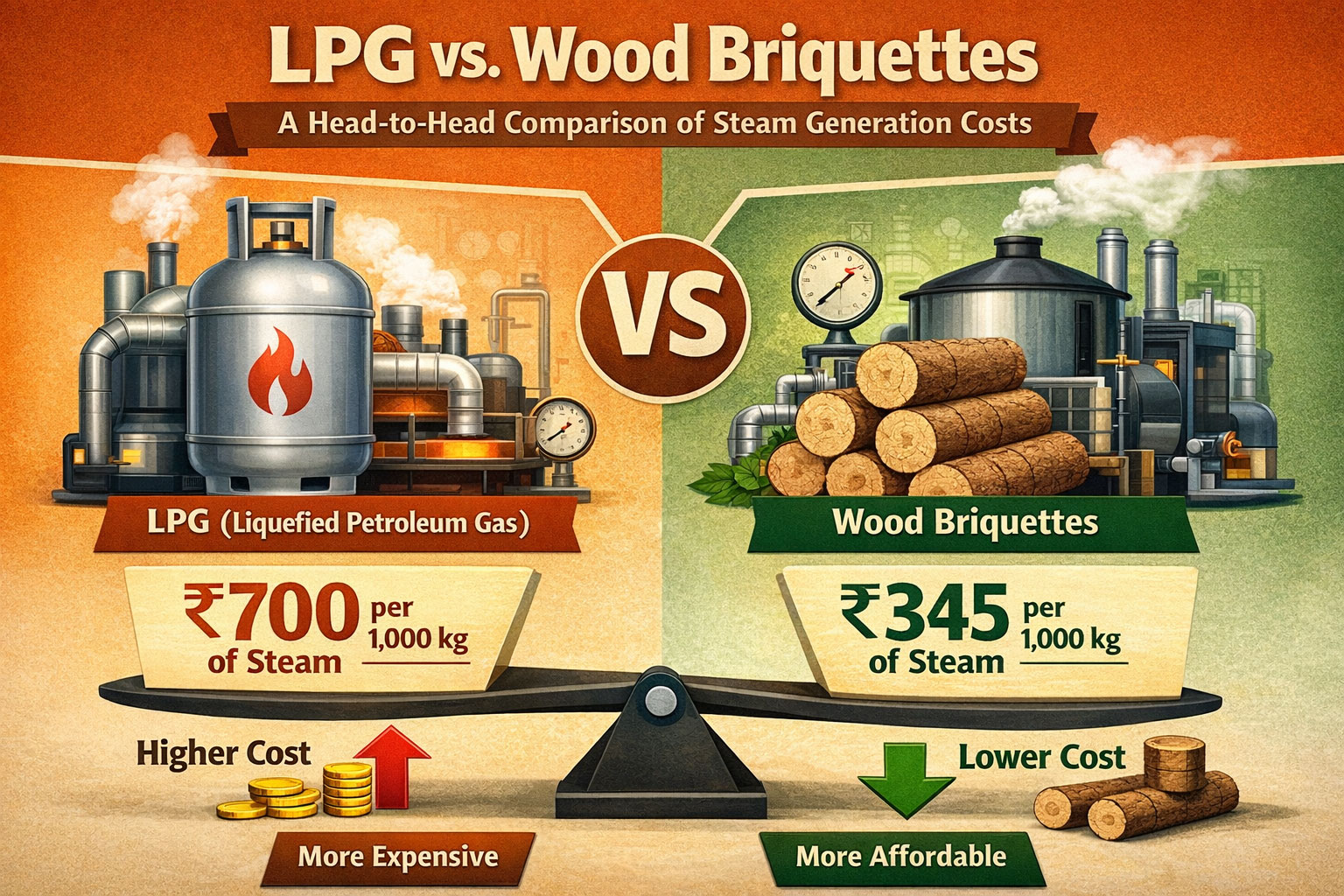
LPG example (illustrative figures — verify current pricing directly): at a calorific value of roughly 11,000 kcal/kg and 92% boiler efficiency, effective delivered heat runs around 10,120 kcal per kg of fuel. At an assumed price of ₹75/kg, that works out to roughly ₹7,410 per million kcal delivered.
Briquette example: at a calorific value of roughly 4,000 kcal/kg and 78% efficiency, effective delivered heat runs around 3,120 kcal per kg. At an assumed price of ₹8.5/kg, that works out to roughly ₹2,724 per million kcal delivered — a substantial differential if these prices hold.
A genuinely important caveat on the LPG figure specifically: current commercial 19 kg LPG cylinder pricing in major Indian cities runs considerably higher than ₹75/kg as of mid-2026 — closer to ₹140–150/kg at small-cylinder retail rates. Large-volume industrial bulk or bullet-tank LPG supply is typically priced more favorably than small commercial cylinders, so your actual delivered cost depends heavily on your specific supply arrangement and contract volume. Before making any purchasing decision, get a current quote from your actual LPG supplier at your actual consumption volume — the gap between commercial cylinder and bulk industrial pricing is large enough that a generic figure could meaningfully mislead your calculation in either direction.
The same caution applies to briquette pricing, which varies by region, season, and local biomass supply conditions. Build this calculation with your own current, local numbers rather than borrowing figures from a general industry comparison.
4. Environmental Position: A Real but Nuanced Difference
LPG, while genuinely cleaner-burning than coal or furnace oil, remains a fossil fuel — it contributes to a company’s Scope 1 carbon footprint and remains subject to global crude oil price volatility, which has shown real swings even in recent months amid geopolitical tension affecting oil-producing regions.
Wood briquettes are generally treated as carbon-neutral in sustainability accounting, since the CO2 released during combustion roughly matches what the source plant material absorbed during its growth — a genuine structural advantage in emissions accounting terms, distinct from LPG’s fossil origin.
One clarification worth making accurately: while biomass fuel switching can support broader sustainability positioning and ESG reporting, formal incentive programs like MSME subsidies or renewable energy certificate eligibility depend on specific scheme criteria and your facility’s designation status — these aren’t automatic for any business switching fuel types, so confirm actual eligibility with a qualified consultant or the relevant government body rather than assuming qualification.
5. Where LPG Genuinely Wins: Logistics and Space
This is a real, structural advantage worth taking seriously rather than dismissing.
LPG requires only a compact high-pressure storage tank and minimal footprint, piped directly into the burner — genuinely convenient in space-constrained urban or high-density industrial settings.
Briquettes need a large, dry, covered storage area, since moisture absorption significantly reduces combustion efficiency and can introduce smoke issues. They also require a dedicated ash collection and disposal system — though boiler ash from clean biomass combustion is often saleable as a potash-rich soil amendment to local agricultural users, offsetting some of that handling cost.
For facilities in genuinely space-constrained locations with strict local particulate emission limits and minimal room for fuel storage infrastructure, LPG’s compact footprint may be the deciding factor even where fuel economics favor briquettes.
6. Side-by-Side Summary
| Criteria | LPG | Wood Briquettes |
|---|---|---|
| Fuel cost per unit of delivered heat | Typically higher | Typically lower, subject to local pricing |
| Combustion control | Full precision modulation | Increasingly automated with modern feeders |
| Regulatory position | Standard fossil fuel compliance requirements | Generally favorable, carbon-neutral treatment |
| Capital expense | Generally lower | Generally higher (solid fuel handling infrastructure) |
| Space requirement | Compact | Larger, requires covered storage |
| Startup speed | Near-instant | Moderate |
7. Making the Actual Decision
LPG remains the more practical choice when: your facility sits in a genuinely space-constrained, high-density urban zone; your local particulate emission tolerance is essentially zero regardless of fuel source; or your process needs the precise, instant modulation LPG’s combustion control offers.
Wood briquettes are worth serious evaluation when: you have adequate storage space and can arrange reliable local biomass supply; your priority includes both cost reduction and improved sustainability positioning; and you’re prepared to invest in the somewhat higher capital cost of solid-fuel handling infrastructure in exchange for materially lower ongoing fuel costs.
For facilities wanting flexibility rather than committing entirely to one fuel, our multi-fuel boilers guide covers systems designed to switch or blend fuel types — a genuine hedge against price volatility in either direction.
Conclusion: Run the Numbers With Your Actual Current Prices
The structural case for briquettes over LPG on fuel cost is real in most scenarios — lower cost per unit of delivered heat, generally favorable regulatory treatment, and improved sustainability positioning. But the exact magnitude of that advantage depends entirely on your actual local fuel pricing at the time you’re making the decision, not a fixed percentage from a general industry comparison. Get current quotes from both an LPG supplier at your actual consumption volume and a local briquette supplier before finalizing your calculation.
Balkrishna Boilers Pvt Ltd manufactures across both fuel types, plus multi-fuel systems for facilities wanting flexibility. Explore the full range on IndianBoilers.com or Balkrishn.com.
Want a cost comparison built around your actual current fuel prices and consumption? Contact our engineering team for a tailored fuel economics analysis.
Related Reading
- The Biomass Boiler ROI Calculation: A Framework, Not Just a Percentage
- Biomass Boilers vs. Coal: Which Wins for Indian Businesses
- Multi-Fuel Boilers: The Future of Industrial Heating in India
- Bagasse and Pellets: The Engineering Behind India’s Two Biggest Biomass Fuels
- What Is a Steam Boiler? Definition, Working, and Types