
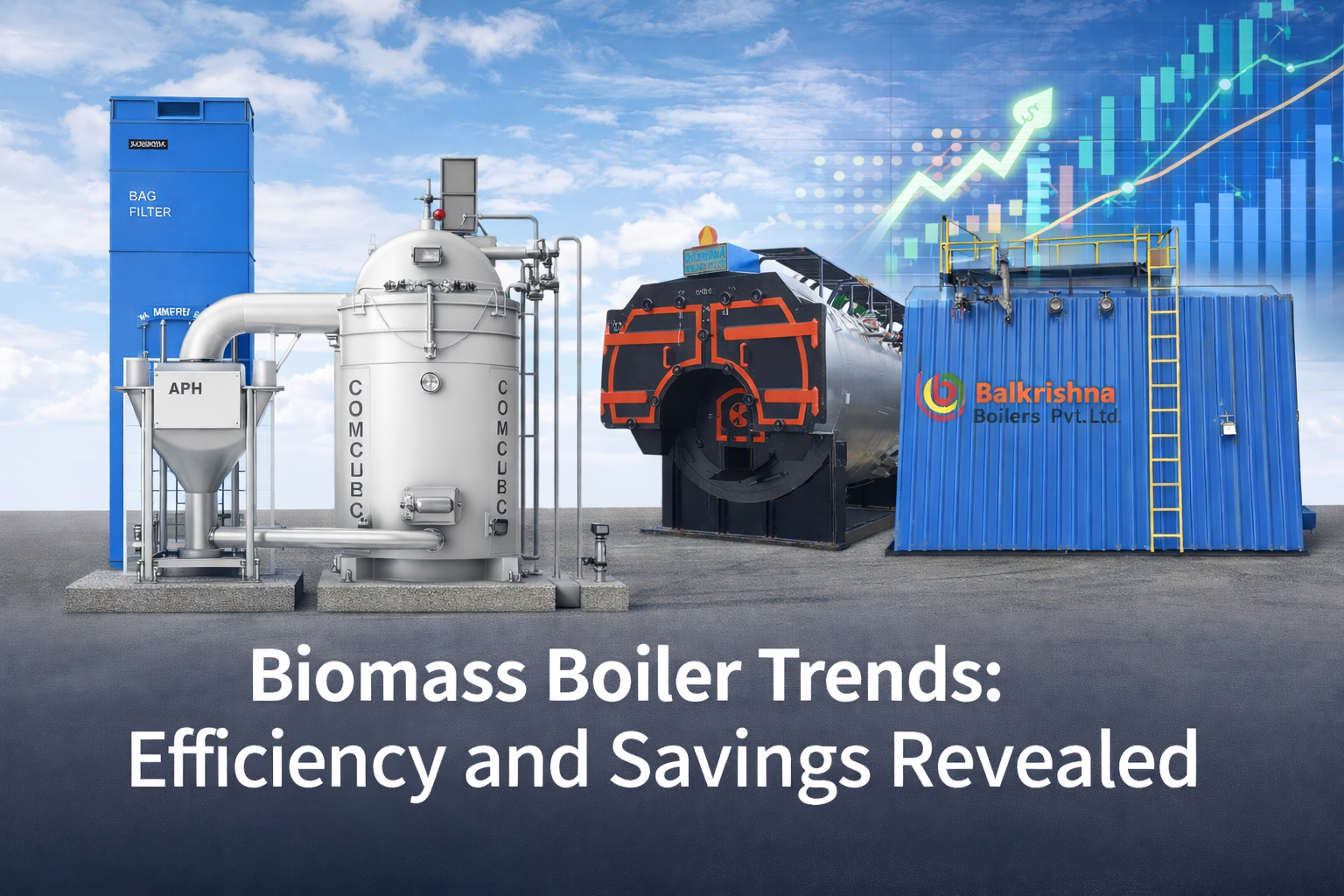
2026 Biomass Boiler Trends – Efficiency and Savings Revealed
Biomass boilers aren’t new — Indian factories have run on rice husk, agro-waste, and wood-fired systems for decades. What’s changed by 2026 is how precisely that combustion can be controlled, how compact the equipment has become, and how much of the old “biomass is unreliable and messy” reputation has been engineered away. This piece looks at what’s genuinely different in today’s biomass systems versus five years ago, what savings are realistic (not just quoted), and where the government incentive landscape actually stands right now.
From “Alternative Fuel” to Default Choice
For years, biomass was framed as the backup option — cheaper than oil, but less consistent, harder to automate, and messier to manage. That framing has largely reversed. Densified biomass fuels — briquettes and pellets — now arrive with far more consistent moisture content and calorific value than loose agricultural residue ever could, which is the single biggest reason combustion control has improved so much. A boiler can only be as precise as the fuel feeding it, and densified fuel gives combustion systems something consistent to work with.
Combined with combustion automation that’s now standard rather than a premium add-on, biomass has moved from “the fuel you switch to for cost reasons and tolerate the trade-offs” to genuinely competitive on operational consistency as well as price.
What’s Actually New: Three Real Trends
Consistent, densified fuel as the default. Briquettes and pellets with tightly controlled moisture content (commonly in the single digits to low double digits) give far more predictable combustion than raw loose biomass, directly translating into steadier steam pressure and fewer manual adjustments by operators.
Combustion automation as standard, not optional. Oxygen and CO sensing feeding into automated air-fuel ratio control is now a baseline feature on new installations rather than a high-end option, letting boilers hold efficiency in the mid-to-high 80s and, with a well-tuned full system, push toward 90%+ under good operating conditions. The specific number your plant achieves depends heavily on fuel consistency, grate design, and how well auxiliary equipment like economizers is integrated — treat any efficiency percentage as an achievable target under proper conditions, not a guarantee independent of your setup.
Compact, modular thermal centers. As industrial land costs climb in established manufacturing clusters, demand has grown for boiler designs that fit a smaller footprint without sacrificing capacity — a genuine engineering shift from the large-footprint biomass systems of a decade ago.
Matching Modern Biomass Technology to Your Process
For compact, space-constrained steam needs — boutique food processing units, pharmaceutical labs, or any site where floor space is at a premium — the COMCUBE biomass-fired boiler uses a modular, plug-and-play design engineered specifically to cut installation time and footprint compared to conventional biomass steam systems.
For heavy-duty, high-volume steam demand — typically 2 TPH to 20 TPH — the STEAMAX briquette-fired boiler uses an advanced reciprocating grate specifically engineered to resist clinker formation, a common failure point when lower-quality agricultural waste is burned without proper grate design.
For high-temperature water or thermal fluid needs in processes like frying or chemical refining, the biomass-fired hot water boiler range (VTFH-SERIES) replaces LDO-fired thermal fluid heating with biomass combustion, meaningfully cutting heating costs versus oil-fired alternatives — the exact savings percentage depends on your current fuel and local biomass pricing, so treat any headline number as directional until confirmed against your own fuel quotes.
For continuous, high-hygiene hot water demand — dairy, poultry, and similar processing environments — the wood briquette-fired hot water boiler (AQUAMAX) is built around a high-efficiency heat exchanger designed to minimise thermal wastage during continuous operation.
For contamination-free process drying — tea, spice, and fruit dehydration where product purity is non-negotiable — the wood briquette-fired hot air generator (AIRMAX) uses indirect heating so combustion gases never contact the process air stream, keeping product quality consistent with export-grade purity requirements.
These sit within our broader Steam Boiler, Hot Water Boiler, and Hot Air Generator categories, alongside the husk-specific HUSKPOWER and waste-heat-recovery-focused ENERPOWER ranges on Balkrishn.com.
The Fuel Economics: A Realistic Framework
Furnace oil, coal, and biomass briquettes sit at genuinely different price points per unit of delivered heat, and that gap is the entire basis of the biomass business case. As a rough framework: furnace oil typically carries the highest cost per delivered kilocalorie of the three, imported or linkage coal sits meaningfully lower, and biomass briquettes generally undercut both — though the exact multiple shifts constantly with global oil prices, domestic coal availability, and regional biomass supply, so any specific rupee figure you’re quoted should be checked against current local pricing rather than treated as a fixed industry number.
Payback periods for an oil-to-biomass conversion commonly fall in the 10 to 18 month range for compact systems and slightly longer for large-scale installations, though this varies with utilisation hours, current fuel type, and site-specific installation costs. Rather than quoting a single blended savings percentage, we’d recommend running the comparison against your own current fuel invoice — the honest answer is that the case for switching is usually strong, but the exact number is specific to your plant, not a national average.
For fuel-specific comparisons that affect this math directly, our guides on Rice Husk vs Mustard Straw ROI and Biomass Pellet vs Biomass Briquette performance are worth reading before you finalise a fuel supply decision.
Where Government Support Actually Stands
It’s worth being precise here rather than repeating outdated scheme details. The Ministry of New and Renewable Energy’s National Bioenergy Programme — which supports biomass pellet and briquette manufacturing, non-bagasse cogeneration, and waste-to-energy projects — was extended through 31 March 2026 as its current phase, with Central Financial Assistance available for qualifying projects. As of this writing, no Phase II extension has been formally confirmed, so any plant planning around this incentive should check the current status directly with MNRE or a qualified energy consultant before finalising a project budget around a specific subsidy figure.
Separately, the government’s Crop Residue Management scheme provides financial assistance toward biomass aggregation and processing infrastructure aimed at reducing stubble burning, which indirectly supports the briquette and pellet supply chain that feeds boilers like ours. Given how frequently scheme terms, subsidy percentages, and eligibility windows change, we’d strongly recommend verifying current incentive details with MNRE or your state renewable energy agency rather than budgeting against a headline figure that may have shifted by the time you apply.
Solving the Two Classic Biomass Headaches
Fuel supply consistency. A 365-day fuel supply used to be biomass’s weakest point — seasonal availability and inconsistent aggregation made year-round planning difficult. Working with established briquette and pellet aggregators, rather than sourcing loose biomass directly, has largely solved this for plants that build the relationship properly, and it’s worth treating fuel-supply planning as seriously as the boiler purchase itself.
Ash management. Modern systems with automated ash removal have taken most of the manual labour out of this process, and biomass ash — being rich in potash — can often be sold to local farmers as a soil amendment, turning what used to be a pure disposal cost into a modest recovery stream rather than a net expense.
Combustion Technology Still Determines Real Performance
None of the automation and fuel-consistency gains above matter if the underlying grate and combustion design is wrong for your fuel. If you’re running loose agro-residue rather than densified fuel, our guides on grate speed’s effect on steam production and fuel consumption and Vibrating Grate vs Reciprocating Grate technology explain how grate mechanism directly affects burn completeness. Fuel moisture remains one of the most underrated performance variables — see our breakdown of fuel moisture vs boiler efficiency for target ranges, and how reciprocating grate boilers handle high-moisture biomass better than conventional designs if your local supply is inconsistent.
The Digital Layer: From Manual Tuning to Continuous Optimisation
The automation trend described above extends into full digital monitoring — continuous tracking of combustion parameters, fuel consumption, and emissions rather than periodic manual checks. Our pieces on how AI and IoT are transforming biomass boiler operations in 2026 and digital twin technology for boiler efficiency and reliability cover how this is increasingly built into new installations, giving plant engineers early warning of combustion drift before it compounds into real fuel waste.
Emission Compliance Alongside Efficiency
Nearly every efficiency gain described here — better combustion control, consistent fuel, reduced excess air — also reduces particulate and NOx output, which matters as CPCB and state pollution control norms continue to tighten. A complete system pairs combustion improvements with proper filtration; see our biomass boiler emission control systems guide and our Pollution Control Equipment range — bag filters, ESPs, and wet scrubbers — for what a fully compliant setup requires.
Industry Fit in 2026
Textile, food processing, and pharmaceutical plants each bring different steam-quality requirements to this decision — our industry-wise guide to the best boiler for textile, pharma, and food industries and dedicated boiler selection guide for food processing units go deeper into these distinctions. If you’re weighing biomass against a full architectural comparison of boiler types, our Water Tube vs Fire Tube guide and our Ultimate Buyer’s Guide to Choosing Steam Boilers in India are useful starting points.
Frequently Asked Questions
Is the National Bioenergy Programme subsidy still available in 2026? The current phase runs through 31 March 2026, with Central Financial Assistance available for qualifying projects, but no Phase II has been confirmed as of this writing. Check directly with MNRE or your state renewable energy agency before budgeting around a specific incentive figure.
What efficiency can I realistically expect from a modern biomass boiler? With consistent fuel, proper grate design, and combustion automation, mid-to-high 80s percent efficiency is a reasonable target, with well-tuned systems pushing higher — but this depends heavily on fuel quality and how well auxiliary equipment is integrated, so treat vendor efficiency claims as conditional on those factors.
Do I need to switch to briquettes, or can I keep using loose biomass? Loose biomass remains viable, especially with the right grate technology, but densified fuel (briquettes/pellets) generally gives more consistent combustion and easier automation. The right choice depends on your local fuel supply chain and existing infrastructure.
How reliable is a year-round biomass fuel supply now? Working with established briquette and pellet aggregators has significantly improved supply consistency compared to sourcing loose biomass directly — worth building this relationship as part of your project planning, not as an afterthought.
Building the Business Case for Your Own Plant
The most useful exercise before any conversion is a side-by-side comparison using your own numbers rather than a vendor’s headline percentage: take your current annual fuel spend, your current calorific value and delivered cost per unit, and compare it against a genuine delivered-fuel quote for briquettes or pellets in your specific region. Divide the incremental capital cost of the new system by your annual fuel savings to get a plant-specific payback period, and treat any vendor’s “X% savings” claim as a starting estimate to be verified against your own invoice, not a guarantee. Utilisation hours matter enormously here — a plant running three shifts will see meaningfully faster payback than one running a single daytime shift, simply because the fuel-cost differential compounds faster against the same fixed capital outlay.
Getting the Sequencing Right
For plants considering a first move into biomass, the practical sequence that tends to work best is: confirm your local fuel supply chain and get firm delivered pricing first, size the boiler to your actual steam or heat demand (not a rounded-up estimate), select combustion and grate technology matched to your specific fuel’s moisture and consistency profile, and only then finalise automation and monitoring specification. Skipping the fuel-supply confirmation step is the most common reason a biomass project underperforms its projected savings — the boiler can only be as good as the fuel actually delivered to site, month after month.
Talk to Our Engineering Team
Balkrishna Boilers Pvt Ltd — IndianBoilers.com and Balkrishn.com — can walk through which biomass system and fuel strategy fits your specific load, space, and budget, including a fuel-cost comparison based on your actual current pricing rather than a generic industry figure. Get in touch with our team or browse our complete product range.
Further reading: How Biomass Boilers Cut Costs and Emissions for Factories · What is a Biomass Boiler? · Steam Boiler Efficiency: Boost Savings by 30% with Proven Tips · Common Biomass Boiler Problems and Their Solutions