
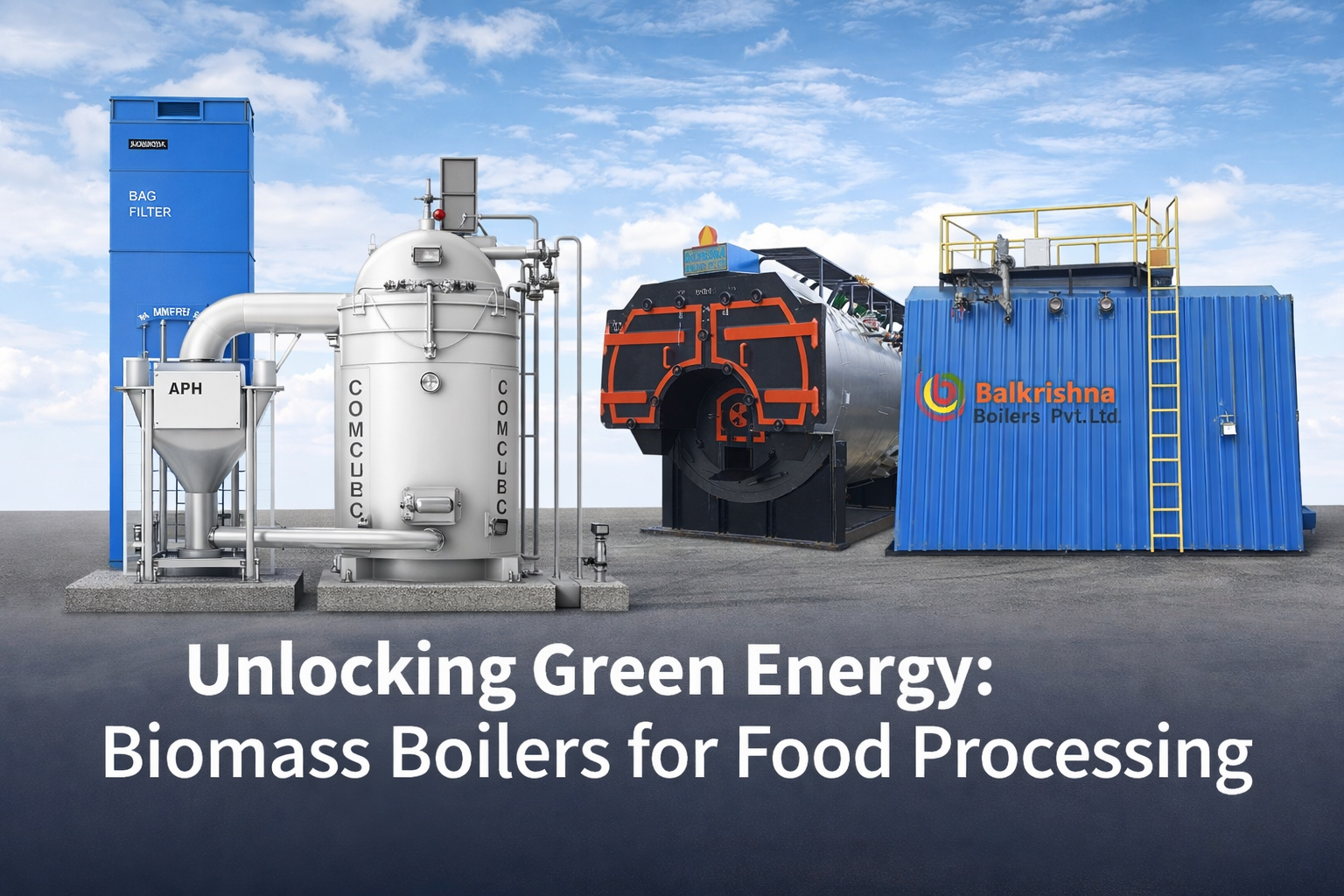
Food processing rarely needs just one type of heat. A single facility might need steam for pasteurization, hot water for CIP cleaning, and hot air for drying — three genuinely different heat-transfer requirements, often running simultaneously on the same production floor. Choosing biomass as your energy source doesn’t simplify that reality; it just changes which equipment you’re matching to each need.
This guide walks through Balkrishna Boilers’ biomass-fired range across all three heat categories — steam, water, and air — and how to think about which system fits which part of your process. If you haven’t yet decided whether biomass is the right direction for your plant at all, our biomass vs. coal comparison and biomass boiler ROI framework are worth reading first.
1. Why Food Processing’s Energy Position Is Genuinely Shifting
Food processing is inherently energy-intensive — pasteurizing milk, drying grains, sterilizing packaged food, and washing down processing equipment all demand consistent, high-quality heat with no room for inconsistency. That heat has traditionally come from furnace oil, light diesel oil, or coal, and all three carry the same structural problem: fossil fuel pricing is tied to global markets and geopolitical shifts that make long-term budgeting genuinely difficult for a food manufacturer trying to plan costs years out.
Regulatory pressure is compounding this. State pollution control boards and the CPCB are tightening emission norms progressively, and older coal-fired units are finding Consent to Operate renewals harder to secure in some jurisdictions. Biomass — briquettes, pellets, and agricultural residue — offers a genuinely different position: broadly carbon-neutral accounting (since the CO2 released in combustion is offset by what the source plant material absorbed during growth), sourced locally rather than through import-dependent supply chains, and increasingly backed by mature, organized supply networks across major agricultural regions.
One clarification worth making accurately: the EU’s Carbon Border Adjustment Mechanism, which entered its full operational phase in January 2026, currently covers only iron and steel, aluminium, cement, fertilizers, electricity, and hydrogen — food products aren’t within its scope as of now. That said, buyers in export markets and larger Indian corporates with their own sustainability commitments increasingly scrutinize supplier energy sourcing as part of procurement decisions generally, independent of any specific carbon tariff — so the broader business case for cleaner energy sourcing still holds, just not through the specific CBAM mechanism.
2. Steam Solutions: COMCUBE and STEAMAX
Steam remains the primary heat-transfer medium across most food processing operations, and we’ve engineered two systems for the specific demands this sector places on steam quality and consistency.
COMCUBE – Biomass Fired Steam Boiler is built for facilities where floor space is genuinely limited but steam demand is still substantial. Its compact, modular configuration delivers strong thermal output without the large footprint traditional biomass boiler designs require — a good fit for small-to-medium bakeries, confectionery units, and spice processing plants working within constrained factory layouts.
STEAMAX – Wood/Briquette Fired Steam Boiler is the workhorse for larger industrial steam loads. It’s optimized specifically for briquette fuel, which offers higher bulk density and easier, more consistent storage than raw biomass — a genuine practical advantage for continuous 24/7 operations. Precise pressure control matters more in food processing than almost any other sector, since pressure instability during processes like retort sterilization directly threatens food safety compliance, and STEAMAX is engineered to hold steady steam delivery even through peak-demand cycles.
3. Where Steam Isn’t the Right Answer: Water Heating Systems
Not every food process needs steam specifically — many applications need hot water or thermal fluid heating at lower pressure, and forcing a steam solution onto a water-heating problem adds unnecessary pressure-system complexity and cost.
A Vertical Thermic Fluid Heater/Water Boiler in our biomass-fired range delivers high-temperature heat without the higher pressure that steam systems inherently carry — a genuine safety advantage in sensitive processing environments, and a better technical fit for precision applications like chocolate tempering or edible oil refining, where the process needs controlled indirect heat rather than direct steam contact.
For facilities needing large volumes of hot water specifically — industrial dairies running CIP cleaning cycles, or slaughterhouse operations — a Wood/Briquette Fired Hot Water Boiler delivers rapid heating so cleaning cycles aren’t delayed by warm-up time, with robust construction designed to handle the mineral content typical of industrial water supplies without the sensitivity a steam system might show to the same water chemistry.
4. Drying and Dehydration: Where Air Quality Is the Actual Product Requirement
For dehydration applications — dried fruits, tea, coffee, spices, and herbs — the quality of the drying air directly determines product quality, and this is a category where the wrong heating approach can genuinely damage the product.
A Wood/Briquette Fired Hot Air Generator in our biomass range uses indirect heating through high-efficiency heat exchangers, specifically to avoid the risk that direct-fired systems carry — smoke or ash contact tainting flavor, color, or nutritional integrity in the finished product. Consistent, uniform air temperature across the drying chamber matters just as much as the heat source itself, since uneven drying shows up directly in product quality and shelf stability.
5. Building Your Own Cost Comparison
Rather than quoting a single ROI figure that won’t reflect your actual plant, here’s how the comparison typically works, illustrated with a representative example:
Illustrative example only — consider a mid-sized fruit pulp processing unit currently running on light diesel oil. LDO might cost roughly ₹75–90 per litre with a calorific value around 10,000 kcal, while a comparable biomass fuel like briquettes might run ₹8–12 per kg with a calorific value in the 3,500–4,000 kcal range. Once you account for the calorific value difference, biomass fuel commonly costs meaningfully less per unit of delivered heat than LDO in regions with strong local biomass supply — though the exact differential depends entirely on your local fuel pricing and current consumption, so this example illustrates the calculation method rather than a number you should expect to match exactly.
To build your actual number: take your current daily fuel cost, estimate the equivalent biomass tonnage needed based on your steam demand and local biomass calorific value, multiply by your actual local biomass price, and compare the difference against the additional capital cost of the biomass system. Our biomass boiler ROI guide walks through this calculation framework in full detail, including maintenance and compliance cost factors beyond fuel alone.
6. Engineering and Compliance Features Worth Confirming
Across our biomass range for food processing applications, look for these standard engineering features when evaluating any system:
- Integrated pollution control — cyclonic separators and bag filtration designed to meet current CPCB emission norms
- PLC-based automation — real-time monitoring of combustion efficiency and steam or water output
- Safety interlocks — high-pressure cutoffs, low-water alarms, and flame sensors as standard safety infrastructure, not optional add-ons
Confirm current specifications directly with our engineering team for your specific application, since exact features vary by model and capacity.
7. Matching System to Application: A Quick Reference
| Food Processing Need | Best-Fit System |
|---|---|
| General process steam, pasteurization, sterilization | COMCUBE or STEAMAX |
| High-temperature indirect heat (chocolate tempering, oil refining) | Biomass-fired thermic fluid/water heater |
| CIP cleaning, large-volume hot water | Biomass-fired hot water boiler |
| Drying and dehydration | Biomass-fired hot air generator |
All are available across IndianBoilers.com and the full Balkrishn.com catalogue.
Conclusion: One Fuel Source, Multiple Right Answers
Switching to biomass doesn’t collapse your equipment decisions into a single choice — it just means matching the right biomass-fired system to each specific heat requirement in your plant, the same discipline you’d apply with any fuel source. A facility running steam for sterilization, hot water for CIP, and hot air for drying genuinely needs three different pieces of equipment, each engineered for its specific job.
Balkrishna Boilers Pvt Ltd manufactures across this full range, matched to your actual process requirements rather than a one-size-fits-all recommendation. Explore the complete range on IndianBoilers.com or Balkrishn.com.
Ready to map the right biomass system to each part of your process? Contact our engineering team for a site-specific consultation.