
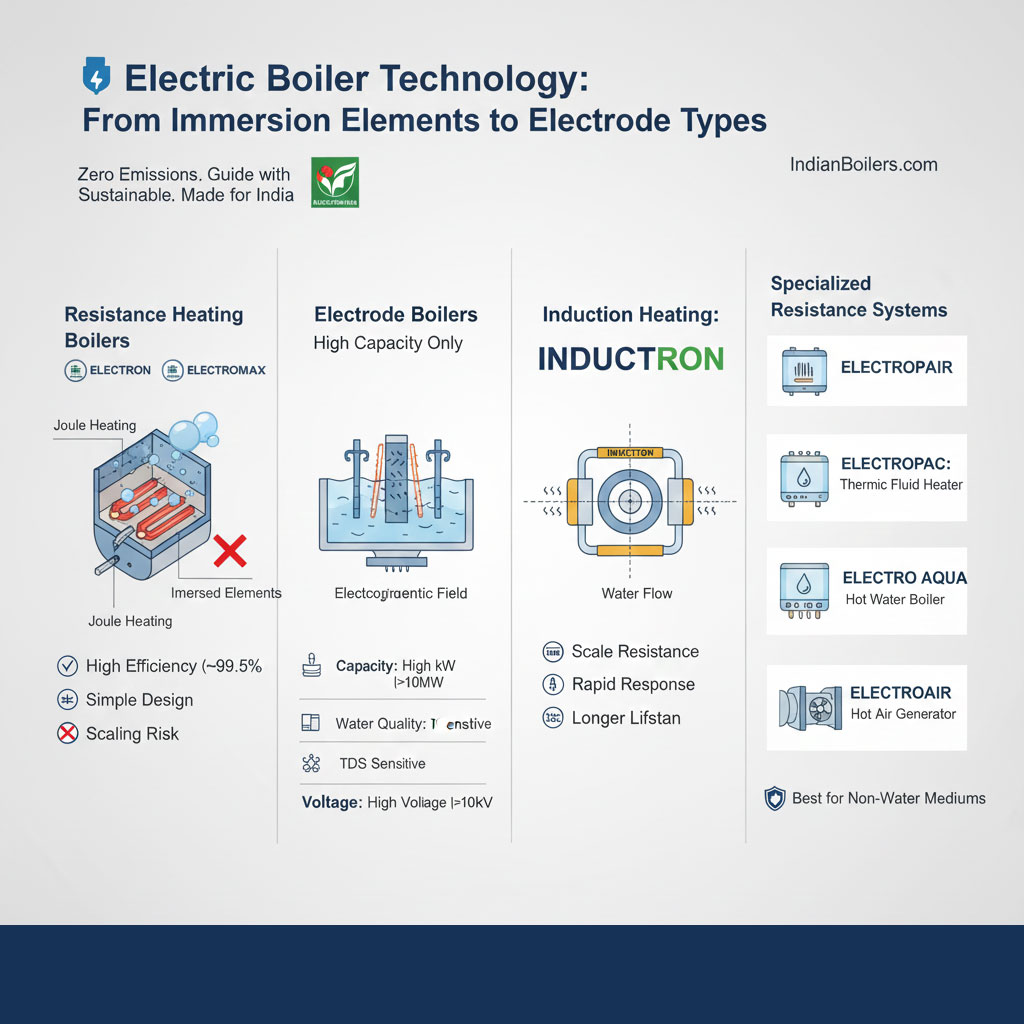
“Electric boiler” sounds like a single category, but ask an engineer to open one up and you’ll find at least three fundamentally different ways it might be turning electricity into heat. The technology underneath the shell — resistance elements, electrode contact, or induction fields — shapes everything downstream: how it handles your water chemistry, how much maintenance it demands, how it scales for capacity, and ultimately whether it’s the right fit for your process at all.
Buying an electric boiler without understanding which of these technologies sits inside it is a bit like buying a vehicle without knowing whether it’s petrol, diesel, or electric — the fuel and operating logic are entirely different, even if the outside looks similar. This guide breaks down each approach, where it fits, and which of our systems — ELECTRON, ELECTROMAX, INDUCTRON, ELECTROPAC, ELECTRO AQUA, and ELECTROAIR — is built on which principle.
If you’re still deciding whether electrification suits your plant at all, start with our complete guide to industrial electric steam boilers before diving into this level of technical detail.
1. Resistance Heating: The Proven Default
Resistance heating is the oldest, most widely deployed electric heating technology in industry, and it’s the principle behind our ELECTRON and ELECTROMAX steam boilers.
How it works
Electric current passes through a highly resistant conductor — typically Nichrome or Incoloy alloy — and that resistance converts electrical energy directly into heat via the Joule effect. The elements sit immersed directly in the boiler water, transferring heat by direct conduction and convection.
Why it’s the industry workhorse
- Efficiency near 99.5% — because heat generates internally with no combustion loss path, almost nothing is wasted.
- Proven, simple design — the technology is mechanically straightforward, which keeps manufacturing and repair relatively simple compared to more exotic heating methods.
- Flexible capacity — output scales by adding or removing heating elements, which is exactly how the compact ELECTRON and the high-capacity, IBR-rated ELECTROMAX are built from the same underlying principle at different scales.
- Precise staged control — banks of elements switch on and off to track demand closely, giving tight modulation without needing exotic control systems.
Where it needs attention
The heating element surface is the hottest point in the entire system, which makes it the first place scale forms if water treatment isn’t rigorous. Scale acts as an insulating layer — it reduces efficiency and, left unaddressed, leads to premature element burnout. This isn’t a flaw unique to resistance heating so much as the trade-off that comes with direct-contact heat transfer: periodic element cleaning or replacement is part of the maintenance plan, not a sign something’s gone wrong.
2. Electrode Boilers: Built for a Different Scale Entirely
Electrode technology solves a different problem than ELECTRON or ELECTROMAX are built for — it’s the approach used in very large, high-pressure installations, often above 10,000 kW, more common in utility-scale power generation than typical industrial process heating.
How it works
Rather than heating an element that then heats the water, electrode boilers pass high-voltage AC current directly through the water itself, between submerged electrodes. The water acts as the resistive medium — heat output is directly proportional to the water’s electrical resistance.
The trade-offs that matter
| Factor | What It Means |
|---|---|
| Capacity | Scales to extremely high kW output — suited to utility or very large industrial users |
| Efficiency | Also close to 99% |
| Water quality | Output depends directly on water conductivity (TDS), which must be held within a precise range |
| Voltage | Typically above 10 kV, requiring specialized high-voltage electrical infrastructure |
| Fit for Indian IBR-compliant industry | Limited — the sensitivity to water conductivity and the specialized infrastructure make resistance-based ELECTROMAX systems the more practical choice for most Indian industrial steam applications |
For the vast majority of plants reading a sizing guide like this one, electrode boilers simply aren’t the relevant category — they’re worth knowing about, but they solve a scale problem most industrial users don’t have.
3. Induction Heating: Solving Resistance Heating’s One Real Weakness
If resistance heating has a single recurring maintenance headache, it’s scale buildup on the element surface. Induction heating — the technology behind our INDUCTRON — was engineered specifically to remove that weak point.
How it works
An induction coil, positioned outside the pressure vessel or separated from the water path, carries current that generates a rapidly alternating electromagnetic field. That field induces eddy currents directly inside a specialized metallic core — the actual heat exchanger — which heats up as a result of its own internal electrical resistance. Water then flows over or through that hot core, picking up heat by conduction. Crucially, the coil itself never touches the water.
What that separation buys you
- Scale resistance — because the heating coil sits apart from the fluid and the core heats more uniformly than a submerged element, the conditions that cause localized scale formation are largely avoided. That translates into meaningfully lower maintenance and efficiency that holds up over the boiler’s operating life rather than degrading year over year.
- Fast response and precise modulation — induction systems ramp up quickly and can be finely controlled, similar to staged resistance elements but often with tighter response.
- Longer mechanism life — keeping the electrical component separate from the water-side scaling and corrosion environment extends the working life of the heating mechanism itself.
Where it fits best
INDUCTRON is particularly well suited to applications where fluid purity and long-term reliability matter more than upfront cost — not just steam, but also clean water heating and thermal fluid applications where element degradation would be a genuine operational risk. The trade-off is CAPEX: the coil and core materials that make induction reliable also make it more expensive to build than a comparable resistance system.
4. Resistance Heating Beyond Steam: Where It’s Actually the Optimal Choice
It’s worth noting that resistance heating’s scaling vulnerability is specifically a water-side problem — in mediums that aren’t water, it stops being a weakness at all. That’s why resistance technology remains the preferred approach across several of our non-steam product lines.
ELECTROPAC – Electric Thermic Fluid Heater — Delivers high-temperature heat, up to roughly 350°C, using resistance elements immersed directly in synthetic thermal fluid rather than water. Because thermal fluid is non-corrosive and non-conductive, the entire scaling mechanism that limits resistance elements in water simply doesn’t apply here — making resistance an efficient, well-matched choice for textile curing, paint baking, chemical reactor jacketing, and asphalt heating applications.
ELECTRO AQUA – Electric Hot Water Boiler — Uses low-density resistance elements for pressurized hot water generation, a simple and compact solution suited to hospitals, hotels, laundries, and industrial washdown stations where the temperature and pressure requirements don’t justify a more complex system.
ELECTROAIR – Electric Hot Air Generator — Uses specialized finned resistance elements set in a duct, with air forced directly over them for clean, flameless drying and curing heat — food drying, pharmaceutical coating, and material curing applications where any combustion fume risk is unacceptable.
5. Matching Technology to Application: A Quick Reference
| Technology | Product | Best Suited For | Key Trade-Off |
|---|---|---|---|
| Resistance | ELECTRON, ELECTROMAX | General industrial steam and hot water; robust, cost-effective CAPEX | Requires disciplined water treatment to control scaling |
| Induction | INDUCTRON | Critical, high-reliability processes; long-term low-maintenance operation | Higher upfront cost, offset by sustained efficiency |
| Electrode | Utility/very high-MW scale only | Power generation and specialized very large steam users | Highly sensitive to water conductivity for output control |
| Specialized resistance | ELECTROPAC, ELECTRO AQUA, ELECTROAIR | Non-water heat transfer mediums — thermal fluid, air | Scaling issue is inherently avoided by the medium itself |
The practical decision usually comes down to two questions: what medium are you actually heating (water, thermal fluid, or air), and how much water-side maintenance discipline can your plant realistically sustain over the equipment’s lifetime? Get those two answers right, and the technology choice mostly falls into place on its own.
6. Sizing and Technology Are Linked, Not Separate Decisions
It’s worth flagging that once you’ve chosen a heating technology, your sizing math changes too. Resistance systems scale in a fairly linear way — total kW output is essentially the sum of your element bank ratings, but that rated capacity should be planned with scale-driven degradation in mind, not just day-one output. Induction systems, by contrast, hold their rated output far more consistently over time, which sometimes allows slightly tighter sizing margins. Our electric steam boiler sizing guide walks through this calculation in detail, including how water quality and diversity factors both feed into the final capacity number.
Conclusion: The Right Technology Depends on What You’re Actually Solving For
Electrification isn’t a single decision — it’s a decision plus a technology choice underneath it, and getting the second part wrong for your water chemistry or process demand can quietly erode the efficiency and reliability gains you switched for in the first place.
For most Indian industrial steam users needing IBR compliance at meaningful capacity, resistance-based ELECTROMAX remains the best balance of proven performance and CAPEX. Where minimal downtime and long-term element life matter more than upfront cost, INDUCTRON‘s induction approach is the stronger long-term investment. And for non-steam applications, the specialized resistance systems in ELECTROPAC, ELECTRO AQUA, and ELECTROAIR are built specifically around the medium they’re heating, not adapted from a steam design.
Balkrishna Boilers Pvt Ltd’s engineering team evaluates your specific water chemistry, load profile, and budget before recommending a technology — not the other way around. Explore the full electric range on IndianBoilers.com or browse the complete catalogue on Balkrishn.com.
Not sure which heating technology fits your process? Talk to our engineering team for a water chemistry and load assessment before you commit to a spec.
Related Reading
- The Complete Guide to Industrial Electric Steam Boilers
- Choosing the Right Electric Steam Boiler Capacity for Your Process
- Electric Boilers for Food, Pharma & Dairy: Safe, Clean Steam Solutions
- 7 Key Benefits of Switching to an Electric Boiler System
- Smart Sensors in Thermic Fluid Heaters – What Actually Matters?