
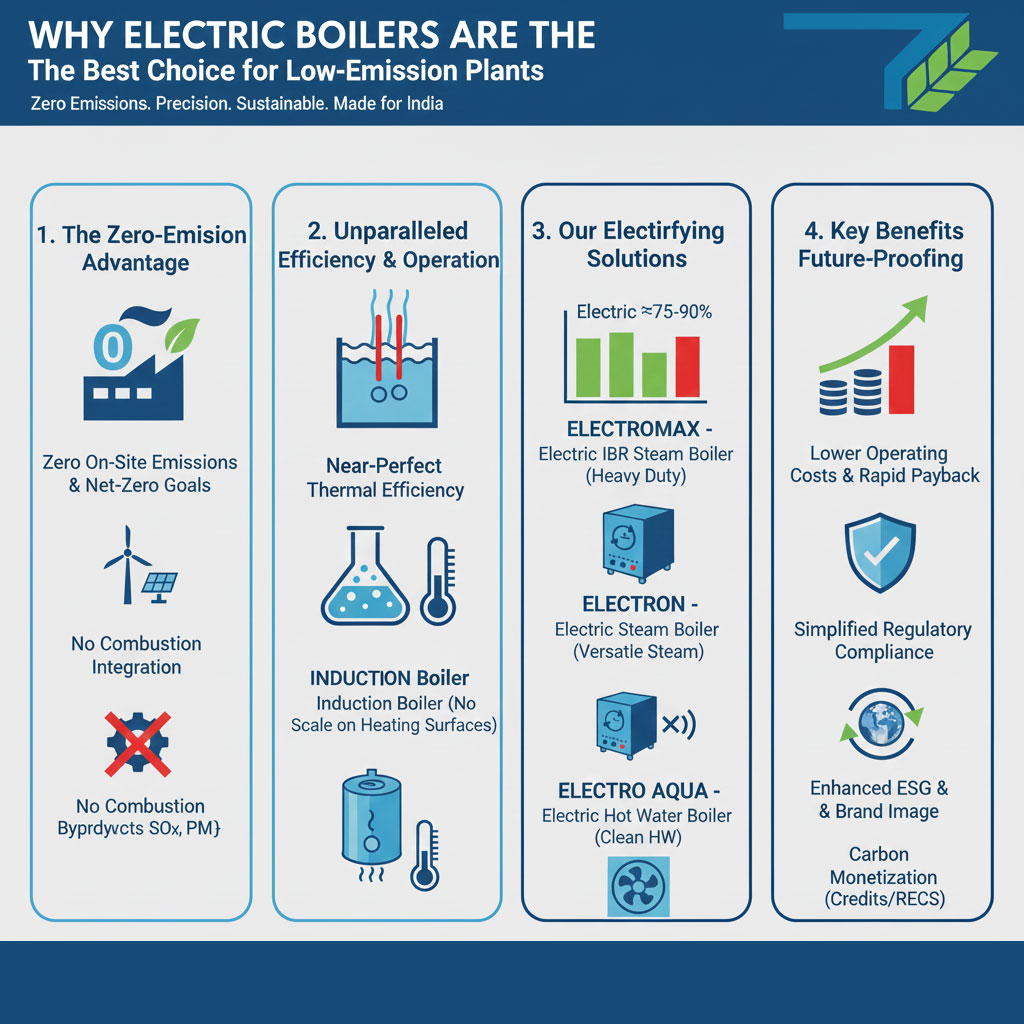
Environmental regulators, ESG auditors and boards of directors are asking industrial plant managers the same hard question in 2026: how quickly can your facility get to zero on-site emissions? For decades, the answer involved bolting scrubbers, electrostatic precipitators and multi-stage filtration onto coal, husk or diesel-fired systems. That approach reduces pollution — it does not eliminate it. A genuinely low-emission plant needs a different starting point altogether, and that starting point is the electric boiler.
Unlike combustion-based systems that are cleaned up after the fact, an electric boiler never produces flue gas in the first place. There is nothing to scrub, filter or monitor for stack emissions because there is no stack. For plants in pharmaceuticals, food processing, textiles, chemicals and specialty manufacturing, this single design difference is reshaping how India’s industrial sector plans its transition to sustainable process heating.
At IndianBoilers.com, part of Balkrishna Boilers Pvt Ltd, we manufacture a complete electric heating range engineered specifically for this transition — from the ELECTRON Electric Steam Boiler and the IBR-compliant ELECTROMAX Electric IBR Steam Boiler, to the ELECTROPAC Electric Thermic Fluid Heater, ELECTRO AQUA Electric Hot Water Boiler, ELECTROAIR Electric Hot Air Generator, and the advanced INDUCTRON Induction Boiler. Every model in this range is also available through our parent brand at Balkrishna Boilers, giving plant owners a single trusted manufacturer for both product research and after-sales support.
This guide breaks down exactly why electric boilers are the smartest long-term choice for any facility working toward genuine low-emission status.
1. Zero-Emission Heating: Solving the Problem at the Source
The phrase “low-emission plant” is often misunderstood as “reduced-emission plant.” True low-emission — and eventually net-zero — status requires eliminating the emission source, not just capturing part of what it produces.
A. No Combustion Means No Combustion Byproducts
Conventional fuel-fired boilers — whether running on coal, husk, diesel or natural gas — generate a predictable list of pollutants the moment fuel is ignited:
- Carbon Dioxide (CO₂): The dominant greenhouse gas driving industrial carbon footprints.
- Nitrogen Oxides (NOx): Contributors to smog formation and acid rain.
- Sulphur Oxides (SOx): Major drivers of acid rain and respiratory illness in surrounding communities.
- Particulate Matter (PM): Fine airborne particles linked to serious health risks for plant workers and nearby residents.
Electric boilers such as the ELECTRON and ELECTROMAX ranges use electrical resistance or induction heating instead of a flame. Because there is no combustion event, there are also no flues, no chimneys, no scrubbing systems and no direct emissions of any of the pollutants listed above. For a plant chasing a genuine net-zero roadmap, switching to electric heating is the single most impactful change available.
B. Emissions Improve Automatically as the Grid Decarbonizes
With an electric boiler, the environmental footprint of your heating process is tied to the electricity source rather than an on-site fuel. As India’s power grid adds more solar, wind and hydro capacity every year, the electricity feeding your boiler gets cleaner without you changing a single piece of equipment.
- Decoupled Risk: Your heating operations are no longer tied to fuel price volatility, supply-chain disruption, or fluctuating fuel-quality issues.
- Automatic Future-Proofing: An electric boiler purchased today will have a smaller carbon footprint five years from now — purely because the grid it draws from keeps improving. Fossil-fuel systems cannot offer this benefit under any circumstances.
If your facility is also weighing solid-fuel alternatives during this transition, our detailed guide on biomass boiler emission control systems is a useful comparison point for understanding how far combustion-based abatement can realistically go versus a true zero-emission electric system.
2. Efficiency That Fossil Fuel Systems Cannot Match
Low-emission credentials mean little if a system wastes energy. Electric boilers are exceptional on both fronts simultaneously — clean and efficient.
A. Near-Perfect Thermal Efficiency
Fuel-fired boilers lose a meaningful share of input energy through stack exhaust, generally capping their maximum thermal efficiency between 75% and 90%, even with modern designs.
Electric boilers routinely achieve thermal efficiencies of up to 99.5%, since almost all the electrical input converts directly into steam, hot water or thermal fluid heat with virtually no exhaust losses. Even accounting for the higher per-unit cost of electricity versus solid or liquid fuel, this efficiency gap significantly narrows — and in many cases closes — the total operating cost difference over the equipment’s lifetime.
B. Precision Control for Sensitive Processes
- Fine-Tuned Temperature Stability: Electric heating elements in systems like the ELECTRON and ELECTROPAC respond almost instantly to load changes, delivering the tight temperature and pressure control that pharmaceutical, specialty chemical and food & beverage processes demand.
- Quiet, Compact Footprint: With no burners, combustion fans or fuel-handling infrastructure, electric boilers run quietly and occupy considerably less floor space — a major advantage for plants operating in urban or space-constrained industrial zones.
Facilities evaluating precision-heating requirements across sectors may also find it useful to read our comparison guide, Best Boiler for Textile, Pharma, and Food Industry, which looks at how different boiler technologies perform against sector-specific tolerances.
3. A Complete Electric Range for Every Industrial Application
Balkrishna Boilers’ electric portfolio is built to replace fossil-fuel systems across the full spectrum of industrial heating needs — high-pressure steam, medium-pressure utilities, hot water, thermal fluid, and hot air.
A. High-Pressure Steam for Heavy Industry
- ELECTROMAX Electric IBR Steam Boiler (also available as ELECTROMAX on Balkrishn.com): Built to comply with Indian Boiler Regulations (IBR), this system delivers high-pressure steam without a fuel line, storage tank or chimney — making it a preferred choice for large pharmaceutical and textile plants pursuing deep decarbonization.
- INDUCTRON Induction Boiler (also on Balkrishn.com): Designed for plants prioritizing equipment longevity and minimal scaling on heating surfaces. Its non-contact, electromagnetic heating method offers fast heat-up times and highly durable components.
B. Medium-Pressure Steam and Hot Water for General Utilities
- ELECTRON Electric Steam Boiler (also on Balkrishn.com): An instantaneous, clean-steam workhorse ideal for hospital sterilization and food production, where steam purity is non-negotiable and demand runs low-to-medium.
- ELECTRO AQUA Electric Hot Water Boiler (also on Balkrishn.com): Efficiently supplies clean hot water for laundries, domestic use and low-temperature process heating, immediately removing CO₂ output associated with small fossil-fuel water heaters.
C. Specialized Heating for Thermal Fluid and Air Applications
- ELECTROPAC Electric Thermic Fluid Heater (also on Balkrishn.com): Ideal for processes requiring very high temperatures — up to 300°C or more — without the high pressures associated with steam systems. Perfect for chemical reactors, paint curing and specialized manufacturing.
- ELECTROAIR Electric Hot Air Generator (also on Balkrishn.com): Delivers clean, precisely controlled hot air for drying and curing applications, avoiding SOx contamination in sensitive drying processes for food and specialty materials.
You can explore the full range, along with technical specifications and IBR compliance details, on our Electric Boiler product category page, or view the equivalent lineup on Balkrishna Boilers’ Electric Boiler page.
For plants running a mixed asset base, it’s also worth comparing electric systems against our Steam Boiler, Thermic Fluid Heater, Hot Water Boiler and Hot Air Generator categories to identify where electrification delivers the fastest emissions payoff first.
4. Addressing the Real Barrier: Power Infrastructure and Cost
Electric boilers are the cleanest option available today, but adopting them at scale does require planning around electrical capacity.
A. Infrastructure Investment vs. Long-Term Savings
The main hurdle to large-scale electric boiler adoption is the need for adequate electrical infrastructure — transformers, dedicated lines and switchgear capable of handling higher kilowatt loads.
- CAPEX vs. OPEX: Initial infrastructure costs can be significant, but they must be weighed against sharply lower operating expenses: reduced maintenance, near-zero fuel-handling costs, and the elimination of ongoing emissions-compliance overhead.
- Off-Peak Scheduling: Plants with flexible production schedules can run electric boilers during off-peak hours when electricity tariffs are lower, storing thermal energy for use during peak-demand periods — a proven way to reduce effective operating costs.
B. Lower Maintenance, Fewer Failure Points
- No Fire-Side Maintenance: There’s no soot blowing, burner servicing or refractory upkeep required, since there’s no flame or exhaust path to maintain.
- Reduced Scaling with INDUCTRON: The non-contact heating core of the INDUCTRON resists scale buildup better than traditional resistance elements, extending service intervals and preserving efficiency over the equipment’s operating life.
Plants currently exploring digital monitoring to extend equipment life may also want to read Digital Twin Technology: Revolutionizing Boiler Efficiency and Reliability, which covers predictive-maintenance strategies applicable across both electric and conventional boiler fleets.
5. Why Electrification Is the Only Real Path to Low-Emission Status
Every unit of heat currently generated by burning fuel represents a unit of pollution that electrification removes entirely. This is not a minor efficiency upgrade — it’s a structural shift in how a plant generates process heat, and it delivers benefits well beyond the emissions stack:
- Immediate Regulatory Compliance: Meet — and exceed — current and upcoming environmental standards without waiting for phased combustion-control retrofits.
- Stronger ESG Positioning: Improve your company’s ESG score and strengthen appeal to environmentally conscious clients, investors and export partners.
- Simplified Plant Operations: Remove the complexity, storage risk and handling hazards associated with fossil fuels entirely.
- Guaranteed Future-Proofing: Your process heating gets cleaner every year as India’s grid adds more renewable capacity — with zero additional investment on your part.
If your facility is still weighing electrification against alternative fuel strategies, our related articles — Electric Boilers: The Clean Future of Industrial Heating, The Ultimate Guide to Industrial Electric Steam Boilers, and Hydrogen-Ready Boilers: Are They Practical for Indian Industries? — provide additional technical context to help you compare options before making a capital decision.
Is Your Plant Ready to Become a Zero On-Site Emission Leader?
The era of incremental emission reduction is ending. The clean future of industrial process heating is electric, and it’s available today from a manufacturer with the engineering depth to support it at scale.
Contact IndianBoilers.com or Balkrishna Boilers Pvt Ltd for a detailed electrical load assessment and a quote on our ELECTRON, ELECTROMAX, ELECTROPAC, ELECTRO AQUA, ELECTROAIR or INDUCTRON electric heating systems, engineered and manufactured in India for pharmaceutical, food, textile, chemical and process industries nationwide.
Frequently Asked Questions
Q1. Are electric boilers really zero-emission, or just low-emission? Electric boilers produce zero direct on-site emissions because there is no combustion taking place inside the unit. Any emissions associated with running the boiler occur at the power generation source, not at your plant — and that figure keeps shrinking every year as India’s electricity grid adds more renewable capacity.
Q2. Are electric boilers more expensive to run than fuel-fired boilers? Electricity typically costs more per unit than coal, husk or diesel. However, electric boilers convert almost all of that energy into usable heat — up to 99.5% thermal efficiency — compared with 75–90% for fossil-fuel systems. Combined with near-zero maintenance and no fuel-handling costs, the total cost of ownership gap narrows considerably, especially with off-peak load scheduling.
Q3. Which electric boiler is right for high-pressure steam applications? For IBR-compliant, high-pressure continuous steam, the ELECTROMAX Electric IBR Steam Boiler is purpose-built for heavy industrial demand, while the INDUCTRON suits plants prioritizing scale resistance and long-term durability.
Q4. Can electric boilers replace thermic fluid heaters and hot air generators too? Yes. The ELECTROPAC Electric Thermic Fluid Heater and ELECTROAIR Electric Hot Air Generator extend zero-emission heating beyond steam and hot water, covering chemical processing, curing, and drying applications as well.
Q5. What infrastructure does my plant need before switching to electric heating? Most facilities need to assess transformer capacity, switchgear, and incoming power supply before installation. Our engineering team at IndianBoilers.com and Balkrishna Boilers provides a full electrical load assessment as part of the quotation process, so you know the exact infrastructure investment required upfront.
Related Reading
- Electric Boilers: The Clean Future of Industrial Heating
- The Ultimate Guide to Industrial Electric Steam Boilers
- Hydrogen-Ready Boilers: Are They Practical for Indian Industries?
- Digital Twin Technology: Revolutionizing Boiler Efficiency and Reliability
- Best Boiler for Textile, Pharma, and Food Industry: An Industry-wise Guide
- Biomass Boiler Emission Control Systems: A Complete Guide