
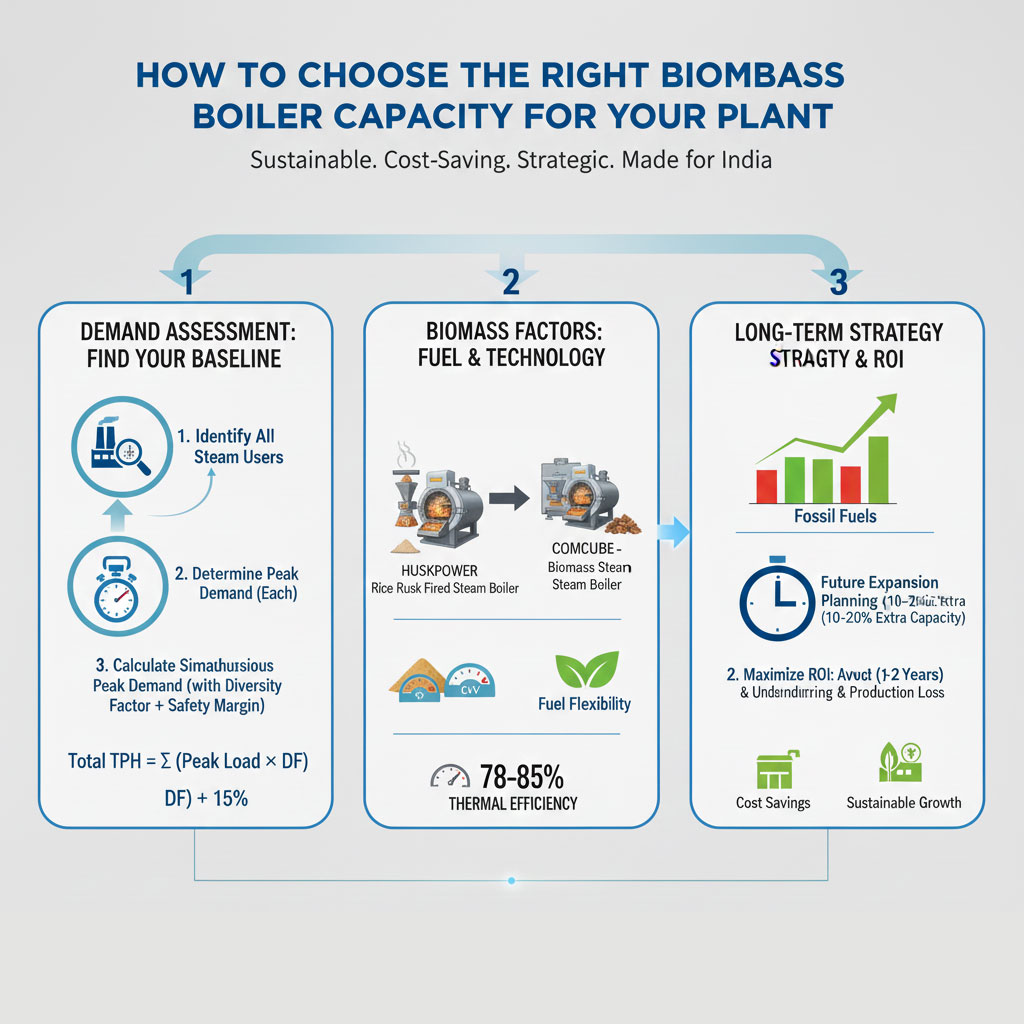
Boiler capacity is not a number you should guess, round up “to be safe,” or copy from a neighbouring factory. It is an engineering decision that determines your fuel bill, your uptime, and your return on investment for the next 15–20 years. Get it wrong and you either choke your production line with an undersized unit, or you tie up lakhs of extra capital in an oversized boiler that cycles on and off all day, wasting fuel and wearing out components faster than it should.
At Balkrishna Boilers Pvt Ltd, manufactured and marketed through IndianBoilers.com and our parent site Balkrishna Boilers, we size hundreds of biomass systems every year for rice mills, textile units, pharma plants, food processors, and chemical industries across India. This guide walks you through the exact process our engineers use — so you can walk into that conversation with a clear idea of what capacity, fuel, and technology your plant actually needs.
1. Why Boiler Capacity Is the Single Biggest Decision You’ll Make
Every steam or thermal system in your plant depends on one number: how much steam or heat your boiler can reliably deliver at peak load. Size it correctly and your biomass fired boiler runs at its optimum efficiency band for its entire operating life. Size it incorrectly, and you’ll be fighting inefficiency, breakdowns, or production bottlenecks for years.
Unlike a straightforward fossil-fuel system, biomass sizing has extra layers — fuel moisture, calorific value, ash content, and grate technology all affect how much usable heat a given boiler can actually generate from a tonne of fuel. That’s why generic sizing rules that work for diesel or gas-fired boilers often fail when applied to rice husk, bagasse, or wood-chip-fired systems.
2. Understanding the Units: TPH and Kcal/hr
Biomass steam boilers are rated in Tonnes of Steam per Hour (TPH), while hot water and thermic fluid systems are typically rated in kcal/hr. Before you can select a capacity, you need every load in your plant converted into the same unit so they can be added together honestly. Mixing up instantaneous demand with average daily consumption is one of the most common sizing errors we see in the field.
3. Step One: List Every Steam and Heat Consumer
Start with a complete equipment audit. Walk your shop floor and note every machine that draws steam, hot water, or thermic fluid — dyeing machines, autoclaves, reactors, dryers, vulcanizers, sterilizers, or turbines. Each one has a rated peak consumption figure, usually stamped on its nameplate or listed in its technical manual. Skipping even one consumer in this list is how plants end up with an undersized boiler within the first year of operation.
4. Step Two: Calculate Simultaneous Peak Demand (Diversity Factor)
Once you know each machine’s individual peak demand, resist the temptation to simply add every number together — that would massively oversize your boiler, because it’s extremely unlikely every machine hits peak demand at the exact same second. Instead, apply a Diversity Factor (DF), typically between 0.6 and 0.9, which reflects realistic staggered operation across your plant. This single step is where most of the “art” of sizing comes in, and it’s exactly the kind of calculation our engineering team runs through detailed process-flow analysis before recommending a model.
5. Step Three: Add a Realistic Safety Margin
After calculating your diversified peak load, add a safety margin of 10%–15%. This buffer accounts for steam leaks, ageing pipework, seasonal variation, and — critically — future production growth. A boiler sized to the bare theoretical minimum leaves zero room for the business to expand without a capital-intensive replacement a few years down the line.
6. Matching Fuel and Technology to Capacity
Once your target TPH or kcal/hr figure is set, the next decision is which biomass technology actually delivers that output efficiently on the fuel available to you.
| Product | Best Suited Output | Ideal Fuel(s) | Typical Capacity Range |
|---|---|---|---|
| HUSKPOWER – Rice Husk Fired Steam Boiler | Steam | Rice husk (primary, high-ash) | 1 TPH – 20 TPH |
| COMCUBE – Biomass Steam Boiler | Steam | Wood chips, bagasse, pellets | 0.5 TPH – 4 TPH |
| VTFH-SERIES – Biomass Fired Hot Water Boiler | Hot water | Mixed agro-waste, wood, shells | 1 Lac – 60 Lac kcal/hr |
The full specification sheets and engineering data for each of these ranges are also available on our manufacturing site — see HUSKPOWER, COMCUBE, and VTFH SERIES — along with the wider steam boiler and hot water boiler ranges if your process needs a different configuration.
If your fuel handling ash is a rice-mill’s main byproduct, rice husk almost always wins on cost — a comparison we’ve broken down in detail in Rice Husk vs. Mustard Straw: Which Biomass Fuel Offers Better ROI for Indian Factories. If your plant is choosing between processed fuels, our guide on Biomass Pellet vs. Biomass Briquette: Which Fuel Gives Better Boiler Performance explains how each affects real-world combustion and, indirectly, the capacity you’ll actually get out of a given boiler footprint.
7. Fuel Moisture and Calorific Value: The Hidden Sizing Variable
On paper, two boilers with the same rated TPH can behave very differently once real fuel enters the picture. Biomass has a lower calorific value and higher moisture content than fossil fuels, which means more raw fuel volume is needed to hit the same thermal output. A furnace and grate sized for 20% moisture fuel will underperform badly if your actual supply runs at 35–40% moisture.
We’ve covered this relationship in depth in Fuel Moisture vs Boiler Efficiency: Finding the Ideal Range for Reciprocating Grate Boilers, and in How Reciprocating Grate Boilers Handle High-Moisture Biomass Better Than Conventional Boilers. If your fuel supply is inconsistent — as agro-waste often is seasonally — this should directly influence which grate and combustion technology you choose, not just which TPH figure you write down on paper.
8. Grate Technology’s Role in Right-Sizing
The grate is where combustion actually happens, and different grate types handle fuel volume, ash, and moisture very differently at a given capacity. A reciprocating grate, a vibrating grate, and a travelling grate are not interchangeable at the same rated TPH once real fuel variability is factored in.
- Our guide on Chain Grate Boiler Grate Speed: How It Affects Steam Production and Fuel Consumption explains how grate speed alone can shift effective output by a meaningful margin at the same nominal capacity.
- If you’re retrofitting an older plant rather than buying new, Reciprocating Grate Boiler Retrofit Guide for Existing Plants walks through how to upgrade combustion technology without a full capacity replacement.
- For a direct head-to-head, Vibrating Grate Boiler vs Reciprocating Grate Boiler: Which Technology Delivers Better Performance is a useful reference before you finalise your specification.
- And if reciprocating grate is your likely choice, Best Biomass Fuels for Reciprocating Grate Boilers: An Industrial Guide helps match fuel to grate at the sizing stage, not after installation.
9. Steam Purity, Pressure, and Industry-Specific Requirements
Capacity sizing doesn’t stop at TPH — pressure and purity requirements shape the design just as much. A turbine application demands a specific maximum pressure your boiler must sustain continuously, not just momentarily. Food and pharma applications, meanwhile, need high-purity steam, which affects blowdown rates and, indirectly, the effective usable capacity of a given boiler.
If you’re sizing for a regulated or hygiene-sensitive industry, our sector-specific guides are worth reading before finalising a specification: Boiler Selection for Food Processing Units and Best Boiler for Textile, Pharma, and Food Industry: An Industry-wise Guide both cover the additional design considerations layered on top of raw capacity.
10. Sizing for Growth, Not Just Today’s Load
The cheapest boiler upgrade is the one you never have to make. It is almost always more economical to install 10%–20% additional capacity upfront than to replace an undersized unit three or four years into a growth phase. Before finalising a specification, sit down with your engineering partner and map out your 5-year and 10-year production targets — not just this year’s numbers.
This is also where waste heat recovery becomes relevant to capacity planning: recovering flue-gas heat through economisers and air preheaters can add 5%–10% effective thermal output without adding combustion capacity at all. Our detailed breakdown in Waste Heat Recovery Boiler for Cement Plants: Complete Engineering Guide applies the same underlying principle to any high-temperature process, not just cement.
11. Common Sizing Mistakes That Cost Indian Manufacturers Lakhs
- Adding peak loads without a diversity factor — leads to a needlessly oversized, capital-heavy boiler.
- Ignoring fuel moisture variability — a boiler that looks correctly sized on paper underperforms the moment monsoon-season fuel moisture rises.
- Choosing grate technology after choosing capacity, instead of together — the two decisions are inseparable for biomass.
- No safety margin for future growth — forces an expensive mid-life replacement instead of a small upfront allowance.
- Overlooking steam purity requirements — especially costly in food, pharma, and textile dyeing applications where rework and downtime are expensive.
12. The ROI Impact of Getting Capacity Right
An oversized biomass boiler cycles on and off frequently, which increases thermal stress, accelerates wear, and actively reduces efficiency — the opposite of what you invested in a biomass system to achieve. An undersized boiler, on the other hand, forces you to run an expensive fossil-fuel unit alongside it as backup, quietly eating away at the fuel-cost advantage that justified switching to biomass in the first place. A correctly sized HUSKPOWER or COMCUBE system, by contrast, runs consistently near its optimum efficiency point — which is exactly where the fast 1–2 year payback that biomass systems are known for actually comes from.
13. How Our Engineers Help You Get This Right
Determining true capacity isn’t a desk exercise — it requires process-flow analysis, fuel testing, and thermodynamic calculation specific to your plant, your fuel source, and your growth plans. Whether your process points toward the high-ash-tolerant HUSKPOWER range, the flexible COMCUBE steam boiler, or the VTFH-SERIES for hot water, our engineering team runs the full sizing exercise before recommending a single model — never the other way around.
Browse the complete range across our Steam Boiler, Hot Water Boiler, and Thermic Fluid Heater categories, or view the same product families on our manufacturing site at balkrishn.com — including the Thermic Fluid Heater range if your process calls for high-temperature heat transfer rather than steam.
Conclusion: Don’t Guess Your Capacity — Calculate It
Boiler capacity sizing sits at the intersection of engineering, fuel economics, and long-term business planning. Get it right, and your biomass system delivers the fast payback, low emissions, and operational reliability it’s designed for. Get it wrong, and you’ll spend years compensating for a decision made without the right data.
Before you finalise your next purchase, read our related guide on how the right biomass system also delivers on sustainability targets: Reduce Carbon Emissions with Biomass Fired Steam Boilers, or continue your research with The Ultimate Guide to Biomass Steam Boilers for Rice Mills and Textiles.
Ready for a professional steam demand audit? Contact IndianBoilers.com or Balkrishna Boilers Pvt Ltd today, and let our engineers calculate — not guess — the ideal biomass boiler capacity for your plant.