
Choosing the right boiler is one of the most significant capital investment decisions a plant manager will ever make. It isn’t just about the initial purchase price; it is about decades of operational costs, safety parameters, and the specific steam demands of your production line.
At IndianBoilers.com, we believe that “better” is subjective. A boiler that is perfect for a dairy plant in Anand might be completely unsuitable for a massive petrochemical refinery in Jamnagar. To help you decide, we have stripped away the marketing jargon to provide a technical, head-to-head comparison between Water Tube and Fire Tube designs.
1. The Fundamental Difference: Fire vs. Water
To choose between the two, you must first understand the “Path of Heat.”
Fire Tube Boilers (The “Inside-Out” Heat)
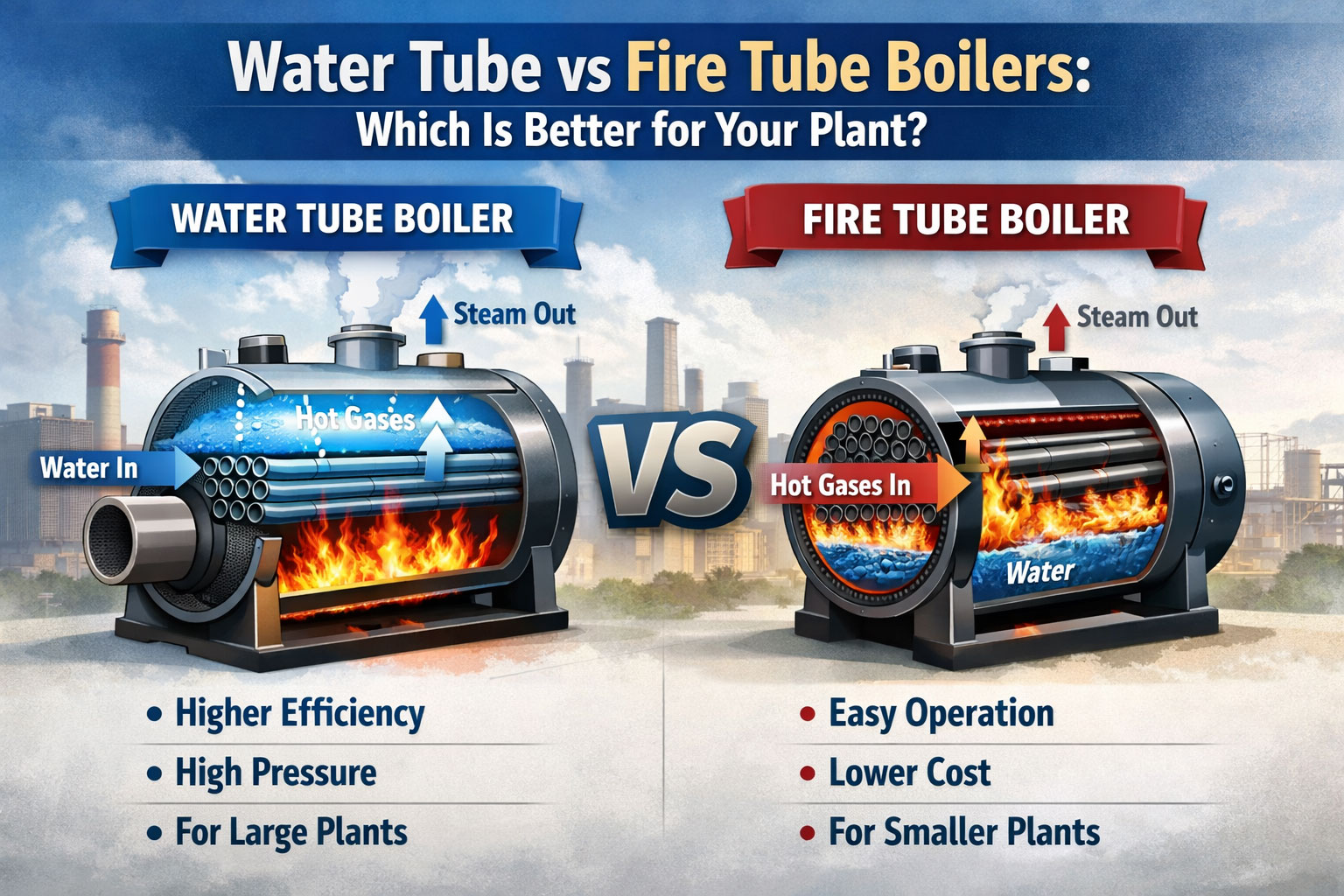
In a fire tube boiler, hot combustion gases (the “fire”) pass through a series of tubes that are submerged in a large volume of water. The heat from the gases is transferred through the tube walls to the surrounding water, eventually turning it into steam.
- Common Applications: Distilleries, food processing, hotels, and small-scale textile units.
- Key Characteristic: Large water storage capacity, which acts as a “thermal flywheel.”
Water Tube Boilers (The “Outside-In” Heat)
In a water tube boiler, the roles are reversed. High-purity water circulates inside the tubes, while the hot combustion gases flow around the outside of these tubes within a refractory-lined chamber.
- Common Applications: Power plants, large chemical complexes, and heavy industrial manufacturing.
- Key Characteristic: High-pressure capability and rapid steam generation.
2. Performance Comparison: Pressures and Capacity
The most immediate “filter” for your decision will be your plant’s pressure and capacity requirements.
| Feature | Fire Tube Boiler | Water Tube Boiler |
| Max Pressure | Limited (usually up to 25 bar) | Virtually Unlimited (up to 160+ bar) |
| Capacity (TPH) | Typically up to 25 Tons/Hr | High (can exceed 500 Tons/Hr) |
| Steam Quality | High (Dry Saturated) | Excellent (High-temp Superheated) |
The IndianBoilers.com Insight: If your process requires high-pressure steam (above 20 bar) for turbines or heavy industrial reactors, a Water Tube boiler is your only safe and viable option. Fire tube boilers have a large-diameter shell; as pressure increases, the required thickness of that shell becomes economically and physically impractical.
3. Response to Load Fluctuations
Does your plant have a steady, constant steam demand, or do you have processes that “spike” (like an autoclave starting up)?
- Fire Tube (The Steady Performer): Because they hold a large volume of water, fire tube boilers have a high “thermal reserve.” If you suddenly demand more steam, the boiler can draw from this stored energy without a massive drop in pressure. However, they take much longer to reach operating pressure from a cold start (often 1–2 hours).
- Water Tube (The Speed Demon): These boilers hold very little water relative to their heating surface. This allows them to respond almost instantly to load changes and reach full pressure in as little as 15–20 minutes.
4. Safety and Risk Management
Safety is the cornerstone of engineering at IndianBoilers.com. Both designs are safe when maintained, but their failure modes differ.
- Fire Tube Risks: Because the entire shell is under pressure and contains a massive amount of heated water, a shell failure can be catastrophic (an “explosive” release of energy). This is why strict IBR (Indian Boiler Regulations) compliance is mandatory for shell thickness and welding.
- Water Tube Safety: In a water tube design, the water is divided into many small-diameter tubes. If a tube fails, it typically results in a small, contained leak rather than a massive explosion. This makes them inherently safer for extremely high-pressure environments.
5. Water Quality and Maintenance
This is where the “hidden” costs of ownership lie.
- Fire Tube (More Forgiving): While we always recommend treated water, fire tube boilers can handle slightly lower-quality feed water. The tubes are also relatively easy to clean manually using brushes or mechanical descalers through the smoke-box doors.
- Water Tube (Very Demanding): These boilers require ultra-pure, demineralized water. Because the water is inside small tubes, even a tiny amount of scale buildup can cause a tube to overheat and burst (“starvation”). Maintenance often requires specialized chemical cleaning or high-pressure hydro-jetting.
6. Installation and Space Constraints
- Fire Tube: These are often sold as “Package Boilers.” They are skid-mounted, factory-tested, and arrive ready to be hooked up to your fuel and water lines. They are compact and take up less floor space.
- Water Tube: Due to their complexity and size, larger water tube boilers are often “field-erected,” meaning they are built piece-by-piece at your plant. This increases installation time and initial capital cost significantly.
Final Verdict: Which is “Better”?
Choose a Fire Tube Boiler if:
- Your steam requirement is below 25 TPH.
- Your operating pressure is below 18-20 bar.
- You want a lower initial investment and easier maintenance.
- Your steam demand has frequent but manageable surges.
Choose a Water Tube Boiler if:
- You are running a power generation turbine.
- You need pressures exceeding 25 bar.
- You need massive steam capacities (above 30 TPH).
- Your process requires highly superheated steam.
How IndianBoilers.com Can Help
At IndianBoilers.com, we don’t just sell equipment; we engineer solutions. Whether you need a compact 3-Pass Wet Back Fire Tube boiler for your textile unit or a high-efficiency Water Tube system for a chemical plant, our team ensures IBR-certified safety and maximum fuel efficiency.
