
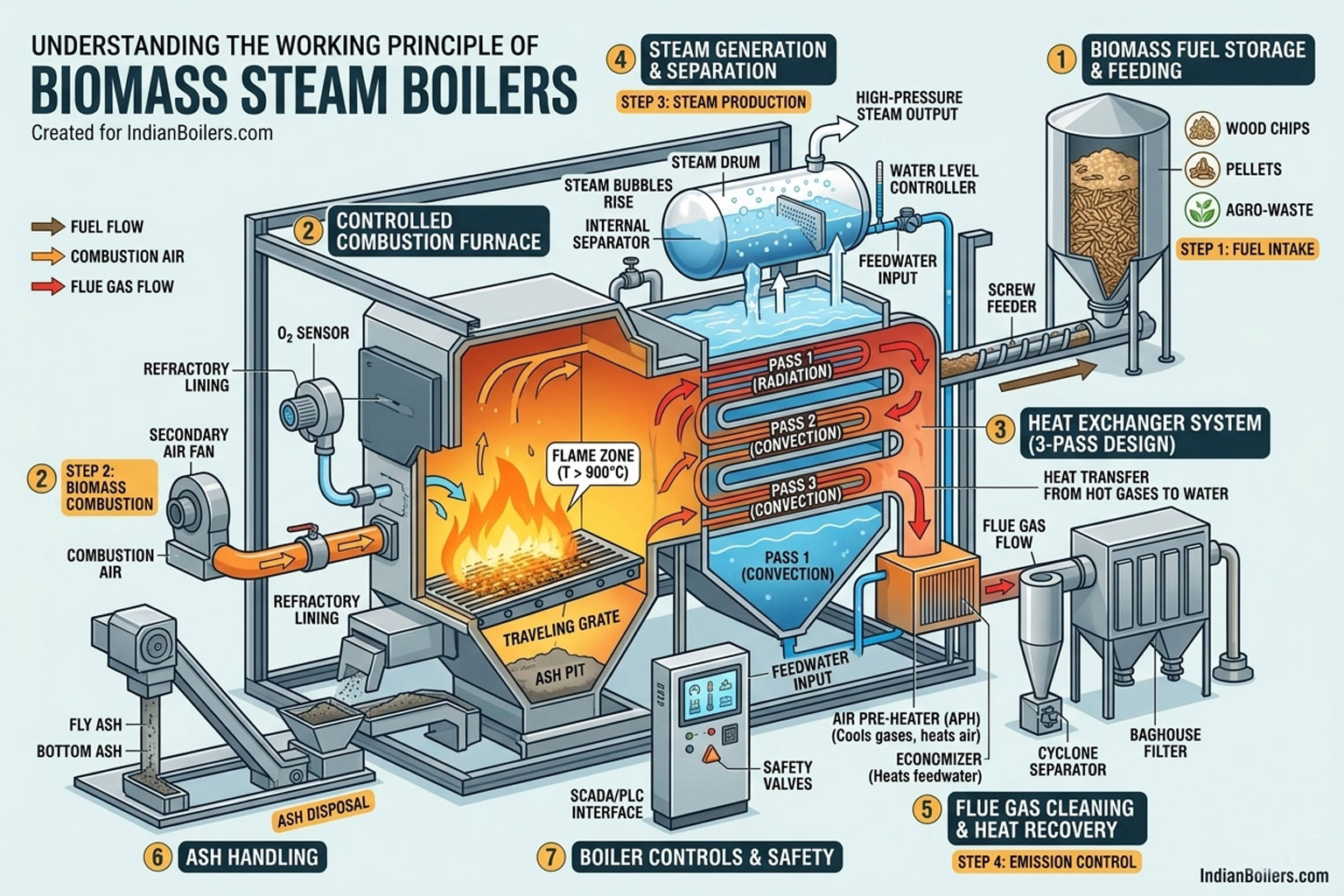
As industrial sectors move toward sustainable energy to combat rising fossil fuel costs and carbon taxes, the Biomass Steam Boiler has emerged as the most viable alternative for renewable thermal energy. At IndianBoilers.com, we specialize in converting agricultural and forestry waste into high-pressure steam, helping plants achieve carbon neutrality without sacrificing performance.
Understanding the working principle of these systems is essential for any facility manager looking to transition from traditional oil or gas-fired units.
1. The Fuel: What is Biomass?
The efficiency of a biomass boiler begins with the fuel. Unlike LPG or Oil, biomass is a solid, carbon-neutral fuel source. Common materials include:
- Wood Pellets & Briquettes: Compressed sawdust and wood waste (high calorific value).
- Agro-Waste: Rice husk, mustard stalk, and coffee grounds.
- Forestry Residue: Wood chips and bark.
2. The Combustion Process: Turning Solid to Heat
The core principle of a biomass boiler is the controlled combustion of organic matter. This process typically occurs in four distinct stages within the furnace:
Stage A: Drying
As the biomass enters the furnace, the initial heat evaporates any residual moisture (water content). High moisture content can lower efficiency, which is why pre-drying or using seasoned briquettes is recommended.
Stage B: Pyrolysis (Gasification)
As temperatures rise, the solid biomass begins to decompose chemically. It releases “volatile gases” (carbon monoxide, methane, and hydrogen). In a well-designed boiler, these gases account for up to 70% of the total heat generated.
Stage C: Gas Combustion
The released volatile gases mix with Secondary Air and burn with a high-temperature flame. This is where the majority of the thermal energy is produced.
Stage D: Charcoal Combustion
The remaining solid carbon (char) burns on the grate with Primary Air, providing a steady, glowing heat source that helps sustain the pyrolysis of new fuel entering the system.
3. Heat Transfer: Moving Energy to Water
Once combustion is complete, the high-temperature flue gases must transfer their energy to the water. Modern biomass boilers generally use a Hybrid Design or a Water Tube Design depending on the capacity.
- Radiation Zone: The water-cooled walls of the furnace (membrane walls) absorb the intense radiant heat from the firebed.
- Convection Zone: The hot gases then pass through a series of smoke tubes or over water tubes. As the gases flow, they transfer heat through the metal walls to the water, eventually generating steam.
4. Advanced Grate Technologies
The “Working Principle” differs based on how the fuel is fed and burned. At IndianBoilers.com, we utilize three primary grate types:
- Fixed Grate: Best for manual feeding and small-scale operations.
- Moving/Chain Grate: The fuel moves slowly across the furnace on a conveyor-like grate, allowing for continuous ash removal and automated feeding.
- Fluidized Bed Combustion (FBC): Fuel is suspended in a “boiling” bed of hot sand and air. This ensures 99% combustion efficiency and is ideal for low-grade fuels like rice husk.
5. Emission Control: Cleaning the Exhaust
A critical part of the working principle is managing the by-products. Biomass combustion produces ash and particulate matter.
- Cyclones & Multi-Cyclones: Use centrifugal force to separate heavy ash particles from the gas.
- Bag Filters: Fine fabric filters capture microscopic dust before the air exits the chimney.
- ID (Induced Draft) Fan: This fan creates a negative pressure, pulling the flue gases through the cleaning systems and out of the stack, ensuring a safe and smokeless boiler house environment.
6. Efficiency Boosters: The “Green” Multipliers
To achieve maximum ROI, biomass boilers are equipped with:
- Air Pre-Heaters (APH): Uses exhaust heat to warm the combustion air, speeding up the drying stage of the fuel.
- Economizers: Heats the incoming feedwater, reducing the amount of fuel needed to reach boiling point.
Conclusion: Why Biomass is the Future
The working principle of a biomass boiler mimics the natural carbon cycle. By utilizing agricultural waste that would otherwise be burned in open fields, industries can generate high-quality steam at a fraction of the cost of fossil fuels.
At IndianBoilers.com, our IBR-certified biomass systems are designed for high thermal efficiency and minimal manual intervention.
